Effectiveness and Perceptions of Low-Achieving Students onthe Use of YouTube in Learning Geography
DOI:
https://doi.org/10.70148/rise.10Keywords:
Geography; Physical Geography; Youtube; Educational Technology; VideoAbstract
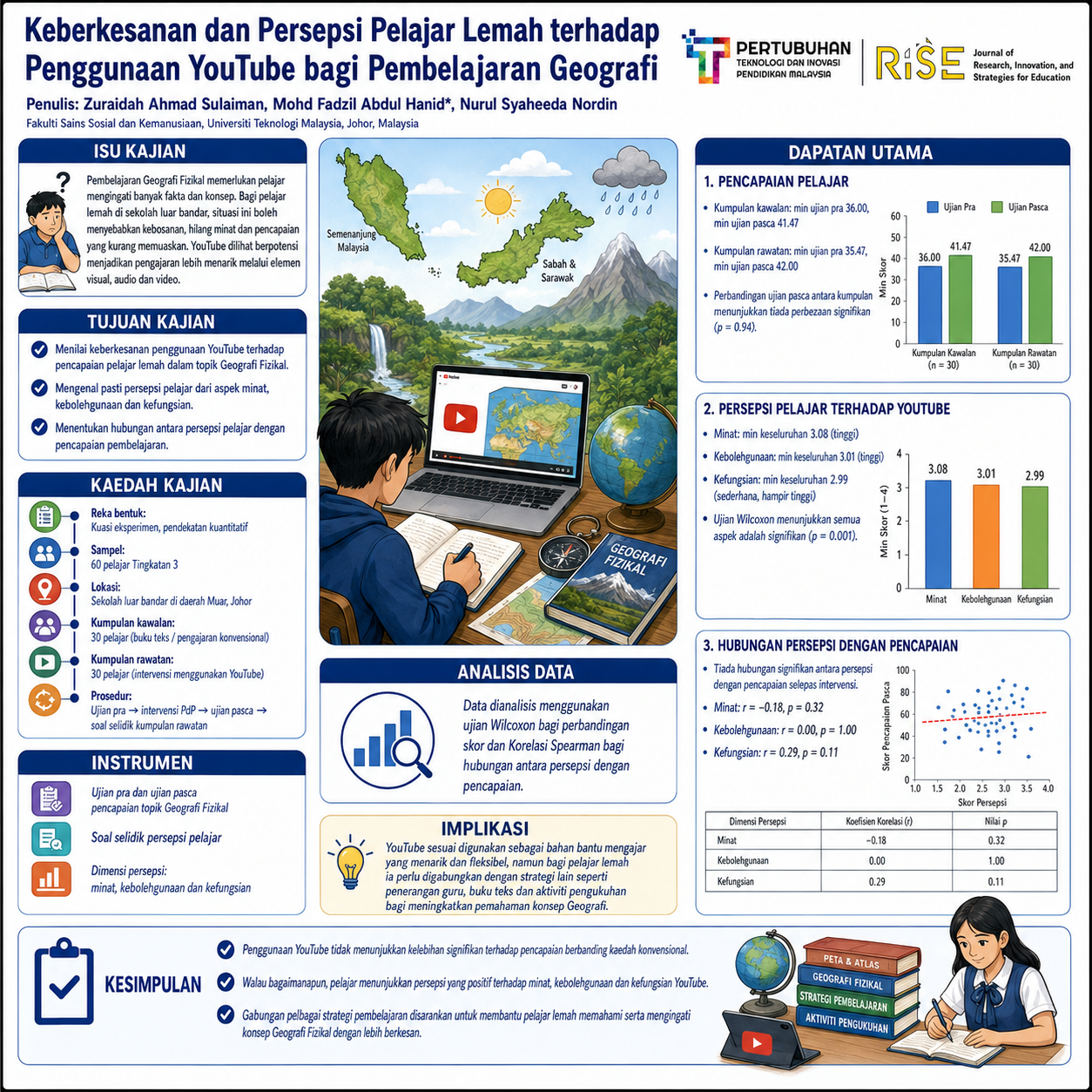
The use of educational technology has been widely used by teachers in the era of the 21st century. This study aims to see the perception of weak students on towards the use of Youtube as well as the effectiveness of learning Geography in rural school in learning the topic of physical Geography. This study was conducted in several secondary schools that rural schools in the Muar Johor district. The selection of rural schools in the district used simple random sampling. The design of this study uses a quasi-experimental method that consists of two groups and uses a quantitative approach in the process of data collection and data analysis. The study sample is form 3 students consisting of 60 students who are divided into two groups, namely the control group and the treatment group. The research instrument used is a set of achievement questions to measure the level of achievement and a questionnaire given to the treatment group with the aim of studying the perception of weak students towards the use of YouTube and its effectiveness. The use technology in various methods can stimulate the learning process of students and can have an effective impact. However, in learning Geography, there are many facts that need to be remembered and understood, so due to this problem, students are easily bored and lose interest in knowing them, resulting in an unsatisfactory level of achievement. The findings of the study show that for weak students in rural area, the learning strategy of using this application, it gives a positive effect. The conclusion, of this study will be able to help educators find a variety of learning strategies for weak students in rural areas to facilitate the process of remembering and understanding facts and concepts in learning Geography on the topic of Physical Geography.
References
Alobaid, A. (2020). Smart multimedia learning of ICT: role and impact on language learners’ writing fluency— YouTube online English learning resources as an example. Smart Learning Environments, 7(1). https://doi.org/10.1186/s40561-020-00134-7
Awal Kurnia Putra Nasution. (2020). Integrasi Media Sosial dalam Pembelajaran generasi Z. Jurnal Teknologi Informasi Dan Pendidikan, 13(1), 80–86.
Bahagian Pembangunan Kurikulum. (2017). Dokumen Standard Kurikulum dan Pentaksiran Geografi Tingkatan 3. Kementerian Pendidikan Malaysia.
Bahagian Pembangunan Kurikulum. (2018). Dokumen Standard Kurikulum dan Pentaksiran Sains Tingkatan 4 dan 5.
Bahagian Pembangunan Kurikulum Pendidikan Malaysia. (2021). Manual Pembudayaan Kemahiran Berfikir Aras Tinggi (KBAT) di Sekolah.
Choon Keong, T., & Carol, A. (2013). Pengaplikasian Video Youtube : Bahan Bantu Mengajar (BBM) Dalam Proses Pengajaran dan Pembelajaran Matapelajaran Sains Sosial. Seminar Pendidikan Sejarah Dan Geografi.
Deng, R., & Gao, Y. (2023). A review of eye tracking research on video-based learning. Education and Information Technologies, 28(6), 7671–7702. https://doi.org/10.1007/s10639-022-11486-7
DeWitt, D., Alias, N., Siraj, S., Yaakub, M. Y., Ayob, J., & Ishak, R. (2013). The Potential of Youtube for Teaching and Learning in the Performing Arts. Procedia - Social and Behavioral Sciences, 103, 1118–1126. https://doi.org/10.1016/j.sbspro.2013.10.439
Evania Eka Febriari. (2023). Penggunaan media pembelajaran powerpoint dan video dalam meningkatkan pemahaman siswa kelas X IPS pada matapelajaran Geografi . Universitas Islam Negeri Maulana Malik Ibrahim.
Fatin Shamimi Che Ibrahim, N., Farahkhanna Mohd Rusli, N., Ra, M., Shaari, in, Nallaluthan, K., Bahasa dan Komunikasi, F., Pendidikan Sultan Idris, U., & Pengurusan dan Ekonomi, F. (2021). Persepsi Pelajar terhadap Aplikasi Multimedia Interaktif dalam Proses Pengajaran dan Pembelajaran Abad ke-21 Students’ Perceptions of Interactive Multimedia Applications in the 21st Century Teaching and Learning Process. ONLINE JOURNAL FOR TVET PRACTITIONERS, 6(1), 15–24. https://doi.org/10.30880/ojtp.2021.06.01.003
Frilly Oktopiani Afroza. (2022). PEMANFAATAN KONTEN YOUTUBE SEBAGAI MEDIA PEMBELAJARAN UNTUK PEMAHAMAN PADA MATA KULIAH SEJARAH INDONESIA ABAD 18-19 M FKIP SEJARAH UNIVERSITAS BATANGHARI.
Harte, W. (2017). Preparing preservice teachers to incorporate geospatial technologies in Geography teaching. Journal of Geography, 116(5), 226–236.
Indra Jaya. (2010). BUKU STATISTIK PENELITIAN PENDIDIKAN.
Ishak, N. S., & Khalid, F. B. (2021). Penggunaan video YouTube bagi Meningkatkan Minat dan Pencapaian murid dalam Pembelajaran Geografi Fizikal di Sekolah Menengah. Malaysian Journal of Social Sciences and Humanities (MJSSH), 6(3), 228–240. https://doi.org/10.47405/mjssh.v6i3.708
Jamian, A. R. (2011). PERMASALAHAN KEMAHIRAN MEMBACA DAN MENULIS BAHASA. Jurnal Pendidikan Bahasa Melayu.
Jia Chzin, D. T., & Surat, S. (2021). Sorotan Literatur Bersistematik : Faktor-Faktor Mempengaruhi Pencapaian Akademik Pelajar. Malaysian Journal of Social Sciences and Humanities (MJSSH), 6(12), 137–157. https://doi.org/10.47405/mjssh.v6i12.1210
Kamal Afify, M. (2019). EFFECT OF INTERACTIVE VIDEO LENGTH WITHIN E-LEARNING ENVIRONMENTS ON COGNITIVE LOAD, COGNITIVE ACHIEVEMENT AND RETENTION OF LEARNING.
Kamlin, M., & Keong, T. C. (2020). Adaptasi Video dalam Pengajaran dan Pembelajaran. Malaysian Journal of Social Sciences and Humanities (MJSSH), 5(10), 105–112. https://doi.org/10.47405/mjssh.v5i10.508
Karma Sonam Rigdel, D. S. , D. M. R. (2023). Effectiveness of Youtube as a supplementary material to enchance the student’s learning achievement in Geography. Asian Journal of Education and Social Studies, 47(3), 53–72.
Katiman Rostam. (2005). Tanggapan guru dan pelajar terhadap status pendidikan geografi. Malaysian Journal of Society and Space, 66–75.
Kementerian Pendidikan Malaysia. (2014). Elemen KBAT dalam Pedagogi.
Kleftodimos, A., & Triantafillidou, A. (2023). The use of the Video Platform FlipGrid for Practicing Science Oral Communication. TechTrends, 67(2), 294–314. https://doi.org/10.1007/s11528-022-00801-1
Lawrence Anak Padi, & Harnani Mat Zin. (2021). Pengaplikasian video Youtube bahan bantu mengajar dalam pengajaran dan pembelajaran di rumah (PdPR) bagi matapelajaran Sejarah. Education Management and Leadership.
Mahat, H., Arshad, S., Saleh, Y., Aiyub, K., Hashim, M., & Nayan, N. (2020). Penggunaan dan penerimaan bahan bantu mengajar multimedia terhadap keberkesanan pembelajaran Geografi. Malaysian Journal of Society and Space, 16(3). https://doi.org/10.17576/geo-2020-1603-16
Mahat, H., Poh Ling, P. C., Nayan, N., Hashim, M., & Saleh, Y. (2017). Pencapaian Pelajar dalam Mata Pelajaran Geografi Sekolah Menengah di Sabah – Analisis Awal. Sains Humanika, 9(2). https://doi.org/10.11113/sh.v9n2.1039
Mayer, R. E., & Moreno, R. (2003). Nine Ways to Reduce Cognitive Load in Multimedia Learning.
Mohd Aris bin Othman. (2007). Keberkesanan kaedah pengajaran berbantukan komputer di kalangan pelajar pencapaian akademik rendah bagi matapelajaran Geografi tingkatan 4 di Negeri Sembilan.
Nur Aisyah Kamaludin, H. H. (2022). Penggunaan Teknologi Maklumat Dan Komunikasi (TMK) Dalam Pendidikan. Dunia Pendidikan, Vol 4 No.2, 333–343.
Nur Yunus, F. A., Mohd Yasin, R., Rahim, M. B., & Che Ros, R. (2014). Kesahan dan Kebolehpercayaan Instrumen Pembelajaran berdasarkan Pendekatan Model Rasch: Kajian Rintis. First Technical and Vocational Education International Seminar 2014.
Ratnasari, I. W. (2017). Hubungan Minat Belajar Terhadap Prestasi Belajar Matematika. 5(2), 289–293.
Setiywan, A. (2014). Faktor-Faktor yang Mempengaruhi Reliabilitas Tes. Jurnal An Nur, VI(2).
Shafiq Bin Mohd Razali, M., & Binti Abdol Raop, N. (2018). Mengenalpasti Faktor-Faktor Yang Meempengaruhi Pencapaian Akademik Pelajar Sarjana Muda Psikologi, Kolej Universiti Islam Melaka (KUIM). In Jurnal Sains Sosial Malaysian Journal of Social Science Jilid (Vol. 3).
Simon Kaukugwa Shilongo. (2018). the use of video and animations to improve learners’ achievement in Namibian Senior Secondary schools in Ohangwena region.
Siti Aminah Sallehin, & Fazlinda binti Ab Halim. (2018). Penggunaan Alat Bantu Mengajar Berasaskan Multimedia dalam Pengajaran dan Pembelajaran di Sekolah Menengah Zon Benut.
Sommerhoff, D., Codreanu, E., Nickl, M., Ufer, S., & Seidel, T. (2023). Pre-service teachers’ learning of diagnostic skills in a video-based simulation: Effects of conceptual vs. interconnecting prompts on judgment accuracy and the diagnostic process. Learning and Instruction, 83. https://doi.org/10.1016/j.learninstruc.2022.101689
Sulistianingsih, E., & Mukminan. (2019). The Development of Web-Based Learning Multimedia on Lithusphere Material and Its Effectivity in Improving Students’ Learning Motivation. 4(1), 11–24. https://doi.org/10.19184/geosi.v3i2.9882
Voon, S. H. &, & Amran. (n.d.). Pengaplikasian Teori Pembelajaran Konstruktivisme Dalam Pembelajaran Matematik.
Wiranti, F. D., Pravikandari, D., & Dewi, K. (n.d.). Adopsi Media Sosial: Problem-Based Learning Berbantuan Instagram dan Whatsapp Group dalam Pembelajaran Geografi. http://ejournal.unikama.ac.id/index.php/JPIG/
Downloads
Published
Issue
Section
License
Copyright (c) 2024 Zuraidah Ahmad Sulaiman, Mohd Fadzil Abdul Hanid, Nurul Syaheeda Nordin (Author)

This work is licensed under a Creative Commons Attribution 4.0 International License.