AI Integration in Differentiated English Language Learning: Conceptual Implications for Primary Education
DOI:
https://doi.org/10.70148/rise.v3i5.8Keywords:
artificial intelligence, differentiated learning, English language education, primary school, integrative literature reviewAbstract
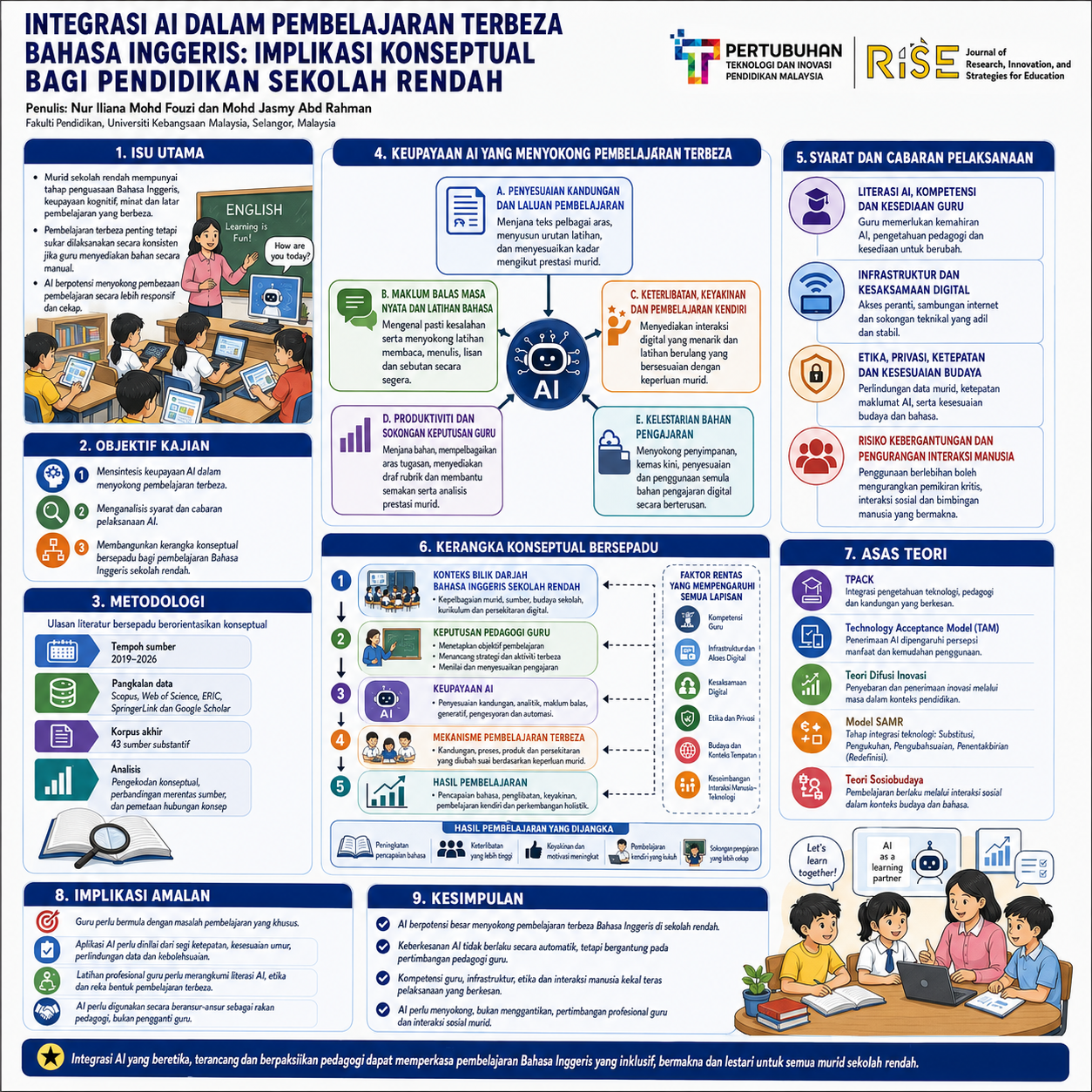
The diversity of pupils’ language proficiency levels, cognitive abilities, interests and learning backgrounds has made differentiated learning increasingly important in primary school English classrooms. However, implementing it consistently through the manual preparation of instructional materials remains challenging. This paper aims to synthesise the capabilities of artificial intelligence (AI) in supporting differentiated learning, analyse its implementation conditions and challenges and develop an integrated conceptual framework for primary school English learning. An integrative conceptual literature review was conducted using sources published between 2019 and 2026 identified through Scopus, Web of Science, ERIC, SpringerLink and Google Scholar. A total of 43 substantive sources were purposively selected based on their relevance to the study objectives for conceptual synthesis. The literature was analysed through conceptual coding, cross-source comparison and mapping relationships among technological capabilities, pedagogical mechanisms, implementation factors and learning outcomes. The findings identified five major AI capabilities: adapting content and learning pathways; providing real-time feedback and language practice; enhancing engagement, confidence, and self-directed learning; improving teacher productivity and decision support; and promoting the sustainability of instructional materials. However, these benefits depend on teachers’ pedagogical judgement and AI competencies and are influenced by infrastructure, equitable digital access, data governance, cultural appropriateness and the balance between human interaction and technology. Based on this synthesis, a conceptual framework is proposed that connects classroom contexts, teachers’ pedagogical decisions, AI capabilities, differentiated learning mechanisms and learning outcomes. AI should support, rather than replace, teachers’ professional judgement and pupils’ social interactions.
References
Alakrash, H. M., & Abdul Razak, N. (2021). Technology-based language learning: Investigation of digital technology and digital literacy. Sustainability, 13, Article 12304. https://doi.org/10.3390/su132112304.
Allman, B., Kimmons, R., Dickson-Deane, C., Bozkurt, A., Warr, M., Stefaniak, J., Dash, M., & Bondah, F. E. (2024). EdTechnica: A vision of an educational publishing community of practice that is accessible, flexible, and just. International Journal of Educational Technology in Higher Education, 21, Article 37. https://doi.org/10.1186/s41239-024-00466-1.
Alotaibi, N. S., & Alshehri, A. H. (2023). Prospects and obstacles in using artificial intelligence in Saudi Arabia higher education institutions—The potential of AI-based learning outcomes. Sustainability, 15(13), Article 10723. https://doi.org/10.3390/su151310723.
Baidoo-Anu, D., & Owusu Ansah, L. (2023). Education in the era of generative artificial intelligence (AI): Understanding the potential benefits of ChatGPT in promoting teaching and learning. Journal of AI, 7(1), 52–62. 10.61969/jai.1337500.
Bond, M., Khosravi, H., De Laat, M., Bergdahl, N., Negrea, V., Oxley, E., Pham, P., Chong, S. W., & Siemens, G. (2024). A meta-systematic review of artificial intelligence in higher education: A call for increased ethics, collaboration, and rigour. International Journal of Educational Technology in Higher Education, 21, Article 4. https://doi.org/10.1186/s41239-023-00436-z.
Casal-Otero, L., Catala, A., Fernández-Morante, C., Taboada, M., Cebreiro, B., & Barro, S. (2023). AI literacy in K–12: A systematic literature review. International Journal of STEM Education, 10, Article 29. https://doi.org/10.1186/s40594-023-00418-7.
Castro, G. P. B., Chiappe, A., Rodríguez, D. F. B., & Sepulveda, F. G. (2024). Harnessing AI for education 4.0: Drivers of personalized learning. Electronic Journal of e-Learning, 22(5), 1–14. https://doi.org/10.34190/ejel.22.5.3467
Cecilia, C. K. Y. (2023). A comprehensive AI policy education framework for university teaching and learning. International Journal of Educational Technology in Higher Education, 20, Article 38. https://doi.org/10.1186/s41239-023-00408-3.
Cecilia, C. K. Y., & Hu, W. (2023). Students’ voices on generative AI: Perceptions, benefits, and challenges in higher education. International Journal of Educational Technology in Higher Education, 20, Article 43. https://doi.org/10.1186/s41239-023-00411-8.
Crompton, H., & Burke, D. (2023). Artificial intelligence in higher education: The state of the field. International Journal of Educational Technology in Higher Education, 20, Article 22. https://doi.org/10.1186/s41239-023-00392-8.
Daher, R. (2025). Integrating AI literacy into teacher education: A critical perspective paper. Discover Artificial Intelligence, 5, Article 217. https://doi.org/10.1007/s44163-025-00475-7.
Davis, F. D. (1989). Perceived usefulness, perceived ease of use, and user acceptance of information technology. MIS Quarterly, 13(3), 319–340. doi:10.2307/249008.
Dimitriadou, E., & Lanitis, A. (2023). A critical evaluation, challenges, and future perspectives of using artificial intelligence and emerging technologies in smart classrooms. Smart Learning Environments, 10, Article 12.
Erra Farina Adnan, Nazurah Mohd Darus, Siti Nur Farahin Faizal, Maslawati Mohamad, & Rafidah Kamarudin. (2024). Benefits and challenges of differentiated learning in Malaysian classrooms: Literature review. International Journal of Academic Research in Business and Social Sciences, 14(8), 616–622. http://dx.doi.org/10.6007/IJARBSS/v14-i8/22428.
Familoni, B. T., & Onyebuchi, N. C. (2024). Advancements and challenges in AI integration for technical literacy: A systematic review. Engineering Science & Technology Journal, 5(4), 1415–1430. 10.51594/estj.v5i4.1042.
Hamilton, E. R., Rosenberg, J. M., & Akcaoglu, M. (2016). The Substitution Augmentation Modification Redefinition (SAMR) model: A critical review and suggestions for its use. TechTrends, 60(5), 433–441. doi:10.1007/s11528-016-0091-y.
Hazaymeh, W. A., Bouzenoun, A., & Remache, A. (2024). EFL instructors’ perspective on using AI applications in English as a foreign language teaching and learning. Emerging Science Journal, 8 (Special Issue), 73–87. 10.28991/ESJ-2024-SIED1-05.
Jiang, M. Y.-C., Jong, M. S.-Y., Lau, W. W.-F., Chai, C.-S., & Wu, N. (2021). Using automatic speech recognition technology to enhance EFL learners’ oral language complexity in a flipped classroom. Australasian Journal of Educational Technology, 37(2), 110–131. https://doi.org/10.14742/ajet.6798.
Joseph, O. B., & Uzondu, N. C. (2024). Integrating AI and machine learning in STEM education: Challenges and opportunities. Computer Science & IT Research Journal, 5(8), 1732–1750. 10.51594/csitrj.v5i8.1379.
Katawazai, R., Haidari, M., Yahya, N.R., Chin, L., Ibrahim, I.F.C., Muhydin, N.,M., & Sandaran, S. C. (2022). An evaluation of cultural elements within Malaysian Year 1 English textbooks: KSSR SK English Year 1 and CEFR Super Minds 1. Sains Humanika, 14(1), 20–25. 10.11113/sh.v14n1.1821.
Katsaris, I., & Vidakis, N. (2021). Adaptive e-learning systems through learning styles: A review of the literature. Advances in Mobile Learning Educational Research, 1(2), 124–145. 10.25082/AMLER.2021.02.007.
Kementerian Pendidikan Malaysia. (2026). Risalah maklumat asas pendidikan. Diperoleh pada 28 Mei 2026, daripada https://emisonline.moe.gov.my/risalahmap/
Komara, I. B., Heryani, R., Somantri, M., & Murron, F. S. (2025). The role of feedback in differentiated learning to support read-write literacy learners in elementary school. International Journal of Elementary Education, 9(3), 473–482. https://doi.org/10.23887/ijee.v9i3.96474.
Labadze, L., Grigolia, M., & Machaidze, L. (2023). Role of AI chatbots in education: Systematic literature review. International Journal of Educational Technology in Higher Education, 20, Article 56. https://doi.org/10.1186/s41239-023-00426-1.
Laufer, M., Leiser, A., Deacon, B., Perrin de Brichambaut, P., Fecher, B., Kobsda, C., & Hesse, F. (2021). Digital higher education: A divider or bridge builder? Leadership perspectives on edtech in a COVID-19 reality. International Journal of Educational Technology in Higher Education, 18, Article 51. https://doi.org/10.1186/s41239-021-00287-6.
Lin, C. C., Huang, A. Y. Q., & Lu, O. H. T. (2023). Artificial intelligence in intelligent tutoring systems toward sustainable education: A systematic review. Smart Learning Environments, 10, Article 41. https://doi.org/10.1186/s40561-023-00260-y.
Liriwati, F. Y. (2023). Transformasi kurikulum; kecerdasan buatan untuk membangun pendidikan yang relevan di masa depan. IHSAN: Jurnal Pendidikan Islam, 1, 62–71. https://doi.org/10.61104/ihsan.v1i2.61.
Maizatul Bahirah Abdul Aziz, & Muhammad Helmi Norman (2026). Kesediaan guru mengintegrasikan kecerdasan buatan (AI) dalam pengajaran dan pembelajaran. Jurnal Dunia Pendidikan, 8(1), 46–61. https://doi.org/10.55057/jdpd.2026.8.1.4.
Mishra, P., & Koehler, M. J. (2006). Technological pedagogical content knowledge: A framework for teacher knowledge. Teachers College Record, 108(6), 1017–1054. doi:10.1111/j.1467-9620.2006.00684.x.
Mohamad Syafiq Ya Shak, Intan Safinas Mohd Ariff Albakri, Mohd Haniff Mohd Tahir, & Mohd Hafiz Mat Adam. (2021). The use of imported CEFR-aligned English language textbooks in Malaysian schools: Issues and concerns. International Journal of Academic Research in Business and Social Sciences, 11(9), 954–963. 10.6007/IJARBSS/v11-i9/10875.
Mohd Amzari Tumiran, Batrisyia Hidayah Baharuddin, & Nasharuddin Mohammad (2025). Potensi kecerdasan buatan (AI) dalam sistem pendidikan di Malaysia: Analisis kandungan. Quantum Journal of Social Sciences and Humanities, 6(2), 237–250. 10.55197/qjssh.v6i2.638.
Nadrah Zainal Abidin, & Harwati Hashim. (2021). Common European Framework of Reference (CEFR): A review on teachers’ perception & plurilingualism. Creative Education, 12(4), 727–736. 10.4236/ce.2021.124051.
Ng, D. T. K., Leung, J. K. L., Su, J., Ng, R. C. W., & Chu, S. K. W. (2023). Teachers’ AI digital competencies and twenty-first century skills in the post-pandemic world. Educational Technology Research and Development, 71(1), 137–161. https://doi.org/10.1007/s11423-023-10203-6.
Nor Syazliana, S., & Harwati, H. (2024). Benefits and challenges in implementing artificial intelligence in education (AIED) in ESL classroom: A systematic review (2019–2022). International Journal of Academic Research in Business and Social Sciences, 14(1), 146–164.
Nur Athirah Mohammed, Abdul Halim Abdul Raof, & Masdinah Alauyah Md Yusof (2021). Challenges in implementing the CEFR in English language classrooms. LSP International Journal, 8(2), 115–128. https://doi.org/10.11113/lspi.v8.17977.
Rahman, A., Raj, A., Tomy, P., & Hameed, M. S. (2024). A comprehensive bibliometric and content analysis of artificial intelligence in language learning: Tracing between the years 2017 and 2023. Artificial Intelligence Review, 57, Article 107. https://doi.org/10.1007/s10462-023-10643-9.
Religioni, A., Meilinda, C., Alawiyah, A., & Farrel, L. M. (2024). Differentiated instructions in ESL and EFL classrooms: A systematic literature review. STAIRS: English Language Education Journal, 5(2), 123–132. https://doi.org/10.21009/stairs.5.2.5.
Rogers, E. M. (2003). Diffusion of innovations (5th ed.). Free Press.
Setyaning Dwi Putra, F., Surahman, S., Rizal Munir, D., Sri Kuswiyanti, T., Tri Utomo, W., Yanto The, H., Sembiring, D., Mardikawati, B., Ramdhany Edy, M., Blasius Perang, F., & Oktaviane, Y. (2024). Transformasi pendidikan mendorong kemajuan bangsa melalui kecerdasan buatan. Widina Media Utama.
Smale-Jacobse, A. E., Meijer, A., Helms-Lorenz, M., & Maulana, R. (2019). Differentiated instruction in secondary education: A systematic review of research evidence. Frontiers in Psychology, 10, Article 2366. 10.3389/fpsyg.2019.02366
Snyder, H. (2019). Literature review as a research methodology: An overview and guidelines. Journal of Business Research, 104, 333–339. 10.1016/j.jbusres.2019.07.039.
Son, J.-B., Ružić, N. K., & Philpott, A. (2025). Artificial intelligence technologies and applications for language learning and teaching. Journal of China Computer-Assisted Language Learning, 5(1), 94–112. 10.1515/jccall-2023-0015.
Tang, W. K. W., & Zhang, X. Y. (2026). Artificial intelligence in English as a foreign language learning: A systematic review of technologies, tools, and their impacts. Computers and Education: Artificial Intelligence, 10, Article 100595. https://doi.org/10.1016/j.caeai.2026.100595.
Torraco, R. J. (2005). Writing integrative literature reviews: Guidelines and examples. Human Resource Development Review, 4(3), 356–367. https://doi.org/10.1177/1534484305278283.
Vygotsky, L. S. (1978). Mind in society: The development of higher psychological processes (M. Cole, V. John-Steiner, S. Scribner, & E. Souberman, Eds.). Harvard University Press.
Walter, Y. (2024). Embracing the future of artificial intelligence in the classroom: The relevance of AI literacy, prompt engineering, and critical thinking in modern education. International Journal of Educational Technology in Higher Education, 21, Article 15. https://doi.org/10.1186/s41239-024-00448-3.
Zamri Mahamod. (2026). Kecerdasan Buatan dalam Pendidikan Bahasa Melayu: Cabaran dan Penyelesaian. Penerbit Universiti Kebangsaan Malaysia.
Zawacki-Richter, O., Marín, V. I., Bond, M., & Gouverneur, F. (2019). Systematic review of research on artificial intelligence applications in higher education—Where are the educators? International Journal of Educational Technology in Higher Education, 16, Article 39. https://doi.org/10.1186/s41239-019-0171-0.
Zhai, C., Wibowo, S., & Li, L. D. (2024). The effects of over-reliance on AI dialogue systems on students’ cognitive abilities: A systematic review. Smart Learning Environments, 11, Article 28. https://doi.org/10.1186/s40561-024-00316-7.
Zhang, C., Schießl, J., Plößl, L., Hofmann, F., & Gläser-Zikuda, M. (2023). Acceptance of artificial intelligence among pre-service teachers: A multigroup analysis. International Journal of Educational Technology in Higher Education, 20, Article 49. https://doi.org/10.1186/s41239-023-00420-7.
Downloads
Published
Issue
Section
License
Copyright (c) 2025 Nur Iliana Mohd Fouzi, Mohd Jasmy Abd Rahman (Author)

This work is licensed under a Creative Commons Attribution 4.0 International License.