Conceptual Framework for the Integration of Artificial Intelligence in Inquiry-Based Biology Learning in Secondary Schools
DOI:
https://doi.org/10.70148/rise.v3i5.9Keywords:
Artificial Intelligence (AI), Biology Education, Inquiry-based Learning, Abstract Concepts, Fact-CheckingAbstract
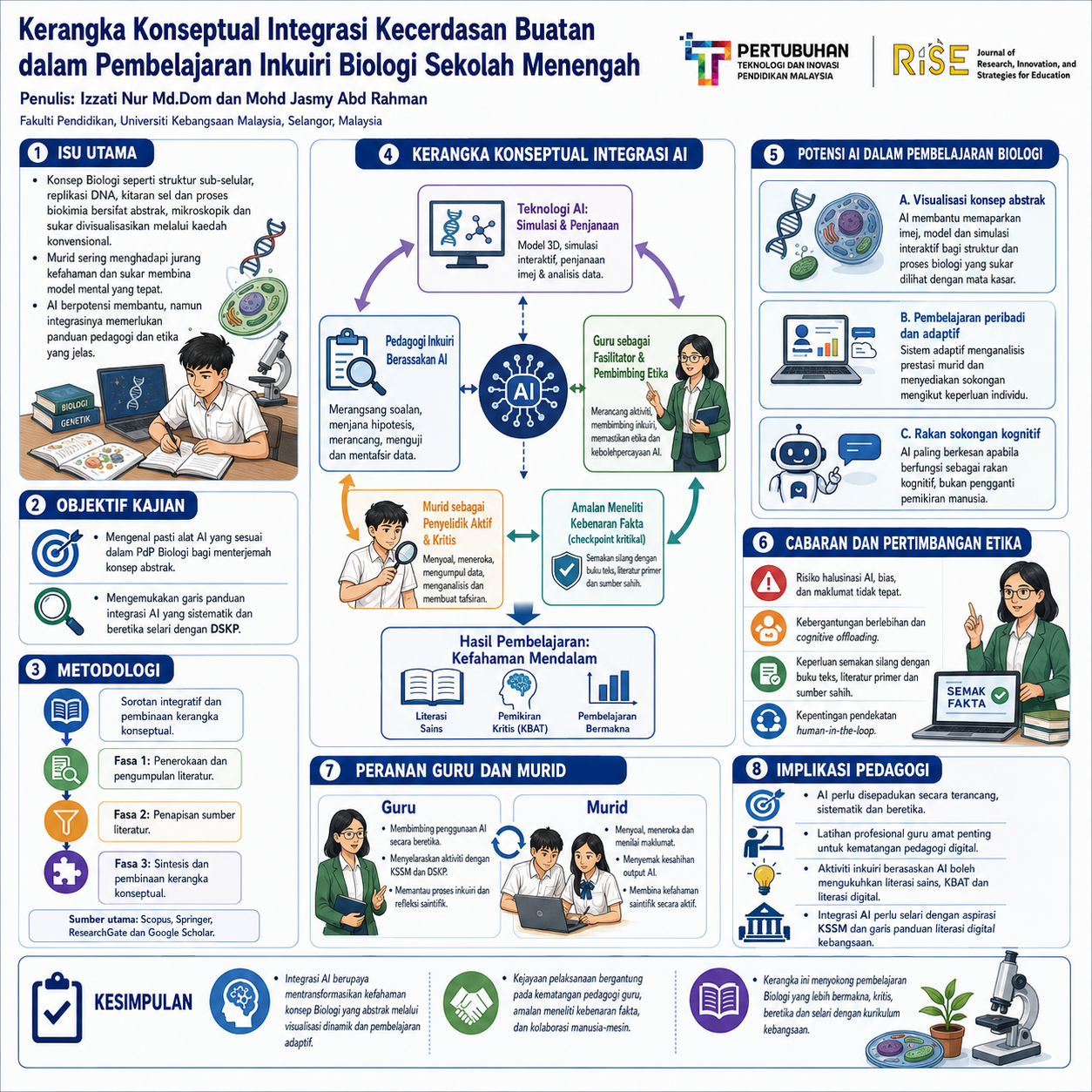
This conceptual paper explores strategic ways to effectively integrate Artificial Intelligence (AI) technology into biology teaching and learning processes, specifically to help students address the challenges of understanding scientific concepts that are microscopic and abstract The thematic analysis of the selected literature identified, this study examines how modern AI tools and personalized learning systems can function as cognitive assistants and catalysts that stimulate deep critical thinking among students. The findings reveal that the integration of this technology demands a holistic and balanced learning ecosystem. This environment combines the role of teachers as facilitators guiding ethical use, students as active researchers evaluating information critically, and technology as a provider of dynamic visual simulations. Through the display of interactive images, models, and biological process simulations, students are better equipped to visualize living structures more easily and effectively. However, this paper places strong emphasis on the importance of continuous fact-checking practices to mitigate the risks of misinformation, bias, or fabrications generated by digital systems. In conclusion, this study highlights the urgent need for a well-planned instructional framework. This step is vital to ensure that synergistic collaboration between humans and machines can strengthen students' scientific literacy, fully aligning with the aspirations of the Kurikulum Standard Sekolah Menengah (KSSM) and national digital literacy guidelines.
References
Ahmedtelba, E., Mitereva, S., & Ponce, M. (2025). Critical integration of generative AI in higher education: Cognitive, pedagogical and ethical perspectives. London Journal of Research in Humanities and Social Science, 25(13), 1–12.
Al Darayseh, A. (2023). Acceptance of artificial intelligence in teaching science: Science teachers’ perspective. Computers and Education: Artificial Intelligence, 4, 100132. https://doi.org/10.1016/j.caeai.2023.100132
Aruleba, K., Sanusi, I. T., Obaido, G., Ogbuokiri, B., & Mienye, I. D. (2025). Beyond the prompt: Student strategies, ethical reflections, and learning with ChatGPT in computer science. Technology, Knowledge and Learning. Advance online publication. https://doi.org/10.1007/s10758-025-09899-7
Ayeni, O. O., Al Hamad, N. M., Chisom, O. N., Osawaru, B., & Adewusi, O. E. (2024). AI in education: A review of personalized learning and educational technology. GSC Advanced Research and Reviews, 18(2), 261–271. https://doi.org/10.30574/gscarr.2024.18.2.0062
Bond, M., Khosrow‐Pour, K., Zawacki‐Richter, O., & O’Shea, S. (2024). A meta systematic review of artificial intelligence in higher education: A call for increased ethics, collaboration, and rigour. International Journal of Educational Technology in Higher Education, 21(1), Article 4. https://doi.org/10.1186/s41239-023-00436-z
Braun, V., & Clarke, V. (2006). Using thematic analysis in psychology. Qualitative Research in Psychology, 3(2), 77–101. https://doi.org/10.1191/1478088706qp063oa
Chakraborty, S., & Harikrishnan, M. (2026). Barriers and enablers to implementing artificial intelligence in life-sciences education: A mixed-methods study. International Journal of Innovative Science and Research Technology, 11(3), 1776–1784. https://doi.org/10.38124/ijisrt/26mar1073
Cooper, G. (2023). Examining science education in ChatGPT: An exploratory study of generative artificial intelligence. Journal of Science Education and Technology, 32(4), 444–452. https://doi.org/10.1007/s10956-023-10039-y
Dao, X.-Q., & Le, N.-B. (2023). LLMs performance on Vietnamese high school biology examination. I.J. Modern Education and Computer Science, 2023(6), 14–30. https://doi.org/10.5815/ijmecs.2023.06.02
Deci, E. L., & Ryan, R. M. (2000). The "what" and "why" of goal pursuits: Human needs and the self-determination of behavior. Psychological Inquiry, 11(4), 227–268. https://doi.org/10.1207/S15327965PLI1104_01
Hu, Z., Wu, Y., & Luo, Z. (2026). Student voices: Synergising artificial and human intelligence in health science education. BMC Medical Education, 26, Article 185. https://doi.org/10.1186/s12909-025-08545-1
Jha, M., & Atif, A. (2025). Reimagining pedagogy for the GenAI era: Frameworks, challenges and institutional strategies. Australasian Journal of Educational Technology, 41(5), 56–73. https://doi.org/10.14742/ajet.10645
Kementerian Pendidikan Malaysia. (2026). Buku panduan literasi AI dalam pendidikan. Bahagian Sumber dan Teknologi Pendidikan.
Kesgin, E. (2025). Bibliometric analysis and predictive modeling map the role of artificial intelligence in science education from research trends to classroom integration. Discover Education, 3(1), Article 45. https://doi.org/10.1007/s44217-025-00906-8
Küçükuncular, A. (2025). Learning with, rather than through, AI: Co-designing science education for critical AI literacy. Frontiers in Education, 10, Article 1716353. https://doi.org/10.3389/feduc.2025.1716353
Lee, J., Park, S., & Kim, D. (2023). Designs and practices using generative AI for sustainable student discourse and knowledge creation. Smart Learning Environments, 10, Article 59. https://doi.org/10.1186/s40561-023-00279-1
Luckin, R. (2023). Machine learning and human intelligence: The future of education in the age of AI. UCL Press.
Miao, F., & Holmes, W. (2023). Guidance for generative AI in education and research. UNESCO.
Papaneophytou, C., & Nicolaou, S. A. (2025). Promoting critical thinking in biological sciences in the era of artificial intelligence: The role of higher education. Trends in Higher Education, 4(2), 24. https://doi.org/10.3390/higheredu4020024
Piaget, J. (1972). Intellectual evolution from adolescence to adulthood. Human Development, 15(1), 1–12. https://doi.org/10.1159/000271225
Snyder, H. (2019). Literature review as a research methodology: An overview and guidelines. Journal of Business Research, 104, 333–339. https://doi.org/10.1016/j.jbusres.2019.07.039
Tan, M. J. T., & Maravilla, N. M. A. (2024). Shaping integrity: Why generative artificial intelligence does not have to undermine education. Frontiers in Artificial Intelligence, 7, 1471224. https://doi.org/10.3389/frai.2024.1471224
Tricco, A. C., Lillie, E., Zarin, W., O’Brien, K. K., Colquhoun, H., Levac, D., Moher, D., Peters, M. D., Horsley, T., & Weeks, L. (2018). PRISMA extension for scoping reviews (PRISMA-ScR): Checklist and explanation. Annals of Internal Medicine, 169(7), 467–473. https://doi.org/10.7326/M18-0850
Usak, M. (2024). Artificial intelligence in biology education. Journal of Baltic Science Education, 23(5), 806–808. https://doi.org/10.33225/jbse/24.23.806
Vasconcelos M. A. R., & dos Santos, R. P. (2025). Enhancing STEM learning with ChatGPT and Bing Chat as objects-to-think-with: A case study. Centre for Generative Artificial Intelligence in Cognition and Education. https://doi.org/10.29333/ejmste/13313
Vendrell, M., & Johnston, S.-K. (2024). Scaffolding critical thinking with generative AI: Design principles for integrating large language models in higher education. Computers and Education: Artificial Intelligence, 7, 100286. https://doi.org/10.1016/j.caeai.2026.100572
Victoriano, A. M., & Tamayo, M. A. L. (2025). Exploring the perception of science teachers in integration of AI in biology education: Literature review. Formosa Journal of Science and Technology (FJST), 4(8), 2603–2616. https://doi.org/10.55927/fjst.v4i8.211
Disclaimer/Publisher’s Note: The statements, opinions and data contained in all publications are solely those of the individual author(s) and contributor(s) and not of RISE and/or the editor(s). RISE and/or the editor(s) disclaim responsibility for any injury to people or property resulting from any ideas, methods, instructions or products referred to in the content.
Downloads
Published
Issue
Section
License
Copyright (c) 2025 Izzati Nur Md.Dom, Mohd Jasmy Abd Rahman (Author)

This work is licensed under a Creative Commons Attribution 4.0 International License.