Ethical Leadership and Caring School Leadership in Malaysian Secondary Schools: Teacher’s Perspective from Hulu Langat
DOI:
https://doi.org/10.70148/rise.v3i6.9Keywords:
Ethical leadership, educational leadership, caring school leadership, secondary school principal, teacher well-being.Abstract
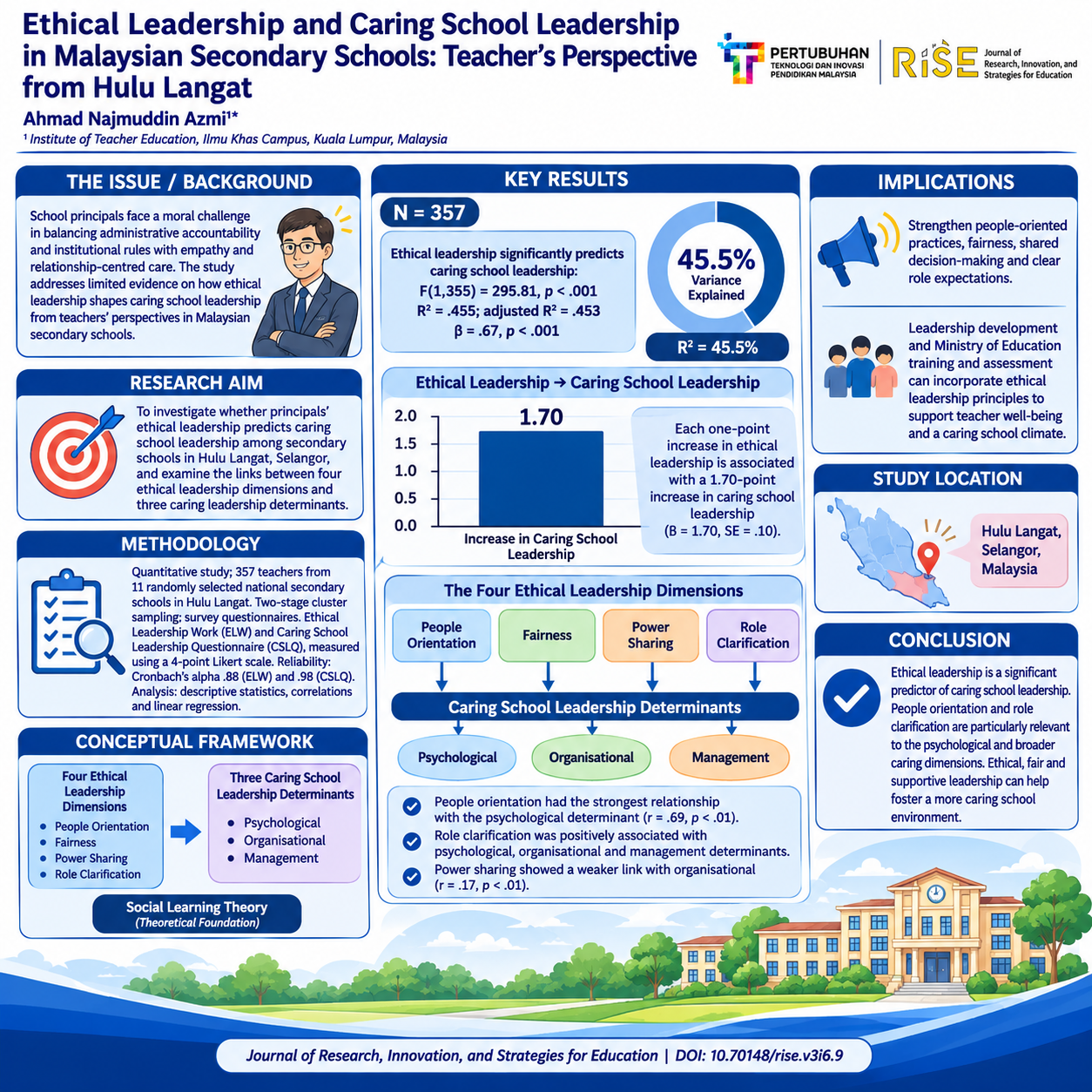
The tension between maintaining rigid administrative accountability and practising relationship-centred care presents educational leaders with complex moral dilemmas, as they struggle to balance institutional rules with empathy. Addressing this issue, this study investigates the influence of ethical leadership on caring school leadership among secondary school principals in Selangor, Malaysia. A sample of 357 teachers from 11 secondary schools participated in the research. Four dimensions of ethical leadership, namely people orientation, fairness, power sharing, and role clarification, were examined, alongside three determinants of caring school leadership, which are psychological, organisational, and management factors, to determine if overall ethical leadership predicts caring school leadership. The regression model strongly predicted school leadership from ethical leadership (F(1 355) = 295.81, p < .001), with leadership explaining 45.5% of the change (R² = .455; adjusted R² = .453), which is a large effect for a single factor in educational leadership research. The standardised coefficient (β =.67, p <.001) and the unstandardised slope (B = 1.70, SE =.10) show that each one-point increase in leadership is linked to a 1.70- p <.001) and the unstandardised slope (B = 1.70 SE =.10) show that each one-point increase in leadership is linked to a 1.70 point increase in caring school leadership. The developed model identifies key ethical leadership dimensions that contribute to a caring school leadership environment. This paper is suggested to provide fresh perspectives on the empirical evidence that ethical leadership and caring school leadership can establish coherent policies and practices in educational society.
References
Ahmed, E. I. (2025). A systematic review of ethical leadership studies in educational research from 1990 to 2022. Educational Management Administration & Leadership, 53(4), 769-788. https://doi.org/10.1177/17411432231193251
Arar, K., & Saiti, A. (2022). Ethical leadership, ethical dilemmas and decision making among school administrators. Equity in Education & Society, 1(1), 126-141. https://doi.org/10.1177/27526461211070828
Blom, N., & Mifsud, D. (2026). A scoping review of followership literature in compulsory schooling contexts. Leadership and Policy in Schools, 1-19. https://doi.org/10.1080/15700763.2025.2608046
Carrasco, A., & Montoya, C. (2024). Caring leadership practices in Chilean educational communities: Perceptions of school principals and teachers. Educational Management Administration & Leadership. Advance online publication. https://doi.org/10.1177/17411432241293563
Chibaya, S. (2025). Effective ethical leadership practices in a context of turbulence and multiple deprivations. Journal of Education, 100, 1–18. https://doi.org/10.17159/2520-9868/i100a05
Crawford, J., Allen, K. A., Pani, B., & Cowling, M. (2024). When artificial intelligence substitutes humans in higher education: the cost of loneliness, student success, and retention. Studies in Higher Education, 49(5), 883-897 https://doi.org/10.1080/03075079.2024.2326956
Gunzenhauser, M. G., Flores, O. J., & Quigley, M. W. (2024). Race-conscious caring for anti-racist leadership: A narrative ethics for cultivating communal responsibility. Journal of School Leadership, 34(1), 3-25. https://doi.org/10.1177/10526846231174151
Hsieh, C. C., Tai, S. E., & Li, H. C. (2023). A bibliometric review of ethical leadership research: Shifting focuses and theoretical insights. AERA Open, 9, 23328584231209266. https://doi.org/10.1177/23328584231209266
Hussey, S. (2025). The compassionate leader: Shaping schools with kindness, courage and purpose. Taylor & Francis. https://doi.org/10.4324/9781003558088
Jones, E. A., Tsai, C.-L., & Bergin, C. (2024). Teachers can differentiate between standards-based leadership skills in principal evaluation surveys: A multilevel analysis. School Effectiveness and School Improvement, 35(4), 387–412. https://doi.org/10.1080/09243453.2024.2369061
Kalshoven, K., Den Hartog, D. N., & De Hoogh, A. H. (2011). Ethical leadership at work questionnaire (ELW): Development and validation of a multidimensional measure. The leadership quarterly, 22(1), 51-69. https://doi.org/10.1016/j.leaqua.2010.12.007
Kalkbrenner, M. T. (2024). Choosing between Cronbach’s coefficient alpha, McDonald’s coefficient omega, and coefficient H: Confidence intervals and the advantages and drawbacks of interpretive guidelines. Measurement and Evaluation in Counseling and Development, 57(2), 93-105. https://doi.org/10.1080/07481756.2023.2283637
King, J., Chinaza, U., & Naidoo, P. M. (2025). A hybrid ethical leadership model for township schools: Integrating classical, contemporary, and African leadership perspectives. Perspectives in Education, 43(4). https://doi.org/10.38140/pie.v43i4.9479
Krejcie, R. V., & Morgan, D. W. (1970). Determining sample size for research activities. Educational and Psychological Measurement, 30(3), 607–610. https://doi.org/10.1177/001316447003000308
Louis, K. S., Murphy, J., & Smylie, M. (2016). Caring leadership in schools: Findings from exploratory analyses. Educational administration quarterly, 52(2), 310-348. https://doi.org/10.1177/0013161x15627678
Madison, K., Fernando, J., Robberts, J., & Eva, N. (2023). From hero to humility: Critical approaches to teaching servant leadership. New Directions for Student Leadership, 2023 (180), 37-47. https://doi.org/10.1002/yd.20567
Mariano, M. T., & Solomon, J. Y. (2024). Organizational commitment as influenced by caring school leadership and empowerment: A convergent design. International Journal of Research and Scientific Innovation, 11(12), 123-142. https://doi.org/10.51244/ijrsi.2024.11120014
Masuwai, A., Zulkifli, H., & Hamzah, M. I. (2025). Exploratory factor analysis of secondary school Islamic Education Teacher self-assessment Instrument: A pilot study. Social Sciences & Humanities Open, 11, 101573. https://doi.org/10.1016/j.ssaho.2025.101573
McGee-Cooper, A., & Trammell, D. (2025). Servant Leadership Learning Communities®: Incubators for great places to work. In Servant leadership: Developments in theory and research (pp. 223-240). Cham: Springer Nature Switzerland. https://doi.org/10.1007/978-3-031-69922-1_12
Ministry of Education Malaysia, (2012) Panduan Aktiviti Perlaksanaan Guru Penyayang. Putrajaya, Government Printing Offices.
Paniagua, R., & Fass-Holmes, B. (2026). Administering surveys to international undergraduates—Recommendations for best practices. Journal of Comparative & International Higher Education, 18(2), 96-124. DOI: 10.64899/2151-0407.2011
Ryu, J., Walls, J., & Seashore Louis, K. (2022). Caring leadership: The role of principals in producing caring school cultures. Leadership and Policy in Schools, 21(3), 585-602. https://doi.org/10.1080/15700763.2020.1811877
Saxena, A., & Prasad, A. (2025). The relationship between ethical leadership and innovative work behaviour: Role of appreciative inquiry. In Handbook of Research on Ethical Leadership and Organizational Practices (pp. 139–158). IGI Global. https://doi.org/10.4018/978-1-5225-9675-2.ch009
Sindone, A., Kearney, S., & Thai, T. (2025). The impact of service-learning on the development of servant leadership. International Journal of Research on Service-Learning & Community Engagement, 13(1), 1–18. https://doi.org/10.37333/001c.151683
Sona, S. I., & Abdullah, M. R. (2025). Integrating servant leadership theory into the da'wah and leadership curriculum: Bridging Islamic principles and contemporary challenge. International Journal of Contemporary Education, Religious Studies and Humanities, 5(1), 38–51.
Thien, L. M., Adams, D., Kho, S. H., & Yap, P. L. (2023). Exploring value-driven leadership: Perspectives from school leaders. Journal of Research on Leadership Education, 18 (3), 534-551. https://doi.org/10.1177/19427751221120479
Torlak, N. G., Demir, A., & Budur, T. (2022). Decision-making, leadership and performance links in private education institutes. Rajagiri Management Journal, 16(1), 63-85. https://doi.org/10.1108/ramj-10-2020-0061
Trang, N. T. Q., Trí, L. Đ. M., & Thớ, A. (2025). Ethical leadership, public service motivation, and organisational citizenship behaviours in Vietnam: A mediated model. Journal for International Business and Entrepreneurship Development, 17(1), 87-111. https://doi.org/10.1504/JIBED.2025.10064123
Willis, C., LaVenia, K. N., & Galletta Horner, C. (2024). Wisdom of the outsiders within: How career technical education leaders can inform educational leadership preparation. Journal of Research on Leadership Education, 19(3), 332-351. https://doi.org/10.1177/19427751231181425
Yusof, N. H., & Cheah, K. S. L. (2023). Amalan, cabaran dan strategi kepimpinan etika Pengetua Sekolah Menengah Kebangsaan terpilih di Selangor [Practices, challenges and strategies of ethical leadership among selected secondary school principals in Selangor]. Institut Aminuddin Baki, Malaysia.
Downloads
Published
Issue
Section
License
Copyright (c) 2026 Ahmad Najmuddin bin Azmi (Author)

This work is licensed under a Creative Commons Attribution 4.0 International License.