Does The Lack of Information and Guidance About Career Opportunities in the Science Field Cause Students to Lose Interest in Choosing This Stream?
DOI:
https://doi.org/10.70148/30bqtz21Keywords:
Science career, Career guidance, Science stream, STEM enrolmentAbstract
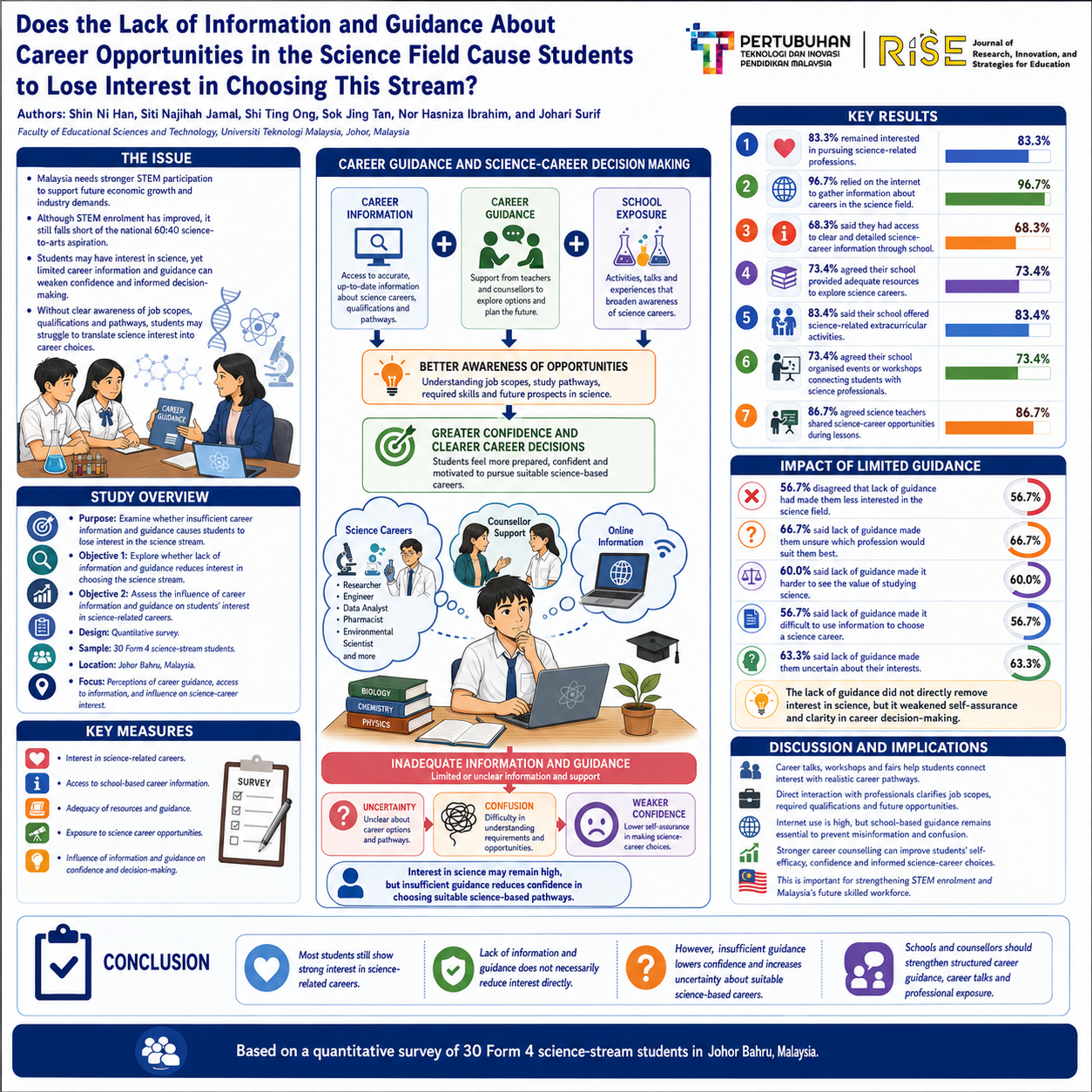
This study investigates whether the lack of career information and guidance contributes to students losing interest in the science stream. Conducted among 30 Form 4 Science stream students in Johor Bahru, the research employed a quantitative survey to assess perceptions of career guidance, access to information, and its influence on interest in science-related careers. The findings reveal that while most students (83.3%) remain interested in pursuing science-related professions, inadequate career counselling leads to uncertainty and reduced confidence in making informed career decisions. Many students rely on the internet for career information, which may expose them to misinformation and further confusion. Although a lack of guidance does not directly diminish interest in science, it significantly affects students’ self-assurance in choosing suitable science-based pathways. Respondents emphasized the importance of structured career counselling, career talks, and exposure to professionals in science fields. Such initiatives help clarify job scopes, required qualifications, and available opportunities, thus supporting better career planning. The study concludes that strengthening career guidance in schools is essential to ensure students are well-informed and motivated to pursue careers in science. Addressing this gap is crucial for Malaysia’s efforts to boost STEM enrolment and develop a skilled workforce for future economic growth.
References
Academy of Sciences Malaysia. (2018). Science outlook 2017: Converging towards progressive Malaysia 2050. Kuala Lumpur, Malaysia: Academy of Sciences Malaysia.
Ahmad, N., Alias, F. A., & Abdul Razak, N. ‘Aina. (2023). Understanding population and sample in research: key concept for valid conclusion. SIG e-Learning@CS.
Alem, D. D. (2020). An overview of data analysis and interpretations in research. Academic Research Journal, 8(1), 1–27.
Ali, R., & Shafiq, F. (2019). Student’s experiences of career counselling and their perceptions of outcomes in Rawalpindi (Pakistan) Colleges. Pertanika Journals, 139–153.
Boye, J. O., Omotosho, J. A., Ria, S. D., Selvia, Eyiah-Bediako, Bentil, J. A., & Dabone, K. T. (2023). Self-knowledge, lack of career information and lack of career counselling as reasons for career indecision among senior high school students in Ghana. Journal of Humanities and Social Science, 29(5).
Campbell, S., Greenwood, M., Prior, S., Shearer, T., Walkem, K., Young, S., Bywaters, D., & Walker, K. (2020). Purposive sampling: complex or simple? Research case examples. Journal of Research in Nursing, 25(8), 652–661. https://doi.org/10.1177/1744987120927206
Drymiotou, I., Constantinou, C. P., & Avraamidou, L. (2021). Enhancing students’ interest in science and understandings of STEM careers: The role of career-based scenarios. International Journal of Science Education, 1–20. https://doi.org/10.1080/09500693.2021.1880664
Elias, S., Din, D. R. @. R. H. M., Ali, M. S., Hussain, M. a. M., Ali, M. S., & Hussain, M. a. M. (2023). career guidance for students: Awareness towards course selection and career planning among secondary students. International Journal of Academic Research in Progressive Education and Development, 13(3). https://doi.org/10.6007/ijarped/v13-i3/17487
Foi, L. Y., & Kean, T. H. (2023). STEM education in Malaysia: An organisational development approach?. International Journal of Advanced Research in Future Ready Learning and Education, 29(1), 1–19.
Garg, R. (2016). Methodology for research I. Indian Journal of Anaesthesia, 60(9), 640. https://doi.org/10.4103/0019-5049.190619
Holt-White, E., Montacute, R., & Tibbs, L. (2022). Paving the way: Careers guidance in secondary schools. Journal of Education, 4(4), 12.
Josephat, V., Timothy, M., & Semali, L. M. (2024). Individual career guidance approach for science subject selection among public secondary school students of Karagwe District, Tanzania. International Journal of Scientific Research and Management (IJSRM), 12(10), 3679–3690. https://doi.org/10.18535/ijsrm/v12i10.el01
Khan, J. A., Raman, A. M., Sambamoorthy, N., & Prashanth, K. (2023). Research methodology (methods, approaches and techniques). San International Scientific Publications. https://doi.org/10.59646/rmmethods/040
Lee, Y.-F., & Lee, L.-S. (2022). Status and trends of stem education in highly competitive countries: country reports and international comparison. ERIC. https://eric.ed.gov/?id=ED623352
Lohr, S. L. (2019). Sampling design and analysis (2nd ed.). CRC Press.
Mahmud, M. I., Kari, N. P. M., & Ai, T. Y. (2022). The relationship between career interest and STEM careers of secondary school students. Journal of Positive School Psychology, 6,(2), 587-595.
Ministry of Education. (2012). Malaysia education blueprint 2013-2025 (Preschool to post-secondary education). Putrajaya, Malaysia.
Mustafa, N. A., Mohamed Shah, N., Waheda Hashim, N., & Md Desa, M. (2021). An overview of stem education and industry 4.0 for early childhood education in Malaysia. Journal of Positive School Psychology, 6(4), 53–62.
Nik Mat, N. H., Salleh, H. S., Yusof, Y., Mohamed, W. N., & Mohd Noor, N. A. (2021). Panduan penyelidikan ilmiah: kaedah dan penulisan (1st ed.). UUM Press.
Nyamwange, J. (2016). Influence of Student’s Interest on Career choice among first year university students in public and private universities in Kisii County, Kenya. Journal of Education and Practice.7(4).
Nyimbili, F., & Nyimbili, L. (2024). Types of purposive sampling techniques with their examples and application in qualitative research studies. British Journal of Multidisciplinary and Advanced Studies, 5(1), 90–99. https://doi.org/10.37745/bjmas.2022.0419
Radhi, N. a. M., & Sallehuddin, Q. (2024, June 27). STEM enrollment jumps to 50.83 per cent among upper secondary school students. NST Online. https://www.nst.com.my/news/nation/2024/06/1068962/stem-enrollment-jumps-5083-cent-among-upper-secondary-school-students
Salama, R., Uzunboylu, H., & El Muti, M. A. (2020). Implementing online questionnaires and surveys by using mobile applications. New Trends and Issues Proceedings on Humanities and Social Sciences, 7(3), 48–70.
Sellami, A., Abdelkader, N., & Umer, S. (2022). A systematic review of STEM education research in the GCC countries: Trends, gaps and barriers. International Journal of STEM Education, 9(1), 1-24. https://doi.org/10.1186/s40594-021-00319-7
Sharapova, N., Zholdasbekova, S., Arzymbetova, S., Zaimoglu, O., & Bozshatayeva, G. (2023). Efficacy of school-based career guidance interventions: A review of recent research. Journal of Education and e-Learning Research, 10(2), 215–222. https://doi.org/10.20448/jeelr.v10i2.4554
Sileyew, K. J. (2019). Research design and methodology. In IntechOpen eBooks. https://doi.org/10.5772/intechopen.85731
Tey, T. C. Y., Moses, P., Cheah, P. K., & Wong, S. L. (2019). Malaysian students’ career interest and perception towards STEM programmes and strategies. In The 7th Workshop on Technology-Enhanced STEM Education (TESTEM WORKSHOP) (Vol. 2). Asia-Pacific Society for Computers in Education (APSCE). https://www.researchgate.net/publication/349310057_Malaysian_students'_career_interest_and_perception_towards_STEM_programmes_and_strategies
Uche, N. (2020). Influence of Counseling Services on Students Career Choice in Secondary Schools: Implication for Career Counseling. Social Development, 8(3), 10.
Zhang, H., Couch, S., Estabrooks, L., Perry, A., & Kalainoff, M. (2023). Role models’ influence on student interest in and awareness of career opportunities in life sciences. International Journal of Science Education Part B, 13(4), 381–399. https://doi.org/10.1080/21548455.2023.2180333
Downloads
Published
Issue
Section
License
Copyright (c) 2025 Han Shin Ni, Siti Najihah Jamal, Norhasniza Ibrahim, Ong Shi Ting, Tan Sok Jing, Johari Surif (Author)

This work is licensed under a Creative Commons Attribution 4.0 International License.