Predicting AI Integration in Educational Leadership: A Proposed Chaid-Based Model of Middle Leaders’ Competencies
DOI:
https://doi.org/10.70148/rise.v2i6.4Keywords:
AI Integration; educational leadership; middle leaders; CHAID prediction model; teacher competenciesAbstract
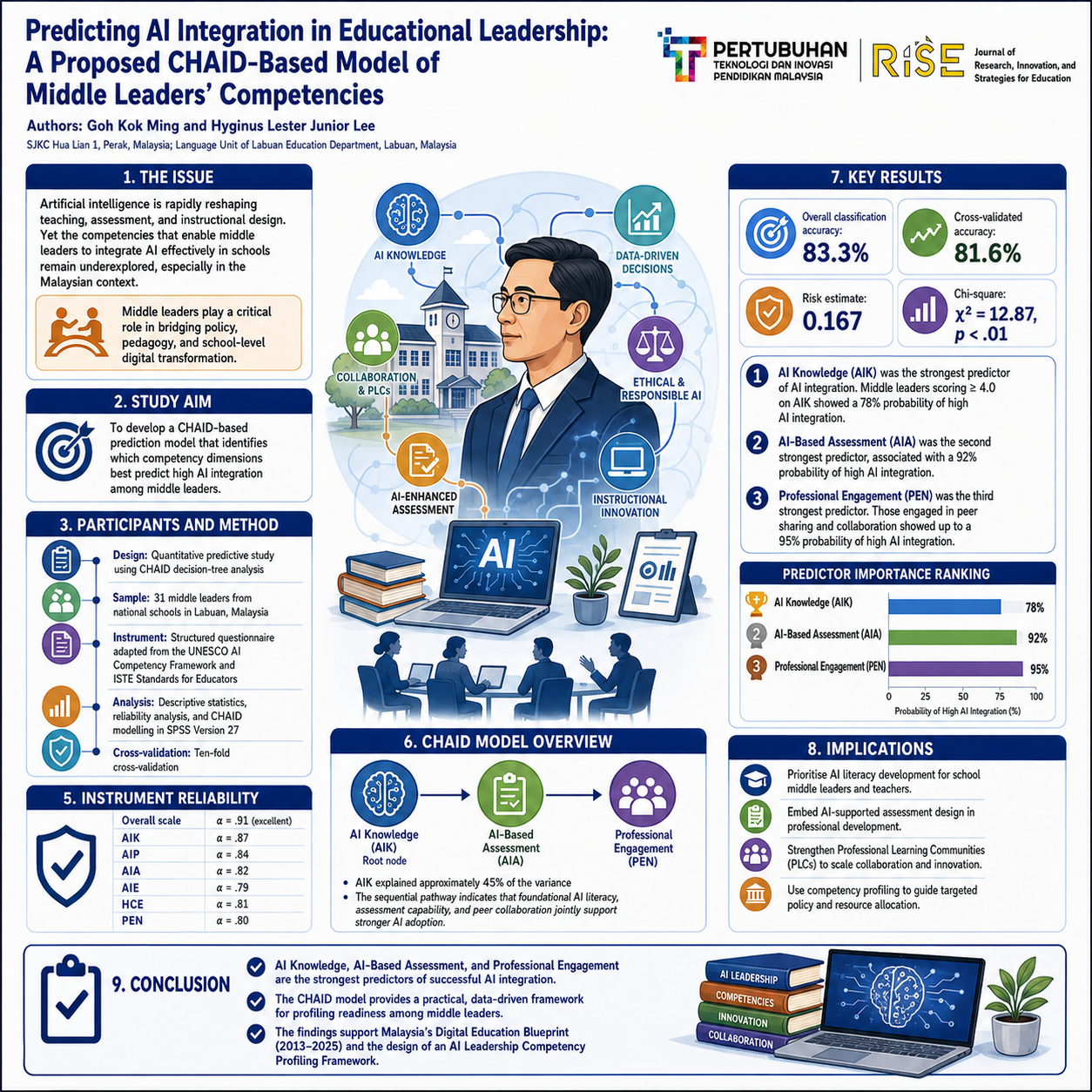
The rapid integration of artificial intelligence (AI) into education is transforming teaching and learning practices worldwide. However, little is known about the factors that drive AI adoption among middle leaders, who play a critical role in shaping digital transformation within schools. This study develops a CHAID-based prediction model to examine the key competency dimensions influencing AI integration among 31 middle leaders from national schools in Labuan, Malaysia. A structured questionnaire was adapted from the UNESCO AI Competency Framework and the ISTE Standards for Educators, comprising 24 items across six dimensions: AI Knowledge (AIK), AI Integration Practices (AIP), AI-Based Assessment (AIA), AI Ethics (AIE), Human-Centered Evaluation (HCE), and Professional Engagement (PEN). Descriptive analysis and decision tree modelling were conducted using SPSS Version 27. Results indicate that AI Knowledge, AI-Based Assessment Design, and Peer Collaboration are the strongest predictors of high AI integration, with the model achieving 83.3% classification accuracy. These findings provide actionable insights for policymakers, school leaders, and teacher educators in designing targeted professional development, supporting Malaysia’s Digital Education Blueprint (2013–2025), and advancing evidence-based strategies to scale AI adoption in educational leadership
References
Adams, D., Mooi, A. N. Y., & Muniandy, V. (2020). Principal leadership preparation towards high-performing school leadership in malaysia. Asian Education and Development Studies, 9(4), 425-439. https://doi.org/10.1108/aeds-02-2018-0046
Ahmad, S. A. (2019). Exploring lecturers’ readiness for 21st century education in malaysian higher learning institutions. European Journal of Teaching and Education. https://doi.org/10.33422/ejte.2019.10.27
Al-Abdullatif, A. M. (2025). Auditing ai literacy competency in k–12 education: the role of awareness, ethics, evaluation, and use in human–machine cooperation. Systems, 13(6), 490. https://doi.org/10.3390/systems13060490
Alamäki, A., Khan, U. A., Kauttonen, J., & Schlögl, S. (2024). An experiment of ai-based assessment: perspectives of learning preferences, benefits, intention, technology affinity, and trust. Education Sciences, 14(12), 1386. https://doi.org/10.3390/educsci14121386
AlTwijri, L., & Alghizzi, T. M. (2024). Investigating the integration of artificial intelligence in english as foreign language classes for enhancing learners’ affective factors: a systematic review. Heliyon, 10(10), e31053. https://doi.org/10.1016/j.heliyon.2024.e31053
Amrullah, M. F. N. (2025). Human-ai collaboration in education: designing effective teacher-ai partnerships for enhanced learning. Communications on Applied Nonlinear Analysis, 32(9s), 1865-1869. https://doi.org/10.52783/cana.v32.4357
Arvin, N., Hoseinabady, M., Bayat, B., & Zahmatkesh, E. (2023). Teacher experiences with ai-based educational tools. AI and Tech in Behavioral and Social Sciences, 1(2), 26-32. https://doi.org/10.61838/kman.aitech.1.2.5
Aryal, M. (2024). Exploring the impact of chatgpt in english language teaching-learning pedagogy. Journal of NELTA Gandaki, 7(1-2), 137-150. https://doi.org/10.3126/jong.v7i1-2.70236
Bai, J. (2025). Overview and summary of ai competency framework for teachers. Global Medical Education. https://doi.org/10.1515/gme-2024-0029
Barrientos, A., Mundo, M. A. D., Inoferio, H. V., Adjid, M. A., Hajan, H. B., Ullong, M. M., … & Espartero, M. M. (2024). Discourse analysis on academic integrity generative ai: perspectives from science and mathematics students in higher education. Environment and Social Psychology, 9(9). https://doi.org/10.59429/esp.v9i9.2927
Barrett, A., & Pack, A. (2023). Not quite eye to a.i.: student and teacher perspectives on the use of generative artificial intelligence in the writing process. International Journal of Educational Technology in Higher Education, 20(1). https://doi.org/10.1186/s41239-023-00427-0
Berg, G. v. d., & Plessis, D. (2023). Chatgpt and generative ai: possibilities for its contribution to lesson planning, critical thinking and openness in teacher education. Education Sciences, 13(10), 998. https://doi.org/10.3390/educsci13100998
Bhojak, N. P., Momin, M., Jani, D., & Mathur, A. (2025). Enhancing teachers’ job satisfaction through the artificial intelligence utilization. Journal of Applied Research in Higher Education. https://doi.org/10.1108/jarhe-03-2024-0126
Bush, T., & Ng, A. Y. M. (2019). Distributed leadership and the malaysia education blueprint. Journal of Educational Administration, 57(3), 279-295. https://doi.org/10.1108/jea-11-2018-0206
Chalwell, K., Stanton, G., & Grice, C. (2023). Christian middle leadership: how the faith of middle leaders shapes and is shaped by school culture and community. International Journal of Christianity & Education, 28(1), 7-21. https://doi.org/10.1177/20569971231159099
Chee, H., Ahn, S., & Lee, J. (2024). A competency framework for ai literacy: variations by different learner groups and an implied learning pathway. British Journal of Educational Technology, 56(5), 2146-2182. https://doi.org/10.1111/bjet.13556
Chen, B., Zhu, X., & Díaz del Castillo H., F. (2023). Integrating generative AI in knowledge building. Computers and Education: Artificial Intelligence, 5, 100184. https://doi.org/10.1016/j.caeai.2023.100184
Choi, D. (2025). Exploring instructional design strategies for utilizing generative ai in early childhood teacher training programs. The K Association of Education Research, 10(1), 549-564. https://doi.org/10.48033/jss.10.1.25
Chorosova, O. M., Gerasimova, R., Protodyakonova, G., & Горохова, Н. (2022). Building foundational digital competencies of teachers in general and inclusive education. VII International Forum on Teacher Education. https://doi.org/10.3897/ap.5.e0295
Chursinov, D. (2025). Formation of future teachers' аі literacy as a pedagogical problem. Scientific Bulletin of Uzhhorod University. Series: Pedagogy. Social Work, 1(56), 264-267. https://doi.org/10.24144/2524-0609.2025.56.264-267
ElSayary, A., Kuhail, M. A., & Hojeij, Z. (2025). Examining the role of prompt engineering in utilizing generative ai tools for lesson planning: insights from teachers’ experiences and perceptions. Human Behavior and Emerging Technologies, 2025(1). https://doi.org/10.1155/hbe2/9986139
Floris, F. D. (2025). Exploring shared repertoire in virtual communities of practice: integration of artificial intelligence in english language teaching. The JALT CALL Journal, 21(2), 102420. https://doi.org/10.29140/jaltcall.v21n2.102420
Ghani, E. K., Ariffin, N., & Sukmadilaga, C. (2022). Factors influencing artificial intelligence adoption in publicly listed manufacturing companies: a technology, organisation, and environment approach. International Journal of Applied Economics, Finance and Accounting, 14(2), 108-117. https://doi.org/10.33094/ijaefa.v14i2.667
Hamid, N. A., & Mansor, M. (2023). Parental engagement using ‘4m’ concept in the education development process in malaysia. International Journal of Academic Research in Progressive Education and Development, 12(2). https://doi.org/10.6007/ijarped/v12-i2/18099
Heins, C. (2022). Artificial intelligence in retail – a systematic literature review. Foresight, 25(2), 264-286. https://doi.org/10.1108/fs-10-2021-0210
Ho, P. X. P. (2024). Using chatgpt in english language learning: a study on i.t. students’ attitudes, habits, and perceptions. International Journal of TESOL & Education, 4(1), 55-68. https://doi.org/10.54855/ijte.24414
Hsu, H.P., Mak, J., Werner, J., White-Taylor, J., Geiselhofer, M., Gorman, A. & Torrejon Capurro, C. (2024). Preliminary study on pre-service teachers’ applications and perceptions of generative artificial intelligence for lesson planning. Journal of Technology and Teacher Education, 32(3), 409-437.
Hudiah, A., Yaumi, M., & Sidik, D. (2024). Designing artificial intelligence-based materials integrated into learning management system. South Eastern European Journal of Public Health, 2363-2372. https://doi.org/10.70135/seejph.vi.2418
Idris, R., Govindasamy, P., & Nachiappan, S. (2023). Challenge and obstacles of stem education in malaysia. International Journal of Academic Research in Business and Social Sciences, 13(4). https://doi.org/10.6007/ijarbss/v13-i4/16676
Ilieva, G., Yankova, T., Ruseva, M., & Kabaivanov, S. (2025). A framework for generative ai-driven assessment in higher education. Information, 16(6), 472. https://doi.org/10.3390/info16060472
International Society for Technology in Education. (2024). ISTE standards: For educators. ISTE. https://iste.org/standards/educators
Isma’il, A., Aliu, A., Ibrahim, M., & Sulaiman, A. B. (2024). Preparing teachers of the future in the era of artificial intelligence. Journal of Artificial Intelligence, Machine Learning and Neural Network, 44, 31-41. https://doi.org/10.55529/jaimlnn.44.31.41
Jamaludin, R. B., Hamid, A. H. A., & Alias, B. S. (2023). Empowering technical and vocational education and training (tvet). International Journal of Academic Research in Business and Social Sciences, 13(12). https://doi.org/10.6007/ijarbss/v13-i12/20159
Joseph, S., Tahir, A., BiBi, F., Hamid, K., Iqbal, M. W., Ruk, S. A., & Ahmad, S. Z. (2024). A review analysis on using "aied" to improve student engagement in hybrid education. Bulletin of Business and Economics (BBE), 13(2), 424-435. https://doi.org/10.61506/01.00348
Katsarou, E., Wild, F., Sougari, A., & Chatzipanagiotou, P. (2023). A systematic review of voice-based intelligent virtual agents in efl education. International Journal of Emerging Technologies in Learning (iJET), 18(10), 65-85. https://doi.org/10.3991/ijet.v18i10.37723
Kasneci, E., Seßler, K., Küchemann, S., Bannert, M., Dementieva, D., Fischer, F., & Kasneci, G. (2023). Chatgpt for good? on opportunities and challenges of large language models for education. https://doi.org/10.35542/osf.io/5er8f
Kelley, M., & Wenzel, T. (2025). Advancing artificial intelligence literacy in teacher education through professional partnership inquiry. Education Sciences, 15(6), 659. https://doi.org/10.3390/educsci15060659
Kim, H., & Kim, W. B. (2024). Secondary school mathematics teachers' perceptions of ai digital textbooks: implications and challenges for adaptive learning. Korean School Mathematics Society, 27(3), 417-452. https://doi.org/10.30807/ksms.2024.27.3.007
Kin, T. M., Kareem, O. A., Musa, K., Ghouri, A. M., & Khan, N. R. (2020). Leading sustainable schools in the era of education 4.0: identifying school leadership competencies in malaysian secondary schools. International Journal of Management in Education, 14(6), 580. https://doi.org/10.1504/ijmie.2020.110690
Kosar, T., Ostojić, D., Liu, Y. D., & Mernik, M. (2024). Computer science education in chatgpt era: experiences from an experiment in a programming course for novice programmers. Mathematics, 12(5), 629. https://doi.org/10.3390/math12050629
Lafuente, D., Cohen, B., Fiorini, G., García, A., Bringas, M., Morzán, E., & Onna, D. (2021). A gentle introduction to machine learning for chemists: an undergraduate workshop using python notebooks for visualization, data processing, analysis, and modeling. Journal of Chemical Education, 98(9), 2892-2898. https://doi.org/10.1021/acs.jchemed.1c00142
Leong, L. V., & Yunus, M. M. (2024). Examining labuan esl teachers’ mastery of tpack in the teaching of english. International Journal of Academic Research in Progressive Education and Development, 13(2). https://doi.org/10.6007/ijarped/v13-i2/21203
Liu, W. (2025). Language teacher ai literacy: insights from collaborations with chatgpt. Journal of China Computer-Assisted Language Learning. https://doi.org/10.1515/jccall-2024-0030
Liu, Z., Zuo, H., & Lu, Y. (2025). The impact of chatgpt on students' academic achievement: a meta‐analysis. Journal of Computer Assisted Learning, 41(4). https://doi.org/10.1111/jcal.70096
Machleid, F., Kaczmarczyk, R., Johann, D., Balčiūnas, J., Atienza-Carbonell, B., Maltzahn, F. v., … & Mosch, L. (2020). Perceptions of digital health education among european medical students: mixed methods survey. Journal of Medical Internet Research, 22(8), e19827. https://doi.org/10.2196/19827
Memišević, H., Biščević, I., Hadžić, S., & Kuduzović, A. (2023). Exploring current trends in education: a review of research topics in the problems of education in the 21st century journal. Problems of Education in the 21st Century, 81(2), 258-268. https://doi.org/10.33225/pec/23.81.258
Memon, T. D., & Kwan, P. (2025). A collaborative model for integrating teacher and genai into future education. TechTrends. https://doi.org/10.1007/s11528-025-01105-w
Meylani, R. (2024). Artificial intelligence in the education of teachers: a qualitative synthesis of the cutting-edge research literature. Journal of Computer and Education Research, 12(24), 600-637. https://doi.org/10.18009/jcer.1477709
Miao, F., & Cukurova, M. (2024). AI competency framework for teachers. UNESCO. https://doi.org/10.54675/zjte2084
Miranda, J., Soledad, M., & Molina, A. (2021). Education 4.0 reference framework for the design of teaching-learning systems: two case studies involving collaborative networks and open innovation. IFIP Advances in Information and Communication Technology, 692-701. https://doi.org/10.1007/978-3-030-85969-5_65
Mnguni, L., Nuangchalerm, P., Islami, R. A. Z. E., Sibanda, D., Ramulumo, M., & Sari, I. J. (2024). Ai integration in biology education: comparative insights into perceived benefits and tpack among south african and indonesian pre-service teachers. Asia-Pacific Science Education, 10(2), 381-410. https://doi.org/10.1163/23641177-bja10086
Mulally, T. (2024). An experiential journey: a year of a professor using ai in the classroom and research. International Journal of Studies in Education and Science, 5(3), 246-256. https://doi.org/10.46328/ijses.98
Mutawa, A. M., & Sruthi, S. (2024). Unesco's ai competency framework. Advances in Educational Technologies and Instructional Design, 75-96. https://doi.org/10.4018/979-8-3693-0884-4.ch004
Nelson, K. R., Du, S., Marshall, D. T., Bowers, S., & Ali, A. (2025). Empowering educators: a practical approach to ai literacy in k-12 classrooms. https://doi.org/10.31235/osf.io/ueyba_v2
Ng, D. T. K., Leung, J. K. L., Chu, K. W. S., & Qiao, S. (2021). ai literacy: definition, teaching, evaluation and ethical issues. Proceedings of the Association for Information Science and Technology, 58(1), 504-509. https://doi.org/10.1002/pra2.487
Noor, A. M., Dorasamy, M., & Raman, M. (2023). The influence of commitment to change and change-related behaviour among academics of malaysian-islamic higher learning institutions. Sustainability, 15(19), 14250. https://doi.org/10.3390/su151914250
OECD. (2024, May 3). OECD updates AI Principles to stay abreast of rapid technological developments. OECD. https://www.oecd.org/en/about/news/press-releases/2024/05/oecd-updates-ai-principles-to-stay-abreast-of-rapid-technological-developments.html
Oliynyk, V. V., Gushchyna, N. I., Kondratova, L., & Касьян, С. П. (2024). Developing digital competence of teachers in postgraduate education using google workspace for education. CTE Workshop Proceedings, 11, 356-380. https://doi.org/10.55056/cte.662
Park, H. (2025). Development of a teacher's ai literacy scale based on meta-analysis. Korea University Institute of Educational Research, 94, 41-76. https://doi.org/10.24299/kier.2025.381.41
Park, J. (2023). Medical students’ patterns of using chatgpt as a feedback tool and perceptions of chatgpt in a leadership and communication course in korea: a cross-sectional study. Journal of Educational Evaluation for Health Professions, 20, 29. https://doi.org/10.3352/jeehp.2023.20.29
Polak, S., Schiavo, G., & Zancanaro, M. (2022). Teachers’ perspective on artificial intelligence education: an initial investigation. CHI Conference on Human Factors in Computing Systems Extended Abstracts, 1-7. https://doi.org/10.1145/3491101.3519866
Qureshi, N., Qureshi, F., Bandeali, M. M., & Akbar, S. (2025). Teacher perceptions and readiness for ai-enhanced teaching in developing countries. The Critical Review of Social Sciences Studies, 3(3), 1665-1682. https://doi.org/10.59075/8tsejm76
Rajun, I. S. A., Singh, S. S. B., & Rabe, Z. (2022). Inclusive leadership in relationship with psychological distress, organizational climate and social intelligence: a theoretical framework study. Malaysian Journal of Social Sciences and Humanities (MJSSH), 7(10), e001696. https://doi.org/10.47405/mjssh.v7i10.1696
Ramasamy, R., Mohamad, M., Sanmugam, M., & Hooi, C. M. (2024). A need analysis of incorporating new teaching approach via technology. Journal of Communication, Language and Culture, 4(1), 175-193. https://doi.org/10.33093/jclc.2024.4.1.9
Rao, A., Gupta, M., & Joshi, N. (2025). The use of chatgpt in teacher training to improve pedagogical competencies. Al-Hijr: Journal of Adulearn World, 3(4), 459-470. https://doi.org/10.55849/alhijr.v3i4.852
Rapanta, C., Botturi, L., Goodyear, P., Ortiz, L. G., & Koole, M. (2020). Online university teaching during and after the covid-19 crisis: refocusing teacher presence and learning activity. Postdigital Science and Education, 2(3), 923-945. https://doi.org/10.1007/s42438-020-00155-y
Rosqueta, L. R. A. (2025). Beyond traditional methods: how elementary teachers in deped dingras district i navigate ai-powered tools – a qualitative inquiry. Pantao (International Journal of the Humanities and Social Sciences). https://doi.org/10.69651/pijhss040239
Rütti-Joy, O., Winder, G., & Biedermann, H. (2023). Building ai literacy for sustainable teacher education. Zeitschrift Für Hochschulentwicklung, 18(4), 175-189. https://doi.org/10.21240/zfhe/18-04/10
Rütti-Joy, O., Winder, G., & Biedermann, H. (2024). Teacher educator professionalism in the age of ai: navigating the new landscape of quality education. Artificial Intelligence. https://doi.org/10.5772/intechopen.1005030
Shaked, H. (2024). How principals’ instructional leadership impacts schools’ middle leadership. Educational Management Administration & Leadership, 53(5), 977-990. https://doi.org/10.1177/17411432241238888
Shi, L., Ding, A. E., & Choi, I. (2024). Investigating teachers’ use of an ai-enabled system and their perceptions of ai integration in science classrooms: a case study. Education Sciences, 14(11), 1187. https://doi.org/10.3390/educsci14111187
Singh, P., & Absar, S. (2024). Mapping ai literacy among punjab’s teachers using structural equation modelling. Journal of Communication and Management, 3(04), 374-381. https://doi.org/10.58966/jcm20243410
Stockwell, G. (2025). Professional development and learner training. Insights Into AI and Language Teaching and Learning, 203-218. https://doi.org/10.29140/9781763711600-12
Stoika, O. (2023). Teacher’s digital competence in the european educational discourse. The Modern Higher Education Review, 8. https://doi.org/10.28925/2617-5266.2023.813
Sullivan, M., Kelly, A., & McLaughlan, P. (2023). Chatgpt in higher education: considerations for academic integrity and student learning. Journal of Applied Learning & Teaching, 6(1). https://doi.org/10.37074/jalt.2023.6.1.17
Sun, D., Boudouaia, A., Zhu, C., & Li, Y. (2024). Would chatgpt-facilitated programming mode impact college students’ programming behaviors, performances, and perceptions? an empirical study. International Journal of Educational Technology in Higher Education, 21(1). https://doi.org/10.1186/s41239-024-00446-5
Syvyi, M. J., Mazbayev, O., Varakuta, O. M., Panteleeva, N. B., & Bondarenko, O. V. (2020). Distance learning as innovation technology of school geographical education. https://doi.org/10.31812/123456789/4422
Tenberga, I., & Daniela, L. (2024). Artificial intelligence literacy competencies for teachers through self-assessment tools. Sustainability, 16(23), 10386. https://doi.org/10.3390/su162310386
Tikkanen, L., Pyhältö, K., Pietarinen, J., & Soini, T. (2019). Lessons learnt from a large-scale curriculum reform: the strategies to enhance development work and reduce reform-related stress. Journal of Educational Change, 21(4), 543-567. https://doi.org/10.1007/s10833-019-09363-1
Tozsin, A., Uçmak, H., Soyturk, S., Aydın, A., Gözen, A. S., Fahim, M. A., & Ahmed, K. (2024). The role of artificial intelligence in medical education: a systematic review. Surgical Innovation, 31(4), 415-423. https://doi.org/10.1177/15533506241248239
Triplett, W. J. (2023). Artificial intelligence in stem education. Cybersecurity and Innovative Technology Journal, 1(1), 23-29. https://doi.org/10.53889/citj.v1i1.296
Wafik, H. M. A., Mahbub, S., Arif, Z., Prince, S. K. A., & Huda, M. N. (2024). Academicians' perspectives on ai integration in bangladesh's education: balancing promise and ethical realities. Cognizance Journal of Multidisciplinary Studies, 4(2), 139-158. https://doi.org/10.47760/cognizance.2024.v04i02.014
Wang, N., & Lester, J. C. (2023). K-12 education in the age of ai: a call to action for k-12 ai literacy. International Journal of Artificial Intelligence in Education, 33(2), 228-232. https://doi.org/10.1007/s40593-023-00358-x
Yang, F., & Jiang, L. (2025). Research on the reconstruction of core competencies for vocational college teachers in the era of generative artificial intelligence. Frontiers in Artificial Intelligence and Applications. https://doi.org/10.3233/faia250058
Valenzuela, J. M. (2025). Developing teachers' ai literacy through professional development. Advances in Higher Education and Professional Development, 215-244. https://doi.org/10.4018/979-8-3693-9102-0.ch009
Velmurugan, R., Bhuvaneswari, R., Kalimuthu, M., & Abey, J. (2025). The role of ai in immersive learning in teacher education. Immersive Learning in Teacher Education, 31-58. https://doi.org/10.4018/979-8-3693-9861-6.ch002
Viberg, O., Mutlu Cukurova, Feldman-Maggor, Y., Giora Alexandron, Shirai, S., Susumu Kanemune, Wasson, B., Tømte, C., Spikol, D., Milrad, M., Coelho, R., & Kizilcec, R. F. (2024). What explains teachers’ trust in ai in education across six countries? International Journal of Artificial Intelligence in Education. https://doi.org/10.1007/s40593-024-00433-x
Vos, L., & Page, S. J. (2020). Marketization, performative environments, and the impact of organizational climate on teaching practice in business schools. Academy of Management Learning & Education, 19(1), 59-80. https://doi.org/10.5465/amle.2018.0173
Umryk, M., Морзе, Н., & Smyrnova‐Trybulska, E. (2025). Development of artificial intelligence competences for educators in the digital society. Open Educational E-Environment of Modern University, 18, 159-173. https://doi.org/10.28925/2414-0325.2025.1813
Užule, K., Dehtjare, J., Verina, N., Ulbinaitė, A., & Kitanovikj, B. (2025). Extending the concept of diversity in entrepreneurship competence education to include ai skills: public administration employees and experts’ insights. Problems of Education in the 21st Century, 83(4), 579-602. https://doi.org/10.33225/pec/25.83.579
Zakaria, R. (2024). Ai in english and math education: bridging the gap between theory and practice. Communications on Applied Nonlinear Analysis, 31(6s), 01-13. https://doi.org/10.52783/cana.v31.1101
Zawacki‐Richter, O., Marín, V. I., Bond, M., & Gouverneur, F. (2019). Systematic review of research on artificial intelligence applications in higher education – where are the educators?. International Journal of Educational Technology in Higher Education, 16(1). https://doi.org/10.1186/s41239-019-0171-0
Zhang, C. (2025). Some challenges and future prospects for teachers in the context of artificial intelligence. Pacific International Journal, 8(4), 65-73. https://doi.org/10.55014/pij.v8i4.848
Zou, D., Xie, H., & Kohnke, L. (2025). Navigating the future: establishing a framework for educators' pedagogic artificial intelligence competence. European Journal of Education, 60(2). https://doi.org/10.1111/ejed.70117
Downloads
Published
Issue
Section
License
Copyright (c) 2025 Kok Ming Goh, Hyginus Lester Junior Lee (Author)

This work is licensed under a Creative Commons Attribution 4.0 International License.