Character Education: A Hybrid Systematic Literature Review And Bibliometric Analysis
DOI:
https://doi.org/10.70148/rise.v2i6.5Keywords:
Character Education, Literature review, VOSviewer, Bibliometric analysisAbstract
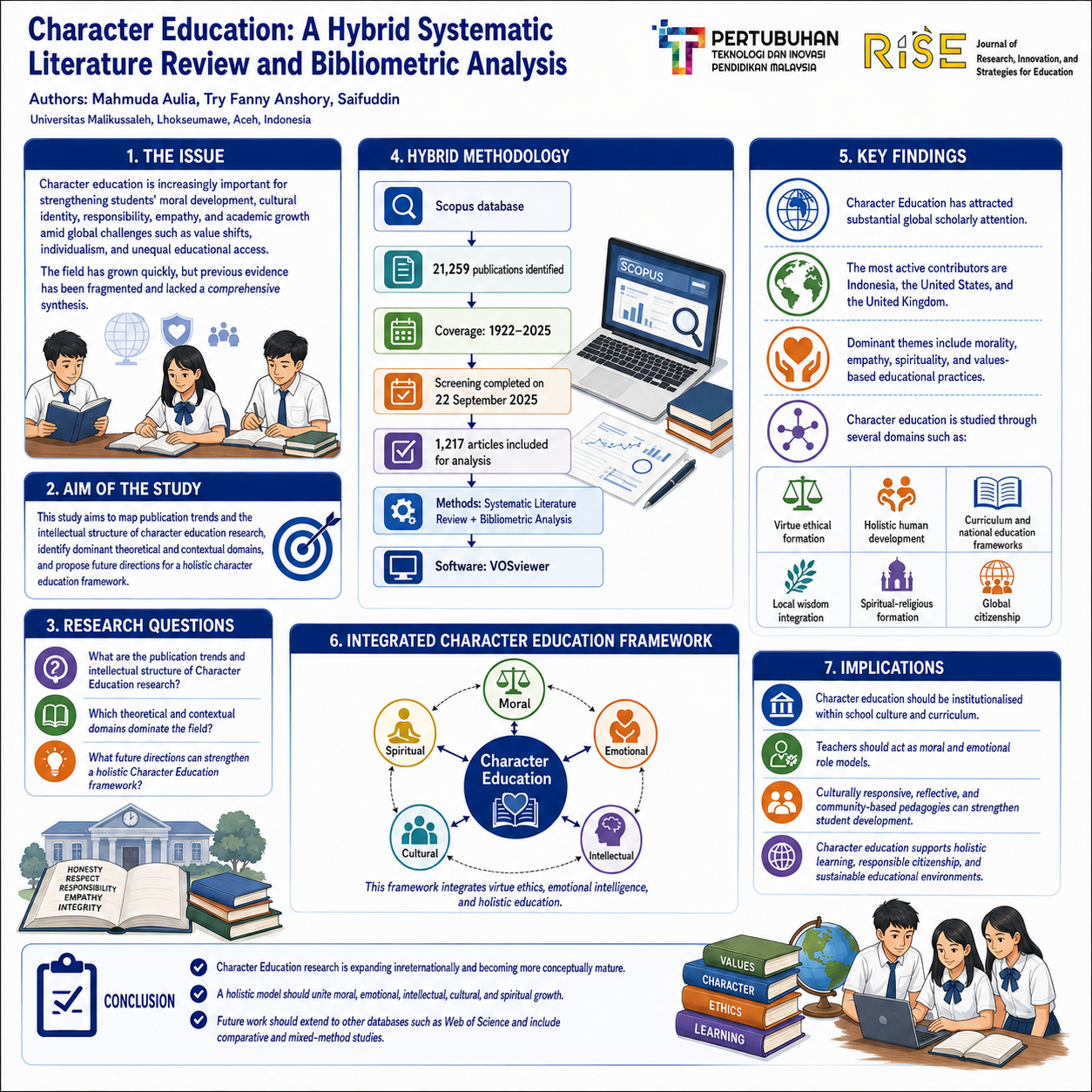
Numerous studies have investigated Character Education in recent decades. Nonetheless, extensive research on this subject is still scarce. Consequently, this study aims to perform a systematic literature review and bibliometric analysis concerning Character Education grounded in existing empirical research. The methodology employed in this research is a Systematic Literature Review, utilizing the term “Character Education” in “Article Titles, Abstracts, and Keywords” from the Scopus database, yielding 21,259 publications from 1922 to 2025. The evaluation was performed on September 22, 2025. The amassed data will undergo bibliometric analysis via VOSviewer. Research on Character Education is not only conducted in countries with dominant contributions such as Indonesia, the United States, and the United Kingdom, but also receives attention from other countries with smaller publication outputs, including Spain, South Korea, Malaysia, Taiwan, China, Turkey, and Australia. Future research should be directed toward regions with relatively lower publication numbers in order to broaden the global perspective. In addition, the principles influencing Character Education encompass moral, emotional, intellectual, cultural, and spiritual dimensions. The conceptual framework of Character Education is also discussed in this study as a foundation for developing more comprehensive and sustainable models of character education. This research utilizes the Scopus database for Character Education articles. Future investigations may enhance generalizability by integrating additional databases like the Web of Science. – The implications pertain to the integration of character education into educational institutions, fostering sustainable learning environments and the holistic development of students in alignment with moral and ethical values. Research on Character Education is expanding globally. Nonetheless, extensive studies on the subject remain confined to existing literature.
References
Aeni, K., Widhanarto, G. P., & Astuti, T. R. P. (2020). Strengthening character education in elementary schools: Learning technology in school culture. International Journal of Scientific and Technology Research, 9(2), 898–902. Scopus.
Agazu, B., Ketemaw Dejenu, A., & Debela, K. (2022). A Comparative Review of Qualitative Research: A Guide to Design and Implementation. Qualitative Report, 27(8), 1499–1508. Scopus. https://doi.org/10.46743/2160-3715/2022.5748
Amal, F. (2025). Transformation of Hadith Teaching as an Effort to Revitalize Islamic Science in Pesantren. Nazhruna: Jurnal Pendidikan Islam, 8(1), 123–138. Scopus. https://doi.org/10.31538/nzh.v8i1.9
Ariani, F., Ulfatin, N., Supriyanto, A. S., & Arifin, I. (2022). Implementing Online Integrated Character Education and Parental Engagement in Local Cultural Values Cultivation. European Journal of Educational Research, 11(3), 1699–1714. Scopus. https://doi.org/10.12973/eu-jer.11.3.1699
Arismunandar, u., & Tolla, I. (2024). Education Character in the Era of Globalization: Facing the Challenges of the Modern World. International Journal of Engineering, Science and Information Technology, 4(4), 230–236. Scopus. https://doi.org/10.52088/ijesty.v4i4.649
Arthur, J. (2005). The re-emergence of character education in British education policy. British Journal of Educational Studies, 53(3), 239–254. Scopus. https://doi.org/10.1111/j.1467-8527.2005.00293.x
Baloǧlu Uǧurlu, N. (2014). Important values of American and Turkish students. Eurasian Journal of Educational Research, 55, 91–108. Scopus. https://doi.org/10.14689/ejer.2014.55.6
Banks, J. A., & Banks, C. A. M. (2010). Multicultural education: Issues and perspectives. John Wiley & Sons.
Banyard PhD, V. L., Hamby, S. L., De, E., & Grych, J. H. (2019). Values Narratives for Personal Growth: Formative Evaluation of the Laws of Life Essay Program. Journal of Humanistic Psychology, 59(2), 269–293. Scopus. https://doi.org/10.1177/0022167815618494
Benson, G. C. S., & Engeman, T. S. (1974). Practical Possibilities in American Moral Education: A Comparison of Values Clarification and the Character Education Curriculum. Journal of Moral Education, 4(1), 53–59. Scopus. https://doi.org/10.1080/0305724740040107
Berkowitz, M. W. (2011). What works in values education. International Journal of Educational Research, 50(3), 153–158. Scopus. https://doi.org/10.1016/j.ijer.2011.07.003
Bier, M. C., Brown, M., McGrath, R., Berkowitz, M. W., & Johnson, K. (2023). Advancing the Science of Character Education: Twenty Plus Years of Reviewing the Literature in Character Education. In Springer International Handbooks of Education: Vol. Part F1708 (pp. 483–496). Scopus. https://doi.org/10.1007/978-3-031-24420-9_26
Bisquerra Alzina, R., & López-Cassà, È. (2021). The intelligent cultivation of moral emotions in adolescence. Revista Espanola de Pedagogia, 79(278), 103–113. Scopus. https://doi.org/10.22550/REP79-1-2021-09
Bulkani, B., Riadin, A., Ni’mah, N., & Setiawan, M. A. (2025). Impact of holistic learning models on character development: A systematic review. Obrazovanie i Nauka, 27(5), 111–141. Scopus. https://doi.org/10.17853/1994-5639-2025-5-111-141
Clemente, N. L. (2024). Educating against intellectual vices. Ethics and Education, 19(1), 109–123. Scopus. https://doi.org/10.1080/17449642.2024.2335133
Cunninghame, I., Vernon, L., & Pitman, T. (2020). To be seen and heard: Enhancing student engagement to support university aspirations and expectations for students from low socioeconomic status backgrounds. British Educational Research Journal, 46(6), 1487–1506. Scopus. https://doi.org/10.1002/berj.3659
Davis, J. B. (1922). The iowa plan of character education methods. Religious Education, 17(6), 435–439. Scopus. https://doi.org/10.1080/0034408220170604
Dewi, E. R., & Alam, A. A. (2020). Transformation model for character education of students. Cypriot Journal of Educational Sciences, 15(5), 1228–1237. Scopus. https://doi.org/10.18844/CJES.V15I5.5155
Diana, R. R., Chirzin, M., Bashori, K., Suud, F. M., & Khairunnisa, N. Z. (2021). Parental engagement on children character education: The influences of positive parenting and agreeableness mediated by religiosity. Cakrawala Pendidikan, 40(2), 428–444. Scopus. https://doi.org/10.21831/cp.v40i2.39477
Donthu, N., Kumar, S., Mukherjee, D., Pandey, N., & Lim, W. M. (2021). How to conduct a bibliometric analysis: An overview and guidelines. Journal of Business Research, 133, 285–296. Scopus. https://doi.org/10.1016/j.jbusres.2021.04.070
Duncan, B. J. (1997). Character education: Reclaiming the social. Educational Theory, 47(1), 119–130. Scopus. https://doi.org/10.1111/j.1741-5446.1997.00119.x
Ginting, L. C. B., Murron, F. S., Fitriani, A. D., Mufliva, R., Rahmawati, E., & Somantri, M. (2025). Development of Comic Character as a Media to Foster Caring and Responsibility for Children. International Research Journal of Multidisciplinary Scope, 6(1), 1451–1462. Scopus. https://doi.org/10.47857/irjms.2025.v06i01.02470
Hambali, I. M., Khasairi, M., Hanafi, Y., & Thoriquttyas, T. (2025). Improving student’s virtue character through the perryso dialogue model. Journal of Education and Learning, 19(3), 1262–1269. Scopus. https://doi.org/10.11591/edulearn.v19i3.21695
Hanim, W. (2019). Development of digital character education comics to improve cognitive empathy. International Journal of Innovation, Creativity and Change, 5(6), 398–407. Scopus.
Hasibuan, A., Mumtaz, N. M., Anwar, K., Haq, M. M. A., & Nurjaman, A. (2025). SUFISTIC APPROACH OF CHARACTER EDUCATION IN AN INDONESIAN ISLAMIC BOARDING SCHOOL. Miqot: Jurnal Ilmu-Ilmu Keislaman, 49(1), 184–204. Scopus. https://doi.org/10.30821/miqot.v49i1.1332
Hidayat, M. T., Rosyadi, A., Rusdiyani, E., & Puspasari, A. (2020). Comparing the effect of Wayang Pahlawan and documentary film for cultivating nationalism among elementary school student. Universal Journal of Educational Research, 8(8), 3545–3550. Scopus. https://doi.org/10.13189/ujer.2020.080830
Ilham, M. I., & Rahman, F. (2024). Character Education of Local Wisdom-based: A Study of Moral Aspect of Quotes belong to Bugis People. Journal of Ecohumanism, 3(3), 1125–1140. Scopus. https://doi.org/10.62754/joe.v3i3.3443
Irwan, M., Irfan, I., Rahman, S. R., Kadir, L., & Risnah, R. (2025). Teachers’ and Adolescents’ Perceptions of Mental Health and Character Education as Preventative Measures Against Youth Violence. Journal of Public Health and Pharmacy, 5(1), 105–118. Scopus. https://doi.org/10.56338/jphp.v5i1.6303
Jevtić, B., & Petrović, J. (2016). Emotional education as the basis for peer violence prevention. Didactica Slovenica - Pedagoska Obzorja, 31(1), 113–126. Scopus.
Jeynes, W. H. (2019). A Meta-Analysis on the Relationship Between Character Education and Student Achievement and Behavioral Outcomes. Education and Urban Society, 51(1), 33–71. Scopus. https://doi.org/10.1177/0013124517747681
Karyono, T., Isa, B. B., & Masunah, J. (2025). Stimulation of drawing expression to strengthen character learning. Cakrawala Pendidikan, 44(2), 286–298. Scopus. https://doi.org/10.21831/cp.v44i2.76617
Khadijah, K., Suciati, I., Khaerani, K., Manaf, A., & Sutamrin, S. (2021). SCHOOLS’ CHARACTER EDUCATION VALUES AND STUDENTS’ MATHEMATICS LEARNING ACHIEVEMENT: A META-ANALYSIS. Cakrawala Pendidikan, 40(3), 670–683. Scopus. https://doi.org/10.21831/cp.v40i3.39924
Khizar, H. M. U., Khurshid, R., & Al-Waqfi, M. (2024). Unraveling the two decades of Knowledge Hiding scholarship: A systematic review, bibliometric analysis, and literature synthesis. Journal of Innovation and Knowledge, 9(4). Scopus. https://doi.org/10.1016/j.jik.2024.100624
Kiltz, G. (2003). An integrated approach to character education in an alternative high school. Current Issues in Education, 6. Scopus. https://www.scopus.com/inward/record.uri?eid=2-s2.0-3042514197&partnerID=40&md5=5e20927458f373a15f7e258026f144b9
Korim, V., & Hanesová, D. (2010). The role of character education and its equivalent subjects in the school curriculum in slovakia and selected european countries. New Educational Review, 21(2), 81–96. Scopus.
Kotzee, B., & Baehr, J. (2024). INTELLECTUAL VIRTUES. In The Routledge International Handbook of Multidisciplinary Perspectives on Character Development, Volume I: Conceptualizing and Defining Character (pp. 512–532). Scopus. https://doi.org/10.4324/9781003251248-28
Krauss, S. E., Zeldin, S., Haslinda, H., Ortega, A., Ali, Z., Ismail, I. A., & Ariffin, Z. (2020). Malaysian youth associations as places for empowerment and engagement. Children and Youth Services Review, 112. Scopus. https://doi.org/10.1016/j.childyouth.2020.104939
Kristjánsson, K. (2025). Richard Pring’s View of Education as a Moral Practice. British Journal of Educational Studies, 73(2), 165–180. Scopus. https://doi.org/10.1080/00071005.2025.2470469
Ladson-Billings, G. (1995). Toward a theory of culturally relevant pedagogy. American Educational Research Journal, 32(3), 465–491.
Liao, P. (2020). EXPERIENTIAL EDUCATION TO TRAIN THE CONSTRUCTION OF CHARACTER BELIEF INDEX. Contemporary Educational Research Quarterly, 28(3), 29–66. Scopus. https://doi.org/10.6151/CERQ.202009_28(3).0002
Lickona, T. (1999). Character Education: Seven Crucial Issues. Action in Teacher Education, 20(4), 77–84. Scopus. https://doi.org/10.1080/01626620.1999.10462937
Limiansi, K., Paidi, P., & Zuchdi, D. (2025). Character education content in science textbook for senior high school students. International Journal of Evaluation and Research in Education, 14(1), 28–36. Scopus. https://doi.org/10.11591/ijere.v14i1.26389
Lopes, J. A. L., Oliveira, C. R., Reed, L., & Gable, R. A. (2013). Character Education in Portugal. Childhood Education, 89(5), 286–289. Scopus. https://doi.org/10.1080/00094056.2013.830880
Marzi, G., Balzano, M., Caputo, A., & Pellegrini, M. M. (2025). Guidelines for Bibliometric-Systematic Literature Reviews: 10 steps to combine analysis, synthesis and theory development. International Journal of Management Reviews, 27(1), 81–103. Scopus. https://doi.org/10.1111/ijmr.12381
Miller, C. B. (2016). On Kristjánsson on Aristotelian character education. Journal of Moral Education, 45(4), 490–501. Scopus. https://doi.org/10.1080/03057240.2016.1239574
Morton, K. R., Worthley, J. S., Testerman, J. K., & Mahoney, M. L. (2006). Defining features of moral sensitivity and moral motivation: Pathways to moral reasoning in medical students. Journal of Moral Education, 35(3), 387–406. Scopus. https://doi.org/10.1080/03057240600874653
Muassomah, M., Abdullah, I., Mujahidin, A., & Masnawi, N. (2020). Believe in Literature: Character Education for Indonesia’s Youth. Universal Journal of Educational Research, 8(6), 2223–2231. Scopus. https://doi.org/10.13189/ujer.2020.080605
Muhtar, T., Supriyadi, T., Lengkana, A. S., & Cukarso, S. H. I. (2021). Character education in physical education learning model: A bibliometric study on 2011-2020 scopus database. International Journal of Human Movement and Sports Sciences, 9(6), 1189–1203. Scopus. https://doi.org/10.13189/saj.2021.090613
Nucci, L., Narvaez, D., & Krettenauer, T. (2014). Introduction and overview. In Handbook of Moral and Character Education (pp. 1–8). Scopus. https://doi.org/10.4324/9780203114896
Nurasiah, I., Sumantri, M. S., Nurhasanah, N., & Casmana, A. R. (2022). Cultural Values’ Integration in Character Development in Elementary Schools: The Sukuraga as Learning Media. Frontiers in Education, 7. Scopus. https://doi.org/10.3389/feduc.2022.849218
Palmer, P. J. (2003). Teaching with heart and soul: Reflections on spirituality in teacher education. Journal of Teacher Education, 54(5), 376–385. Scopus. https://doi.org/10.1177/0022487103257359
Park, J. (2017). Investigating the strategic importance of character education in nursing in South Korea. Information, 20(7), 5239–5247. Scopus.
Parmini, N. P., & Wardhani, N. K. S. K. (2025). Dharmagita and Character Education: An Ethnographic Perspective on Literary Traditions among Ubud Youth. Journal of Ecohumanism, 4(1), 2198–2210. Scopus. https://doi.org/10.62754/joe.v4i1.6040
Prawiyogi, A. G., Suparman, T., & Fitri, A. (2025). Folktales as a media for positive character building education in elementary schools (Case Study in Karawang, West Java, Indonesia). Edelweiss Applied Science and Technology, 9(1), 1219–1227. Scopus. https://doi.org/10.55214/25768484.v9i1.4378
Pritchard, A. (1969). Statistical Bibliography or Bibliometrics? Journal of Documentation, 25, 348–349.
Puka, B. (2005). Inclusive moral education: A critique and integration of competing approaches. In Education, Culture and Values: Volume IV: Moral Education and Pluralism (Vol. 4, pp. 196–223). Scopus. https://doi.org/10.4324/9780203980712-20
Purwaningsih, E., & Ridha, R. (2024). The Role of Traditional Cultural Values in Character Education. Pakistan Journal of Life and Social Sciences, 22(2), 5305–5314. Scopus. https://doi.org/10.57239/PJLSS-2024-22.2.00396
Rijal, S., Miswari, u., & Sihotang, B. (2025). IMPLEMENTING TAZKIYAH AL-NAFS IN THE DEVELOPMENT OF STUDENT CHARACTER. Miqot: Jurnal Ilmu-Ilmu Keislaman, 49(1), 162–183. Scopus. https://doi.org/10.30821/miqot.v49i1.1398
Risdiyanti, I., & Prahmana, R. C. I. (2017). Ethnomathematics: Exploration in javanese culture. 943(1), 012032.
Ristiana, H., Mahmud, A., Suminar, T., & Wasino, W. (2025). Building morality: The role of character education, learning environment, and motivation. Perspektivy Nauki i Obrazovania, 73(1), 566–582. Scopus. https://doi.org/10.32744/pse.2025.1.36
Said, S. M., & Sharif, S. (2023). Unveiling the Excellent Leadership Qualities and Practices of Principals in Islamic Schools: A Systematic Literature Review. International Journal of Learning, Teaching and Educational Research, 22(9), 43–61. Scopus. https://doi.org/10.26803/ijlter.22.9.3
Sakti, S. A., Endraswara, S., & Rohman, A. (2024). Revitalizing local wisdom within character education through ethnopedagogy apporach: A case study on a preschool in Yogyakarta. Heliyon, 10(10). Scopus. https://doi.org/10.1016/j.heliyon.2024.e31370
Sanderse, W. (2025). Blurring the lines between imitation and emulation in moral development. Theory and Research in Education, 23(1), 43–60. Scopus. https://doi.org/10.1177/14778785241304317
Santosa, I. S., Purwanto, E. A., Sumaryono, S., & Utomo, P. P. (2025). Understanding work engagement in public administration: A comprehensive bibliometric and systematic review of the past decade. Social Sciences and Humanities Open, 11. Scopus. https://doi.org/10.1016/j.ssaho.2025.101479
Sari, Y. Y., Fatayan, A., Pandhita, G., Ayu, S., Yatri, I., & Nurfauziah, H. (2025). Integrating Neuroscience-Based Augmented Reality Media for Character Education. International Journal of Information and Education Technology, 15(4), 828–834. Scopus. https://doi.org/10.18178/ijiet.2025.15.4.2289
Setiyatna, H., Harun, n., Supianto, S., & Mualim, R. (2024). Implementation of class-based character education strengthening: A case study at SMAIT Nur Hidayah Sukoharjo. Multidisciplinary Reviews, 7(9). Scopus. https://doi.org/10.31893/multirev.2024219
Shields, D. L. (2011). Character: As the aim of education. Phi Delta Kappan, 92(8), 48–53. Scopus. https://doi.org/10.1177/003172171109200810
Sitanggang, A. O., Lubis, D. P., Muljono, P., & Pramono, F. (2025). A systematic literature review: Character education to build tolerance. Multidisciplinary Reviews, 8(10). Scopus. https://doi.org/10.31893/multirev.2025201
Smith, C. A. (2024). The Pedagogy of a Classroom for Intellectual Virtues. Episteme, 21(4), 1093–1103. Scopus. https://doi.org/10.1017/epi.2023.17
Suciati, I., Idrus, I., Hajerina, H., Taha, N., & Wahyuni, D. S. (2023). Character and moral education based learning in students’ character development. International Journal of Evaluation and Research in Education, 12(3), 1185–1194. Scopus. https://doi.org/10.11591/ijere.v12i3.25122
Sudarwati, N. (2018). Development of character education movie and effectiveness level in growing entrepreneurship behavior of primary school students. Journal of Engineering and Applied Sciences, 13(5), 1253–1261. Scopus. https://doi.org/10.3923/jeasci.2018.1253.1261
Sun, X., Li, J., & Meng, L. (2021). Reflection on EFL/ESL Teachers’ Emotional Creativity and Students L2 Engagement. Frontiers in Psychology, 12. Scopus. https://doi.org/10.3389/fpsyg.2021.758931
Thapa, A., Cohen, J., Guffey, S., & Higgins-D’Alessandro, A. (2013). A Review of School Climate Research. Review of Educational Research, 83(3), 357–385. Scopus. https://doi.org/10.3102/0034654313483907
Umar, M., Qodratulloh, W. S., Ma`arif, M. A., Ismail, F., & Rahman, R. (2025). REVITALIZATION OF ISLAMIC CHARACTER VALUES IN LOCAL FOLKLORE AND ITS IMPLICATION ON CHARACTER EDUCATION. Ulumuna, 29(1), 188–220. Scopus. https://doi.org/10.20414/ujis.v29i1.1375
Winton, S. (2010). Character development and critical democratic education in Ontario, Canada. Leadership and Policy in Schools, 9(2), 220–237. Scopus. https://doi.org/10.1080/15700760903100758
Yani, A., Afrianto, I., Syukran, M., Noviyanti Rachman, W. O. N., & Muhamad, Z. (2025). Adolescent Behavior in Implementing Clean and Healthy Living Practices through Local Wisdom-Based Character Education: A Cross-Sectional Study. Journal of Public Health and Pharmacy, 5(1), 54–63. Scopus. https://doi.org/10.56338/jphp.v5i1.6141
Zurqoni, Z., Retnawati, H., Apino, E., & Anazifa, R. D. (2018). Impact of character education implementation: A goal-free evaluation. Problems of Education in the 21st Century, 76(6), 881–899. Scopus. https://doi.org/10.33225/pec/18.76.881
Downloads
Published
Issue
Section
License
Copyright (c) 2025 Mahmuda Aulia, Try Fanny Anshory, Saifuddin (Author)

This work is licensed under a Creative Commons Attribution 4.0 International License.