Integrating Arts into STEM: A Systematic Review of STEAM Education Practices in Southeast Asia
DOI:
https://doi.org/10.70148/rise.v3i5.10Keywords:
STEAM education, Southeast Asia, educational innovation, interdisciplinary learning, systematic literature reviewAbstract
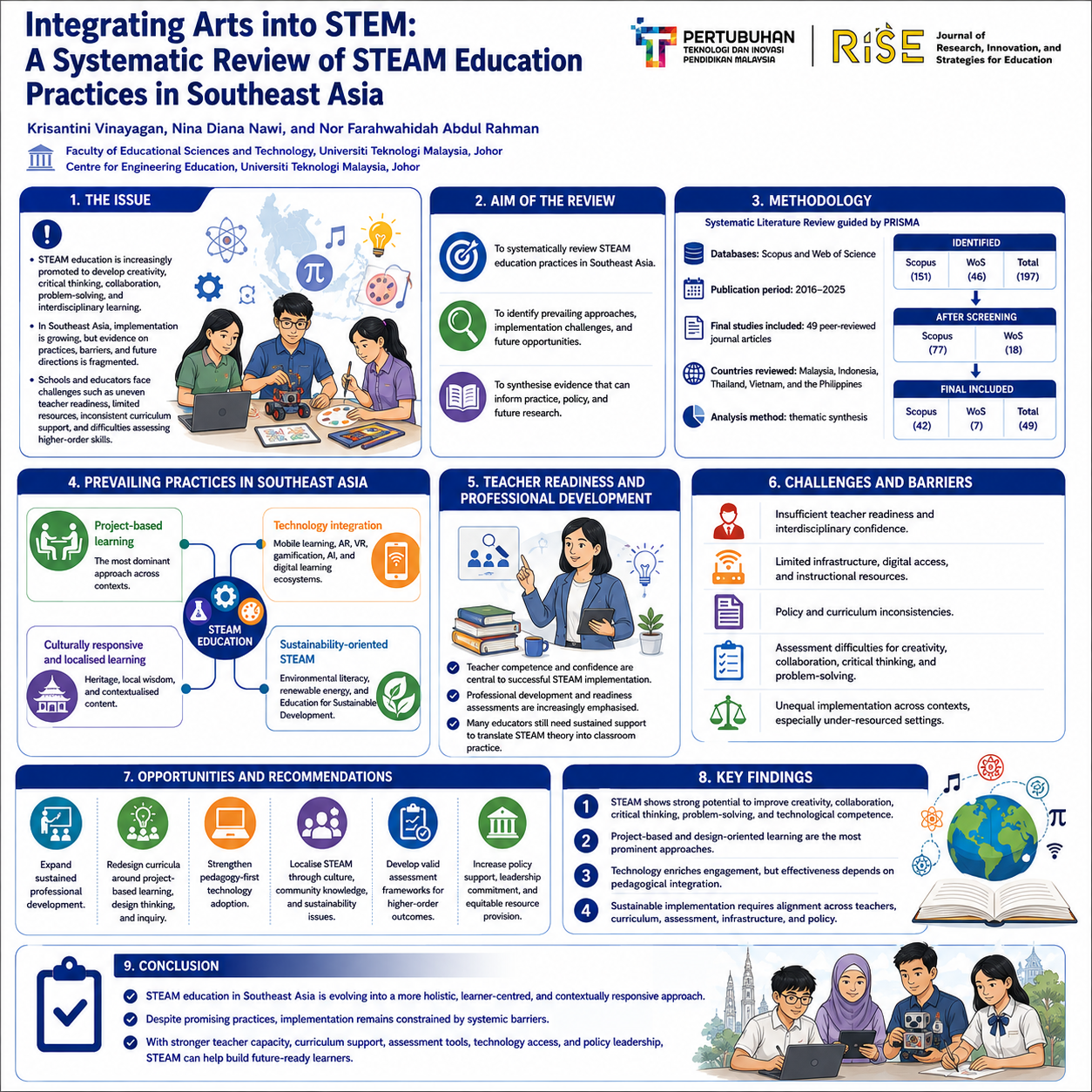
STEAM (Science, Technology, Engineering, Arts, and Mathematics) education has gained increasing attention as an interdisciplinary approach for developing creativity, critical thinking, collaboration, and problem-solving skills essential for the 21st century. Despite its growing adoption across Southeast Asia, evidence regarding implementation practices, challenges, and future directions remains fragmented. This study aims to systematically review STEAM education practices in five Southeast Asian countries, namely Malaysia, Indonesia, Thailand, Vietnam, and the Philippines. Guided by the Preferred Reporting Items for Systematic Reviews and Meta-Analyses (PRISMA) framework, 49 studies published between 2016 and 2025 were retrieved from Scopus and Web of Science databases and analyzed using thematic synthesis. The findings indicate that project-based learning, technology integration, culturally responsive pedagogy, and sustainability-oriented approaches are the predominant practices implemented across the region. However, several barriers continue to hinder effective implementation, including inadequate teacher readiness, limited infrastructure and resources, policy inconsistencies, and challenges in assessing higher-order skills. The review further identifies opportunities to strengthen STEAM education through sustained professional development, pedagogically driven technology adoption, localized curriculum design, improved assessment frameworks, and stronger policy and leadership support. This study contributes to a comprehensive understanding of the current landscape of STEAM education in Southeast Asia and provides evidence-based recommendations to support future educational practices, policymaking, and research in the region.
References
Adnan, M., Ahmad, C. N. C., Ibharim, L. F. M., Khalid, F. a. M., Prihaswati, M., Khasanah, U., & Hidayat, R. (2023). Development and Usability of STEAM Textbook Integrated Character Education with Local Wisdom Themes for Primary School Students. Journal of Higher Education Theory and Practice, 23(5). https://doi.org/10.33423/jhetp.v23i5.5925
Ahmad, D. N., Astriani, M. M., Alfahnum, M., & Setyowati, L. (2021). Increasing Creative Thinking of Students by Learning Organization with STEAM Education. Jurnal Pendidikan IPA Indonesia, 10(1), 103–110. https://doi.org/10.15294/jpii.v10i1.27146
Anito, J. C., Jr, & Morales, M. P. E. (2019). The Pedagogical Model of Philippine STEAM Education: Drawing implications for the reengineering of Philippine STEAM learning ecosystem. Universal Journal of Educational Research, 7(12), 2 662–2669. https://doi.org/10.13189/ujer.2019.071213
Arpaci, I., Dogru, M. S., Kanj, H., Ali, N., & Bahari, M. (2023). An experimental study on the implementation of a STEAM-Based learning module in science education. Sustainability, 15(8), 6807. https://doi.org/10.3390/su15086807
Awang, Z., Yakob, N., Hamzah, A., & Talling, M. M. (2020). Exploring STEAM teaching in preschool using Fred Rogers approach. International Journal of Evaluation and Research in Education (IJERE), 9(4), 1071. https://doi.org/10.11591/ijere.v9i4.20674
Belbase, S., Mainali, B. R., Kasemsukpipat, W., Tairab, H., Gochoo, M., & Jarrah, A. (2021). At the dawn of science, technology, engineering, arts, and mathematics (STEAM) education: prospects, priorities, processes, and problems. International Journal of Mathematical Education in Science and Technology, 53(11), 2919–2955. https://doi.org/10.1080/0020739x.2021.1922943
Bureekhampun, S., & Mungmee, T. (2020). STEAM education for preschool students: Patterns, activity designs and effects. Journal for the Education of Gifted Young Scientists, 8(3), 1201–1212. https://doi.org/10.17478/jegys.775835
Chansaengsee, S. (2023). STEAM approach for improving 21st century skills of multicultural students attending inclusive classroom. Kasetsart Journal of Social Sciences, 45(1). https://doi.org/10.34044/j.kjss.2024.45.1.02
Corrigan, M. W., Wong, J. T., Grove, D., Andersen, S., & Hughes, B. S. (2025). Enhancing Elementary Students Conceptual Understandings of Scientific Phenomena: The Impact of STEAM‐First and STEM‐First Approaches. Science Education.
Djam’an, N. (2025). Examining the implementation of environmental education in the STEAM approach for sustainability. Discover Education, 4(1). https://doi.org/10.1007/s44217-025-00837-4
Ekayana, A. a. G., Parwati, N. N., Agustini, K., & Ratnaya, I. G. (2025). Project based learning framework with STEAM methodology assessed based on self-efficacy: Does it affect creative thinking skills and learning achievement in studying fundamental computers? Journal of Technology and Science Education, 15(1), 107. https://doi.org/10.3926/jotse.2751
Ellianawati, E., Subali, B., Putra, B. R., Wahyuni, S., Dwijananti, P., Adhi, M. A., & Yusof, M. M. M. (2024). Critical thinking and creativity in STEAM-based collaborative learning on renewable energy issues. Journal of Education and Learning (EduLearn), 19(1), 112–119. https://doi.org/10.11591/edulearn.v19i1.21638
Ha, N. T. T. (2023). Applying physics knowledge and STEAM education in high School: Connecting traditional Vietnamese culture through the Moon-Shaped Lute Production Project. European Journal of Educational Research, volume–13– 2024(volume–13–issue–1–january–2024),325–339. https://doi.org/10.12973/eujer.13.1.325
Hakim, S. R., Hariyanto, D., Suprapto, N., Yulkifli, Y., Fahmi, H. Z., Nisa, K., & Rizki, I. A. (2025). Design and implementation of VR lato-lato STEAM in engineering education science. International Journal of Evaluation and Research in Education (IJERE), 14(4), 2749. https://doi.org/10.11591/ijere.v14i4.32206
How, M., & Hung, W. L. D. (2019). Educing AI-Thinking in Science, Technology, Engineering, Arts, and Mathematics (STEAM) Education. Education Sciences, 9(3), 184. https://doi.org/10.3390/educsci9030184
How, M., & Hung, W. L. D. (2019). Educing AI-Thinking in Science, Technology, Engineering, Arts, and Mathematics (STEAM) education. Education Sciences, 9(3), 184. https://doi.org/10.3390/educsci9030184
Imamyartha, D., Widiati, U., Fardhani, A. E., A’yunin, A., Mitasari, M., & Hapsari, G. C. (2024). STEAM pedagogy in foreign language education: An endeavour to broaden CLIL pedagogy through 6E’s framework. Indonesian Journal of Applied Linguistics, 13(3), 477–489. https://doi.org/10.17509/ijal.v13i3.66933
Khoiri, N., Roshayanti, F., & Widarti, R. (2023). Integration of STEAM and ESD: Improving the understanding of fluid concepts and creativity. Journal of Education and e-Learning Research, 10(3), 578–584. https://doi.org/10.20448/jeelr.v10i3.4987
Kummanee, J., Nilsook, P., & Wannapiroon, P. (2020). Digital learning ecosystem involving STEAM gamification for a vocational innovator. International Journal of Information and EducationTechnology, 10(7), 533–539. https://doi.org/10.18178/ijiet.2020.10.7.1420
Laksmiwati, P. A., Lavicza, Z., Cahyono, A. N., Alagic, M., & Mumcu, F. (2024).When engineering design meets STEAM education in hybrid learning environment: teachers’ innovation key through design heuristics. Asia Pacific Journal of Education, 1–19. https://doi.org/10.1080/02188791.2024.2373226
Laksmiwati, P. A., Lavicza, Z., Cahyono, A. N., Yunianto, W., & Houghton, T. (2023). Unveiling the implementation of STE(A)M Education: An exploratory case study of Indonesia from experts’ and policymakers’ perspectives. Cogent Education, 10(2). https://doi.org/10.1080/2331186x.2023.2267959
Lam, H., Chuong, A., Thien, N. H., Thi, T., Hanh, T., & Do, C. (2023). Assessing the competence of early childhood education students at teacher education universities in Vietnam in terms of implementing STEAM education. European Journal of Contemporary Education, 12(2). https://doi.org/10.13187/ejced.2023.2.385
Manh-Tuan, N., Tuyen, N. T. T., & Tien-Trung, N. (2025). Influences on preschool teachers’ willingness to persist in implementing STEM activities: An investigation in Vietnam. Journal of Technology andScience Education, 15(2), 495. https://doi.org/10.3926/jotse.3104
Muzakkir, N., Rauf, R. a. A., & Zulnaidi, H. (2024). Development and validation of the Quran – Science, Technology, Engineering, Art, And Mathematics (Q-STEAM) module. STEM Education, 4(4), 346–363. https://doi.org/10.3934/steme.2024020
Naufal, M. A., Ramdhani, N., Syahid, N. K., Zahrah, F., Nurfadya, M., Hafid, N. A., Dassa, A., Ihsan, H., & Ahmad, A. (2024). STEAM learning implementation in Makassar: SWOT analysis. Journal of Education and Learning (EduLearn), 18(3), 794–803. https://doi.org/10.11591/edulearn.v18i3.21353
Nguyen, H., Nguyen, H., & Ta, T. T. (2024). Enhancing Technology Competence among Primary Students through STEAM Lessons Applying the Design Thinking Process. Revija Za Elementarno Izobraževanje, 189–207. https://doi.org/10.18690/rei.2960
Nguyen, M., Hà, T. A., Mai, H., Vu, K. T., & Nguyễn, M. Q. (2024). Factors affecting preschool teachers’ implementation of STEAM activities: A quantitative study in Vietnam. Social Sciences & Humanities Open, 11, 101227. https://doi.org/10.1016/j.ssaho.2024.101227
Nindiasari, H., Pranata, M. F., Sukirwan, S., Sugiman, S., Fathurrohman, M., Ruhimat, A., & Yuhana, Y. (2024). The use of augmented reality to improve students’ geometry concept problem-solving skills through the STEAM approach. Infinity Journal, 13(1), 119–138. https://doi.org/10.22460/infinity.v13i1.p119-138
Oanh, D. T. K., & Dang, T. D. H. (2025). Effect of STEAM Project-Based Learning on engineering students’ 21st century skills. European Journal of Educational Research, 14(3), 705–721. https://doi.org/10.12973/eu-jer.14.3.705
Perez, J. C. S., Jr, Salic-Hairulla, M. A., Magsayo, J. R., Nabua, E. B., & Malayao, S. O., Jr. (2024). Developing an inquiry-based STEAM teaching packet in ecoliteracy for pre-service teachers. Journal of Education and Learning (EduLearn), 19(2), 764– 774. https://doi.org/10.11591/edulearn.v19i2.21664
Prahani, B. K., Nisa, K., Suliyanah, S., & Deta, U. A. (2024). Evaluation of ChatGPT research in STEAM education. International Journal of Evaluation and Research in Education (IJERE), 14(1), 598. https://doi.org/10.11591/ijere.v14i1.30423
Pransiska, R., Rozimela, Y., & Hadiyanto, H. (2025). Understanding kindergarten teachers’ readiness and acceptance of STEAM-Oriented interactive E-Books for English vocabulary instruction. International Journal of Learning Teaching and Educational Research, 24(3), 500–516. https://doi.org/10.26803/ijlter.24.3.24
Rahim, B., Ambiyar, A., Waskito, W., Fortuna, A., Prasetya, F., Andriani, C., ... & Salman, A. (2024). Effectiveness of project-based learning in metal welding technology course with STEAM approach in vocational education. Available at SSRN 4849914.
Rahmawati, Y., Irwanto, I., Mardiah, A., Taylor, E., Taylor, P. C., Lisdiana, H., & Syaadah, R. S. (2025). Students’ engagement in STEAM PJBL-Design Thinking for Environmental Literacy. Journal of Education Culture and Society, 16(1), 555–580. https://doi.org/10.15503/jecs2025.2.555.580
Rahmawati, Y., Taylor, E., Taylor, P. C., Ridwan, A., & Mardiah, A. (2022). Students’ engagement in Education as Sustainability: Implementing an Ethical Dilemma- STEAM Teaching Model in Chemistry learning. Sustainability, 14(6), 3554. https://doi.org/10.3390/su14063554
Ramli, S. S., Maaruf, S. Z., & Abdullah, N. (2025). STEAM-ing Criteria: Best Criteria for Integrating Science Module with Visual Art. (2025). Asian Journal of University Education, 21(1), 68–82. https://doi.org/10.24191/ajue.v21i1.5481
Relmasira, S. C., Lai, Y. C., & Donaldson, J. P. (2023). Fostering AI literacy in Elementary Science, Technology, Engineering, Art, and Mathematics (STEAM) education in the age of generative AI. Sustainability, 15(18), 13595. https://doi.org/10.3390/su151813595
Siregar, Y. E. Y., Rahmawati, Y., & Suyono, S. (2023). The impact of an integrated STEAM project delivered via mobile technology on the reasoning ability of elementary school students. Journal of Technology and Science Education, 13(1), 410. https://doi.org/10.3926/jotse.1446
Suharni, S., Mohamed, S., & Bakar, K. A. (2025). Exploring Teachers Challenges in implementing literacy and STEAM in Early-Childhood Classrooms. International Journal of Learning Teaching and Educational Research, 24(6), 810–832. https://doi.org/10.26803/ijlter.24.6.37
Sumarni, W., Sumarti, S. S. S., Dewi, S. H. D., & Imaduddin, M. (2025). Collaborative Ethno-STEAM Enriched Project-Based Learning (COE-STEAM-PJBL): its impact on prospective science teachers’ collaboration and creative thinking skills. Jurnal Pendidikan IPA Indonesia, 14(3). https://doi.org/10.15294/jpii.v14i3.25487
Suryanti, S., Nursalim, M., Choirunnisa, N. L., & Yuliana, I. (2023). STEAM-Project- Based Learning: a catalyst for elementary school students’ scientific literacy skills. European Journal of Educational Research, volume–13–2024(volume–13–issue–1– january–2024), 1–14. https://doi.org/10.12973/eu-jer.13.1.1
Sutama, S., Prayitno, H. J., Ishartono, N., & Sari, D. P. (2020). Development of  mathematics learning process by using flipped Classroom integrated by STEAM education in senior high school. Universal Journal of Educational Research, 8(8), 3690–3697. https://doi.org/10.13189/ujer.2020.080848
Taibo, H., & Liang, C. (2022). Research on the Training Mode of Children’s Engineering Thinking with the Concept of STEAM Education. Journal of Curriculum and Teaching, 11(7), 7. https://doi.org/10.5430/jct.v11n7p7
Tan, W., Samsudin, M. A., Ismail, M. E., & Ahmad, N. J. (2020). Gender differences in students’ achievements in learning concepts of electricity via steam integrated approach utilizing scratch. Problems of Education in the 21st Century, 78(3), 423–448. https://doi.org/10.33225/pec/20.78.423
Wannapiroon, N., & Petsangsri, S. (2020). Effects of STEAMification model in flipped classroom learning environment on creative thinking and creative innovation. TEM Journal, 1647–1655. https://doi.org/10.18421/tem94-42
Wannapiroon, N., & Pimdee, P. (2022). Thai undergraduate science, technology, engineering, arts, and math (STEAM) creative thinking and innovation skill development: a conceptual model using a digital virtual classroom learning environment. Education and Information Technologies, 27(4), 5689–5716. https://doi.org/10.1007/s10639-021-10849-w
Worapun, W., & Nuangchalerm, P. (2024). An innovative instructional model to foster creative thinking in primary school students in Thailand. Journal of Curriculum and Teaching, 13(4), 138. https://doi.org/10.5430/jct.v13n4p138
Yunianto, W., Cahyono, A. N., Prodromou, T., El-Bedewy, S., & Lavicza, Z. (2024). CT integration in STEAM learning: Fostering students’ creativity by making Batik stamp pattern. Science Activities, 62(1), 26–52. https://doi.org/10.1080/00368121.2024.2378860
Zaqiah, Q. Y., Hasanah, A., & Heryati, Y. (2024). The role of steam education in improving student collaboration and creativity: a case study in madrasah. Jurnal Pendidikan Islam, 10(1), 101–112. https://doi.org/10.15575/jpi.v10i1.35207
Downloads
Published
Issue
Section
License
Copyright (c) 2025 Krisantini Vinayagan, Nina Diana Nawi, Nor Farahwahidah Abdul Rahman (Author)

This work is licensed under a Creative Commons Attribution 4.0 International License.