Digital Inequality and Social Stratification in Contemporary Societies: A Hybrid Systematic Literature Review and Bibliometric Analysis
DOI:
https://doi.org/10.70148/rise.v3i5.1Keywords:
Digital Inequality, Social Staratification, Systematic Literature Review, Bibliometric analysis, VOSviewer, Digital divide, Digital inclusion, Literature Review, Social inequalityAbstract
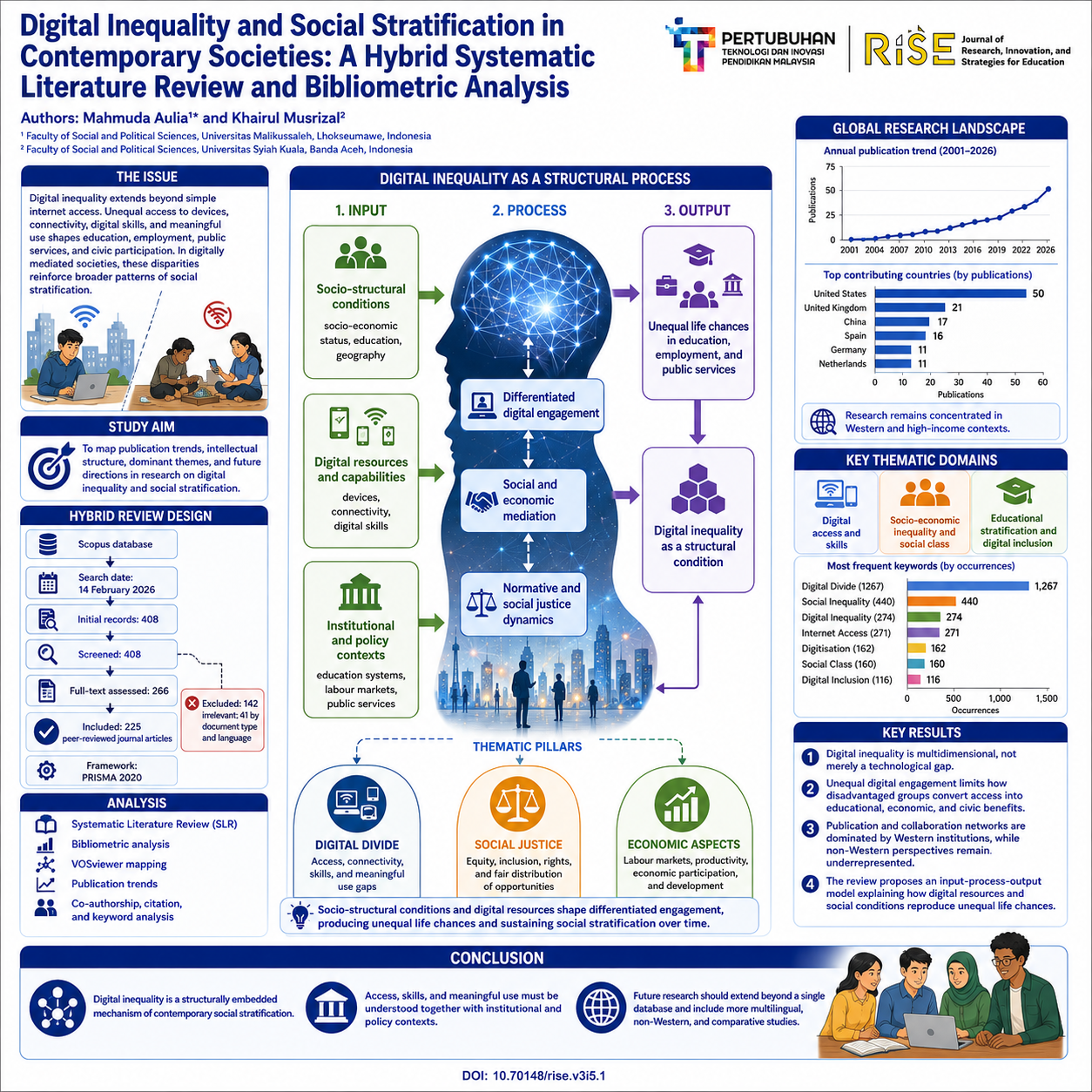
This study integrates a Systematic Literature Review (SLR) and bibliometric analysis to examine global research on digital inequality within the broader context of social stratification. Data were retrieved from the Scopus database on 14 February 2026, initially identifying 408 publications between 2001 and 2026. Following a rigorous screening process based on the PRISMA 2020 guidelines, 225 peer-reviewed journal articles were selected for final analysis. Bibliometric mapping and visualization were conducted using VOSviewer to identify publication trends, thematic clusters, and intellectual structures. The findings indicate substantial growth in scholarship over time, with research heavily concentrated in Western nations, particularly the United States and the United Kingdom. The dominant thematic domains include digital access and skills, social and economic inequality, educational stratification, and digital inclusion. Collectively, these themes demonstrate that digital inequality is a multidimensional, structural condition that actively reproduces unequal life chances across social groups rather than a mere technological gap. Based on these insights, this study proposes an integrative conceptual model structured across input (socio-structural conditions and digital resources), process (differentiated digital engagement), and output (stratified social, economic, and civic outcomes) dimensions. This framework extends existing literature by positioning digital exclusion as a core mechanism of contemporary social reproduction. Overall, this study provides a comprehensive mapping of global publication patterns and intellectual directions in the field. The findings highlight the need for future research to expand data sources beyond a single database and incorporate diverse regional, non-Western contexts to foster a more inclusive and globally representative understanding of digital stratification.
References
Büchi, M., & Hargittai, E. (2022). A Need for Considering Digital Inequality When Studying Social Media Use and Well-Being. Social Media and Society, 8(1). Scopus. https://doi.org/10.1177/20563051211069125
Cho, M., & Kim, K. M. (2021). Exploring the disparity in tangible outcomes of internet use between persons with disabilities and persons without disabilities in South Korea. Disability and Health Journal, 14(3). Scopus. https://doi.org/10.1016/j.dhjo.2021.101101
DiMaggio, P., & Bonikowski, B. (2008). Make money surfing the web? The impact of internet use on the earnings of U.S. workers. American Sociological Review, 73(2), 227–250. Scopus. https://doi.org/10.1177/000312240807300203
Engzell, P., Frey, A., & Verhagen, M. D. (2021). Learning loss due to school closures during the COVID-19 pandemic. Proceedings of the National Academy of Sciences of the United States of America, 118(17). Scopus. https://doi.org/10.1073/PNAS.2022376118
González-Betancor, S. M., López-Puig, A. J., & Cardenal, M. E. (2021). Digital inequality at home. The school as compensatory agent. Computers and Education, 168. Scopus. https://doi.org/10.1016/j.compedu.2021.104195
Halford, S., & Savage, M. (2010). Reconceptualizing digital social inequality. Information Communication and Society, 13(7), 937–955. Scopus. https://doi.org/10.1080/1369118X.2010.499956
Hartmann, M., Lowis, D., & Klocke, V. (2025). Disconnection divide: When rooflessness meets (digital) dis/connection. Media, Culture and Society. Scopus. https://doi.org/10.1177/01634437251385461
Helsper, E. J., & Reisdorf, B. C. (2017). The emergence of a “digital underclass” in Great Britain and Sweden: Changing reasons for digital exclusion. New Media and Society, 19(8), 1253–1270. Scopus. https://doi.org/10.1177/1461444816634676
Hilbert, M. (2015). Digital Divide(s). In The International Encyclopedia of Digital Communication and Society (pp. 1–7). Scopus. https://doi.org/10.1002/9781118767771.wbiedcs012
Lissitsa, S. (2015). Digital use as a mechanism to accrue economic capital: A Bourdieusian perspective. Innovation: The European Journal of Social Science Research, 28(4), 464–482. Scopus. https://doi.org/10.1080/13511610.2015.1081557
Liu, H., Fang, C., & Sun, S. (2017a). Digital inequality in provincial China. Environment and Planning A, 49(10), 2179–2182. Scopus. https://doi.org/10.1177/0308518X17711946
Liu, H., Fang, C., & Sun, S. (2017b). Digital inequality in provincial China. Environment and Planning A, 49(10), 2179–2182. Scopus. https://doi.org/10.1177/0308518X17711946
López-Sintas, J., Lamberti, G., & Sukphan, J. (2020). The social structuring of the digital gap in a developing country. The impact of computer and internet access opportunities on internet use in Thailand. Technology in Society, 63. Scopus. https://doi.org/10.1016/j.techsoc.2020.101433
Mansell, R. (2017). Inequality and digitally mediated communication: Divides, contradictions and consequences. Javnost, 24(2), 146–161. Scopus. https://doi.org/10.1080/13183222.2017.1287966
Martini, E., & Sgambato, M. C. (2025). Digital Inequalities and Access to Technology: Analyzing How Digital Tools Exacerbate or Mitigate Social Inequalities. Societies, 15(11). Scopus. https://doi.org/10.3390/soc15110318
McPherson, S., & Wilkinson, M. (2001). Health informatics and the cultural divide: A UK perspective. Health Informatics Journal, 7(2), 62–65. Scopus. https://doi.org/10.1177/146045820100700202
Merisalo, M., & Makkonen, T. (2022). Bourdieusian e-capital perspective enhancing digital capital discussion in the realm of third level digital divide. Information Technology and People, 35(8), 231–252. Scopus. https://doi.org/10.1108/ITP-08-2021-0594
Page, M. J., McKenzie, J. E., Bossuyt, P. M., Boutron, I., Hoffmann, T. C., Mulrow, C. D., Shamseer, L., Tetzlaff, J. M., Akl, E. A., Brennan, S. E., Chou, R., Glanville, J., Grimshaw, J. M., Hróbjartsson, A., Lalu, M. M., Li, T., Loder, E. W., Mayo-Wilson, E., McDonald, S., … Moher, D. (2021). The PRISMA 2020 statement: An updated guideline for reporting systematic reviews. BMJ, 372, n71. https://doi.org/10.1136/bmj.n71
Ragnedda, M., & Muschert, G. (2015). Max weber and digital divide studies. International Journal of Communication, 9(1), 2757–2762. Scopus.
Räsänen, P., Koivula, A., & Keipi, T. (2021). Online information seeking patterns and social inequality in a digital economy. International Review of Retail, Distribution and Consumer Research, 31(2), 211–228. Scopus. https://doi.org/10.1080/09593969.2020.1864658
Reynolds, R., Aromi, J., McGowan, C., & Paris, B. (2022). Digital divide, critical-, and crisis-informatics perspectives on K-12 emergency remote teaching during the pandemic. Journal of the Association for Information Science and Technology, 73(12), 1665–1680. Scopus. https://doi.org/10.1002/asi.24654
Robinson, L., Schulz, J., Khilnani, A., Ono, H., Cotton, S. R., McClain, N., Levine, L., Chen, W., Huang, G., Casilli, A. A., Tubaro, P., Dodel, M., Quan-Haase, A., Ruiu, M. L., Ragnedda, M., Aikat, D., & Tolentino, N. (2020). Digital inequalities in time of pandemic: COVID-19 exposure risk profiles and new forms of vulnerability. First Monday, 25(7). Scopus. https://doi.org/10.5210/FM.V25I7.10845
Rosenberg, D. (2020). Immigrants’ disadvantage online: Understanding the effects of immigration status, gender and country of origin on the e-government use in Israel. Digital Policy, Regulation and Governance, 23(1), 45–58. Scopus. https://doi.org/10.1108/DPRG-06-2020-0071
Sanrey, C., Goudeau, S., Stanczak, A., & Darnon, C. (2021). A Two-Sided Lockdown? Social Class Variations in the Implementation of Homeschooling During the COVID-19 Lockdown. Frontiers in Psychology, 12. Scopus. https://doi.org/10.3389/fpsyg.2021.670722
Scheerder, A. J., van Deursen, A. J. A. M., & van Dijk, J. A. G. M. (2019). Internet use in the home: Digital inequality from a domestication perspective. New Media and Society, 21(10), 2099–2118. Scopus. https://doi.org/10.1177/1461444819844299
Tian, H. (2025). Information Technology, Urban–Rural Health Disparities and Pathways to Sustainable Development: Evidence from the 2023 Chinese General Social Survey. Sustainability (Switzerland), 17(17). Scopus. https://doi.org/10.3390/su17177740
Uy-Tioco, C. S. (2019). ‘Good enough’ access: Digital inclusion, social stratification, and the reinforcement of class in the Philippines. Communication Research and Practice, 5(2), 156–171. Scopus. https://doi.org/10.1080/22041451.2019.1601492
van Deursen, A. J. A. M., Helsper, E. J., Eynon, R., & van Dijk, J. A. G. M. (2017). The compoundness and sequentiality of digital inequality. International Journal of Communication, 11, 452–473. Scopus.
Viluckienė, J. (2015). Digital divide as social inequality in relation to IT users with disabilities. Filosofija, Sociologija, 26(4), 314–321. Scopus.
Vitral Rezende, S. (2023). The opportunity to learn during the COVID-19 pandemic: Social inequalities and the digital divide in Brazil. International Journal of Educational Development, 103. Scopus. https://doi.org/10.1016/j.ijedudev.2023.102897
Willekens, M., Siongers, J., & Lievens, J. (2022). Social stratification and social media disengagement. The effect of economic, cultural and social capital on reasons for non-use of social media platforms. Poetics, 95. Scopus. https://doi.org/10.1016/j.poetic.2022.101708
Yu, L. (2006). Understanding information inequality: Making sense of the literature of the information and digital divides. Journal of Librarianship and Information Science, 38(4), 229–252. Scopus. https://doi.org/10.1177/0961000606070600
Yu, L. (2011). The divided views of the information and digital divides: A call for integrative theories of information inequality. Journal of Information Science, 37(6), 660–679. Scopus. https://doi.org/10.1177/0165551511426246
Zhao, Y., & Kuang, M. (2025). Digital divides in China: Evidence from CGSS2005–2021. Chinese Sociological Review, 57(4), 452–513. Scopus. https://doi.org/10.1080/21620555.2025.2475430
Zilian, S. S., & Zilian, L. S. (2020). Digital inequality in Austria: Empirical evidence from the survey of the OECD “Programme for the International Assessment of Adult Competencies.” Technology in Society, 63. Scopus. https://doi.org/10.1016/j.techsoc.2020.101397
Downloads
Published
Issue
Section
License
Copyright (c) 2025 Mahmuda Aulia, Khairul Musrizal (Author)

This work is licensed under a Creative Commons Attribution 4.0 International License.