The Influence of Socio-Educational Participation Towards Educational Well-being among Secondary School Children in Sri Lanka
DOI:
https://doi.org/10.70148/rise.v3i4.15Keywords:
Socio-Educational Participation, Educational Wellbeing, Children, Soft Skills, Hard Skills, Socio-Educational Participation, Educational Well-being, Children, Soft Skills, Hard SkillsAbstract
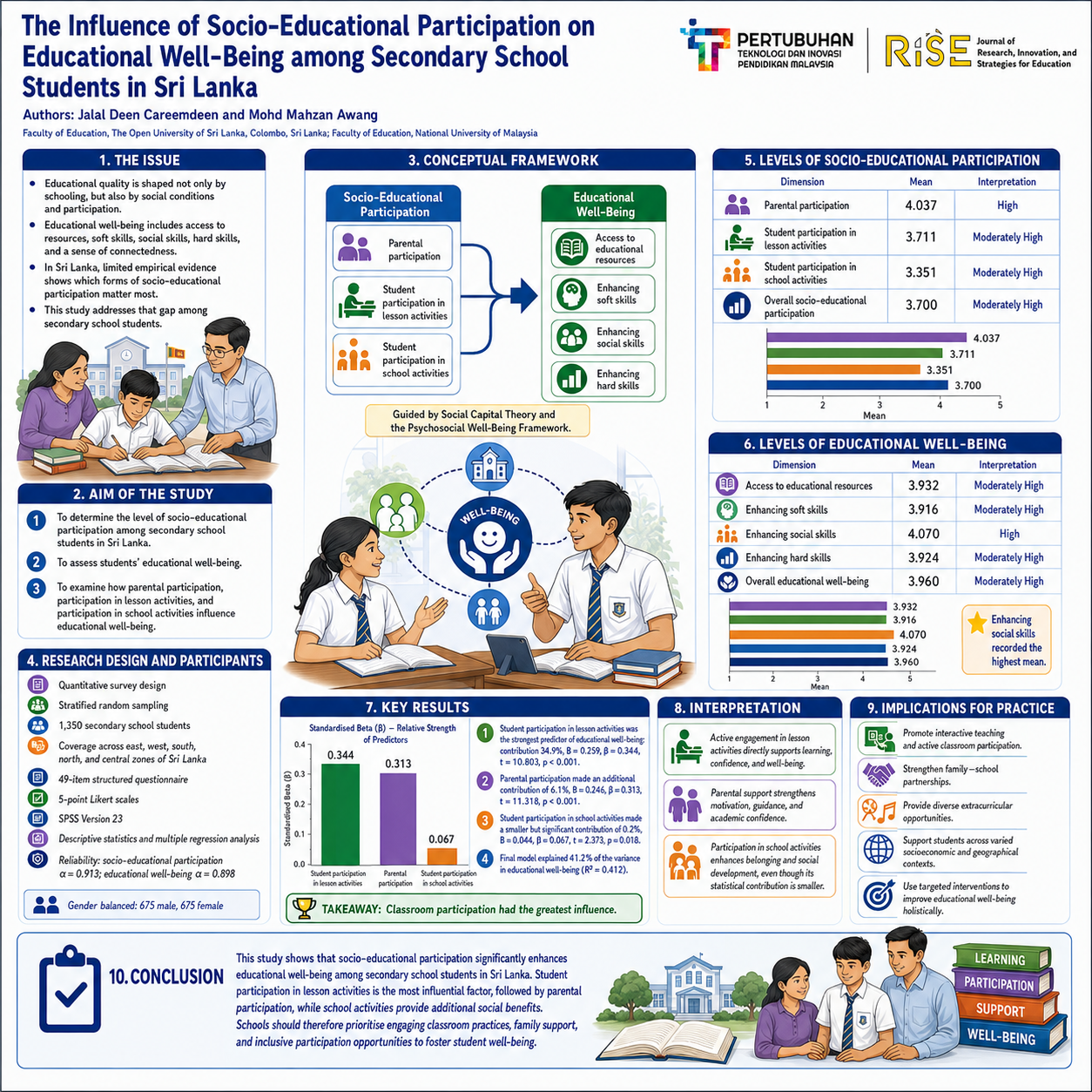
This study investigates the influence of socio-educational participation on the educational well-being of secondary school students in Sri Lanka. Student well-being, encompassing academic, social, and emotional dimensions, is crucial for success. However, the relationship between socio-educational participation, including parental involvement and student engagement in classroom and extracurricular activities, and student well-being in Sri Lanka remains under-explored. A quantitative approach was employed, surveying 1,350 students across diverse regions of Sri Lanka using a structured questionnaire. Descriptive statistics, Inferential statistics, specifically multiple regression analysis, were employed to explore the predictive relationship between socio-educational participation and educational well-being. The findings reveal that student participation in lesson activities is the most significant factor associated to educational well-being (34.9%) of the variance (ΔR² = 0.349), followed by parental involvement (6.1%) of the variance (ΔR² = 0.061), and participation in school activities (0.2%) (ΔR² = 0.002). These results demonstrate that active socio-educational participation, particularly student engagement in lessons, plays a vital role in enhancing student access to resources, skill development, and overall well-being. The study concludes that targeted educational policies and practices should prioritise fostering both parental involvement and, most importantly, student engagement to improve educational outcomes and well-being within the Sri Lankan context.
References
Abeyasekera, A. (2014). A social justice approach to well-being: The PADHI psychosocial framework. In Wellbeing and quality of life assessment (pp. 35–53). Practical Action Publishing. https://doi.org/10.3362/9781780448411.004.
Ahmad, Z., Soroya, S. H., & Mahmood, K. (2023). Bridging social capital through the use of social networking sites: A systematic literature review. Journal of Human Behavior in the Social Environment, 33(4), 473–489. https://doi.org/10.1080/10911359.2022.2064025.
Al-Ansari, A., Al-Harbi, F., AbdelAziz, W., AbdelSalam, M., Tantawi, M., & ElRefae, I. (2016). Factors affecting student participation in extra-curricular activities: A comparison between two Middle Eastern dental schools. The Saudi Dental Journal, 28(1), 36–43. https://doi.org/10.1016/j.sdentj.2015.05.002.
Al-Salman, F. A., & Haider, N. (2023). A systematic review of student engagement indicators and educational well-being: Post-pandemic trends. Computers & Education: Artificial Intelligence, 5, 100161. https://doi.org/10.1016/j.caeai.2023.100161.
Alhawiti, N. M. (2023). The influence of active learning on the development of learner capabilities in the college of applied medical sciences: Mixed-methods study. Advances in Medical Education and Practice, 87–99. https://doi.org/10.2147/AMEP.S392875.
Antonopoulou, T. J., Sideridis, G., & Stamovlasis, V. (2023). The effect of socioeconomic status and school climate on student wellbeing. Journal of Educational Psychology, 115(2), 213–225. https://doi.org/10.1037/edu0000760.
Aziz, F., Quraishi, U., & Kazi, A. S. (2018). Factors behind classroom participation of secondary school students: A gender-based analysis. Universal Journal of Educational Research, 6(2), 211–217. https://doi.org/10.13189/ujer.2018.060201.
Bardorfer, M. (2024). Fostering students' active participation in higher education: The role of teacher-student rapport. Athens Journal of Education, 11(3), 433–450. https://doi.org/10.30958/aje.11-3-4.
Chaves, M. R., Alves, R. A., & Oliveira, L. C. (2023). School-based family support and adolescents' educational achievement: A meta-synthesis. Educational Review, 75(3), 365–388. https://doi.org/10.1080/00131911.2021.1972746.
Coleman, J. S. (1988). Social capital in the creation of human capital. American Journal of Sociology, 94, S95–S120. https://www.jstor.org/stable/2780243.
Flores-Verduzco, G. R., Fraijo-Sing, B. S., & Tapia-Fonllem, C. O. (2020). School environment as a mediating variable between family support and social wellbeing in high school students. International Journal of Emotional Education, 12(2). https://eric.ed.gov/?id=EJ1276292.
Freeman, R. (2017). The relationship between extracurricular activities and academic achievement (Doctoral dissertation). National Louis University. https://digitalcommons.nl.edu/diss/245.
Guilmette, M., Mulvihill, K., Villemaire-Krajden, R., & Barker, E. T. (2019). Past and present participation in extracurricular activities is associated with adaptive self-regulation of goals, academic success, and emotional wellbeing among university students. Learning and Individual Differences, 73, 8–15. https://doi.org/10.1016/j.lindif.2019.04.006.
Jensen, D. H., & Jetten, J. (2015). Bridging and bonding interactions in higher education: Social capital and students’ academic and professional identity formation. Frontiers in Psychology, 6, 126. https://doi.org/10.3389/fpsyg.2015.00126.
Kim, C. J., Park, H., & Lee, J. (2022). Parental involvement and children's academic outcomes: Evidence from cross-national perspectives. International Journal of Educational Development, 91, 102581. https://doi.org/10.1016/j.ijedude.2022.102581.
Lei, H., Cui, Y., & Chiu, M. M. (2018). The relationship between teacher support and students' academic emotions: A meta-analysis. Frontiers in Psychology, 8, 2288. https://doi.org/10.3389/fpsyg.2017.02288.
Li, J., & Xue, E. (2023). Dynamic interaction between student learning behaviour and learning environment: Meta-analysis of student engagement and its influencing factors. Behavioral Sciences, 13(1), 59. https://doi.org/10.3390/bs13010059.
Liu, K., Yang, Y., Li, M., Li, S., Sun, K., & Zhao, Y. (2021). Parents’ and adolescents’ perceptions of parental involvement and their relationships with depression among Chinese middle school students during the COVID-19 pandemic. Children and Youth Services Review, 129, 106190. https://doi.org/10.1016/j.childyouth.2021.106190.
McNeal, R. B., Jr. (2014). Parent involvement, academic achievement and the role of student attitudes and behaviors as mediators. Universal Journal of Educational Research, 2(8), 564–576. https://doi.org/10.13189/ujer.2014.020805.
Muhibbin, A., Patmisari, P., Naidu, N. B. M., Prasetiyo, W. H., & Hidayat, M. L. (2023). An analysis of factors affecting student wellbeing: Emotional intelligence, family and school environment. International Journal of Evaluation and Research in Education, 12(4), 1954–1963. https://doi.org/10.11591/ijere.v12i4.25670.
Noble, T., Wyatt, T., McGrath, H., Roffey, S., & Rowling, L. (2008). Scoping study into approaches to student wellbeing: Final report. Australian Government Department of Education. https://docs.education.gov.au/documents/scoping-study-approaches-student-wellbeing-final-report.
Putnam, R. (1993). The prosperous community: Social capital and public life. The American Prospect, 4, 35–42. https://faculty.washington.edu/matsueda/courses/590/Readings/Putham%201993%20Am%20Prospect.pdf.
Putnam, R. (2001). Social capital: Measurement and consequences. Canadian Journal of Policy Research, 2(1), 41–51.
Ramirez, S., Aldunate, M. P., Arriagada, C., Bueno, M., Cuevas, F., González, X., ... & Gaete, J. (2021). Brief research report: The association between educational experiences and COVID-19 pandemic-related variables, and mental health among children and adolescents. Frontiers in Psychiatry, 12, 647456. https://doi.org/10.3389/fpsyt.2021.647456.
Werang, B. R., Agung, A. A. G., Sri, A. A. P., Leba, S. M. R., & Jim, E. L. (2024). Parental socioeconomic status, school physical facilities availability, and students’ academic performance. Edelweiss Applied Science and Technology, 8(5), 1–15. https://doi.org/10.55214/25768484.v8i5.1146.
Yamaguchi, A. (2013). Influences of social capital on health and well-being: A qualitative approach. Global Journal of Health Science, 5(5), 153. https://doi.org/10.5539/gjhs.v5n5p153.
Yang, D., Chen, P., Wang, K., Li, Z., Zhang, C., & Huang, R. (2023). Parental involvement and student engagement: A review of the literature. Sustainability, 15(7), 5859. https://doi.org/10.3390/su15075859.
Yuan, H., & Wang, M. (2023). The withdrawal effect in secondary schools: A meta-analysis of school disengagement factors. Educational Psychology Review, 35, 211–229. https://doi.org/10.1007/s106.
Downloads
Published
Issue
Section
License
Copyright (c) 2025 Careemdeen Jalal Deen (Author)

This work is licensed under a Creative Commons Attribution 4.0 International License.