How Grade 11 Students Match Audio to Function Graphs: Distractor Patterns and Error Pathways
DOI:
https://doi.org/10.70148/rise.v3i4.14Keywords:
audio-to-graph matching, graph interpretation, distractor analysis, error pathways, mathematics assessmentAbstract
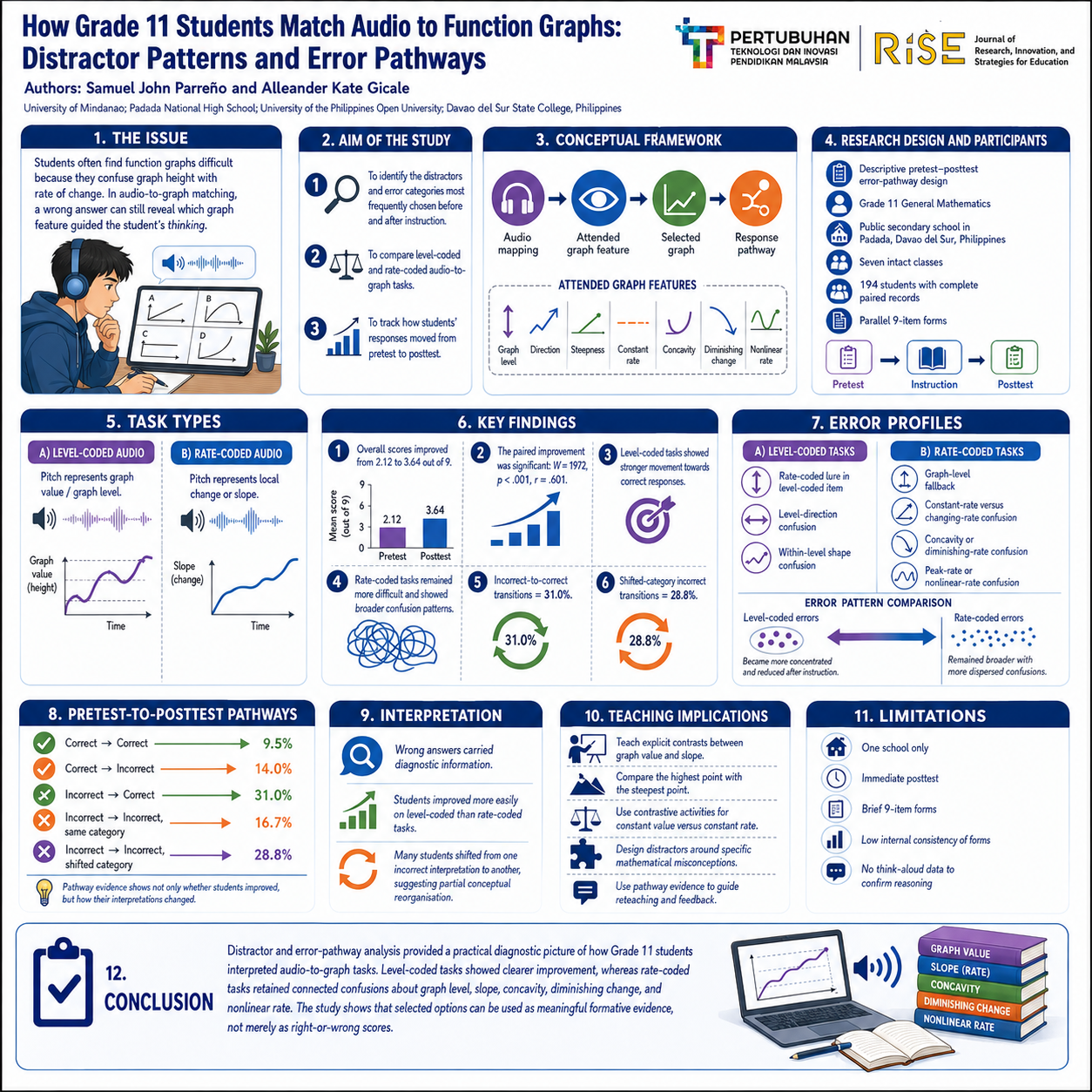
Multiple-choice responses can reveal which graph features guide students’ choices, not only whether an answer is correct. This study examined distractor patterns and pretest-to-posttest error pathways in audio-to-graph matching among 194 Grade 11 students from seven classes in a Philippine public secondary school. Parallel nine-item forms used level-coded audio, in which pitch tracked graph value, and rate-coded audio, in which pitch tracked local change. Responses were classified by correctness, graph family, mapping mismatch, and mathematical error category. Mean scores increased from 2.12 (SD = 1.32) to 3.64 (SD = 1.72) out of 9, W = 1972, p < .001, r = .601. Level-coded tasks showed marked movement from rate-coded lures to correct responses. Rate-coded tasks retained broader patterns of graph-level fallback, constant-versus-changing-rate confusion, concavity confusion, and nonlinear-rate confusion. Across 1,746 paired item attempts, 31.0% moved from incorrect to correct and 28.8% shifted between different incorrect categories. The study contributes a diagnostic pathway approach that identifies which distinctions in graph level, slope, concavity, and changing rate stabilized after instruction and which remained unsettled.
References
Ainsworth, S. (2006). DeFT: A conceptual framework for considering learning with multiple representations. Learning and Instruction, 16(3), 183–198. https://doi.org/10.1016/j.learninstruc.2006.03.001
Akveld, M., & Kinnear, G. (2024). Improving mathematics diagnostic tests using item analysis. International Journal of Mathematical Education in Science and Technology, 55(10), 2478-2505. https://doi.org/10.1080/0020739X.2023.2167132
Attali, Y., & Fraenkel, T. (2000). The point-biserial as a discrimination index for distractors in multiple-choice items: Deficiencies in usage and an alternative. Journal of Educational Measurement, 37(1), 77–86. https://doi.org/10.1111/j.1745-3984.2000.tb01077.x
Beichner, R. J. (1994). Testing student interpretation of kinematics graphs. American Journal of Physics, 62(8), 750–762. https://doi.org/10.1119/1.17449
Black, P., & Wiliam, D. (1998). Assessment and classroom learning. Assessment in Education: Principles, Policy & Practice, 5(1), 7–74. https://doi.org/10.1080/0969595980050102
Byerley, C., & Thompson, P. W. (2017). Secondary mathematics teachers’ meanings for measure, slope, and rate of change. The Journal of Mathematical Behavior, 48, 168–193. https://doi.org/10.1016/j.jmathb.2017.09.003
Carlson, M. P., Jacobs, S., Coe, E., Larsen, S., & Hsu, E. (2002). Applying covariational reasoning while modeling dynamic events: A framework and a study. Journal for Research in Mathematics Education, 33(5), 352–378. https://doi.org/10.2307/4149958
CAST. (2024). Universal Design for Learning guidelines version 3.0. https://udlguidelines.cast.org/
DiBattista, D., & Kurzawa, L. (2011). Examination of the quality of multiple-choice items on classroom tests. The Canadian Journal for the Scholarship of Teaching and Learning, 2(2), Article 4. https://doi.org/10.5206/cjsotl-rcacea.2011.2.4
Downing, S. M., & Haladyna, T. M. (Eds.). (2006). Handbook of test development. Lawrence Erlbaum Associates.
Dubus, G., & Bresin, R. (2013). A systematic review of mapping strategies for the sonification of physical quantities. PLOS ONE, 8(12), e82491. https://doi.org/10.1371/journal.pone.0082491
Duval, R. (2006). A cognitive analysis of problems of comprehension in a learning of mathematics. Educational Studies in Mathematics, 61, 103–131. https://doi.org/10.1007/s10649-006-0400-z
Ebel, R. L., & Frisbie, D. A. (1991). Essentials of educational measurement (5th ed.). Prentice Hall.
Frederiksen, J. R., & Collins, A. (1989). A systems approach to educational testing. Educational Researcher, 18(9), 27–32. https://doi.org/10.3102/0013189X018009027
Friel, S. N., Curcio, F. R., & Bright, G. W. (2001). Making sense of graphs: Critical factors influencing comprehension and instructional implications. Journal for Research in Mathematics Education, 32(2), 124–158. https://doi.org/10.2307/749671
Gierl, M. J., Bulut, O., Guo, Q., & Zhang, X. (2017). Developing, analyzing, and using distractors for multiple-choice tests in education: A comprehensive review. Review of Educational Research, 87(6), 1082–1116. https://doi.org/10.3102/0034654317726529
Glazer, N. (2011). Challenges with graph interpretation: A review of the literature. Studies in Science Education, 47(2), 183–210. https://doi.org/10.1080/03057267.2011.605307
Grond, F., & Hermann, T. (2012). Aesthetic strategies in sonification. AI & Society, 27(2), 213–222. https://doi.org/10.1007/s00146-011-0341-7
Haladyna, T. M., Downing, S. M., & Rodriguez, M. C. (2002). A review of multiple-choice item-writing guidelines for classroom assessment. Applied Measurement in Education, 15(3), 309–333. https://doi.org/10.1207/S15324818AME1503_5
Hermann, T., Hunt, A., & Neuhoff, J. G. (Eds.). (2011). The Sonification Handbook. Logos Verlag.
Ivanjek, L., Susac, A., Planinic, M., Andrasevic, A., & Milin-Sipus, Z. (2016). Student reasoning about graphs in different contexts. Physical Review Physics Education Research, 12(1), 010106. https://doi.org/10.1103/PhysRevPhysEducRes.12.010106
Johnson, H. L., Donovan, C., Knurek, R., Whitmore, K. A., & Bechtold, L. (2024). Proposing and testing a model relating students’ graph selection and graph reasoning for dynamic situations. Educational Studies in Mathematics. https://doi.org/10.1007/s10649-024-10299-4
Leinhardt, G., Zaslavsky, O., & Stein, M. K. (1990). Functions, graphs, and graphing: Tasks, learning, and teaching. Review of Educational Research, 60(1), 1–64. https://doi.org/10.3102/00346543060001001
Mayer, R. E. (2020). Multimedia learning (3rd ed.). Cambridge University Press.
McDermott, L. C., Rosenquist, M. L., & van Zee, E. H. (1987). Student difficulties in connecting graphs and physics: Examples from kinematics. American Journal of Physics, 55(6), 503–513. https://doi.org/10.1119/1.15104
Moore-Russo, D., & Nagle, C. (2024). Connecting representations and ways of thinking about slope from algebra to calculus. The Mathematics Enthusiast, 21(3), 569–602. https://doi.org/10.54870/1551-3440.1643
Nagle, C., Moore-Russo, D., Viglietti, J., & Martin, K. (2013). Calculus students’ and instructors’ conceptualizations of slope: A comparison across academic levels. International Journal of Science and Mathematics Education, 11(6), 1491–1515. https://doi.org/10.1007/s10763-013-9411-2
Ohshiro, K., Hurst, A., & DuBois, L. (2021). Making math graphs more accessible in remote learning: Using sonification to introduce discontinuity in calculus. In Proceedings of the 23rd International ACM SIGACCESS Conference on Computers and Accessibility (Article 77, pp. 1–4). Association for Computing Machinery. https://doi.org/10.1145/3441852.3476533
Planinic, M., Ivanjek, L., Susac, A., & Milin-Sipus, Z. (2013). Comparison of university students’ understanding of graphs in different contexts. Physical Review Special Topics - Physics Education Research, 9(2), 020103. https://doi.org/10.1103/PhysRevSTPER.9.020103
Rexigel, E., Kuhn, J., Becker, S., & Malone, S. (2024). The more the better? A systematic review and meta-analysis of the benefits of more than two external representations in STEM education. Educational Psychology Review, 36, Article 4. https://doi.org/10.1007/s10648-024-09958-y
Rodriguez, M. C. (2005). Three options are optimal for multiple-choice items: A meta-analysis of 80 years of research. Educational Measurement: Issues and Practice, 24(2), 3–13. https://doi.org/10.1111/j.1745-3992.2005.00006.x
Sadler, D. R. (1989). Formative assessment and the design of instructional systems. Instructional Science, 18, 119–144. https://doi.org/10.1007/BF00117714
Shah, P., & Hoeffner, J. (2002). Review of graph comprehension research: Implications for instruction. Educational Psychology Review, 14(1), 47–69. https://doi.org/10.1023/A:1013180410169
Tarrant, M., & Ware, J. (2010). A comparison of the psychometric properties of three- and four-option multiple-choice questions in nursing assessments. Nurse Education Today, 30(6), 539–543. https://doi.org/10.1016/j.nedt.2009.11.002
Tarrant, M., Ware, J., & Mohammed, A. M. (2009). An assessment of functioning and non-functioning distractors in multiple-choice questions: A descriptive analysis. BMC Medical Education, 9, Article 40. https://doi.org/10.1186/1472-6920-9-40
Tomlinson, B. J., & Walker, B. N. (2020). Auditory display in interactive science simulations: Description and sonification support interaction and enhance opportunities for learning. In Proceedings of the 2020 CHI Conference on Human Factors in Computing Systems (pp. 1–12). Association for Computing Machinery. https://doi.org/10.1145/3313831.3376886
Downloads
Published
Issue
Section
License
Copyright (c) 2025 Samuel John Parreño, Alleander Kate Gicale (Author)

This work is licensed under a Creative Commons Attribution 4.0 International License.