Instructional Challenges in Teaching English Reading Comprehension in Tanzanian Public Primary Schools
DOI:
https://doi.org/10.70148/rise.v3i5.4Keywords:
reading comprehension, teaching strategies, primary education, tanzaniaAbstract
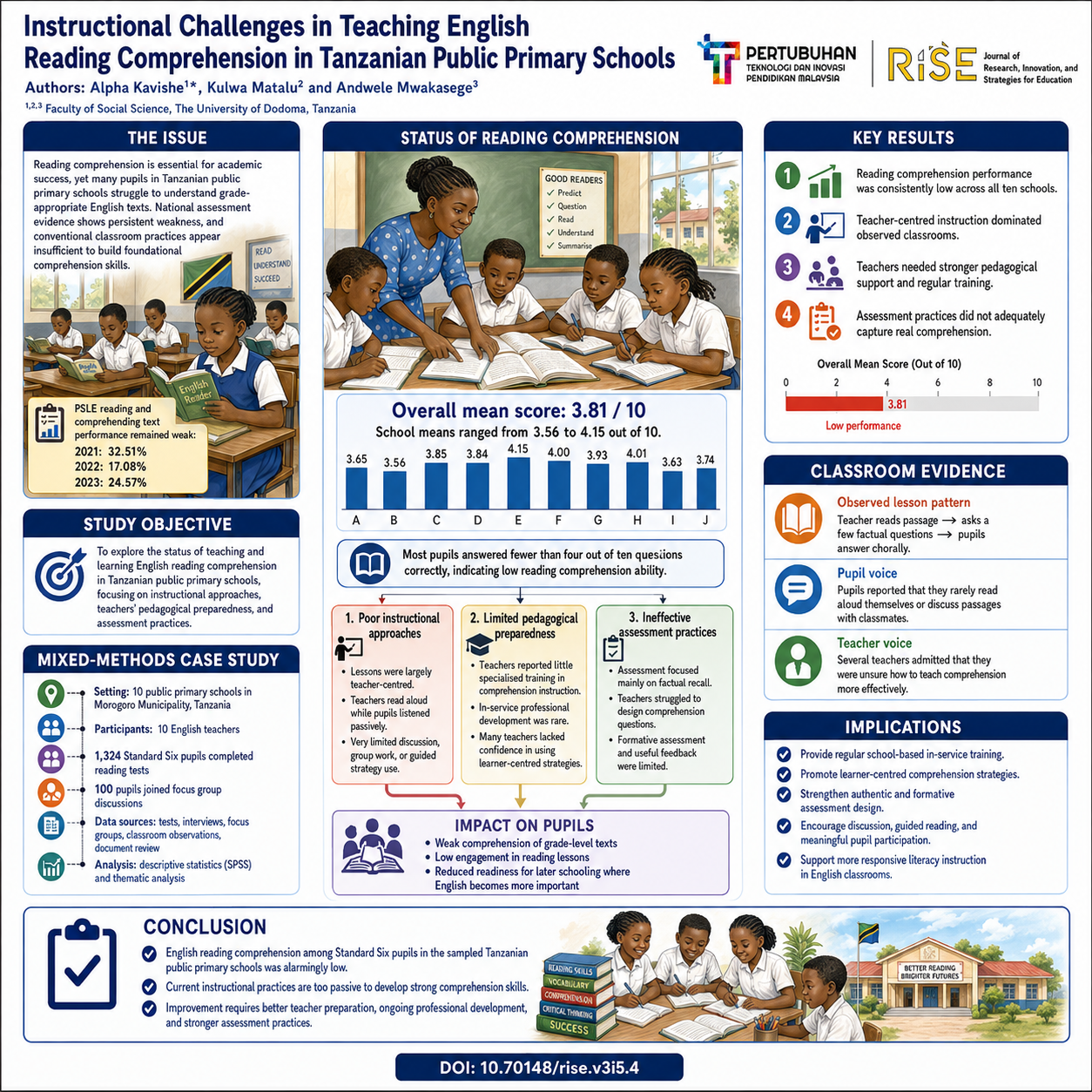
This study explored the status of teaching and learning English reading comprehension skills in public primary schools in Tanzania, focusing on instructional approaches, teachers’ preparedness, and assessment practices. A mixed-methods case study design was employed. Data were collected from ten public primary schools in Morogoro Municipality. Participants included 10 English subject teachers who participated in semi-structured interviews, a cohort of 1,324 Standard Six pupils who completed reading comprehension tests, and a subset of 100 pupils who participated in focus group discussions (10 pupils per school). Qualitative data were analysed thematically following Braun and Clarke's six-phase process, while test scores were analysed using descriptive statistics (means, standard deviations) via SPSS version 25. Pupils demonstrated low reading comprehension ability, with mean test scores ranging from 3.56 to 4.15 out of 10 across all ten schools. No school achieved a mean score above 4.15, indicating consistently poor performance. Qualitative findings revealed three major thematic challenges: (1) persistent use of teacher-centred, passive instructional approaches with minimal pupil interaction; (2) limited teachers’ pedagogical preparedness and lack of regular in-service professional development opportunities; and (3) significant difficulties among teachers in designing and implementing effective reading comprehension assessments. Current instructional practices are insufficient for developing foundational reading comprehension skills among Tanzanian public primary pupils. Regular school-based in-service training focused on learner-centred strategies and authentic assessment design is urgently needed. The study contributes empirical evidence from a previously under-researched region to the growing literature on reading instruction in East African public primary schools.
References
Al-Jamal, D., Al-Hawamleh, M., & Al-Jamal, G. (2013). An assessment of reading comprehension practice in Jordan. Jordan Journal of Educational Science, 9(3), 335–344.
Amineh, R. J., & Als, H. D. (2015). Review of constructivism and social constructivism. Journal of Social Sciences, Literature and Languages, 1(1), 9–16.
Aronson, B., & Laughter, J. (2016). The theory and practice of culturally relevant education: A synthesis of research across content areas. Review of Educational Research, 86(1), 163– 206. https://doi.org/10.3102/0034654315582066
Benson, P. (2011). Teaching and researching autonomy (2nd ed.). Pearson Education.
Borg, S. (2006). Teacher cognition and language education: Research and practice. Continuum.
Braun, V., & Clarke, V. (2006). Using thematic analysis in psychology. Qualitative Research in Psychology, 3(2), 77 –101. https://doi.org/10.1191/1478088706qp063oa
Cenoz, J., & Gorter, D. (2020). Teaching English through pedagogical translanguaging. World Englishes, 39(2), 300 –311. https://doi.org/10.1111/weng.12462
Compton-Lilly, C., Hamman-Ortiz, L., & Shedrow, S. (2021). Culturally responsive literacy instruction: A review of research. Reading Research Quarterly, 56(S1), S181–S199.
Creese, A., & Blackledge, A. (2010). Translanguaging in the bilingual classroom: A pedagogy for learning and teaching? The Modern Language Journal, 94(1), 103–115. https://doi.org/10.1111/j.1540-4781.2009.00986.x
Creswell, J. W., & Creswell, J. D. (2018). Research design: Qualitative, quantitative, and mixed methods approaches (5th ed.). Sage Publications.
Duke, N. K., Pearson, P. D., Strachan, S. L., & Billman, A. K. (2011). Essential elements of fostering and teaching reading comprehension. In S. J. Samuels & A. E. Farstrup (Eds.), What research has to say about reading instruction (4th ed., pp. 286–314). International Reading Association.
Elleman, A., & Oslund, E. (2019). Reading comprehension research: Implications for practice and policy. Policy Insights from the Behavioral and Brain Sciences, 6(1), 1–16. https://doi.org/10.1177/2372732218816339
Erlita, Y. (2021). Teaching reading by visualisation as a strategy. BAHAS, 32(4), 307–389. https://doi.org/10.30743/bahas.v32i4.4567
Foorman, B., Beyler, N., Borradaile, K., Coyne, M., Denton, C. A., Dimino, J., Furgeson, J., Hayes, L., Henke, J., Justice, L., Keating, B., Lewis, W., Sattar, S., Streke, A., Wagner, R., & Wissel, S. (2016). Foundational skills to support reading for understanding in kindergarten through 3rd grade (NCSEE 2016-4008). National Center for Education Evaluation and Regional Assistance. https://ies.ed.gov/ncee/wwc/Docs/ReferenceResources/wwc_foundationalreading_070516.pdf
García, O., & Kleyn, T. (Eds.). (2016). Translanguaging with multilingual students: Learning from classroom moments. Routledge.
Gay, G. (2018). Culturally responsive teaching: Theory, research, and practice (3rd ed.). Teachers College Press.
Gove, A., & Cvelich, P. (2011). Early reading: Igniting education for all. A report by the Early Grade Learning Community of Practice. Research Triangle Institute.
Guthrie, J. T., & Wigfield, A. (2019). Engagement and motivation in reading. In P. Afflerbach (Ed.), Handbook of reading research (Vol. V, pp. 193–218). Routledge.
Hardman, F., Abd-Kadir, J., Agg, C., Migwi, J., Ndambuku, J., & Smith, F. (2012). Changing pedagogical practice in Kenyan primary schools: The impact of school-based training. Comparative Education, 48(2), 229 –248. https://doi.org/10.1080/03050068.2011.608896
Harmer, J. (2021). How to teach English. Ocelot Publishing.
Hueynova, F. (2023). Assessment of students' reading comprehension skills in teaching English. Teaching Training Practice, 1(4), 1–18. https://doi.org/10.10572/intechopen.110600
Kadeghe, M. (2018). Reading instruction in Tanzanian primary schools: A study of Standard II classrooms [Unpublished master's thesis]. University of Dar es Salaam.
Ladson-Billings, G. (2014). Culturally relevant pedagogy 2.0: a.k.a. the remix. Harvard Educational Review, 84(1), 74 –84. https://doi.org/10.17763/haer.84.1.p2rj131485484751
Madani, H. (2016). Assessment of reading comprehension. Revista Romaneasca pentru Educatie Multidimensionala, 8(1), 125–147. https://doi.org/10.18662/rrem/2016.0801.08
Ministry of Education, Science and Technology. (2017). Education sector development plan (2016/17–2020/21). United Republic of Tanzania.
Mligo, I. R. (2016). Teachers' and students' perceptions of reading difficulties in English language in Tanzanian primary schools [Doctoral dissertation, University of Dodoma].
Mushi, S. L. (2020). Culturally responsive pedagogy in Tanzania: Teachers' perceptions and practices. Journal of Education and Practice, 11(15), 78–85.
Ngonyani, E., Matete, R. E., & Kashaigili, J. J. (2025). Exploring interactive strategies for addressing reading difficulties in English among standard six pupils in Tanzania. Journal of Education for Sustainable Innovation, 3(1), 11 –24. https://doi.org/10.56916/jesi.v3i1.1045
Nurie, Y. (2017). Pedagogical practices in teaching reading comprehension: A case study of three EFL teachers in a secondary school in Ethiopia. PASAA, 54(1), 1–17. https://digital.car.chula.ac.th/pasaa/vol54/iss1/5
Patton, M. Q. (2015). Qualitative research and evaluation methods (4th ed.). Sage Publications.
Piper, B., Zuilkowski, S. S., & Ong'ele, S. (2016). Implementing mother tongue instruction in the real world: Results from a medium-scale randomized controlled trial in Kenya. Comparative Education Review, 60(4), 776 –807. https://doi.org/10.1086/688493
Probyn, M. (2019). Pedagogical translanguaging and the construction of science knowledge in a multilingual South African classroom: Challenging monoglossic/post-colonial orthodoxies. Classroom Discourse, 10(3-4), 216 –236. https://doi.org/10.1080/19463014.2019.1628792
Qorro, M. A. S. (2013). Language of instruction in Tanzania: Why are research findings not heeded? International Review of Education, 59(1), 29–45. https://doi.org/10.1007/s11159-013-9341-z
Shabani, K., Khatib, M., & Ebadi, S. (2010). Vygotsky's zone of proximal development: Instructional implications and teachers' professional development. English Language Teaching, 3(4), 237 –248. https://doi.org/10.5539/elt.v3n4p237
Snow, C. E. (2010). Academic language and the challenge of reading for learning about science. Science, 328(5977), 450–452. https://doi.org/10.1126/science.1182597
Tanzania Institute of Education. (2019). English language syllabus for primary school education: Kiswahili medium schools. Ministry of Education, Science and Technology.
United Republic of Tanzania. (2021). Candidates' item response analysis report for the Primary School Leaving Examination (PSLE). National Examination Council of Tanzania.
United Republic of Tanzania. (2022). Candidates' item response analysis report for the Primary School Leaving Examination (PSLE). National Examination Council of Tanzania.
United Republic of Tanzania. (2023). Candidates' item response analysis report for the Primary School Leaving Examination (PSLE). National Examination Council of Tanzania.
van Lier, L. (2008). Agency in the classroom. In J. P. Lantolf & M. E. Poehner (Eds.), Sociocultural theory and the teaching of second languages (pp. 163–186). Equinox.
Zhao, Y., & Zhang, L. J. (2022). Teacher-centred or learner-centred? A review of reading comprehension instruction in ESL contexts. Language Teaching Research, 26(5), 1–25.
Downloads
Published
Issue
Section
License
Copyright (c) 2025 Ms. Alpha Kavishe, Dr. Kulwa Matalu, Dr. Andwele Mwakasege (Author)

This work is licensed under a Creative Commons Attribution 4.0 International License.