A Conceptual Framework Of Artificial Intelligence And The Metaverse In Future Education
DOI:
https://doi.org/10.70148/rise.v3i5.3Keywords:
Model Edu-AIMeta, Artificial Intelligence (AI), Metaverse, Immersive Learning, Future Education Ecosystem, Edu-AIMeta ModelAbstract
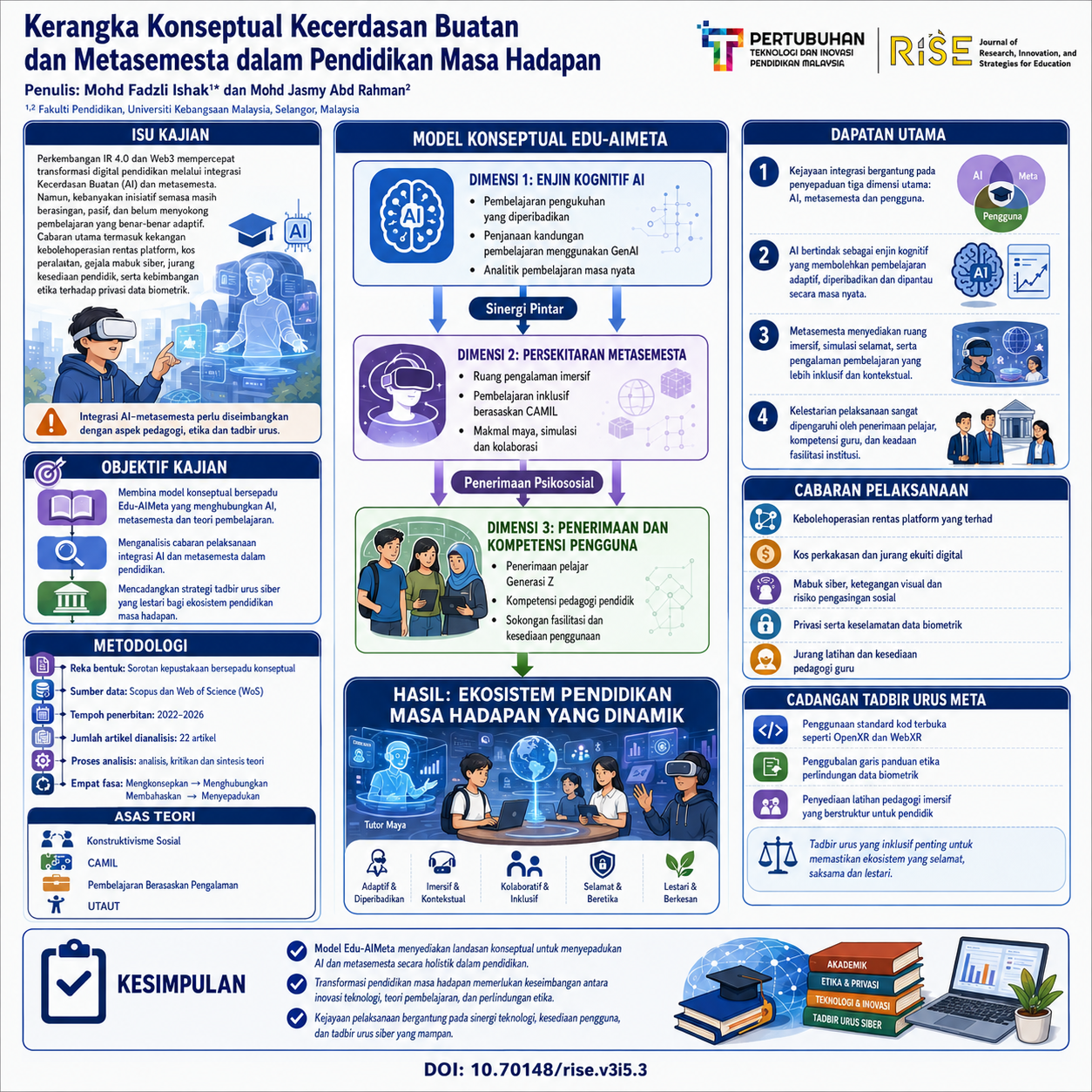
The rapid development of the Fourth Industrial Revolution (IR 4.0) and Web3 has catalyzed digital transformation in the education sector through the convergence of Artificial Intelligence (AI) and the metaverse. However, most existing initiatives remain isolated and passive, lacking adaptive learning capabilities. These initiatives also face cross-platform interoperability constraints, cybersickness, gaps in educator readiness, and ethical concerns regarding biometric data privacy. In view of this, this study was conducted with the objective of constructing an integrated conceptual framework, Edu-AIMeta, that links technological dimensions with learning theories, critically analyzing implementation challenges, and proposing sustainable cyber-governance strategies. To achieve these goals, this study employs a conceptual-integrated literature review design by critically analyzing and synthesizing theoretical perspectives from 22 articles published between 2022 and 2026 across the Scopus and Web of Science (WoS) databases. The research findings outline three primary dimensions of integration success: the AI cognitive engine, the spatial metaverse environment, and user adoption and competence, particularly among Generation Z students and educators. Moving forward, this paper recommends the development of an inclusive meta-governance framework through the implementation of open-source standards, the formulation of ethical guidelines for biometric data protection, and the provision of structured immersive pedagogical training programs to ensure an equitable, secure, and sustainable future educational ecosystem.
References
Abdelmagid, A. S., Jabli, N. M., Al-Mohaya, A. Y., & Teleb, A. A. (2025). Integrating interactive metaverse environments and generative artificial intelligence to promote the green digital economy and e-entrepreneurship in higher education. Sustainability, 17(12), 5594. https://doi.org/10.3390/su17125594
Almeman, K., EL Ayeb, F., Berrima, M., Issaoui, B., & Morsy, H. (2025). The Integration of AI and Metaverse in Education: A Systematic Literature Review. Applied Sciences, 15(2), 863. https://doi.org/10.3390/app15020863
Alotaibi, N. (2026). Metaverse adoption among university Generation Z. Computers and Education Open, 10, 100340. https://doi.org/10.1016/j.caeo.2026.100340
Alzubaidi, L., Fadhel, M. A., & Duhaim, A. M. (2024). Navigating the metaverse: unraveling the impact of artificial intelligence. Artificial Intelligence Review, 57(2), 36. https://doi.org/10.1007/s10462-024-10881-5
Chong, A. P., Wong, K.-T., Vestly, K. L. S., & Kumar, K. S. (2026). Signs, shapes, and spaces: A CAMIL-informed qualitative study of metaverse geometry learning for deaf and hard-of-hearing students. Education Sciences, 16(2), 185. https://doi.org/10.3390/socsci15030191
Cukurova, M. (2025). The interplay of learning, analytics and artificial intelligence in education: A vision for hybrid intelligence. British Journal of Educational Technology, 56(2), 469–488. https://doi.org/10.1111/bjet.13514
Elsokkary, N., Khan, W., Shurrab, M., & Al-Nasraween, M. (2026). Reinforcement learning and the Metaverse: A symbiotic collaboration. Smart Learning Environments, 13(1), 1–18. https://doi.org/10.1007/s10462-025-11433-1
Flores-Castañeda, R. O., Olaya-Cotera, S., & Iparraguirre-Villanueva, O. (2024). Benefits of Metaverse Application in Education: A Systematic Review. International Journal of Engineering Pedagogy (iJEP), 14(1), 65–81. https://doi.org/10.3991/ijep.v14i1.42421
Jabbouri, R., Issa, H., Dakroub, R., & Ankit, A. (2025). Unlocking immersive education: The emergence of the meta-governance framework. Information Technology & People, 38(4), 2069–2093. https://doi.org/10.1108/ITP-10-2023-1070
Kolb, D. A. (1984). Experiential learning: Experience as the source of learning and development. Prentice-Hall.
Krishnan, C., & Chowdhury, D. (2024). Navigating complexity: Thematic insights into ethical challenges and metaverse integration. Cogent Education, 11(1), 2428110. https://doi.org/10.1080/2331186X.2024.2428110
Kye, B., Han, N., Kim, Y., Park, Y., & Jo, S. (2021). Educational applications of metaverse: Possibilities and limitations. Journal of Educational Evaluation for Health Professions, 18, 32. https://doi.org/10.3352/jeehp.2021.18.32
MacInnis, D. J. (2011). A framework for conceptual contributions in marketing. Journal of Marketing, 75(4), 136–154. https://doi.org/10.1509/jmkg.75.4.136
Mahmoud, A. B. (2024). Exploring the public's beliefs, emotions and sentiments towards the adoption of the metaverse in education: A qualitative inquiry using big data. British Educational Research Journal, 50(5), 2320–2341. https://doi.org/10.1002/berj.4026
Makransky, G., & Petersen, G. B. (2021). The Cognitive Affective Model of Immersive Learning (CAMIL): A theoretical framework-based measure of learning in immersive virtual reality. Educational Psychology Review, 33(1), 1–37. https://doi.org/10.1007/s10648-020-09586-2
Mishra, A., Masih, J., Rajendran, I., Srinivasan, R., & Gupta, K. (2025). From Lecture Halls to Metaverse Worlds: A New Era in Engineering Education. International Journal of Engineering Pedagogy (iJEP), 15(8), 17–30. https://doi.org/10.3991/ijep.v15i8.59069
Mystakidis, S. (2022). Metaverse. Encyclopedia, 2(1), 486–497. https://doi.org/10.3390/encyclopedia2010031
Ortega-Rodríguez, P. J. (2022). From extended reality to the metaverse: A critical reflection on contributions to education. Teoría de la Educación. Revista Interuniversitaria, 34(2), 189–208. https://doi.org/10.14201/teri.27848
Owusu-Antwi, K., & Amenuvor, F. E. (2023). Understanding the metaverse: A review of virtual worlds and augmented reality environments. Current Journal of Applied Science and Technology, 42(23), 42–48. https://doi.org/10.9734/cjast/2023/v42i234172
Pari-Bedoya, I. N. M. A. (2023). Smart Learning in Virtual Worlds: A Systematic Literature Review on the Usage and Applications of Metaverse in Education. International Journal of Learning, Teaching and Educational Research, 22(9), 85–101. https://doi.org/10.26803/ijlter.22.9.5
Prabowo, P., Utama, I. D., & Rahmatillah, I. (2025). The role of knowledge of AI, AR/VR, and the metaverse of higher education students in enhancing students' business ideation. Journal of Entrepreneurship Education, 28(1), 1–15. https://doi.org/10.1080/2331186X.2025.2526897
Rachmadtullah, R., Setiawan, B., Wasesa, A. J. A., & Wicaksono, J. W. (2023). Elementary school teachers' perceptions of the potential of metaverse technology as a transformation of interactive learning media in Indonesia. International Journal of Innovative Research and Scientific Studies, 6(1), 128–136. https://doi.org/10.53894/ijirss.v6i1.1119
Sripan, T., & Jeerapattanatorn, P. (2025). Metaverse-based learning: A comprehensive review of current trends, challenges, and future implications. Contemporary Educational Technology, 17(3), ep584. https://doi.org/10.30935/cedtech/16434
Sun, H., Choi, S., Wong, P. Y. P., Shen, J. D., Francisco, M. L. L., & Nurgissayeva, A. (2025). Uncovering the drivers of intent to use the metaverse: Diverse experiences in sustainability education. Discover Sustainability, 6, Article 152. https://doi.org/10.1007/s43621-025-00903-9
Svoboda, P., & Knihová, L. (2025). Exploring the future of education: Integrating metaverse and AI tools to enhance learning experiences. TEM Journal, 14(1), 631–643. https://doi.org/10.18421/TEM141-56
Tlili, A., Huang, R., Shehata, B., Liu, D., Zhao, J., Metwally, A. H. S., Wang, Y., Denden, M., Bozkurt, A., & Burgos, D. (2022). Is metaverse in education a blessing or a curse: A combined content and bibliometric analysis. Smart Learning Environments, 9(1), 24. https://doi.org/10.1186/s40561-022-00205-x
Torraco, R. J. (2016). Writing integrative literature reviews: Using the past and present to explore the future. Human Resource Development Review, 15(4), 404–428. https://doi.org/10.1177/1534484316671606
Venkatesh, V., Morris, M. G., Davis, G. B., & Davis, F. D. (2003). User acceptance of information technology: Toward a unified view. MIS Quarterly, 27(3), 425–478. https://doi.org/10.2307/30036540
Vieriu, A. M., & Petrea, G. (2025). The Impact of Artificial Intelligence (AI) on Students’ Academic Development. Education Sciences, 15(3), 343. https://doi.org/10.3390/educsci15030343
Vygotsky, L. S. (1978). Mind in society: The development of higher psychological processes. Harvard University Press.
Wong, G. W. C., Wong, P. P. Y., & Chong, C. (2024). Virtual to Reality: Understanding the role of metaverse as a pedagogical strategy. The Electronic Journal of e-Learning, 22(3), 95–108. https://doi.org/10.34190/ejel.21.6.3219
Downloads
Published
Issue
Section
License
Copyright (c) 2025 MOHD FADZLI BIN ISHAK, Mohd Jasmy Abd Rahman (Author)

This work is licensed under a Creative Commons Attribution 4.0 International License.