The Integration of Kolb’s Learning Model with Minecraft: Effects on the Learning of Perimeter and Area
DOI:
https://doi.org/10.70148/rise.v2i5.3Keywords:
Kolb's Learning Model, Minecraft, Perimeter and area, Mathematics, Teaching and learningAbstract
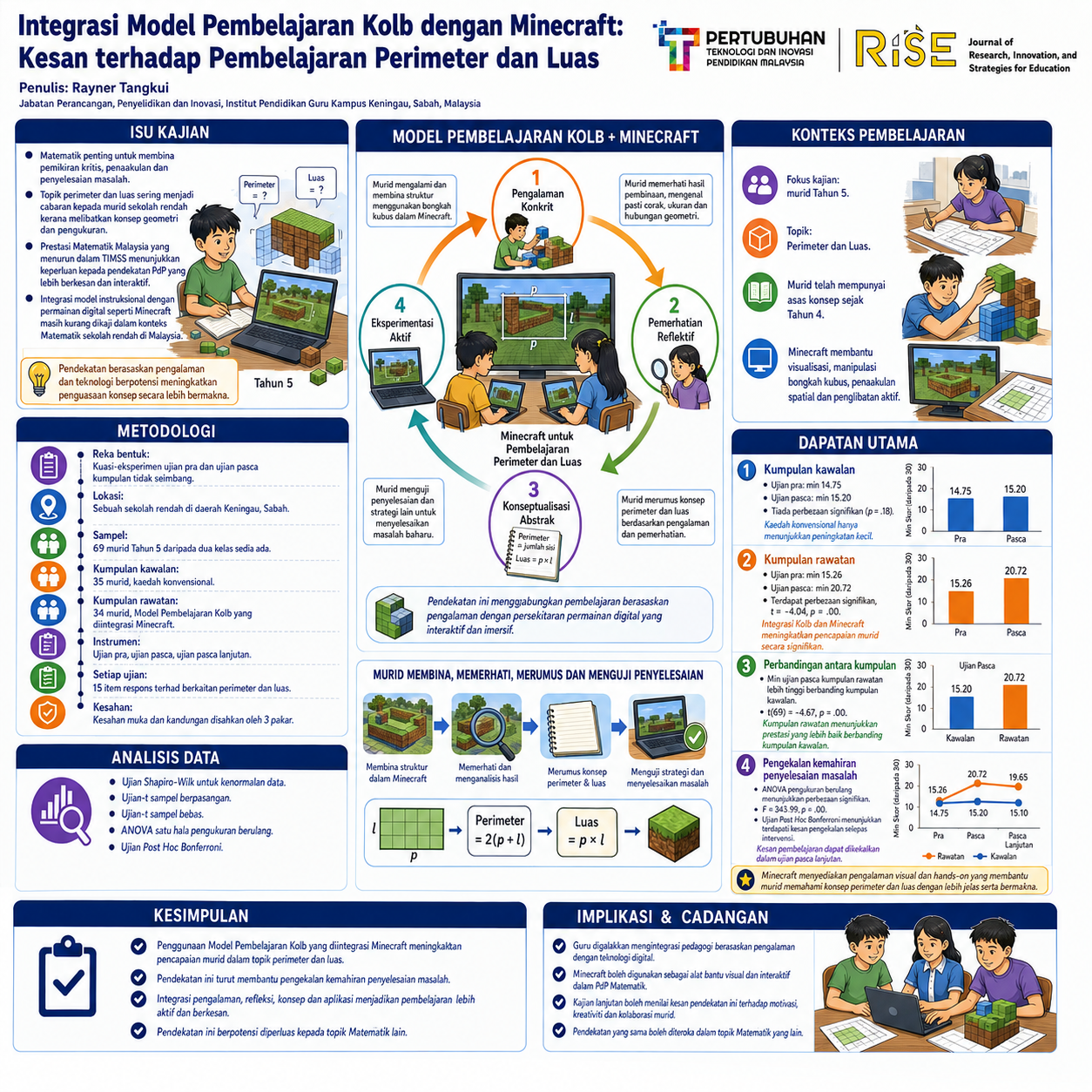
This quasi-experimental study aims to identify the effectiveness of Kolb’s Learning Model integrated with Minecraft in enhancing achievement and retention of problem-solving skills in the teaching and learning of Perimeter and Area. The study sample consisted of 69 Year 5 pupils from two intact classes. Through cluster sampling, a class of 35 pupils was selected as the control group while a class of 34 pupils was selected as the treatment group. The research instruments included a pretest and a posttest to measure pupils’ achievement in Perimeter and Area, while a delayed posttest was administered to evaluate the retention of problem-solving skills among Year 5 pupils in the treatment group. Findings revealed a significant difference in the mean posttest scores (t(69) = -4.67, p = .00), with the treatment group achieving higher mean scores compared to the control group. Furthermore, one-way ANOVA results indicated that problem-solving skills in Perimeter and Area were successfully retained in the treatment group. It can be concluded that integrating Kolb’s Learning Model with Minecraft has a significant impact on enhancing pupils’ achievement and sustaining their problem-solving skills in Perimeter and Area.
References
Abadi, M. A. S. & Amir, M. F. (2022). Analysis of the elementary school students’ Difficulties in Solving Perimeter and Area Problems. Jurnal Ilmiah Pendidikan Matematika, 10(2), 396-408.
Almazroui, K. M. (2022). Project-based learning for 21st-century skills: An overview and case study of moral education in the UAE. The Social Studies, 114(3), 125-136.
Ameli, S. R., & Mousavi Haghshenas, M. (2022). A descriptive-analytical study of the Open-World Game Design "Grand Theft Auto V and online version" with an emphasis on Role-Playing Capabilities. Journal of Cyberspace Studies, 7(1), 1-22.
Kementerian Pendidikan Malaysia. (2018). DSKP Matematik Tahun 4. Bahagian Pembangunan Kurikulum.
Kementerian Pendidikan Malaysia. (2018). DSKP Matematik Tahun 5. Bahagian Pembangunan Kurikulum.
Kementerian Pendidikan Malaysia. (2018). DSKP Matematik Tahun 6. Bahagian Pembangunan Kurikulum
Bahagian Perancangan Dan Penyelidikan Dasar Pendidikan. (2024). Laporan awal pencapaian Malaysia dalam TIMSS 2023. Wilayah Persekutuan Putrajaya.
Bernama. (2023, December 13). Malaysia records lowest TIMSS 2023 score in mathematics and science. Bernama. https://www.bernama.com/en/news.php?id=2371592
Carstens, K. J., Mallon, J. M., Bataineh, M. & Al-Bataineh, A. (2021). Effects of technology on student learning. The Turkish Online Journal of Educational Technology, 20(2), 105-113.
Cigognini, M. E., Benassi, A. & Nardi, A. (2023). Minecraft as a remote lab for active learning: The students’ experience during the pandemic. Edulearn Proceedings, 23, 7271-7280.
De Sousa, J. R., Gusmão, T. C. R. S., Font, V. & Lando, J.C. (2020). Task (re) design to enhance the didactic-mathematical knowledge of teachers. Acta Scientiae, 22(4), 98-120.
Donellan, J. (2019). 50 Best Open World Games You Should Play. https://culturedvultures.com/best-open-world-games/2/ pada 12 Julai 2023.
Haiyan, W. & Abdullah, M. F. N. L. (2023). Value research of integrating history of mathematics into primary school mathematics teaching. Frontiers in Educational Research, 6(14), 12-18.
Hüvös, A. (2023). Teaching students how to learn. Educational Utopias, 227-239.
Huang, Y-M., Chan, H-Y., Wang, Y-H., & Ho, Y-F. (2023). Effects of a blended multimedia teaching approach on self-efficacy and skills in over-the-counter medication counselling verses a lecture-based approach: protocal for a prospective cohort study of undergraduate students from a pharmacy school in Taiwan. BMJ Open, 13:e068738.
International Association for the Evaluation of Educational Achievement (IEA). (2023). TIMSS 2023 international results in mathematics and science. IEA. https://www.iea.nl
Imam, S. S., Adamu, H. M. & Haruna, R. (2023). Effects of Kolb’s Experiental Learning Model and Gardner’s Multiple Intelligence Learning Model on students’ psychomotor achievement in electrical installation and maintenance work. Bichi Journal of Education, 17(1), 40-51.
Kaitera, S. & Harmoinen, S. Developing mathematical problem-solving skills in primary school by using visual representations on heuristics. International Journal on Math, Science and Technology Education, 10(2), 111-116.
Kementerian Pelajaran Malaysia. (2012b). Pelan pembangunan pendidikan Malaysia 2013-2025. Putrajaya: Kementerian Pelajaran Malaysia.
Kementerian Pendidikan Malaysia. 2018. Pelaporan pentaksiran sekolah rendah 2018. Putrajaya: Bahagian Pembangunan Kurikulum.
Khaedar, I. D. A., Nizaruddin, Zuhri, M. S. (2023). Profil berfikir kritis siswa dalam menyelesaikan permasalahan Matematika menggunakan pembelajaran berbasis Google Classroom. Jurnal Matematika dan Pendidikan Matematika, 5(1), 30-37.
Kılıç, Ç. (2017). A new problem-posing approach based on problem-solving strategy: Analyzing pre-service primary school teachers’ performance. Educational Sciences: Theory & Practice, 17, 771-789.
Kolb, D. A. (1984). Experiential Learning: Experience as the Source of Learning and Development. Englewood Cliffs, NJ: Prentice Hall.
Kuhn, J. (2017). Minecraft: Education Edition. CALICO Journal, 35, 214-223.
Landis, J. & Kosh, G. 1977. The measurement of observer agreement for categorical data. Biometrics, 33, 159-74.
Layco, E. P. (2022). Mathematics education 4.0: Teachers’ competence and skills readiness in facing the impact of industry 4.0 in education. Journal of Positive School Psychology. 6(2), 1233-1259.
Ling, A. N. B & Muhammad Sofwan Mahmud. (2023). Challenges of teachers when teaching sentence-based mathematics problem-solving skills. Frontiers in Psychology. 13:1074202.
Lutz, S. T., & Huitt, W. G. (2018). Information processing and memory: Theory and applications. In W. Huitt, Ed., Becoming a brilliant star: Twelve core ideas supporting holistic education. La Vergne, TN: IngramSpark.
Malatij, K. S., Ramollo, J. K. & Malatij, M. J. (2023). The use of Kolb’s theory to conduct effective teaching in mathematics: A case study of learner articulation gap in a grade 3 class. Journal of Educational Studies, 22(1), 26-45
McHugh, M. 2012. Interrater reliability: The Kappa Statistic. Biochemia Medica, 22, 276-282.
Mohd Iskandar Ibrahim. (2023). Tujuh teras kementerian pendidikan sudah ada konsep MADANI. Kuala Lumpur: Berita Harian.
Polya, G. (1957). How to Solve It. A new aspect of mathematical method. 2nd Edition, Princeton University Press, Princeton.
Qureshi, M. A., Khaskheli, A., Qureshi, J. A., Raza, S. A., & Yousufi, S.Q. (2021). Factors affecting students’ learning performance through collaborative learning and engagement. Interactive Learning Environments, 31(4), 2371-2391.
Runnalls, C. & Hong, D. S. (2019). “Well, they understand the concept of area”: pre-service teachers’ responses to student area misconceptions. Mathematics Education Research Journal, 32(5), 629-651.
Saadiah Ismail. (2023). Konsep Madani Malaysia adalah jalan ke hadapan untuk Malaysia. Kuala Lumpur: Berita Harian.
Sharma, S., & Khanna, R. (2023). Experiential learning: an experiment with new ideas and receive feedback in a safe environment. European Chemical Bulletin, 12(4), 13001-13008.
Taherdoost, H. (2016). Validity and Reliability of the Research Instrument; How to Test the Validation of a Questionnaire/Survey in a Research. International Journal of Academic Research in Management, 5, 28-36.
Tangkui, R., & Keong, T. C. (2021). The effects of digital game-based learning using Minecraft towards pupils’ achievement in fractions. International Journal On E-Learning Practices, 4, 76-91.
Tangkui, R. (2022). Kesan penggunaan Minecraft terhadap pencapaian dan motivasi murid Tahun 5 dalam Perimeter dan Luas. Jurnal Pendidikan Sains dan Matematik Malaysia, 12(2), 51-66.
Tangkui, R. (2023). Integrating computational thinking and the Polya Model in Minecraft: Effects on learners’ Fractions achievement. Indonesian Journal of Science and Mathematics Education, 6(2), 125-136.
Valderama, J., & Oligo, J. (2021). Learning retention in Mathematics over consecutive weeks: Impact of motivated forgetting. International Journal of Evaluation and Research in Education, 10(4), 1245-1254.
Wulandari, S., & Gusteti, M. U. (2020). Analisis kesalahan menyelesaikan soal Trigonometri siswa kelas x sma. Math Educa Journal, 4(1), 64-80.
Yanuarto, W. N., Setyaningsih, E., & Wahyuningsih, P. (2023). Minecraft for Education: Promoting Social and Emotional Learning in Mathematics. Jurnal Pendidikan Indonesia, 12(1), 175-184.
Yusoff, M. S. B. (2019). ABC of Content Validation and Content Validity Index Calculation. Education in Medicine Journal, 11(2), 49-54.
Zaharin, F. Z., Abd Karim, N. S., Adenan, N. H., Md Junus, N. W., Tarmizi, R. A., Abd Hamid, N. Z., & Abd Latib, L. (2021). Gamification in Mathematics: Students’ perceptions in learning Perimeter and Area. Jurnal Pendidikan Sains Dan Matematik Malaysia,11, 72-80.
Downloads
Published
Issue
Section
License
Copyright (c) 2025 Rayner Tangkui (Author)

This work is licensed under a Creative Commons Attribution 4.0 International License.