Motivational Experiences Of Student-Athletes In Gamified Vocabulary Learning Through Wayground: A Qualitative Study Based On Keller’s Arcs Model
DOI:
https://doi.org/10.70148/rise.v3i5.15Keywords:
Wayground, Vocabulary learning, Motivation, ARCS model, Digital tool, Student-athletesAbstract
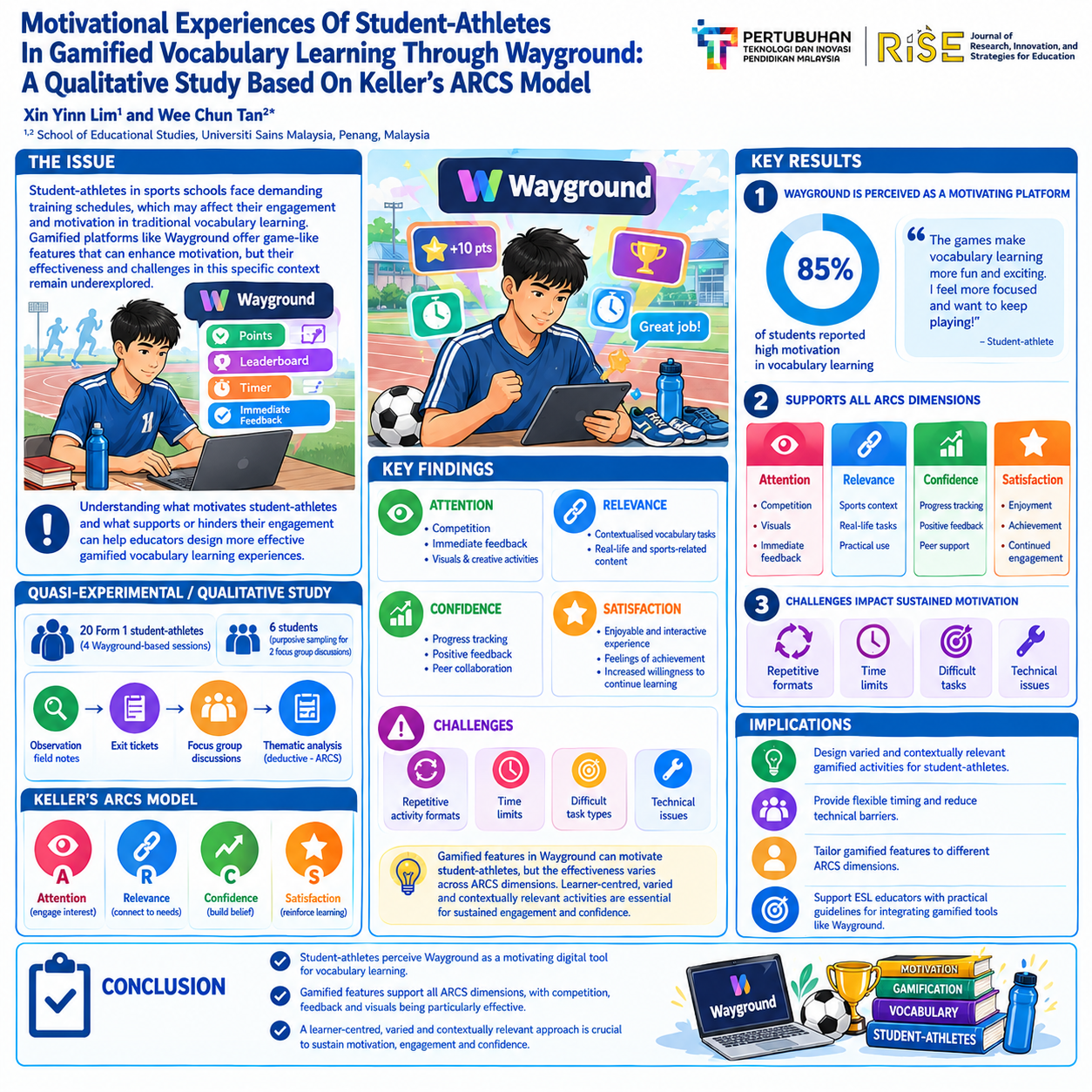
This qualitative case study explored Form 1 student-athletes’ motivational experiences in vocabulary learning through Wayground based on Keller’s ARCS model (Attention, Relevance, Confidence, and Satisfaction). The study also identified aspects of Wayground-based vocabulary learning that supported or hindered their motivation in a Malaysian sports school. Twenty Form 1 student-athletes participated in four Wayground-based vocabulary sessions, and six students were purposively selected for two focus group discussions. Data were collected through observation field notes, exit tickets, and focus group discussions and analysed using a predominantly deductive thematic analysis guided by Keller’s ARCS model. The findings indicated that students generally perceived Wayground as a motivating digital learning platform. Features such as competition, immediate feedback, visuals, creative activities, contextualised vocabulary tasks, and peer collaboration supported students’ attention, relevance, confidence, and satisfaction. However, some students also reported challenges, including repetitive activity formats, time limits, difficult task types, and technical issues, which reduced their sustained engagement and confidence. The findings highlight the importance of designing learner-centred, varied, and contextually relevant gamified vocabulary-learning activities that meet the learning needs of student-athletes. The study provides practical implications for ESL educators to integrate gamified platforms to support students’ motivation in vocabulary learning. It also offers context-specific insight into how the motivational value of gamified features may vary across ARCS dimensions within the student-athlete learning context.
References
Abdullah, M. A. S., Ma’rof, A. M., Tengku Kamalden, T. F., & Ahmad, N. A. (2023). Achievement motivation and academic success: A study of student-athletes in a Malaysian sports school. International Journal of Academic Research in Progressive Education and Development, 12(2), 446-459. http://dx.doi.org/10.6007/IJARPED/v12-i2/16633
Aulia, M., Achmad, D., & Putri, I. (2025). Mobile assisted-language learning to improve students’ lexical resources via the use of Wayground application. English Education Journal, 16(4), 269–279. https://doi.org/10.24815/eej.v16i4.50285
Basuki, Y., & Hidayati, Y. N. (2019). Kahoot! or Quizizz: The students' perspectives. In Proceedings of the 3rd English Language and Literature International Conference (ELLiC) (pp. 1–10). European Alliance for Innovation. https://doi.org/10.4108/eai.27-4-2019.2285331
Braun, V., & Clarke, V. (2006). Using thematic analysis in psychology. Qualitative Research in Psychology, 3(2), 77–101. https://doi.org/10.1191/1478088706qp063oa
Braun, V., & Clarke, V. (2021). Thematic analysis: A practical guide. SAGE Publications.
Deterding, S., Dixon, D., Khaled, R., & Nacke, L. (2011). From game design elements to gamefulness: Defining “gamification.” In Proceedings of the 15th International Academic MindTrek Conference (pp. 9–15). ACM. https://doi.org/10.1145/2181037.2181040
Hamari, J., Koivisto, J., & Sarsa, H. (2014). Does gamification work?—A literature review of empirical studies on gamification. In Proceedings of the 47th Hawaii International Conference on System Sciences (pp. 3025–3034). https://doi.org/10.1109/HICSS.2014.377
Isa, N. M., Zainal Abidin, N. A., Abdul Malek, N., Mohmad Sidik, M. H., & Abu Bakar, S. A. (2018). It's not just about the game: A study on attitudes and motivation of Malaysian secondary sports school students in East Malaysia towards learning English as a second language. MATEC Web of Conferences, 150, Article 05009. https://doi.org/10.1051/matecconf/201815005009
Jiang, X., & Wang, K. (2025). Exploring relationships between identities, dual career competency, and burnout among young talented athletes. BMC Psychology, 13(1), Article 190. https://doi.org/10.1186/s40359-024-02341-0
Judan, M. H., Awang, M. M., & Othman, N. (2022). Isu dan cabaran pelajar atlet dalam mengimbangi pencapaian akademik dan sukan. Malaysian Journal of Social Sciences and Humanities (MJSSH), 7(8), e001682. https://doi.org/10.47405/mjssh.v7i8.1682
Keller, J. M. (1987). Development and use of the ARCS model of instructional design. Journal of Instructional Development, 10(3), 2–10. https://doi.org/10.1007/BF02905780
Keller, J. M. (2010). Motivational design for learning and performance: The ARCS model approach. Springer.
Lincoln, Y. S., & Guba, E. G. (1985). Naturalistic inquiry. Sage Publications.
Mayer, R. E. (2009). Multimedia learning (2nd ed.). Cambridge University Press.
Ministry of Education Malaysia. (2017). Dokumen standard kurikulum dan pentaksiran (DSKP): English language Form 1. Curriculum Development Division.
Nation, I. S. P. (2001). Knowing a word. In Learning vocabulary in another language (pp. 23–59). Cambridge University Press.
Olmos-Vega, F. M., Stalmeijer, R. E., Varpio, L., & Kahlke, R. (2023). A practical guide to reflexivity in qualitative research: AMEE Guide No. 149. Medical Teacher, 45(3), 241–251. https://doi.org/10.1080/0142159X.2022.2057287
Pham, A. T., Thai, C. T. H., & Nguyen, T. V. (2025). Gamified learning in grammar lessons: EFL students’ perceptions of Kahoot! and Quizizz. Acta Psychologica, 259, 105436. https://doi.org/10.1016/j.actpsy.2025.105436
Shamsudin, S. F. F., Mihat, W., Szabo, C. Z., Yusoff, M. S. A., & Wong, W. L. (2025). A systematic review of vocabulary teaching approaches in Malaysia pre-and post CEFR implementation (2011–2024). Malaysian Journal of ELT Research, 22(2), 112-133. https://doi.org/10.52696/GPDV2998
Stambulova, N. B., & Wylleman, P. (2019). Psychology of athletes' dual careers: A state-of-the-art critical review of the European discourse. Psychology of Sport and Exercise, 42, 74–88. https://doi.org/10.1016/j.psychsport.2018.11.013
Su, C.-H., & Cheng, C.-H. (2015). A mobile gamification learning system for improving the learning motivation and achievements. Journal of Computer Assisted Learning, 31(3), 268–286. https://doi.org/10.1111/jcal.12088
Wong, A. S. C., Lee, J. Y. V., Fung, M. E., & Willibrord, O. (2019). Vocabulary size of Malaysian secondary school students. International Journal of Modern Languages and Applied Linguistics, 3(4), 27–34. https://doi.org/10.24191/ijmal.v3i2.7364
Yin, R. K. (2014). Case study research: Design and methods (5th ed.). SAGE Publications.
Zhang, S., & Hasim, Z. (2023). Gamification in EFL/ESL instruction: A systematic review of empirical research. Frontiers in Psychology, 13, 1030790. https://doi.org/10.3389/fpsyg.2022.1030790
Zhou, Y., & Zhou, M. (2026). A meta-analysis on mobile-assisted vocabulary learning: Do mobile applications help? ReCALL, 38(1), 75-93. https://doi.org/10.1017/S0958344025100335
Downloads
Published
Issue
Section
License
Copyright (c) 2025 Xin Yinn Lim, Wee Chun Tan (Author)

This work is licensed under a Creative Commons Attribution 4.0 International License.