Mendepani Cabaran PBD: Analisis Hubungan Pengetahuan, Kemahiran, dan Sikap Guru
DOI:
https://doi.org/10.70148/rise.11Kata kunci:
Pentaksiran Bilik Darjah (PBD); Tahap Penguasaan (TP); Pengetahuan Guru; Kemahiran Guru; Sikap Guru; Pendidikan Matematik; Sekolah RendahAbstrak
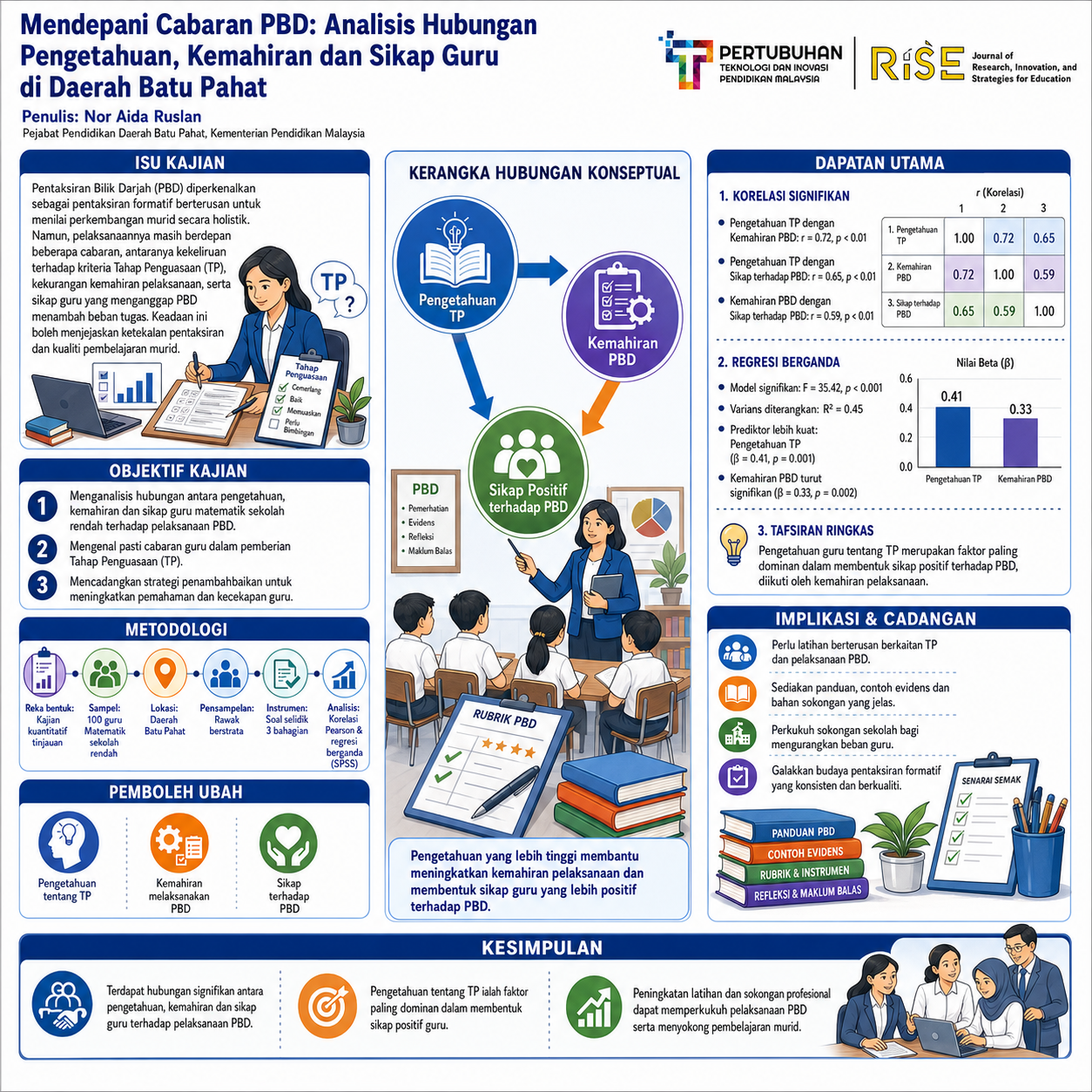
Kajian ini bertujuan untuk menganalisis hubungan antara pengetahuan, kemahiran, dan sikap guru matematik sekolah rendah di Batu Pahat terhadap pemberian Tahap Penguasaan (TP) dalam Pentaksiran Bilik Darjah (PBD). PBD, sebagai alat penilaian formatif, telah diperkenalkan dalam sistem pendidikan Malaysia untuk menilai perkembangan murid secara berterusan tanpa tekanan peperiksaan tradisional. Walaupun PBD membawa potensi yang besar dalam meningkatkan kualiti pendidikan, pelaksanaannya menghadapi beberapa cabaran. Kajian terdahulu mendapati bahawa kekeliruan terhadap kriteria penilaian TP, kurangnya kemahiran dalam pelaksanaan PBD, serta sikap negatif guru, seperti anggapan beban tambahan, telah menghalang keberkesanan pentaksiran ini. Kajian ini menggunakan pendekatan kuantitatif dengan kaedah soal selidik kepada sampel rawak berstrata guru-guru matematik sekolah rendah di Batu Pahat. Hasil kajian akan dianalisis menggunakan teknik statistik seperti analisis korelasi dan regresi berganda untuk menentukan kekuatan hubungan antara pengetahuan, kemahiran, dan sikap guru dalam pelaksanaan PBD. Dapatan kajian ini diharapkan dapat memberikan cadangan konkrit untuk meningkatkan tahap pemahaman dan kecekapan guru dalam melaksanakan PBD, seterusnya memperbaiki proses pembelajaran murid di Malaysia.
Rujukan
Ahmad, I., & Akbar, R. A. (2020). Examining relationship between self-efficacy beliefs of elementary level English
teachers and their implementation practices of formative assessment in Punjab. International Journal of
Education, 3(2), 123-134. https://www.iiste.org/Journals/index.php/JEP/article/view/51252
Ahmad, N., & Ismail, M. (2017). Impact of teacher attitudes on formative assessment implementation: A case study
in Malaysian schools. Malaysian Journal of Education, 34(2), 123-134.
https://ejournal.ukm.my/jpend/article/view/20791
Ahmedi, V. (2019). Teachers’ attitudes and practices towards formative assessment in primary schools. Journal of
Social Studies Education Research, 10, 161-175. https://jsser.org/index.php/jsser/article/view/1646
Boström, E., & Palm, T. (2023). The effect of a formative assessment practice on student achievement in
mathematics. Frontiers in Education, 8. https://doi.org/10.3389/feduc.2023.1101192
Cuizon, R. O., & Haider, A. (2019). Intervening effect of teacher-quality on the relationship between student
attitude and academic outcomes in mathematics. International Journal of Engineering and Future
Technology, 16, 43-51. https://www.ijeft.org
Gotch, C. M., Poppen, M. I., Razo, J. E., & Modderman, S. L. (2021). Examination of teacher formative assessment
self-efficacy development across a professional learning experience. Teacher Development, 25, 534-
https://doi.org/10.1080/13664530.2021.1943503
Hwang, S., & Son, T. (2021). Students’ attitude toward mathematics and its relationship with mathematics
achievement. Journal of Education and e-Learning Research, 8(3), 272-280. https://doi.org/10.20448/journal.509.2021.83.272.280
Ismail, I., & Zahari, R. (2018). Research progress on quantum memory. Journal of Quantum Information Science.
https://doi.org/10.29329/ijpe.2018.139.6
Jamaludin, M. S., Ismail, Z., & Yusoff, R. (2019). Teacher assessment practices in formative assessment: Exploring
teachers' attitudes. Educational Measurement and Evaluation Review, 45, 161-175.
https://www.pssc.org.ph/product-category/journal-issues/
Kültür, Y. Z., & Kutlu, M. (2021). The effect of formative assessment on high school students' mathematics
achievement and attitudes. Journal of Pedagogical Research, 5(3), 203-218. https://doi.org/10.33902/jpr.2021474302
Matthews, J. S. (2020). Formative learning experiences of urban mathematics teachers and their role in classroom
care practices and student belonging. Urban Education, 55(4), 507-541. https://doi.org/10.1177/0042085919842625
Mohd Noor, S., & Saad, Z. (2020). Challenges in implementing formative assessment in primary schools. Journal of
Education and Social Sciences, 15(3), 85-102. https://jesoc.com/issues/
Pinger, P., Rakoczy, K., Besser, M., & Klieme, E. (2018). Interplay of formative assessment and instructional
quality—Interactive effects on students’ mathematics achievement. Learning Environments Research, 21, 61-79. https://doi.org/10.1007/s10984-017-9240-2
Ramollo, J. K., & Kanjee, A. (2023). Supporting teachers to develop formative assessment knowledge and skills in
no-fee schools. South African Journal of Childhood Education, 13(1), 1247. https://doi.org/10.4102/sajce.v13i1.1247
Schildkamp, K., van der Kleij, F., Heitink, M., Kippers, W., & Veldkamp, B. (2020). Formative assessment: A
systematic review of critical teacher prerequisites for classroom practice. International Journal of Educational Research, 101602. https://doi.org/10.1016/j.ijer.2020.101602
Xiang, X., Yum, S., & Lian, R. (2023). Effect of cognitive attitude and affective attitude on formative assessment
practice: Intention as a mediator. Social Behavior and Personality: An International Journal. https://doi.org/10.2224/sbp.12484
Muat turun
Diterbitkan
Terbitan
Bahagian
Lesen
Hak Cipta (c) 2025 Nor Aida Ruslan (Author)

Kerja ini dilesenkan di bawah Creative Commons Attribution 4.0 International License.