Hubungan Antara Jangkaan Fizik Dengan Pencapaian Fizik Dalam Kalangan Pelajar Tingkatan Empat Di Daerah Besut
DOI:
https://doi.org/10.70148/rise.v2i6.3Kata kunci:
jangkaan fizik, pencapaian fizik, kajian korelasiAbstrak
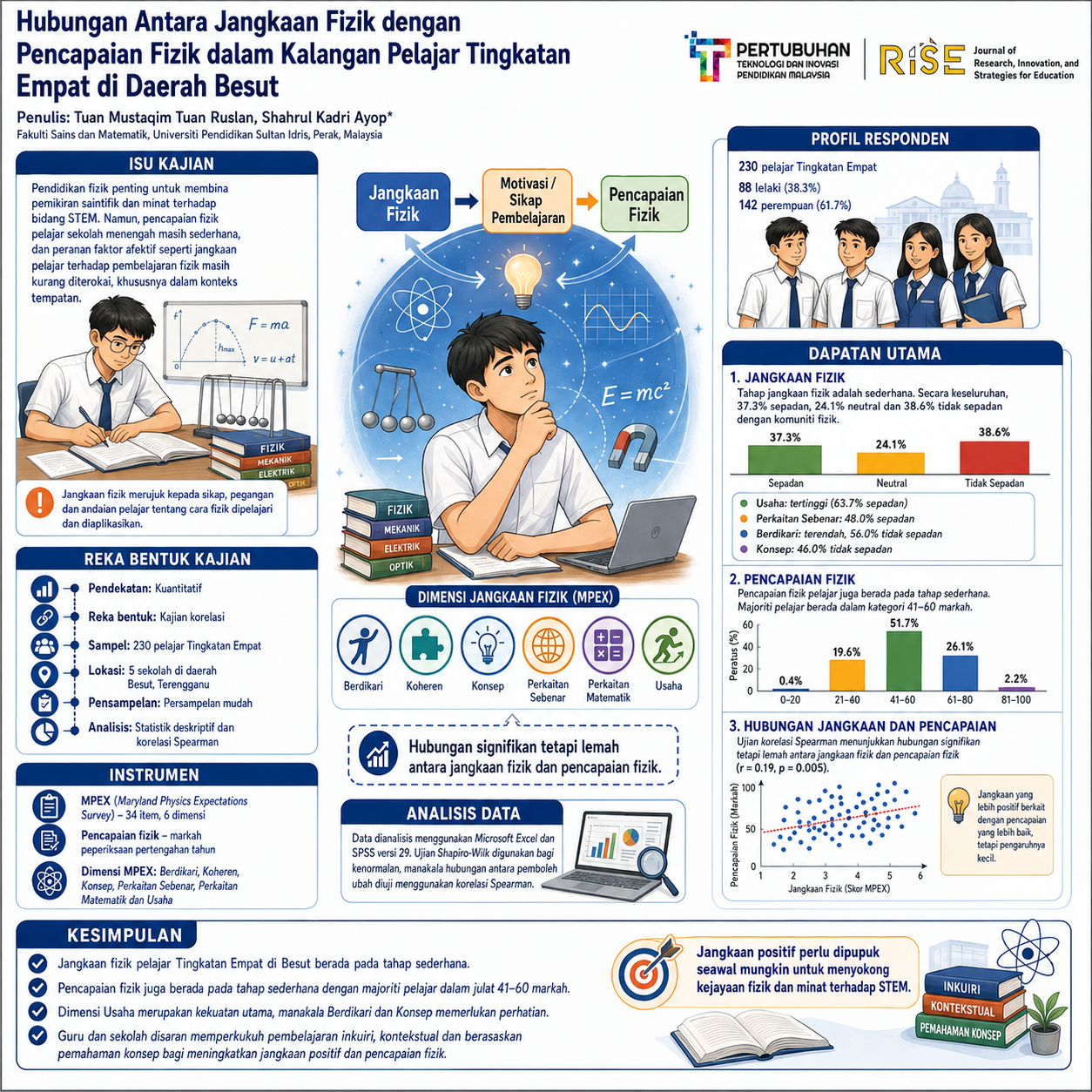
Kajian ini bertujuan menentukan hubungan antara jangkaan Fizik dengan pencapaian Fizik dalam kalangan pelajar Tingkatan Empat di daerah Besut, Terengganu. Kajian ini mempunyai tiga objektif utama iaitu mengenal pasti jangkaan Fizik, mengenal pasti tahap pencapaian Fizik, dan menentukan hubungan antara kedua-duanya. Reka bentuk kajian yang digunakan ialah kajian korelasi dengan pendekatan kuantitatif melibatkan seramai 230 pelajar Tingkatan Empat daripada lima buah sekolah. Instrumen utama kajian ialah soal selidik Maryland Physics Expectations Survey (MPEX), manakala pencapaian Fizik diukur melalui markah peperiksaan pertengahan tahun. Data dianalisis menggunakan statistik deskriptif (min, peratus) dan inferensi (ujian korelasi Spearman). Hasil kajian mendapati jangkaan Fizik pelajar dan pencapaian Fizik berada pada tahap sederhana. Ujian korelasi menunjukkan wujud hubungan signifikan tetapi lemah ( antara jangkaan Fizik dan tahap pencapaian Fizik.
Rujukan
Assem, H. D., Nartey, L., Appiah, E., & Aidoo, J. K. (2023). A Review of Students’ Academic Performance in Physics: Attitude, Instructional Methods, Misconceptions and Teachers Qualification. European Journal of Education and Pedagogy, 4(1), 84–92. https://doi.org/10.24018/EJEDU.2023.4.1.551
Bond, T. G., & Fox, C. M. (2007). Applying the rasch model: Fundamental measurement in the human sciences: Second edition. Applying the Rasch Model: Fundamental Measurement in the Human Sciences: Second Edition, 1–340. https://doi.org/10.4324/9781410614575
Creswell, J. W. ., & Guetterman, T. C. . (2024). Educational Research: Planning, Conducting, and Evaluating Quantitative and Qualitative Research, 7th Edition. Pearson, 677.
Eccles, J. S., & Wigfield, A. (2020). From expectancy-value theory to situated expectancy-value theory: A developmental, social cognitive, and sociocultural perspective on motivation. Contemporary Educational Psychology, 61, 101859. https://doi.org/10.1016/J.CEDPSYCH.2020.101859
Flanagan, J. R., Beck, C. T., & Polit, D. F. (2024). Polit & Beck’s Nursing Research: Generating and Assessing Evidence for Nursing Practice. 2024, International Edition., 810.
Hayat, A. A., Shateri, K., Amini, M., & Shokrpour, N. (2020). Relationships between academic self-efficacy, learning-related emotions, and metacognitive learning strategies with academic performance in medical students: A structural equation model. BMC Medical Education, 20(1). https://doi.org/10.1186/s12909-020-01995-9
Knaub, A. V, Aiken, J. M., & Ding, L. (2010). Two-phase study examining perspectives and use of quantitative methods in physics education research. https://doi.org/10.1103/PhysRevPhysEducRes.15.020102
Körhasan, N. D., & Çıtak, C. (2024). Examination of undergraduate students’ physics expectations. European Journal of Physics, 45(4), 045701. https://doi.org/10.1088/1361-6404/AD37E5
Krejcie, R. V., & Morgan, D. W. (1970). Determining Sample Size for Research Activities. Educational and Psychological Measurement, 30(3), 607–610. https://doi.org/10.1177/001316447003000308
Kritsadatan, N., & Wattanakasiwich, P. (2014). First Year Students’ and Physics Teachers’ Expectations in Learning Physics: Case Study in Thailand. International Journal of Innovation in Science and Mathematics Education, 22(1), 32–42.
Lembaga Peperiksaan Kementerian Pendidikan. (n.d.). Laporan Analisis Keputusan SPM 2024.
Mistades, V. M. (2011). Freshman Physics Majors’ Cognitive Expectations and Academic Performance in their Introductory Physics Course. The Manila Journal of Science, 7(1), 1–6.
Piaget, J. (1977). The Role of Action in the Development of Thinking. In W. F. Overton & J. M. Gallagher (Eds.), Knowledge and Development: Volume 1 Advances in Research and Theory (pp. 17–42). Springer US. https://doi.org/10.1007/978-1-4684-2547-5_2
Redish, E. F., Saul, J. M., & Steinberg, R. N. (1998). Student expectations in introductory physics. American Journal of Physics, 66(3), 212–224. https://doi.org/10.1119/1.18847
Taber, K. S. (2025). Developing Intellectual Sophistication and Scientific Thinking—The Schemes of William G. Perry and Deanna Kuhn. In Science Education in Theory and Practice (pp. 215–231). Springer, Cham. https://doi.org/10.1007/978-3-031-81351-1_13
Vygotsky, L. S. (1978). Development of Higher Psychological Processes (M. Cole, V. Jolm-Steiner, S. Scribner, & E. Souberman, Eds.). Harvard University Press. https://doi.org/10.2307/j.ctvjf9vz4
Wahono, B., Lin, P. L., & Chang, C. Y. (2020). Evidence of STEM enactment effectiveness in Asian student learning outcomes. In International Journal of STEM Education (Vol. 7, Issue 1). Springer. https://doi.org/10.1186/s40594-020-00236-1
Zemplén, G. Á. (2023). Epistemic Beliefs and Physics Teacher Education. The International Handbook of Physics Education Research: Special Topics, 11-1-11–30. https://doi.org/10.1063/9780735425514_011
Muat turun
Diterbitkan
Terbitan
Bahagian
Lesen
Hak Cipta (c) 2025 Shahrul Kadri Ayop, Tuan Mustaqim Tuan Ruslan (Author)

Kerja ini dilesenkan di bawah Creative Commons Attribution 4.0 International License.