Reframing Engineering Education for the Age of AI-Integrated Digital Twins: A Conceptual Framework for Practice-Oriented Learning
DOI:
https://doi.org/10.70148/rise.v3i5.11Kata kunci:
engineering education, digital twin learning, artificial intelligence, practice-oriented learning, decision-based learning, curriculum innovation, industry–academia integrationAbstrak
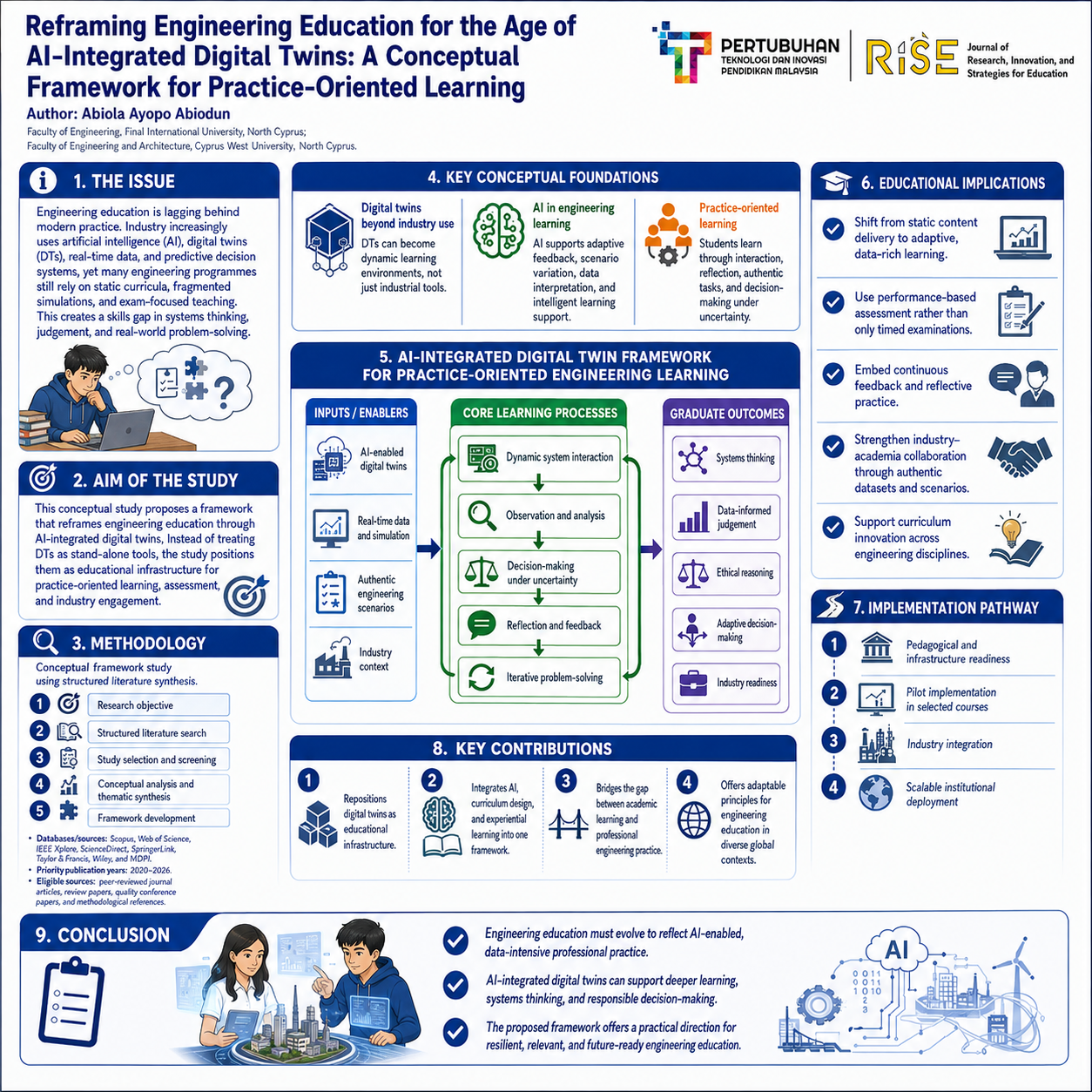
The growing intersection of artificial intelligence (AI) and digital twins (DTs) is transforming the design, operation, and management of engineering infrastructure by enabling data-driven modelling, monitoring, prediction, and decision-making, while integrating engineering processes that have traditionally operated in isolation. However, engineering education has not evolved in parallel with these rapid technological advances, often treating AI and DTs as individual tools rather than inputting them within pedagogical models that promote systems thinking and real-world engineering practice. This gap has created a significant disconnect between conventional engineering education and the evolving competencies required by modern industry. This study proposes a conceptual framework for reframing engineering education through AI-integrated DTs as engineering learning platforms rather than instructional technologies alone. The framework was developed through a structured conceptual synthesis of recent literature, examining the limitations of existing educational approaches and identifying opportunities to strengthen systems thinking, uncertainty management, decision-making, and ethical reasoning within engineering curricula. Based on this synthesis, the proposed framework positions DTs as educational infrastructure that supports continuous student engagement with realistic engineering scenarios. Also, it facilitates practice-oriented learning and strengthens the combination of academic learning with engineering practice and industrial applications. The study contributes a structured theoretical framework to guide curriculum transformation and provides practical implementation pathways for integrating AI-enabled DTs into future engineering education.
Rujukan
Álvarez Ariza, J., & Hernández Hernández, C. (2026, January). Investigating the Impact of Education 4.0 and Digital Learning on Students’ Learning Outcomes in Engineering: A Four-Year Multiple-Case Study. In Informatics (Vol. 13, No. 2, p. 18). MDPI.
Álvarez, J., García, M., Rodríguez, P., & Hernández, C. (2023). Engineering education in the era of digital transformation: Towards authentic and interdisciplinary learning. Education Sciences, 13(11), 1124.
Ang, H. Q., & Domingo, B. (2025). An Innovative and Universal Teaching Model in Engineering Education to Foster Industry 5.0 Skills—EPIC Principles. Education Sciences, 15(9), 1096.
Booth, A., Martyn-St James, M., Clowes, M., & Sutton, A. (2021). Systematic approaches to a successful literature review, 1-100.
Daineko, Y., Mukanova, M., & Seitnur, A. (2025). Immersive technologies and digital twins in education: Innovative solutions for learning and university management. In Proceedings of the 1st International Workshop on Application of Immersive Technology (AIT 2025) (pp. 1–8). Almaty, Kazakhstan.
Fuller, A., Fan, Z., Day, C., & Barlow, C. (2020). Digital twin: Enabling technologies, challenges and open research. IEEE access, 8, 108952-108971.
Grieves, M., & Vickers, J. (2016). Mitigating unpredictable, undesirable emergent behavior in complex systems (excerpt). Florida Inst. Technol., Melbourne, FL, USA, Tech. Rep.
Hazrat, M. A., Hassan, N. M. S., Chowdhury, A. A., Rasul, M. G., & Taylor, B. A. (2023). Developing a skilled workforce for future industry demand: The potential of digital twin-based teaching and learning practices in engineering education. Sustainability, 15(23), 16433.
Jaakkola, E. (2020). Designing conceptual articles: four approaches. AMS review, 10(1), 18-26.
Jebelli, H., Asadi, S., Mutis, I., Liu, R., & Cheng, J. (Eds.). (2024, September). Digital twins in construction and the built environment. Reston, VA: American Society of Civil Engineers.
Karanam, S. A. K., & Hartman, N. W. (2025). A systematic review of digital twin (DT) and virtual learning environments (VLE) for smart manufacturing education. Manufacturing letters, 44, 1597-1608.
Kirkwood, A., & Price, L. (2014). Technology-enhanced learning and teaching in higher education: what is ‘enhanced’and how do we know? A critical literature review. Learning, media and technology, 39(1), 6-36.
Kotecha, M. C., Dandridge, T. M., & Smith, T. R. (2025, June). Digital Twins in Engineering and Design Education: A Systematized Review. In 2025 ASEE Annual Conference & Exposition.
Liu, X., & David, I. (2025). AI simulation by digital twins: systematic survey, reference framework, and mapping to a standardized architecture: X. Liu, I. David. Software and Systems Modeling, 1-26.
Liu, C. (2025). A comprehensive review of applications of AI technologies in higher engineering education. Discover Education, 4(1), 528.
Luckin, R., & Holmes, W. (2016). Intelligence unleashed: An argument for AI in education.
Makransky, G., & Petersen, G. B. (2019). Investigating the process of learning with desktop virtual reality: A structural equation modeling approach. Computers & Education, 134, 15-30.
Makransky, G., Andreasen, N. K., Baceviciute, S., & Mayer, R. E. (2021). Immersive virtual reality increases liking but not learning with a science simulation and generative learning strategies promote learning in immersive virtual reality. Journal of Educational Psychology, 113(4), 719.
Negahban, A. (2024). Simulation in engineering education: The transition from physical experimentation to digital immersive simulated environments. Simulation, 100(7), 695-708.
Omrany, H., Al-Obaidi, K. M., Ghaffarianhoseini, A., Chang, R. D., Park, C., & Rahimian, F. (2026). Digital twin technology for education, training and learning in construction industry: implications for research and practice. Engineering, Construction and Architectural Management, 33(3), 1836-1870.
Pathak, R. K., & Upadhyay, P. (2024). Integration of digital twin technologies in education for experiential learning: Benefits and challenges. International Research Journal of Advanced Engineering.
Paul, J., & Criado, A. R. (2020). The art of writing literature review: what do we know and what do we need to know?. International business review, 29(4), 101717.
Rahman, A., Khandakar, A., Ayari, M. A., Naji, K., Al-Ali, A. K., Sellami, A. L., & Alhazbi, S. M. A. (2026). Artificial intelligence innovations challenges and emerging trends in engineering education. Discover Education.
Snyder, H. (2019). Literature review as a research methodology: An overview and guidelines. Journal of business research, 104, 333-339.
Syarifuddin, S., Kurra, T., Susanto, A., Saputra, H. D., Lumbantobing, M. A., Pancawati, R., ... & Tanggu Mara, A. (2025). Artificial Intelligence-Based Digital Twins Metaverse to Improve STEM Work Skills and Adaptive Expertise in Higher Education: A Conceptual Framework. F1000Research, 14, 1376.
Tjahyadi, H., Prasetya, K., & Murwantara, I. M. (2023). Digital twin based laboratory for control engineering education. International Journal of Information and Education Technology, 13(4), 704-711.
Torraco, R. J. (2016). Writing integrative literature reviews: Using the past and present to explore the future. Human resource development review, 15(4), 404-428.
Zawacki-Richter, O., Marín, V. I., Bond, M., & Gouverneur, F. (2019). Systematic review of research on artificial intelligence applications in higher education–where are the educators?. International journal of educational technology in higher education, 16(1), 39.
Zhang, T., Grzelak, D., Zhao, W., Islam, M. A., Fricke, H., & Assmann, U. (2025). A Review on the Construction, Modeling, and Consistency of Digital Twins for Advanced Air Mobility Applications. Drones, 9(6), 394.
Muat turun
Diterbitkan
Terbitan
Bahagian
Lesen
Hak Cipta (c) 2025 Abiola Ayopo Abiodun (Author)

Kerja ini dilesenkan di bawah Creative Commons Attribution 4.0 International License.