Exploring institutional capacity building and training initiatives for curriculum responsiveness in Tanzanian universities. A qualitative inquiry
DOI:
https://doi.org/10.70148/rise.v3i5.12Kata kunci:
Competence-based curriculum, Curriculum development, Higher Education, Responsive curriculum development, Training, Capacity buildingAbstrak
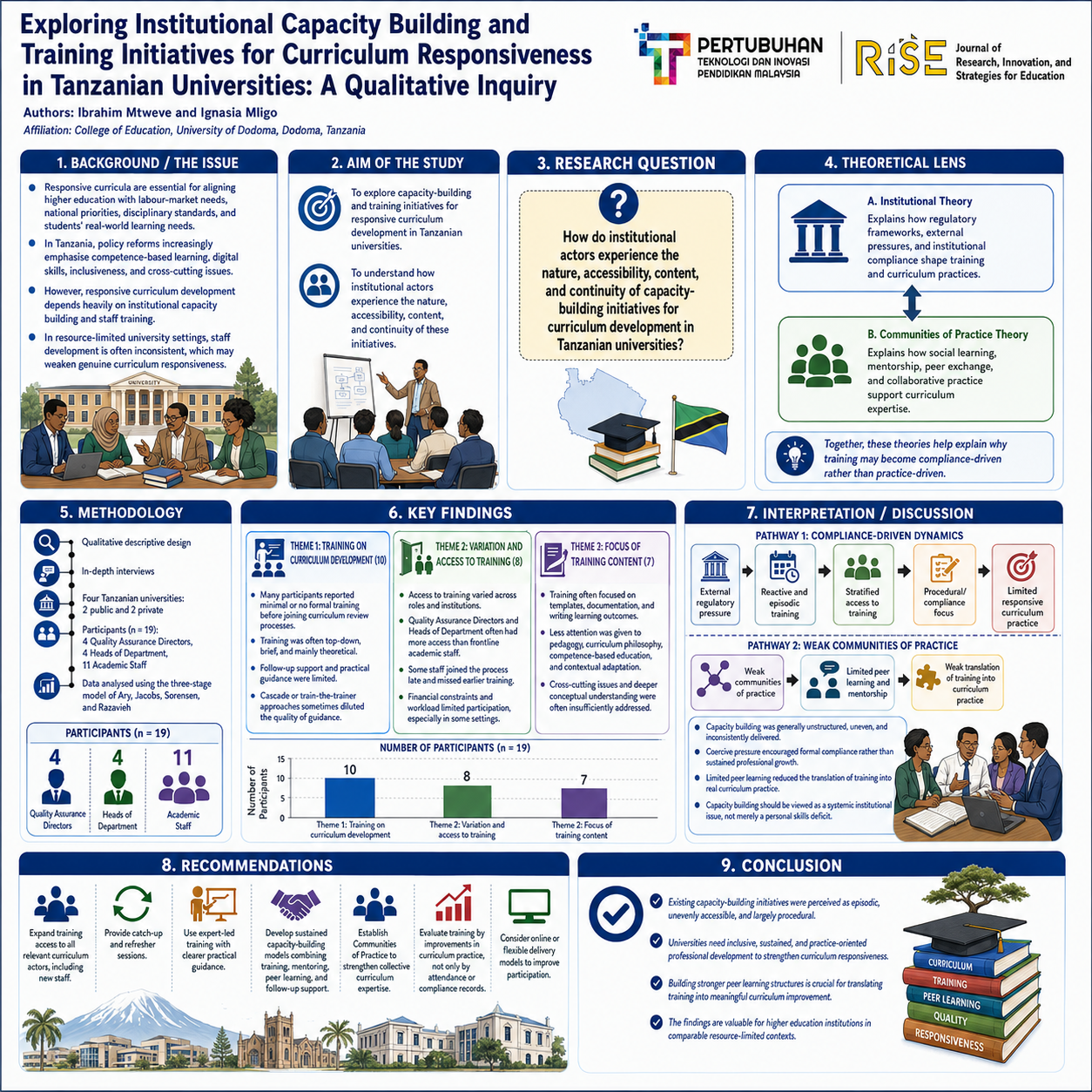
This study explored the capacity-building and training initiatives for responsive curriculum development in Tanzanian universities. This is because, although there has been a growing scholarly focus on curriculum responsiveness, little research has explored how institutional capacity-building and training initiatives facilitate responsive curriculum development, especially in resource-limited university environments. Guided by Institutional Theory and Communities of Practice Theory, the study used a qualitative descriptive design and conducted in-depth interviews with 19 participants, including four quality assurance directors, four department heads, and eleven academic staff from two public and two private universities. Following the three-stage analysis model by Ary, Jacobs, Sorensen, and Razavieh, the study revealed three themes: training on curriculum development; variation and access to training; and the focus of training content. Generally, capacity-building efforts were unstructured, top-down, and inconsistently delivered, with minimal follow-up or peer learning. The study shows that coercive isomorphism pressure is associated with formal compliance without the capacity to deliver, and the lack of active Communities of Practice hinders the reflection of training in actual curriculum practices. The study extends global literature on curriculum implementation in developing countries by conceptualising capacity building as influenced by institutional pressures and social learning frameworks, rather than solely by personal skill deficits. The study recommends engaging curriculum developers more extensively throughout the entire process and exploring expert-led training options and sustained capacity-building models. It also highlights the importance of increasing both the frequency and flexibility of training sessions. Additionally, the findings offer valuable insights for higher education institutions in comparable resource-limited contexts seeking to enhance curriculum responsiveness.
Rujukan
Almeqdad, Q. I., Alodat, A. M., Alquraan, M. F., Mohaidat, M. A., & Al-Makhzoomy, A. K. (2023). The effectiveness of universal design for learning: A systematic review of the literature and meta-analysis. Cogent Education, 10(1), 2218191. https://doi.org/10.1080/2331186X.2023.2218191
Ball, S., Maguire, M., Braun, A., Perryman, J., & Hoskins, K. (2012). Assessment technologies in schools: ’ deliverology ’ and the ‘play of dominations’. Research Papers in Education, 27(5), 513–533. https://doi.org/10.1080/02671522.2010.550012
Chand, S. P. (2024). Teachers’ views on professional learning and development in primary schools in Fiji. Asia Pacific Education Review, 25(5), 1391–1402. https://doi.org/10.1007/s12564-024-10004-3
Darling-Hammond, L., Hyler, M. E., & Gardner, M. (2017). Effective Teacher Professional Development. Palo Alto, CA: Learning Policy Institute. Retrieved from https://doi.org/10.54300/122.311
DiMaggio, P. J., & Powell, W. W. (1983). The iron cage revisited institutional isomorphism and collective rationality in organizational fields. In J. A. C. Baum & F. Dobbin (Eds.), Economics Meets Sociology in Strategic Management (Vol. 17, pp. 0): Emerald Group Publishing Limited.
Fullan, M. (2016). The new meaning of educational change (5th ed.): Teachers College Press.
Hamidu, H. K., & Peter, I. R. (2025). The Alignment/Linkage of Students’ Academic Competence Experienced in Secondary Schools and Universities. A Case Study of Competence-Based Curriculum Implementation in Tanzania. International Journal of Social Science and Human Research. https://doi.org/10.47191/ijsshr/v8-i2-58
Hasibuan, K., Ledy, A., & Az-Zahra, F. Z. (2024). Curriculum Development For 21st Century Skills: Trends, Challenges, and Solutions. MODELING: Jurnal Program Studi PGMI, 11(4), 295–305. https://doi.org/10.69896/modeling.v11i4.2660
Ishengoma, J. M. (2017). Incorporating the Tuning Approach in Higher Education Curricular Reforms and Course Design in Tanzania for Enhancing graduates’ Competencies: Stakeholders’ Views. Tuning Journal for Higher Education, 5(1), 121–169. https://doi.org/10.18543/tjhe-5(1)-2017pp121-169
Kallio, H., Pietilä, A. M., Johnson, M., & Kangasniemi, M. (2016). Systematic methodological review: Developing a framework for a qualitative semi‐structured interview guide. Journal of Advanced Nursing, 72(12), 2954–2965. https://doi.org/10.1111/jan.13031
Kavenuke, P. S., Mlyakado, B. P., & Mkumbo, K. A. (2020). Problems confronting the teaching profession in Tanzania: What who says matters. Journal of Learning for Development, 7(3), 431–444. Retrieved from https://jl4d.org/index.php/ejl4d/article/view/1069/1099
Kibona, B. (2023). Higher education and employability in Tanzania: Students' accounts. Journal of International Development, 36(1), 254–267. https://doi.org/10.1002/jid.3820
Kidayi, P., Dausen, E., Ndile, M., Sixsmith, J., Mawona, Z., Berntsen, K., … De Zeeuw, J. (2025). Development of a training programme to improve health literacy and respectful, compassionate care competencies among undergraduate student nurses: a quantitative study. BMC Medical Education, 25. https://doi.org/10.1186/s12909-025-06894-5
Kikomelo, S. (2024). Factors for effective curriculum implementation in higher learning institutions in Tanzania. The Accountancy and Business Review, 16(3), 65–83. https://doi.org/10.59645/abr.v16i3.363
Kumar, P. (2017). Capacity Building for Quality Enhancement in Higher Education. SRPN: Social Economics (Topic). https://doi.org/10.47992/ijmts.2581.6012.0027
Lave, J., & Wenger, E. (1991). Situated learning: Legitimate peripheral participation: Cambridge University Press.
Lupeja, T. L., & Komba, S. (2021). Implementation of competence-based curriculum in the context of the colonial education system in Tanzania. International Journal of Research Studies in Education, 10(5), 33–43. https://doi.org/10.5861/ijrse.2021.5082
Malterud, K., Siersma, V. D., & Guassora, A. D. (2016). Sample size in qualitative interview studies: Guided by information power. Qualitative Health Research, 26(13), 1753–1760. https://doi.org/10.1177/1049732315617444
Meyer, J. W., & Rowan, B. (1977). Institutionalized organizations: Formal structure as myth and ceremony. American journal of sociology, 83(2), 340–363. https://doi.org/10.31430/GXJZ1686
Mgaiwa, S. J. (2021). Fostering Graduate employability: rethinking Tanzania’s University practices. SAGE Open, 11. https://doi.org/10.1177/21582440211006709
Mkulu, D. (2020). Role of Holistic Education in Empowering University Students for Industrial Development in Tanzania. Journal of Humanities and Education Development. ttps://doi.org/10.22161/jhed.2.3.4
Msamba, E. M., Msuya, E. A., & Anangisye, W. A. L. (2023). The Impact of In-Service Education and Training on Teachers’ Learning: Perspectives from English Foreign Language Teachers in Tanzania. Education Research International, 1–12. https://doi.org/10.1155/2023/6135444
Moll, I. (2004). Curriculum responsiveness: The anatomy of a concept. In H. Griesel (Ed.), Curriculum responsiveness: Case studies in higher education (pp. 1–19). Pretoria, South Africa: South African Universities Vice-Chancellors Association (SAUVCA)
Mubofu, C., & Mambo, H. (2023). Adequacy of LIS Curriculum in Response to Global Trends: A Case Study of Tanzanian Universities. Open Information Science, 7(1). https://doi.org/10.1515/opis-2022-0162
Mulder, M., & Winterton, J. (2017). Competence-based vocational and professional education: Springer.
Munene, I. I. (2013). “... University is ISO 9000: 2008 certified”: Neoliberal echoes, knowledge production and quality assurance in Kenyan state universities. Journal of Higher Education in Africa, 11, 161–182. Retrieved from https://www.jstor.org/stable/jhigheducafri.11.1-2.161
Neergaard, M. A., Olesen, F., Andersen, R. S., & Søndergaard, J. (2009). Qualitative description – the poor cousin of health research? BMC Medical Research Methodology, 9(52). https://doi.org/10.1186/1471-2288-9-52
Ngassapa, O. D., Kaaya, E. E., Fyfe, M. V., Lyamuya, E. F., Kakoko, D. C., Kayombo, E. J., . . . Macfarlane, S. B. (2012). Curricular transformation of health professions education in Tanzania: The process at Muhimbili University of Health and Allied Sciences (2008–2011). Journal of Public Health Policy, 33(1), S64-S91. https://doi.org/10.1057/jphp.2012.43
Nyerere, J. K. (1968). Education for self-reliance. Division of Tertiary Education, Ministry of National Education. Retrieved from https://www.juliusnyerere.org/uploads/education_for_self_reliance_1967.pdf
OECD. (2016). Global competency for an inclusive world. Retrieved from https://www.oecd.org/education/Global-competency-for-an-inclusive-world.pdf
OECD. (2018). The future of education and skills: Education 2030. Paris, France: OECD Publishing. Retrieved from https://www.oecd.org/education/2030-project/
Sandelowski, M. (2010). What's in a name? Qualitative description revisited. Res Nurs Health, 33(1), 77–84. https://doi.org/10.1002/nur.20362
Scott, W. R. (2014). Institutions and organisations: Ideas, interests, and identities (4th ed.): Sage.
Sirili, N., Mloka, D., Mselle, L. T., Kisenge, R., Mbugi, E., Russa, D., . . . Kaaya, E. (2023). Opportunities and Challenges for Implementation of Harmonised Competence-Based Curricula in Medicine and Nursing Programmes in Tanzania: Experiences of Biomedical Sciences’ Stakeholders. Advances in Medical Education and Practice, 14, 487–498. https://doi.org/10.2147/amep.s381242
Thornton, P. H., & Ocasio, W. (1999). Institutional logics and the historical contingency of power in organisations: Executive succession in the higher education publishing industry, 1958–1990. American journal of sociology, 105(3), 801–843. https://doi.org/10.1086/210361
Tikly, L. (2019). Education for sustainable development in the postcolonial world: Towards a transformative agenda for Africa. Routledge.
Tsevi, L. (2015). Quality assurance in private higher education: The case of Ghana (PROPHE Working Paper No. 20). Retrieved from Program for Research on Private Higher Education website: https://prophe.org/en/working-papers/quality-assurance-in-private-higher-education-the-case-of-ghana/.
Toor, R., Cerimele, J., Farnum, M., & Ratzliff, A. (2020). Longitudinal faculty development in curriculum design: Our experience in the integrated care training program. Academic Psychiatry, 44, 761–765. https://doi.org/10.1007/s40596-020-01298-7
UNESCO. (2017). Education for sustainable education: learning objectives. Paris, France: UNESCO
UNESCO. (2021). Reimagining our futures together: A new social contract for education. Paris, France: UNESCO. Retrieved from https://www.unesco.org/en/articles/reimagining-our-futures-together-new-social-contract-education
URT. (1999). National higher education policy. Ministry of Science, Technology and Higher Education. Retrieved from http://www.tzonline.org/pdf/nationalhighereducationpolicy.pdf
URT. (2023). Education and Training Policy of 2014 version 2023. Ministry of Education, Science and Technology
Van Schaik, S. (2020). Accessible and Adaptable Faculty Development to Support Curriculum Reform in Medical Education. Academic Medicine. https://doi.org/10.1097/acm. 0000000000003804
Velthuis, F., Dekker, H., Coppoolse, R., Helmich, E., & Jaarsma, D. (2021). Educators' experiences with governance in curriculum change processes: a qualitative study using rich pictures. Adv Health Sci Educ Theory Pract, 26(3), 1027–1043. https://doi.org/10.1007/s10459-021-10034-1
Wenger, E. (1998). Communities of practice: Learning, meaning, and identity. Cambridge, UK: Cambridge University Press.
World Bank. (2020). Tanzania Education Sector Public Expenditure Review 2020. World Bank. Retrieved from https://documents.worldbank.org/en/publication/documents-reports/documentdetail/652621468175141871/tanzania-public-expenditure-review
Muat turun
Diterbitkan
Terbitan
Bahagian
Lesen
Hak Cipta (c) 2025 Ibrahim Mtweve, Dr. Ignasia Mligo (Author)

Kerja ini dilesenkan di bawah Creative Commons Attribution 4.0 International License.