GEMA-ADHD: Potensi Gemini Dalam Reka Bentuk Bahan Didik Hibur untuk Murid ADHD
DOI:
https://doi.org/10.70148/rise.v3i5.5Kata kunci:
Gemini, ADHD, Didik Hibur, Kecerdasan Buatan Generatif, Murid berkeperluan pendidikan khasAbstrak
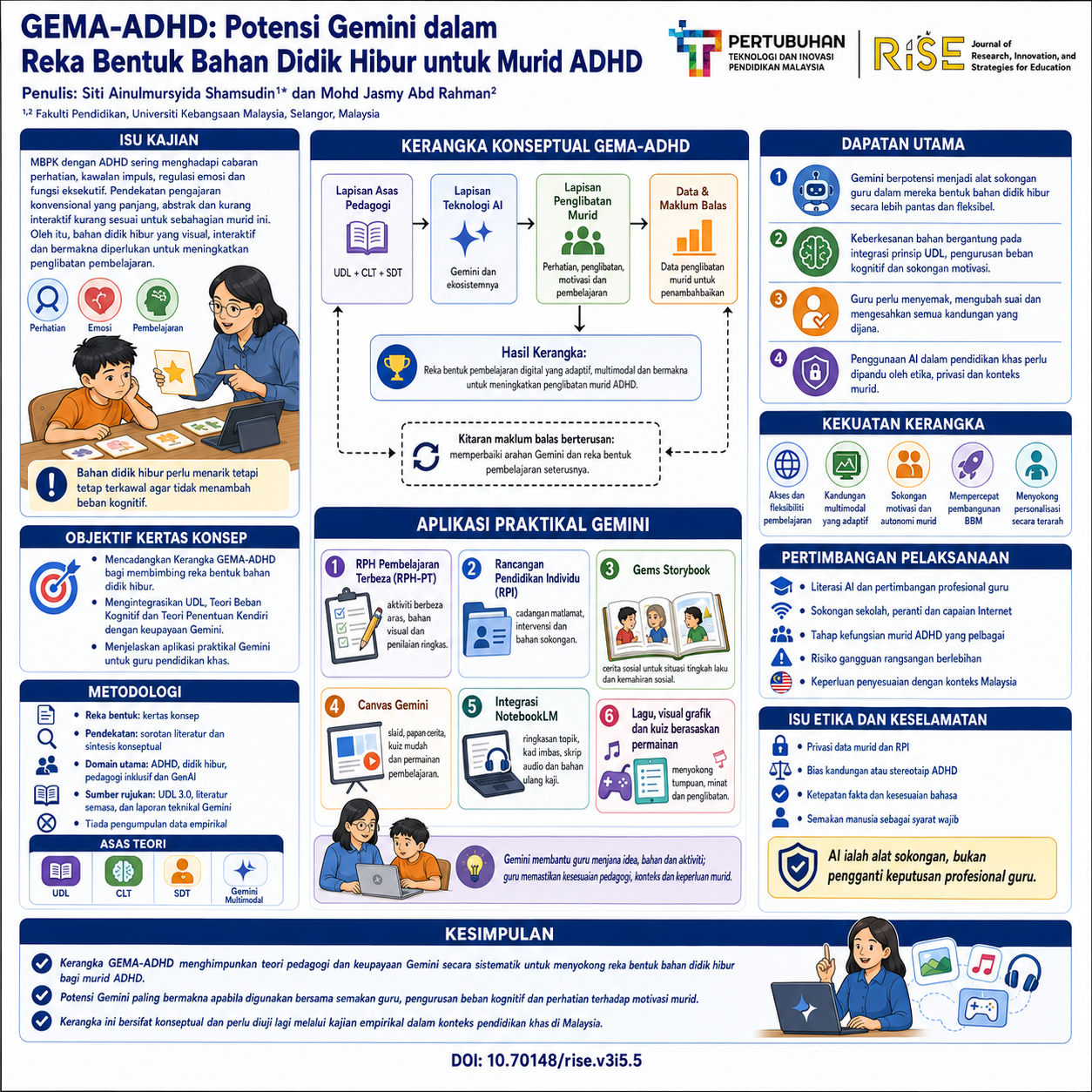
Kertas konsep ini membentangkan Kerangka GEMA-ADHD (Gemini-Edutainment-Multimodal- Adaptif untuk ADHD), iaitu suatu kerangka konseptual yang menghuraikan potensi model kecerdasan buatan generatif Gemini oleh Google DeepMind dalam membantu guru pendidikan khas mereka bentuk bahan didik hibur yang bersesuaian untuk murid berkeperluan pendidikan khas (MBPK) dengan Attention-Deficit Hyperactivity Disorder (ADHD). MBPK dalam kategori ini menghadapi pelbagai cabaran kognitif, emosi dan tingkah laku yang menyukarkan penglibatan aktif mereka dalam pembelajaran berbentuk konvensional. Kerangka ini mengintegrasikan empat komponen utama, iaitu Universal Design for Learning sebagai asas kebolehcapaian dan fleksibiliti, Teori Beban Kognitif sebagai panduan pengurusan rangsangan dan pemprosesan maklumat, Teori Penentuan Kendiri sebagai asas motivasi, serta keupayaan multimodal Gemini sebagai alat sokongan penjanaan kandungan. Secara khusus, kertas ini menghuraikan beberapa aplikasi praktikal Gemini iaitu dalam pembinaan Rancangan Pengajaran Harian Pembelajaran Terbeza (RPH-PT), pembangunan Rancangan Pendidikan Individu berteraskan intervensi didik hibur, penjanaan cerita sosial menggunakan Gems Storybook, reka bentuk visual dan aplikasi permainan pembelajaran melalui fungsi Canvas di Gemini, penghasilan pelbagai Bahan Bantu Mengajar (BBM) melalui integrasi NotebookLM serta pembangunan bahan pentaksiran seperti kuiz dan tugasan berasaskan didik hibur. Implikasi praktikal dan agenda penyelidikan lanjut turut dibincangkan.
Rujukan
Agrawal, S., Bhatt, P., & Sharma, N. (2023). Real-time AI attention monitoring and content adaptation for children with ADHD: A pilot study. Frontiers in Psychology, 14, 1089341. https://doi.org/10.3389/fpsyg.2023.1089341
Aishworiya, R., & Kang, Y. Q. (2021). Including children with developmental disabilities in the school setting during the COVID-19 pandemic: A narrative review. Frontiers in Psychiatry, 12, 643040. https://doi.org/10.3389/fpsyt.2021.643040
Alqahtani, M. F., Bhattarai, B. M., & Huang, Y. (2023). Generative AI in differentiated instruction: A quality assessment study with special education teachers. Education Sciences, 13(8), 821. https://doi.org/10.3390/educsci13080821
Armstrong, T. (2023). The power of neurodiversity: Unleashing the advantages of your differently wired brain (2nd ed.). Da Capo Press.
Bender, E. M., Gebru, T., McMillan-Major, A., & Shmitchell, S. (2021). On the dangers of stochastic parrots: Can language models be too big? In Proceedings of the 2021 ACM Conference on Fairness, Accountability, and Transparency (FAccT ’21) (pp. 610–623). https://doi.org/10.1145/3442188.3445922
Boyle, J. R., Rosen, S. M., & Forchelli, G. (2021). Exploring metacognitive strategy use during note-taking for students with learning disabilities. British Journal of Educational Technology, 52(4), 1397–1412. https://doi.org/10.1111/bjet.13093
CAST. (2024). Universal Design for Learning guidelines version 3.0. https://udlguidelines.cast.org
Chan, C. K. Y., & Hu, W. (2023). Students’ voices on generative AI: Perceptions, benefits, and challenges in higher education. Journal of Information Technology Education: Research, 22, 631–663. https://doi.org/10.28945/5202
Chen, O., Castro-Alonso, J. C., Paas, F., & Sweller, J. (2023). The expertise reversal effect and working memory: Instructional implications for cognitive load theory. Educational Psychology Review, 35(1), 21. https://doi.org/10.1007/s10648-023-09737-5
Cheng, L., Liu, M., & Xu, X. (2024). AI-assisted individualized education program development: Enhancing goal specificity and reducing teacher workload. Journal of Special Education Technology, 39(1), 45–61. https://doi.org/10.1177/01626434231162145
Cortese, S., Coghill, D., Santosh, P., Hollis, C., & Simonoff, E. (2023). Starting ADHD medications in children and adolescents. The Lancet Child & Adolescent Health, 7(6), 388–390. https://doi.org/10.1016/S2352-4642(23)00075-5
Darejeh, A., & Singh, D. (2021). A review on user interface design principles to increase software usability for users with less computer literacy. Education and Information Technologies, 26(5), 6315–6344. https://doi.org/10.1007/s10639-021-10537-z
Embi, M. A., Nordin, N. M., & Panah, E. (2024). Artificial intelligence in Malaysian education: Policies, practices, and prospects. Asian Journal of University Education, 20(1), 102–118. https://doi.org/10.24191/ajue.v20i1.25681
Farrokhnia, M., Banihashem, S. K., Noroozi, O., & Wals, A. (2023). A SWOT analysis of ChatGPT: Implications for educational practice and research. Innovations in Education and Teaching International, 61(3), 460–474. https://doi.org/10.1080/14703297.2023.2195846
Fitas, R. (2025). Inclusive education with AI: Supporting special needs and tackling language barriers. AI and Ethics, 5, 5729–5757. https://doi.org/10.1007/s43681-025-00824-3
González-Pérez, L. I., Ramírez-Montoya, M. S., & García-Peñalvo, F. J. (2021). Self-determination theory and digital learning environments: Motivating students with special needs. Computers & Education, 168, 104187. https://doi.org/10.1016/j.compedu.2021.104187
Google DeepMind. (2024). Gemini 1.5: Unlocking multimodal understanding across millions of tokens of context. https://storage.googleapis.com/deepmind-media/gemini/gemini_v1_5_report.pdf
Holmes, W., Porayska-Pomsta, K., Holstein, K., Sutherland, E., Baker, T., Shum, S. B., Santos, O. C., Rodrigo, M. T., Cukurova, M., Bittencourt, I. I., & Koedinger, K. R. (2022). Ethics of AI in education: Towards a community-wide agenda. British Journal of Educational Technology, 53(4), 836–854. https://doi.org/10.1111/bjet.13177
Hoogman, M., van Rooij, D., Klein, M., Boedhoe, P., Ilioska, I., Mennes, M., ... Franke, B. (2022). Consortium neuroscience of attention deficit/hyperactivity disorder and autism spectrum disorder: The ENIGMA adventure. Human Brain Mapping, 43(1), 37–55. https://doi.org/10.1002/hbm.25029
Hwang, G. J., Xie, H., Wah, B. W., & Gašević, D. (2022). Vision, challenges, roles and research issues of AI in education. Computers and Education: Artificial Intelligence, 3, 100060. https://doi.org/10.1016/j.caeai.2022.100060
Kasneci, E., Sessler, K., Küchemann, S., Bannert, M., Dementieva, D., Fischer, F., Gasser, U., Groh, G., Günnemann, S., Hüllermeier, E., Krusche, S., Kutyniok, G., Michaeli, T., Nerdel, C., Pfeffer, J., Poquet, O., Sailer, M., Schmidt, A., Seidel, T., ... Kasneci, G. (2023). ChatGPT for good? On opportunities and challenges of large language models for education. Learning and Individual Differences, 103, 102274. https://doi.org/10.1016/j.lindif.2023.102274
Kementerian Pendidikan Malaysia. (2022). Garis panduan pelaksanaan pendidikan inklusif murid berkeperluan khas di Malaysia.
Kim, S., Song, K., Lockee, B., & Burton, J. (2022). Gamification in learning and education: Enjoy learning like gaming. Computers & Education, 177, 104382. https://doi.org/10.1016/j.compedu.2021.104382
Kuoch, S. L. K., & Mirenda, P. (2024). Social story interventions for young children with autism spectrum disorders: A meta-analysis. Journal of Autism and Developmental Disorders, 54(2), 512–528. https://doi.org/10.1007/s10803-023-05918-x
Luo, Y., Zhang, Y., & Chen, W. (2023). Technology-based interventions for ADHD in educational settings: A systematic review and meta-analysis. Journal of Attention Disorders, 27(4), 345–362. https://doi.org/10.1177/10870547221149768
Mayer, R. E. (2021). Multimedia learning (3rd ed.). Cambridge University Press.
Ok, M. W., Rao, K., & Somerville, M. (2023). Universal Design for Learning and technology in special education: A meta-analysis. Exceptional Children, 89(4), 427–445. https://doi.org/10.1177/00144029221128974
Ramachandra, V., Martinez, E., & Torres, A. (2022). Musical mnemonic strategies and information retention in children with learning disabilities: A meta-analytic update. Frontiers in Human Neuroscience, 16, 889124. https://doi.org/10.3389/fnhum.2022.889124
Rao, K., Smith, S. J., & Lowrey, K. A. (2022). Personalized versus generic social stories for students with autism spectrum disorder and ADHD: A comparative effectiveness study. Remedial and Special Education, 43(5), 310–322. https://doi.org/10.1177/07419325211036420
Salari, N., Ghasemi, H., Abdoli, N., Rahmani, A., Shiri, M. H., Hashemian, A. H., Akbari, H., & Mohammadi, M. (2023). The global prevalence of ADHD in children and adolescents: A systematic review and meta-analysis. Italian Journal of Pediatrics, 49(1), 48. https://doi.org/10.1186/s13052-023-01456-1
Shamsudin, S. A. (2025). PEKA OKU: Inovasi chatbot AI dalam memperkasakan murid berkeperluan pendidikan khas. In Bridging ideas to impact: A journey through discovery and innovation, series 5. Penerbit UTHM. https://doi.org/10.5281/zenodo.18277053
Skulmowski, A., & Xu, K. M. (2022). Understanding cognitive load in digital and online learning: A new perspective on extraneous cognitive load. Computers in Human Behavior, 130, 107163. https://doi.org/10.1016/j.chb.2021.107163
Tlili, A., Shehata, B., Adarkwah, M. A., Bozkurt, A., Hickey, D. T., Huang, R., & Imoize, A. L. (2023). What if the devil is my guardian angel: ChatGPT as a case study of using chatbots in education. Smart Learning Environments, 10(1), 15. https://doi.org/10.1186/s40561-023-00237-x
Vansteenkiste, M., Ryan, R. M., & Soenens, B. (2022). Basic psychological need theory: Advancements, critical themes, and future directions. Motivation and Emotion, 44(1), 1–31. https://doi.org/10.1007/s11031-019-09818-1
Willcutt, E. G., Nigg, J. T., Pennington, B. F., Solanto, M. V., Rohde, L. A., Tannock, R., Loo, S. K., Carlson, C. L., McBurnett, K., & Lahey, B. B. (2021). Validity of DSM-IV attention deficit/hyperactivity disorder symptom dimensions and subtypes. Psychological Bulletin, 138(2), 291–307. https://doi.org/10.1037/a0026244
Wong, K. P., Qin, J., Xie, Y. J., & Zhang, B. (2023). Effectiveness of technology-based interventions for school-age children with attention-deficit/hyperactivity disorder: Systematic review and meta-analysis of randomized controlled trials. JMIR Mental Health, 10, e51459. https://doi.org/10.2196/51459
Zawacki-Richter, O., Marín, V. I., Bond, M., & Gouverneur, F. (2023). Systematic review of research on artificial intelligence applications in higher education – where are the educators? International Journal of Educational Technology in Higher Education, 20(1), 14. https://doi.org/10.1186/s41239-019-0171-0
Zhang, K., Tlili, A., & Burgos, D. (2024). Addressing the impact of generative AI on education: From the perspective of teachers and students. Educational Technology & Society, 27(1), 1–15. https://doi.org/10.30191/ets.202401_27(1).0001
Muat turun
Diterbitkan
Terbitan
Bahagian
Lesen
Hak Cipta (c) 2025 Siti Ainulmursyida Shamsudin, Mohd Jasmy Abd Rahman (Author)

Kerja ini dilesenkan di bawah Creative Commons Attribution 4.0 International License.