Kerangka Konseptual Kecerdasan Buatan Dan Metasemesta Dalam Pendidikan Masa Hadapan
DOI:
https://doi.org/10.70148/rise.v3i5.3Kata kunci:
Kecerdasan Buatan (AI), Metasemesta, Pembelajaran Imersif, Ekosistem Pendidikan Masa Hadapan, Model Edu-AIMetaAbstrak
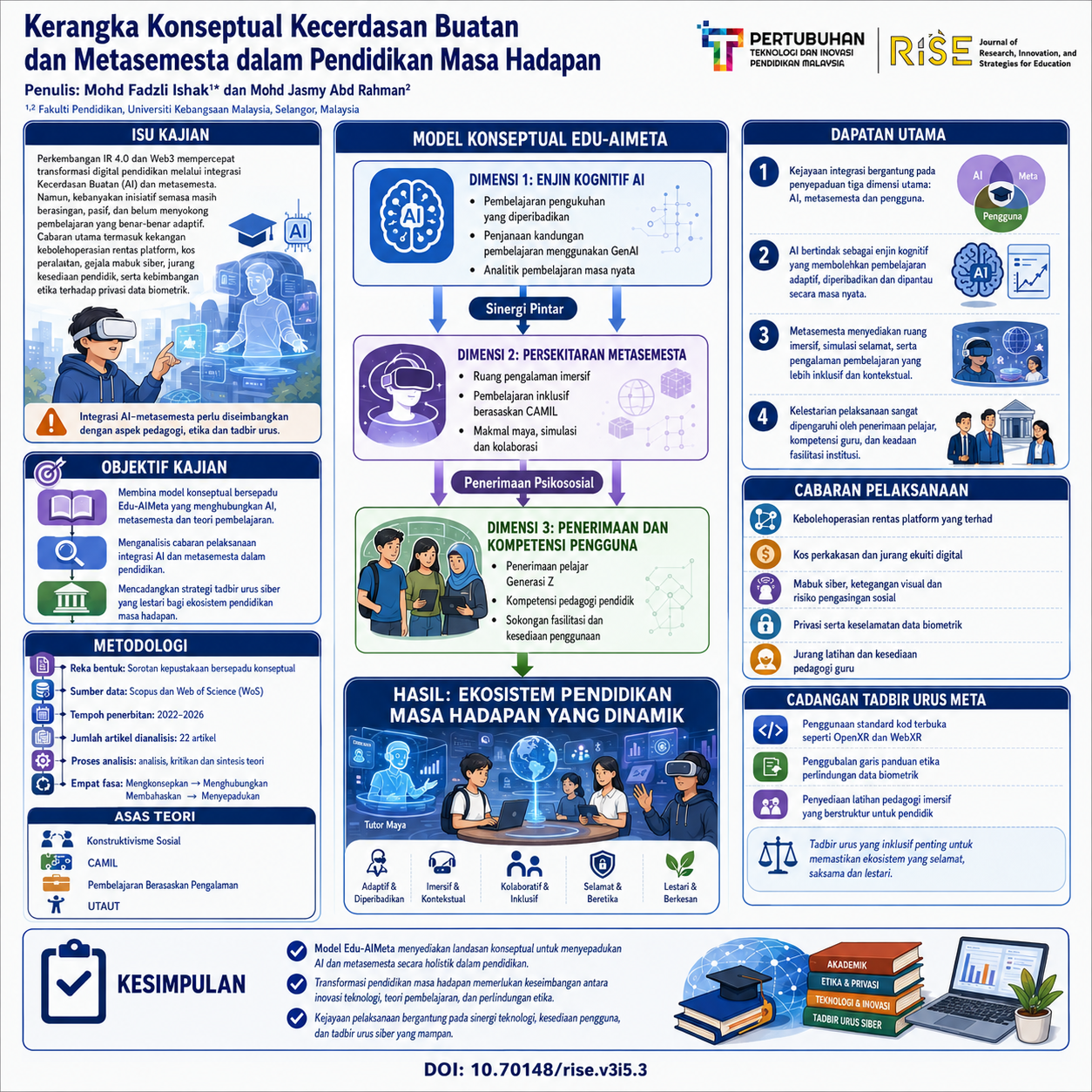
Perkembangan pesat Revolusi Industri 4.0 (IR 4.0) dan Web3 memangkinkan transformasi digital dalam sektor pendidikan menerusi penumpuan teknologi Kecerdasan Buatan (AI) dan metasemesta. Walau bagaimanapun, sebahagian besar inisiatif sedia ada masih bersifat berasingan dan pasif tanpa keupayaan pembelajaran yang boleh disuaikan. Inisiatif ini juga berhadapan dengan kekangan kebolehoperasian rentas platform, gejala mabuk siber, jurang kesediaan pendidik, serta kebimbangan etika berkaitan dengan privasi data biometrik. Sehubungan dengan itu, kajian ini dijalankan dengan objektif untuk membina model konseptual bersepadu Edu-AIMeta yang menghubungkan dimensi teknologi dengan teori pembelajaran, menganalisis cabaran pelaksanaan secara kritis, dan mengemukakan strategi tadbir urus siber yang lestari. Bagi mencapai matlamat tersebut, kajian ini menerapkan reka bentuk sorotan kepustakaan konseptual bersepadu dengan menganalisis dan mensintesis secara kritis perspektif teoretikal daripada 22 artikel yang diterbitkan antara tahun 2022 hingga 2026 menerusi pangkalan data Scopus dan Web of Science (WoS). Hasil dapatan kajian merumuskan tiga dimensi utama keberhasilan integrasi, iaitu enjin kognitif AI, persekitaran metasemesta spatial, serta penerimaan dan kompetensi pengguna, khususnya dalam kalangan pelajar Generasi Z dan pendidik. Sebagai langkah ke hadapan, kajian ini mencadangkan pembangunan kerangka tadbir urus meta yang inklusif menerusi penerapan standard kod terbuka, penggubalan garis panduan etika perlindungan data biometrik, serta penyediaan program latihan pedagogi imersif secara berstruktur bagi menjamin kelestarian ekosistem pendidikan masa hadapan yang selamat dan saksama.
Rujukan
Abdelmagid, A. S., Jabli, N. M., Al-Mohaya, A. Y., & Teleb, A. A. (2025). Integrating interactive metaverse environments and generative artificial intelligence to promote the green digital economy and e-entrepreneurship in higher education. Sustainability, 17(12), 5594. https://doi.org/10.3390/su17125594
Almeman, K., EL Ayeb, F., Berrima, M., Issaoui, B., & Morsy, H. (2025). The Integration of AI and Metaverse in Education: A Systematic Literature Review. Applied Sciences, 15(2), 863. https://doi.org/10.3390/app15020863
Alotaibi, N. (2026). Metaverse adoption among university Generation Z. Computers and Education Open, 10, 100340. https://doi.org/10.1016/j.caeo.2026.100340
Alzubaidi, L., Fadhel, M. A., & Duhaim, A. M. (2024). Navigating the metaverse: unraveling the impact of artificial intelligence. Artificial Intelligence Review, 57(2), 36. https://doi.org/10.1007/s10462-024-10881-5
Chong, A. P., Wong, K.-T., Vestly, K. L. S., & Kumar, K. S. (2026). Signs, shapes, and spaces: A CAMIL-informed qualitative study of metaverse geometry learning for deaf and hard-of-hearing students. Education Sciences, 16(2), 185. https://doi.org/10.3390/socsci15030191
Cukurova, M. (2025). The interplay of learning, analytics and artificial intelligence in education: A vision for hybrid intelligence. British Journal of Educational Technology, 56(2), 469–488. https://doi.org/10.1111/bjet.13514
Elsokkary, N., Khan, W., Shurrab, M., & Al-Nasraween, M. (2026). Reinforcement learning and the Metaverse: A symbiotic collaboration. Smart Learning Environments, 13(1), 1–18. https://doi.org/10.1007/s10462-025-11433-1
Flores-Castañeda, R. O., Olaya-Cotera, S., & Iparraguirre-Villanueva, O. (2024). Benefits of Metaverse Application in Education: A Systematic Review. International Journal of Engineering Pedagogy (iJEP), 14(1), 65–81. https://doi.org/10.3991/ijep.v14i1.42421
Jabbouri, R., Issa, H., Dakroub, R., & Ankit, A. (2025). Unlocking immersive education: The emergence of the meta-governance framework. Information Technology & People, 38(4), 2069–2093. https://doi.org/10.1108/ITP-10-2023-1070
Kolb, D. A. (1984). Experiential learning: Experience as the source of learning and development. Prentice-Hall.
Krishnan, C., & Chowdhury, D. (2024). Navigating complexity: Thematic insights into ethical challenges and metaverse integration. Cogent Education, 11(1), 2428110. https://doi.org/10.1080/2331186X.2024.2428110
Kye, B., Han, N., Kim, Y., Park, Y., & Jo, S. (2021). Educational applications of metaverse: Possibilities and limitations. Journal of Educational Evaluation for Health Professions, 18, 32. https://doi.org/10.3352/jeehp.2021.18.32
MacInnis, D. J. (2011). A framework for conceptual contributions in marketing. Journal of Marketing, 75(4), 136–154. https://doi.org/10.1509/jmkg.75.4.136
Mahmoud, A. B. (2024). Exploring the public's beliefs, emotions and sentiments towards the adoption of the metaverse in education: A qualitative inquiry using big data. British Educational Research Journal, 50(5), 2320–2341. https://doi.org/10.1002/berj.4026
Makransky, G., & Petersen, G. B. (2021). The Cognitive Affective Model of Immersive Learning (CAMIL): A theoretical framework-based measure of learning in immersive virtual reality. Educational Psychology Review, 33(1), 1–37. https://doi.org/10.1007/s10648-020-09586-2
Mishra, A., Masih, J., Rajendran, I., Srinivasan, R., & Gupta, K. (2025). From Lecture Halls to Metaverse Worlds: A New Era in Engineering Education. International Journal of Engineering Pedagogy (iJEP), 15(8), 17–30. https://doi.org/10.3991/ijep.v15i8.59069
Mystakidis, S. (2022). Metaverse. Encyclopedia, 2(1), 486–497. https://doi.org/10.3390/encyclopedia2010031
Ortega-Rodríguez, P. J. (2022). From extended reality to the metaverse: A critical reflection on contributions to education. Teoría de la Educación. Revista Interuniversitaria, 34(2), 189–208. https://doi.org/10.14201/teri.27848
Owusu-Antwi, K., & Amenuvor, F. E. (2023). Understanding the metaverse: A review of virtual worlds and augmented reality environments. Current Journal of Applied Science and Technology, 42(23), 42–48. https://doi.org/10.9734/cjast/2023/v42i234172
Pari-Bedoya, I. N. M. A. (2023). Smart Learning in Virtual Worlds: A Systematic Literature Review on the Usage and Applications of Metaverse in Education. International Journal of Learning, Teaching and Educational Research, 22(9), 85–101. https://doi.org/10.26803/ijlter.22.9.5
Prabowo, P., Utama, I. D., & Rahmatillah, I. (2025). The role of knowledge of AI, AR/VR, and the metaverse of higher education students in enhancing students' business ideation. Journal of Entrepreneurship Education, 28(1), 1–15. https://doi.org/10.1080/2331186X.2025.2526897
Rachmadtullah, R., Setiawan, B., Wasesa, A. J. A., & Wicaksono, J. W. (2023). Elementary school teachers' perceptions of the potential of metaverse technology as a transformation of interactive learning media in Indonesia. International Journal of Innovative Research and Scientific Studies, 6(1), 128–136. https://doi.org/10.53894/ijirss.v6i1.1119
Sripan, T., & Jeerapattanatorn, P. (2025). Metaverse-based learning: A comprehensive review of current trends, challenges, and future implications. Contemporary Educational Technology, 17(3), ep584. https://doi.org/10.30935/cedtech/16434
Sun, H., Choi, S., Wong, P. Y. P., Shen, J. D., Francisco, M. L. L., & Nurgissayeva, A. (2025). Uncovering the drivers of intent to use the metaverse: Diverse experiences in sustainability education. Discover Sustainability, 6, Article 152. https://doi.org/10.1007/s43621-025-00903-9
Svoboda, P., & Knihová, L. (2025). Exploring the future of education: Integrating metaverse and AI tools to enhance learning experiences. TEM Journal, 14(1), 631–643. https://doi.org/10.18421/TEM141-56
Tlili, A., Huang, R., Shehata, B., Liu, D., Zhao, J., Metwally, A. H. S., Wang, Y., Denden, M., Bozkurt, A., & Burgos, D. (2022). Is metaverse in education a blessing or a curse: A combined content and bibliometric analysis. Smart Learning Environments, 9(1), 24. https://doi.org/10.1186/s40561-022-00205-x
Torraco, R. J. (2016). Writing integrative literature reviews: Using the past and present to explore the future. Human Resource Development Review, 15(4), 404–428. https://doi.org/10.1177/1534484316671606
Venkatesh, V., Morris, M. G., Davis, G. B., & Davis, F. D. (2003). User acceptance of information technology: Toward a unified view. MIS Quarterly, 27(3), 425–478. https://doi.org/10.2307/30036540
Vieriu, A. M., & Petrea, G. (2025). The Impact of Artificial Intelligence (AI) on Students’ Academic Development. Education Sciences, 15(3), 343. https://doi.org/10.3390/educsci15030343
Vygotsky, L. S. (1978). Mind in society: The development of higher psychological processes. Harvard University Press.
Wong, G. W. C., Wong, P. P. Y., & Chong, C. (2024). Virtual to Reality: Understanding the role of metaverse as a pedagogical strategy. The Electronic Journal of e-Learning, 22(3), 95–108. https://doi.org/10.34190/ejel.21.6.3219
Muat turun
Diterbitkan
Terbitan
Bahagian
Lesen
Hak Cipta (c) 2025 MOHD FADZLI BIN ISHAK, Mohd Jasmy Abd Rahman (Author)

Kerja ini dilesenkan di bawah Creative Commons Attribution 4.0 International License.