Kerangka Mekanisme Adaptif Bagi Integrasi Pembelajaran Berasaskan Permainan Digital Dalam Pendidikan Matematik Sekolah Menengah (Miad-M)
DOI:
https://doi.org/10.70148/rise.v3i5.7Kata kunci:
Kerangka MIAD-M, Pembelajaran Berasaskan Permainan Digital (DGBL), Matematik Sekolah Menengah, Kerangka Konseptual, Era DigitalAbstrak
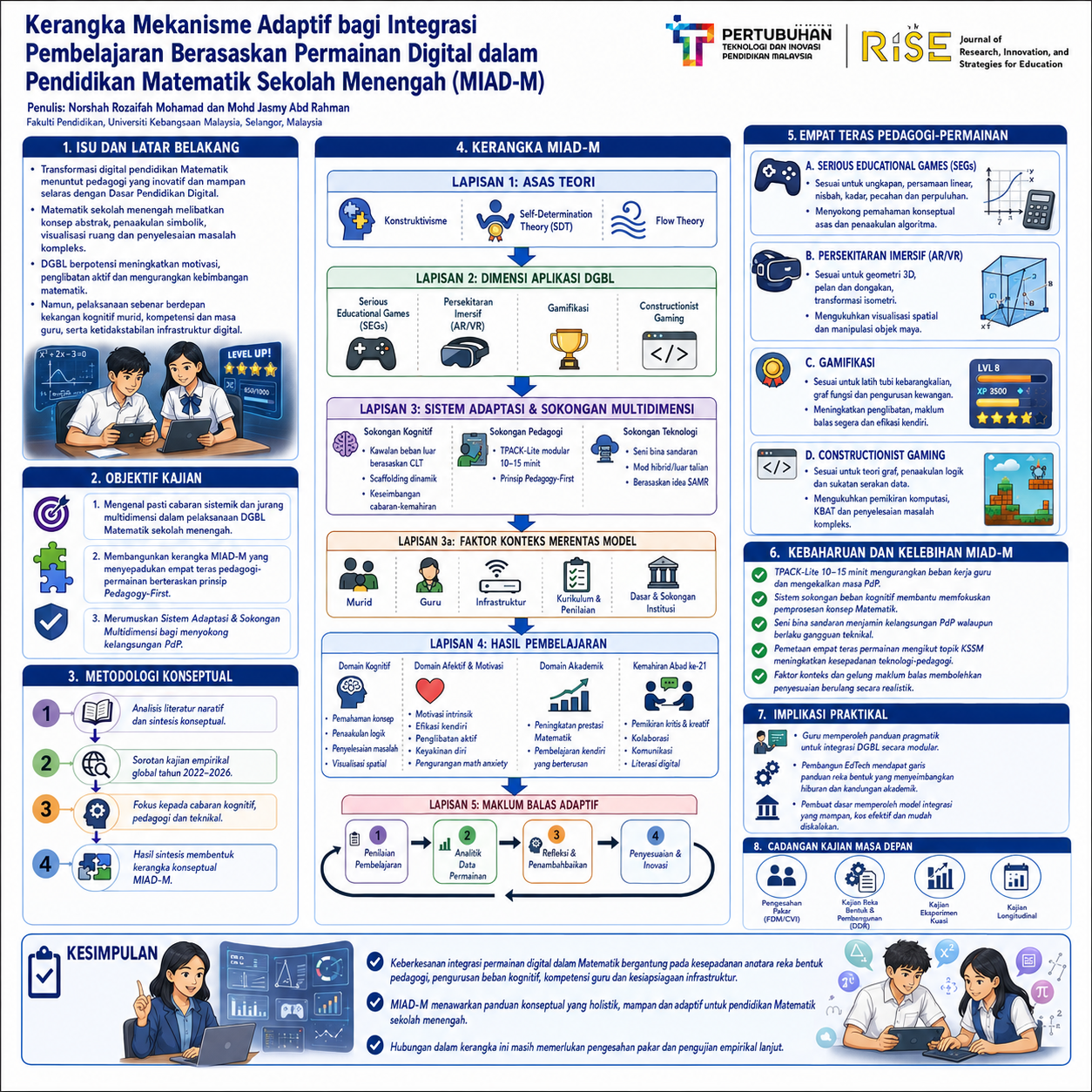
Transformasi digital dalam pendidikan Matematik menuntut pengintegrasian pedagogi yang inovatif dan mampan, selaras dengan hasrat Dasar Pendidikan Digital (DPD) negara. Walau bagaimanapun, pelaksanaan Pembelajaran Berasaskan Permainan Digital (Digital Game-Based Learning, DGBL) di bilik darjah sering kali berhadapan dengan kekangan multidimensi yang merangkumi isu beban kognitif luaran murid, kekangan kompetensi pedagogi dan masa guru, serta isu ketidakstabilan infrastruktur digital sekolah. Justeru, kertas konsep ini bertujuan mengemukakan Kerangka Mekanisme Adaptif bagi Integrasi Pembelajaran berasaskan Permainan Digital dalam Pendidikan Matematik Sekolah Menengah (MIAD-M) sebagai satu kerangka konseptual yang holistik bagi memperkasakan pengajaran dan pembelajaran Matematik sekolah menengah dalam era digital. Kerangka ini dibangunkan melalui pendekatan analisis literatur naratif serta sintesis konseptual terhadap kajian empirikal global yang diterbitkan antara tahun 2022 hingga 2026. Secara strukturnya, MIAD-M menyepadukan empat Teras Integrasi Pedagogi-Permainan, iaitu Serious Educational Games (SEGs), Persekitaran Pembelajaran Imersif (AR/VR), Gamifikasi, dan Constructionist Gaming yang dipetakan secara fungsional mengikut keperluan topik-topik Matematik sekolah menengah. Nilai kebaharuan (novelty) utama kerangka ini terletak pada komponen Sistem Adaptasi dan Sokongan Multidimensi yang merangkumi tiga elemen kuncinya: protokol sokongan kognitif bagi pengurusan keseimbangan cabaran-kemahiran, sokongan pedagogi melalui pendekatan modular "TPACK-Lite" sepanjang 10 hingga 15 minit, serta sokongan teknikal berasaskan seni bina sandaran. Pembinaan kerangka MIAD-M ini memberikan sumbangan teori yang penting melalui gabungan pelbagai teori pembelajaran digital. Selain itu, ia menyediakan panduan praktikal yang mampan, mudah diperluas, dan kos efektif untuk pendidik, pembangun EdTech, serta pembuat dasar dalam menjayakan transformasi digital yang lebih inklusif dan dinamik.
Rujukan
Akçayır, M., & Akçayır, G. (2017). Advantages and challenges associated with augmented reality for education: A systematic review of the literature. Educational Research Review, 20, 1–11. https://doi.org/10.1016/j.edurev.2016.11.002
Cals, J. W., & Kotz, D. (2013). Effective writing and publishing scientific papers, part X: Measuring research output. Journal of Clinical Epidemiology, 66(4), 359. https://doi.org/10.1016/j.jclinepi.2013.01.003
Christopoulos, A., Mystakidis, S., Kurczaba, J., Laakso, M. J., & Stylios, C. (2024). Is immersion in 3D virtual games associated with mathematical ability improvement in game-based learning? International Journal of Science and Mathematics Education, 22(7), 1479–1499. https://doi.org/10.1007/s10763-023-10416-5
Csikszentmihalyi, M. (1990). Flow: The psychology of optimal experience. Harper & Row.
Deci, E. L., & Ryan, R. M. (1985). Intrinsic motivation and self-determination in human behavior. Plenum Press.
Dehghanzadeh, H., Farrokhnia, M., Dehghanzadeh, H., Taghipour, K., & Noroozi, O. (2024). Using gamification to support learning in K-12 education: A systematic literature review. British Journal of Educational Technology, 55(1), 34–70. https://doi.org/10.1111/bjet.13354
Dengel, A. (2022). What is immersive learning? In Proceedings of the 2022 8th International Conference of the Immersive Learning Research Network (iLRN) (pp. 1–5). IEEE. https://doi.org/10.23919/iLRN55037.2022.9815941
Deterding, S., Dixon, D., Khaled, R., & Nacke, L. (2011). From game design elements to gamefulness: Defining "gamification". In Proceedings of the 15th International Academic MindTrek Conference: Envisioning Future Media Environments (pp. 9–15). ACM. https://doi.org/10.1145/2181037.2181040
Ersozlu, Z. (2024). Exploring game-based learning to enhance mathematics teaching and learning: A case study of year 6. Contemporary Educational Technology, 16(3), em512. https://doi.org/10.30935/cedtech/18747
Fuentes-Riffo, K., Salcedo-Lagos, P., Sanhueza-Campos, C., Pinacho-Davidson, P., Friz-Carrillo, M., Kotz-Grabole, G., & Espejo-Burkart, F. (2023). The influence of gamification on high school students' motivation in geometry lessons. Sustainability, 15(21), 15432. https://doi.org/10.3390/su152115432
Gee, J. P. (2003). What video games have to teach us about learning and literacy. Palgrave Macmillan.
Hainey, T., Connolly, T. M., Boyle, E. A., Wilson, A., & Razak, A. (2016). A systematic literature review of games-based learning empirical evidence in primary, secondary and higher education. Computers & Education, 102, 202–223. https://doi.org/10.1016/j.compedu.2016.09.001
Hanggara, Y., Qohar, A., & Sukoriyanto. (2024). The impact of augmented reality-based mathematics learning games on students' critical thinking skills. International Journal of Interactive Mobile Technologies, 18(7), 173–187. https://doi.org/10.3991/ijim.v18i07.45210
Ishak, N. A., Luan, W. S., & Mohd Ayub, A. F. (2023). Digital game-based learning in mathematics education: A systematic review of empirical evidence. Eurasia Journal of Mathematics, Science and Technology Education, 19(4), em2243. https://doi.org/10.29333/ejmste/13010
Jaakkola, E. (2020). Designing conceptual articles: Four approaches. AMS Review, 10(1-2), 18–26. https://doi.org/10.1007/s13162-020-00161-0
Jarrah, A. M., Wardat, Y., Fidalgo, P., & Ali, N. (2025). Gamifying mathematics education through Kahoot: Fostering motivation and achievement in the classroom. Research and Practice in Technology Enhanced Learning, 20(10), 1–27. https://doi.org/10.58459/rptel.2025.20010
Jukić Matić, L., & Palha, S. A. G. (2025). Challenges and opportunities in applying constructionist digital games in secondary mathematics education. International Electronic Journal of Mathematics Education, 20(3), em0768. https://doi.org/10.29333/iejme/15124
Kafai, Y. B., & Burke, Q. (2015). Constructionist gaming: Understanding the benefits of making games for learning. Educational Psychologist, 50(4), 313–334. https://doi.org/10.1080/00461520.2015.1122533
Kasım, S., & Deringöl, Y. (2025). Investigating secondary school students' mathematics anxiety and attitudes towards mathematics in the digital era. Journal of Pedagogical Research, 9(1), 88–104. https://doi.org/10.33902/JPR.2025.210
Kementerian Pendidikan Malaysia. (2023). Dasar Pendidikan Digital (DPD). Kementerian Pendidikan Malaysia.
Kitchenham, B., & Charters, S. (2007). Guidelines for performing systematic literature reviews in software engineering (Technical Report No. EBSE 2007-001). Keele University & Durham University.
Koehler, M. J., Mishra, P., & Cain, W. (2013). What is technological pedagogical content knowledge (TPACK)? Journal of Education, 193(3), 13–19. https://doi.org/10.1177/002205741319300303
MacInnis, D. J. (2011). A framework for conceptual contributions in marketing. Journal of Marketing, 75(4), 136–154. https://doi.org/10.1509/jmkg.75.4.136
Mandala, A. S., Anwar, L., Sa'dijah, C., & Zulnaidi, H. (2025). Development of mobile augmented reality-based geometry learning games to facilitate spatial reasoning. Infinity Journal, 14(2), 323–348. https://doi.org/10.22460/infinity.v14i2.p323-348
Mishra, P., & Koehler, M. J. (2006). Technological pedagogical content knowledge: A framework for teacher knowledge. Teachers College Record, 108(6), 1017–1054. https://doi.org/10.1111/j.1467-9620.2006.00684.x
Moral-Sánchez, S. N., Sánchez-Compaña, M. T., & Sánchez-Cruzado, C. (2022). Flipped learning model enriched with gamification educational platforms for learning geometry. Pixel-Bit, Revista de Medios y Educación, 65, 149–182. https://doi.org/10.12795/pixelbit.93538
OECD. (2023). Digital education outlook 2023: Towards an effective digital education ecosystem. OECD Publishing. https://doi.org/10.1787/c74f03de-en
Page, M. J., McKenzie, J. E., Bossuyt, P. M., Boutron, I., Hoffmann, T. C., Mulrow, C. D., Shamseer, L., Tetzlaff, J. M., Akl, E. A., Welch, V., & Moher, D. (2021). The PRISMA 2020 statement: An updated guideline for reporting systematic reviews. Systematic Reviews, 10(1), 1–11. https://doi.org/10.1186/s13643-021-01626-4
Papert, S. (1980). Mindstorms: Children, computers, and powerful ideas. Basic Books.
Piaget, J. (1952). The origins of intelligence in children. International Universities Press.
Plass, J. L., Homer, B. D., & Kinzer, C. K. (2015). Foundations of game-based learning. Educational Psychologist, 50(4), 258–283. https://doi.org/10.1080/00461520.2015.1122533
Polydoros, G., & Antoniou, A. S. (2025). Empowering students with learning disabilities: Examining serious digital games' potential for performance and motivation in math education. Behavioral Sciences, 15(3), 205. https://doi.org/10.3390/bs15030205
Pramuditya, S. A., Noto, M. S., & Azzumar, F. (2022). Characteristics of students' mathematical problem solving abilities in open-ended-based virtual reality game learning. Infinity Journal, 11(2), 255–272. https://doi.org/10.22460/infinity.v11i2.p255-272
Pramuditya, S. A., Widiyasari, R., & Fitriadi, P. (2025). Enhancing 3D geometry learning: A differentiated educational game approach. Infinity Journal, 14(4), 1043–1064. https://doi.org/10.22460/infinity.v14i4.p1043-1064
Puentedura, R. R. (2006). Transformation, technology, and education. Hippasus.
Ragni, M., Tarallo, A., & Di Tore, P. A. (2023). Immersive learning environments and mathematics education: A systematic mapping study. Education and Information Technologies, 28(8), 9875–9901. https://doi.org/10.1007/s10639-023-11612-4
Sailer, M., & Homner, L. (2020). The gamification of learning: A meta-analysis. Educational Research Review, 29, 100301. https://doi.org/10.1016/j.edurev.2019.100301
Sansyzbayev, A., Kadirbayeva, R., Daiyrbekov, S., & Zhetpisbayeva, G. (2025). Applying gamification technology to enhance student engagement in high school mathematics. International Journal of Information and Education Technology, 15(7), 1398–1409. https://doi.org/10.18178/ijiet.2025.15.7.2105
Suparman, La'ia, H. T., Makur, A. P., Turmudi, Juandi, D., Helsa, Y., & Masniladevi. (2024). Development of Ucing Sumput digital game to stabilize students' achievement emotions in mathematics. Qubahan Academic Journal, 4(4), 156–177. https://doi.org/10.48161/qaj.v4n4a297
Suri, H. (2011). Purposeful sampling in qualitative research synthesis. Qualitative Research Journal, 11(2), 63–75. https://doi.org/10.3316/QRJ1102063
Susilawati, W., Sharov, S., Pasqa, M., & Malik, H. (2025). Integrating realistic mathematics education, AI, and gamification to enhance students' learning motivation and problem-solving skills. Journal on Mathematics Education, 16(4), 1257–1282. https://doi.org/10.22460/jme.v16i4.pp1257-1282
Sweller, J. (1988). Cognitive load during problem solving: Effects on learning. Cognitive Science, 12(2), 257–285. https://doi.org/10.1207/s15516709cog1202_4
Zaura, B., Elizar, E., Johar, R., Hidayat, M., Tanjung, A., & Mastura, A. (2026). Gamified learning and fraction heroes: Effects on students' mastery and gender differences. Journal of Information Technology Education: Innovations in Practice, 25, 1–17. https://doi.org/10.28945/5431
Zekeik, H., Mouali, S., Sefian, M. L., & Khalfouni, M. (2025). Enhancing geometry learning with mobile augmented reality: Evaluating the GeoFormeAR application in middle school education. International Journal of Interactive Mobile Technologies, 19(20), 113–131. https://doi.org/10.3991/ijim.v19i20.49001
Muat turun
Diterbitkan
Terbitan
Bahagian
Lesen
Hak Cipta (c) 2025 Norshah Rozaifah Mohamad, Mohd Jasmy Abd Rahman (Author)

Kerja ini dilesenkan di bawah Creative Commons Attribution 4.0 International License.