Kerangka Konseptual Integrasi Kecerdasan Buatan dalam Pembelajaran Inkuiri Biologi Sekolah Menengah
DOI:
https://doi.org/10.70148/rise.v3i5.9Kata kunci:
Kecerdasan Buatan, Pendidikan Biologi, Pembelajaran Inkuiri, Konsep Abstrak, Amalan Meneliti Kebenaran Fakta (Fact-Checking)Abstrak
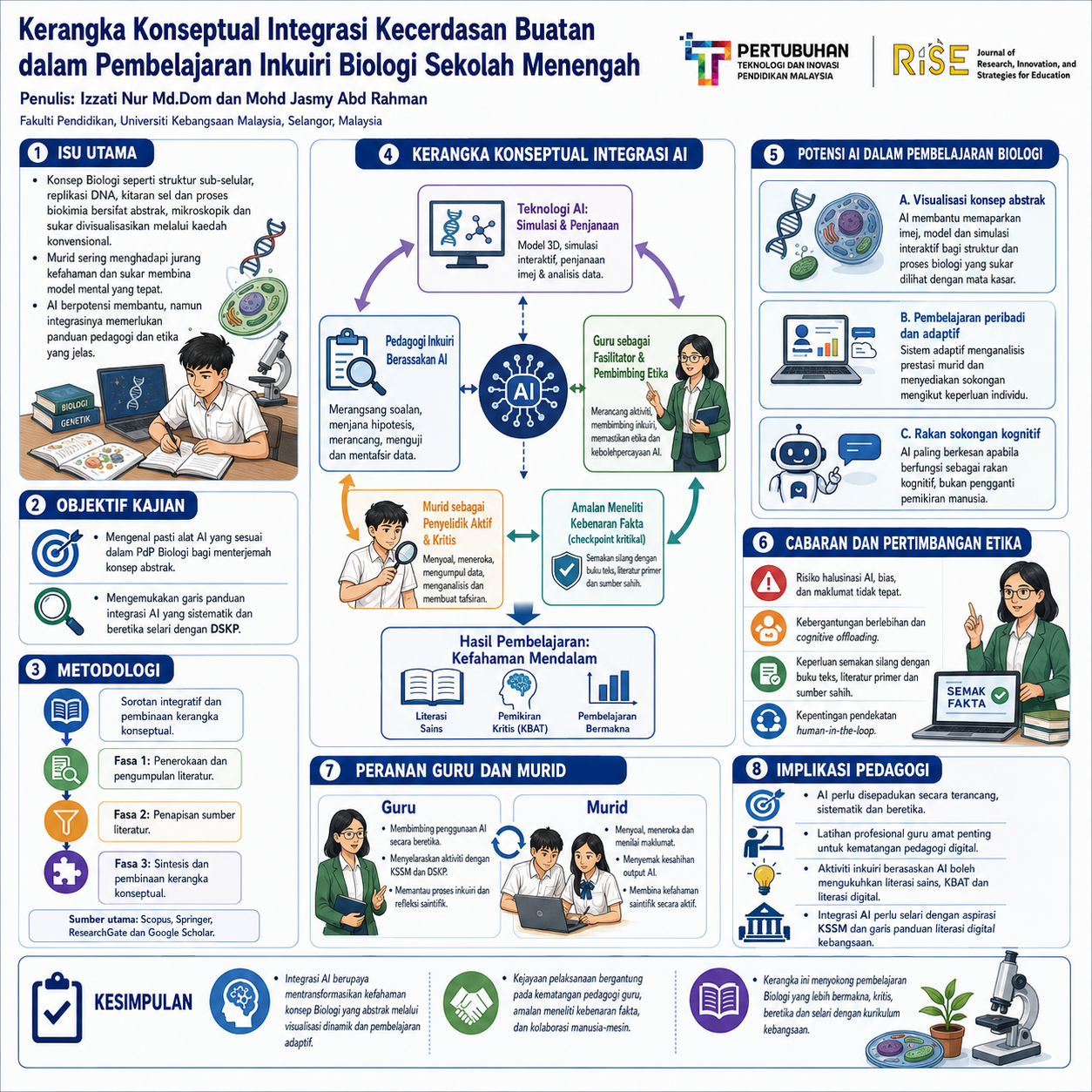
Kertas konsep ini meneroka cara strategik untuk menggabungkan teknologi Kecerdasan Buatan (AI) secara berkesan ke dalam proses pengajaran dan pembelajaran biologi, khususnya bagi membantu pelajar menangani cabaran memahami konsep saintifik yang sukar dilihat dengan mata kasar dan bersifat abstrak. Berlandaskan kaedah rujukan kepustakaan secara konseptual, kajian ini meneliti bagaimana alat AI moden dan sistem pembelajaran yang bersesuaian mampu berfungsi sebagai pembantu kognitif serta pemangkin minda yang merangsang cara pelajar berfikir secara mendalam. Dapatan mendedahkan bahawa integrasi teknologi ini menuntut satu persekitaran pembelajaran yang menyeluruh dan seimbang. Persekitaran tersebut menggabungkan peranan guru sebagai fasilitator yang membimbing etika penggunaan, pelajar sebagai penyelidik yang menilai maklumat secara kritis, serta teknologi sebagai penyedia simulasi visual yang dinamik. Melalui paparan imej, model, dan simulasi proses biologi yang interaktif, pelajar dapat membayangkan struktur hidupan dengan lebih mudah dan berkesan. Walau bagaimanapun, kertas ini memberi penekanan yang amat mendalam terhadap kepentingan amalan menyemak kesahihan fakta secara berterusan bagi membendung risiko maklumat palsu, bias, atau rekaan yang mungkin dihasilkan oleh sistem digital. Kesimpulannya, kajian ini mengetengahkan keperluan mendesak terhadap satu kerangka pengajaran yang terancang. Langkah ini penting bagi memastikan kerjasama yang sinergi antara manusia dan mesin mampu memperkukuh literasi sains pelajar, sekali gus selari sepenuhnya dengan aspirasi Kurikulum Standard Sekolah Menengah serta panduan literasi digital kebangsaan.
Rujukan
Ahmedtelba, E., Mitereva, S., & Ponce, M. (2025). Critical integration of generative AI in higher education: Cognitive, pedagogical and ethical perspectives. London Journal of Research in Humanities and Social Science, 25(13), 1–12.
Al Darayseh, A. (2023). Acceptance of artificial intelligence in teaching science: Science teachers’ perspective. Computers and Education: Artificial Intelligence, 4, 100132. https://doi.org/10.1016/j.caeai.2023.100132
Aruleba, K., Sanusi, I. T., Obaido, G., Ogbuokiri, B., & Mienye, I. D. (2025). Beyond the prompt: Student strategies, ethical reflections, and learning with ChatGPT in computer science. Technology, Knowledge and Learning. Advance online publication. https://doi.org/10.1007/s10758-025-09899-7
Ayeni, O. O., Al Hamad, N. M., Chisom, O. N., Osawaru, B., & Adewusi, O. E. (2024). AI in education: A review of personalized learning and educational technology. GSC Advanced Research and Reviews, 18(2), 261–271. https://doi.org/10.30574/gscarr.2024.18.2.0062
Bond, M., Khosrow‐Pour, K., Zawacki‐Richter, O., & O’Shea, S. (2024). A meta systematic review of artificial intelligence in higher education: A call for increased ethics, collaboration, and rigour. International Journal of Educational Technology in Higher Education, 21(1), Article 4. https://doi.org/10.1186/s41239-023-00436-z
Braun, V., & Clarke, V. (2006). Using thematic analysis in psychology. Qualitative Research in Psychology, 3(2), 77–101. https://doi.org/10.1191/1478088706qp063oa
Chakraborty, S., & Harikrishnan, M. (2026). Barriers and enablers to implementing artificial intelligence in life-sciences education: A mixed-methods study. International Journal of Innovative Science and Research Technology, 11(3), 1776–1784. https://doi.org/10.38124/ijisrt/26mar1073
Cooper, G. (2023). Examining science education in ChatGPT: An exploratory study of generative artificial intelligence. Journal of Science Education and Technology, 32(4), 444–452. https://doi.org/10.1007/s10956-023-10039-y
Dao, X.-Q., & Le, N.-B. (2023). LLMs performance on Vietnamese high school biology examination. I.J. Modern Education and Computer Science, 2023(6), 14–30. https://doi.org/10.5815/ijmecs.2023.06.02
Deci, E. L., & Ryan, R. M. (2000). The "what" and "why" of goal pursuits: Human needs and the self-determination of behavior. Psychological Inquiry, 11(4), 227–268. https://doi.org/10.1207/S15327965PLI1104_01
Hu, Z., Wu, Y., & Luo, Z. (2026). Student voices: Synergising artificial and human intelligence in health science education. BMC Medical Education, 26, Article 185. https://doi.org/10.1186/s12909-025-08545-1
Jha, M., & Atif, A. (2025). Reimagining pedagogy for the GenAI era: Frameworks, challenges and institutional strategies. Australasian Journal of Educational Technology, 41(5), 56–73. https://doi.org/10.14742/ajet.10645
Kementerian Pendidikan Malaysia. (2026). Buku panduan literasi AI dalam pendidikan. Bahagian Sumber dan Teknologi Pendidikan.
Kesgin, E. (2025). Bibliometric analysis and predictive modeling map the role of artificial intelligence in science education from research trends to classroom integration. Discover Education, 3(1), Article 45. https://doi.org/10.1007/s44217-025-00906-8
Küçükuncular, A. (2025). Learning with, rather than through, AI: Co-designing science education for critical AI literacy. Frontiers in Education, 10, Article 1716353. https://doi.org/10.3389/feduc.2025.1716353
Lee, J., Park, S., & Kim, D. (2023). Designs and practices using generative AI for sustainable student discourse and knowledge creation. Smart Learning Environments, 10, Article 59. https://doi.org/10.1186/s40561-023-00279-1
Luckin, R. (2023). Machine learning and human intelligence: The future of education in the age of AI. UCL Press.
Miao, F., & Holmes, W. (2023). Guidance for generative AI in education and research. UNESCO.
Papaneophytou, C., & Nicolaou, S. A. (2025). Promoting critical thinking in biological sciences in the era of artificial intelligence: The role of higher education. Trends in Higher Education, 4(2), 24. https://doi.org/10.3390/higheredu4020024
Piaget, J. (1972). Intellectual evolution from adolescence to adulthood. Human Development, 15(1), 1–12. https://doi.org/10.1159/000271225
Snyder, H. (2019). Literature review as a research methodology: An overview and guidelines. Journal of Business Research, 104, 333–339. https://doi.org/10.1016/j.jbusres.2019.07.039
Tan, M. J. T., & Maravilla, N. M. A. (2024). Shaping integrity: Why generative artificial intelligence does not have to undermine education. Frontiers in Artificial Intelligence, 7, 1471224. https://doi.org/10.3389/frai.2024.1471224
Tricco, A. C., Lillie, E., Zarin, W., O’Brien, K. K., Colquhoun, H., Levac, D., Moher, D., Peters, M. D., Horsley, T., & Weeks, L. (2018). PRISMA extension for scoping reviews (PRISMA-ScR): Checklist and explanation. Annals of Internal Medicine, 169(7), 467–473. https://doi.org/10.7326/M18-0850
Usak, M. (2024). Artificial intelligence in biology education. Journal of Baltic Science Education, 23(5), 806–808. https://doi.org/10.33225/jbse/24.23.806
Vasconcelos M. A. R., & dos Santos, R. P. (2025). Enhancing STEM learning with ChatGPT and Bing Chat as objects-to-think-with: A case study. Centre for Generative Artificial Intelligence in Cognition and Education. https://doi.org/10.29333/ejmste/13313
Vendrell, M., & Johnston, S.-K. (2024). Scaffolding critical thinking with generative AI: Design principles for integrating large language models in higher education. Computers and Education: Artificial Intelligence, 7, 100286. https://doi.org/10.1016/j.caeai.2026.100572
Victoriano, A. M., & Tamayo, M. A. L. (2025). Exploring the perception of science teachers in integration of AI in biology education: Literature review. Formosa Journal of Science and Technology (FJST), 4(8), 2603–2616. https://doi.org/10.55927/fjst.v4i8.211
Disclaimer/Publisher’s Note: The statements, opinions and data contained in all publications are solely those of the individual author(s) and contributor(s) and not of RISE and/or the editor(s). RISE and/or the editor(s) disclaim responsibility for any injury to people or property resulting from any ideas, methods, instructions or products referred to in the content.
Muat turun
Diterbitkan
Terbitan
Bahagian
Lesen
Hak Cipta (c) 2025 Izzati Nur Md.Dom, Mohd Jasmy Abd Rahman (Author)

Kerja ini dilesenkan di bawah Creative Commons Attribution 4.0 International License.