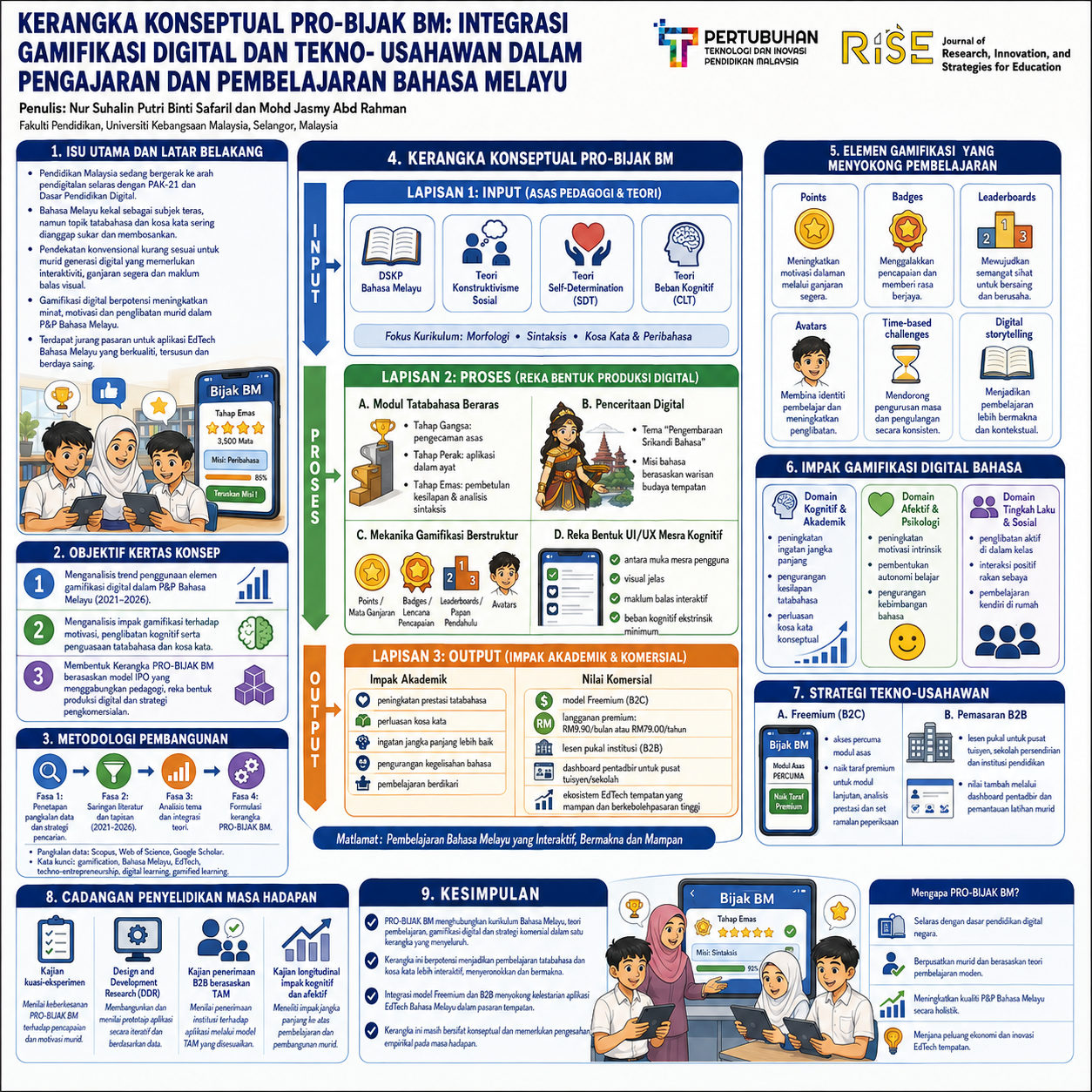
Kerangka Konseptual PRO-BIJAK BM: Integrasi Gamifikasi Digital dan Tekno-Usahawan dalam Pengajaran dan Pembelajaran Bahasa Melayu
DOI:
https://doi.org/10.70148/rise.v3i5.6Kata kunci:
Gamifikasi Digital, Bahasa Melayu, Tekno-Usahawan, Kerangka Produksi, Aplikasi Bijak BMAbstrak
Kertas konsep ini membentangkan Kerangka Konseptual PRO-BIJAK BM (Pembangunan-Gamifikasi-Inovatif Bahasa Melayu), iaitu satu struktur panduan pembangunan aplikasi teknologi pendidikan yang menghuraikan potensi integrasi elemen gamifikasi digital dan strategi tekno-usahawan dalam pengajaran dan pembelajaran (P&P) Bahasa Melayu. Komponen struktur bahasa seperti tatabahasa dan kosa kata berisiko dianggap kurang menarik oleh sesetengah pelajar generasi digital apabila disampaikan menerusi pendekatan konvensional secara sehala semata-mata. Bagi menangani isu ini, pembentukan kerangka ini dilaksanakan menerusi analisis konseptual berasaskan literatur dengan menyintesis lima elemen utama: (1) Dokumen Standard Kurikulum dan Pentaksiran (DSKP) Bahasa Melayu sebagai teras kandungan; (2) Teori Konstruktivisme Sosial sebagai asas persekitaran interaktif; (3) Teori Motivasi Self-Determination (SDT) dan Teori Beban Kognitif (CLT) sebagai pendorong intrinsik serta pengawal beban kognitif murid; dan (4) Model Input-Proses-Output (IPO) sebagai struktur panduan pembangunan perisian. Secara khusus, kertas konsep ini mengemukakan cadangan reka bentuk aplikasi "Bijak BM" yang menyerapkan mekanika permainan berstruktur, penceritaan digital, antaramuka mesra pengguna (UI/UX), serta pelan pengkomersialan mampan menerusi model Freemium dan pemasaran Business-to-Business (B2B). Sumbangan utama kerangka ini terletak pada penyediaan panduan konseptual komprehensif yang menghubungkan teori pedagogi bahasa dengan realiti pasaran teknologi pendidikan (EdTech) tempatan.
Rujukan
Ahmad, N., Hashim, H., & Yunus, M. M. (2024). Sustaining student engagement in language learning through custom-built gamified mobile applications. Malaysian Journal of Educational Technology, 24(1), 45-58. https://doi.org/10.5281/zenodo.10893410
Alqahtani, M. F., Bhattarai, B. M., & Huang, Y. (2023). Generative AI in differentiated instruction: A quality assessment study with special education teachers. Education Sciences, 13(8), 821. https://doi.org/10.3390/educsci13080821
Boyle, J. R., Rosen, S. M., & Forchelli, G. (2021). Exploring metacognitive strategy use during note-taking for students with learning disabilities. British Journal of Educational Technology, 52(4), 1397–1412. https://doi.org/10.1111/bjet.13093
Chen, O., Castro-Alonso, J. C., Paas, F., & Sweller, J. (2023). The expertise reversal effect and working memory: Instructional implications for cognitive load theory. Educational Psychology Review, 35(1), 21. https://doi.org/10.1007/s10648-023-09737-5
Darejeh, A., & Singh, D. (2021). A review on user interface design principles to increase software usability for users with less computer literacy. Education and Information Technologies, 26(5), 6315–6344. https://doi.org/10.1007/s10639-021-10537-z
Embi, M. A., Nordin, N. M., & Panah, E. (2024). Artificial intelligence in Malaysian education: Policies, practices, and prospects. Asian Journal of University Education, 20(1), 102–118. https://doi.org/10.24191/ajue.v20i1.25681
Farrokhnia, M., Banihashem, S. K., Noroozi, O., & Wals, A. (2023). A SWOT analysis of ChatGPT: Implications for educational practice and research. Innovations in Education and Teaching International, 61(3), 460–474. https://doi.org/10.1080/14703297.2023.2195846
González-Pérez, L. I., Ramírez-Montoya, M. S., & García-Peñalvo, F. J. (2021). Self-determination theory and digital learning environments: Motivating students with special needs. Computers & Education, 168, 104187. https://doi.org/10.1016/j.compedu.2021.104187
Hassan, R., & Zulkifli, H. (2025). Impak perisian gamifikasi berasaskan ganjaran lencana terhadap penguasaan kosa kata murid sekolah rendah. Jurnal Pendidikan Bahasa Melayu, 15(2), 89-102.
Kementerian Pendidikan Malaysia. (2022). Garis panduan pelaksanaan pendidikan inklusif dan digital murid sekolah di Malaysia. Bahagian Pembangunan Kurikulum.
Kim, S., Song, K., Lockee, B., & Burton, J. (2022). Gamification in learning and education: Enjoy learning like gaming. Computers & Education, 177, 104382. https://doi.org/10.1016/j.compedu.2021.104382
Mayer, R. E. (2021). Multimedia learning (3rd ed.). Cambridge University Press.
Mohamad, M., Yunus, M. M., Hashim, H., & Jeremy, J. S. M. (2021). Teachers' perception towards the use of Quizizz in the teaching and learning of English: A systematic review. Sustainability, 13(11), 6436. https://doi.org/10.3390/su13116436
Nathan, L. S., & Hashim, H. (2023). A systematic review on gamified learning for improving language skills in ESL classrooms. International Journal of Academic Research in Business & Social Sciences, 13(4), 458-469. https://doi.org/10.6007/IJARBSS/v13-i4/16854
Ramli, S., Nor, M. M., & Ismail, A. (2023). Meneroka keberkesanan gamifikasi dalam pengajaran tatabahasa Bahasa Melayu: Satu kajian kuasi-eksperimen. Jurnal Kurikulum & Pengajaran Asia Pasifik, 11(3), 12-25.
Ryan, R. M., & Deci, E. L. (2017). Self-determination theory: Basic psychological needs in motivation, development, and wellness. Guilford Publishing.
Skulmowski, A., & Xu, K. M. (2022). Understanding cognitive load in digital and online learning: A new perspective on extraneous cognitive load. Computers in Human Behavior, 130, 107163. https://doi.org/10.1016/j.chb.2021.107163
Sweller, J. (1988). Cognitive load during problem solving: Effects on learning. Cognitive Science, 12(2), 257-285.
Tlili, A., Shehata, B., Adarkwah, M. A., Bozkurt, A., & Huang, R. (2023). What if the devil is my guardian angel: Chatbots in education. Smart Learning Environments, 10(1), 15. https://doi.org/10.1186/s40561-023-00237-x
Vansteenkiste, M., Ryan, R. M., & Soenens, B. (2022). Basic psychological need theory: Advancements, critical themes, and future directions. Motivation and Emotion, 44(1), 1–31. https://doi.org/10.1007/s11031-019-09818-1
Vygotsky, L. S. (1978). Mind in society: The development of higher psychological processes. Harvard University Press.
Yunus, M. M., Zakaria, S., & Sulaiman, N. A. (2022). Game-based learning platforms in Malay language classrooms: Challenges and opportunities. Asian Journal of University Education, 18(4), 310-323. https://doi.org/10.24191/ajue.v18i4.19821
Zhang, K., Tlili, A., & Burgos, D. (2024). Addressing the impact of generative AI on education: From the perspective of teachers and students. Educational Technology & Society, 27(1), 1–15. https://doi.org/10.30191/ets.202401_27(1).0001
Muat turun
Diterbitkan
Terbitan
Bahagian
Lesen
Hak Cipta (c) 2025 Nur Suhailin Putri Safaril, Mohd Jasmy Abd Rahman (Author)

Kerja ini dilesenkan di bawah Creative Commons Attribution 4.0 International License.