Strategic Innovations to Reshape the Future of Education
DOI:
https://doi.org/10.70148/rise.v3i3.4Keywords:
strategic innovation, education and training, Sustainable Development Goal 4 (SDG 4), developing countries, digital transformation, educational sustainabilityAbstract
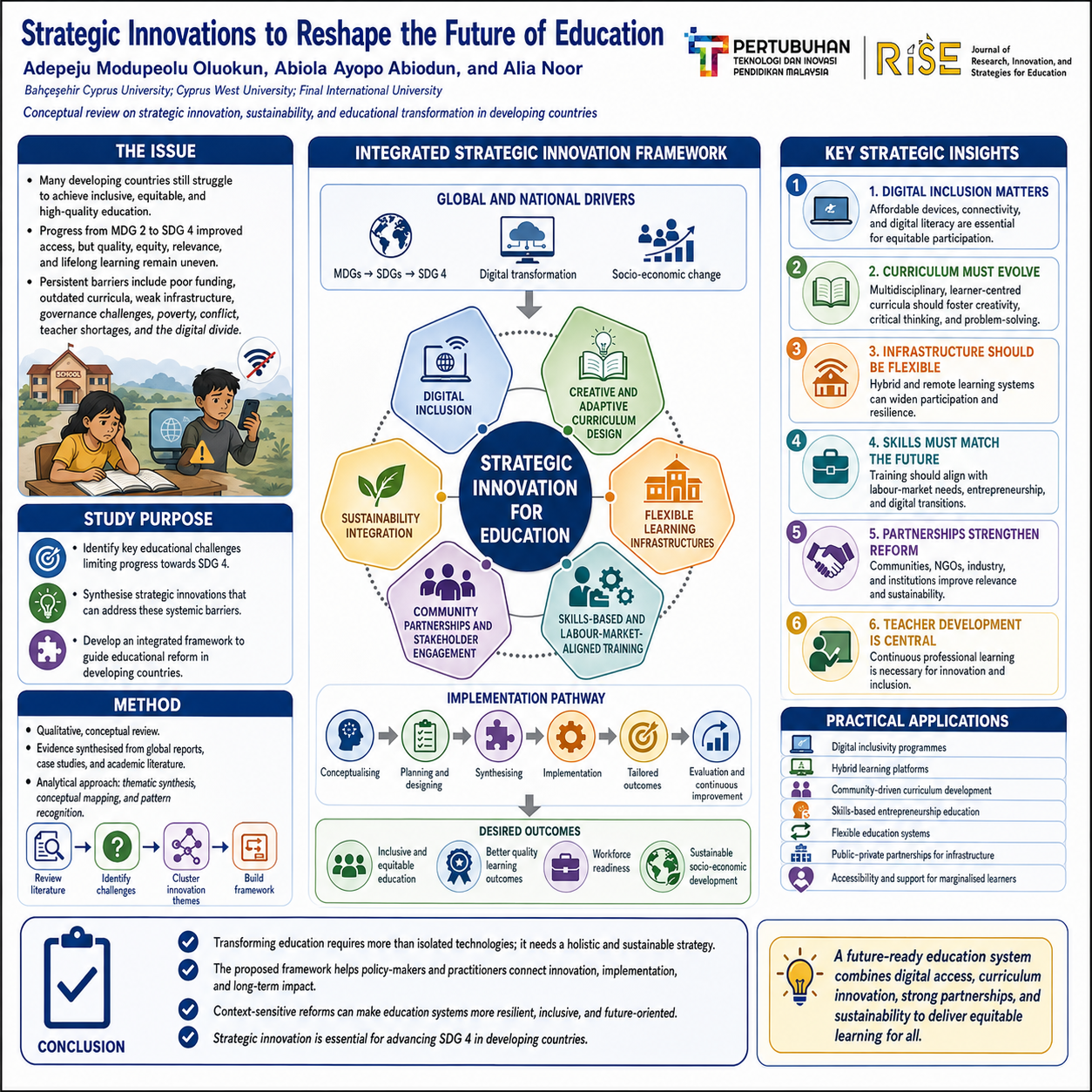
In recent decades, educational scholars and practitioners have developed a range of teaching tools, technologies and techniques to improve teaching and learning and to support wider industrial and digital transformations. Despite, despite these advances, many education systems, particularly in developing countries, still struggle to ensure inclusive, equitable and high-quality education in line with the fourth Sustainable Development Goal 4 (SDG 4). Existing studies often focus on isolated initiatives or technologies, but fail to provide a coherent and context-sensitive framework linking strategic innovation in education and training to the wider agenda of the MDGs and SDGs. This review study takes a qualitative and conceptual approach, synthesising evidence from global reports, case studies and academic literature to identify the key challenges and outline a set of strategic, innovative and transformative actions for developing countries. The paper proposes an integrated framework combining digital inclusion, creative curricula design, flexible learning infrastructures, skills-based training, community partnerships and sustainable practices as mutually reinforcing levers for education reform. By explaining how these strategic innovations can be planned, designed and implemented, the study aims to guide policy makers, institutional leaders and practitioners in redesigning education and training systems in developing regions to better prepare learners for their future works and lives, while promoting sustainable socio-economic development.
References
Akbar, M. (2016). Digital technology shaping teaching practices in higher education. Frontiers in ICT, 1, 1–7.
Akour, M., & Alenezi, M. (2022). Higher education future in the era of digital transformation. Education Sciences, 12(11), 784.
Ali, A. (2023). Exploring the transformative potential of technology in overcoming educational disparities. International Journal of Multidisciplinary Sciences and Arts, 2(1), 1–10.
Annan-Diab, F., & Molinari, C. (2017). Interdisciplinarity: Practical approach to advancing education for sustainability and for the Sustainable Development Goals. The International Journal of Management Education, 15(2), 73–83.
Audebrand, L. K. (2010). Sustainability in strategic management education: The quest for new root metaphors. Academy of Management Learning & Education, 9(3), 413–428.
Aung, T. N., & Khaing, S. S. (2016). Challenges of implementing e-learning in developing countries: A review. In Genetic and Evolutionary Computing: Proceedings of the Ninth International Conference on Genetic and Evolutionary Computing (pp. 405–411). Springer.
Bakytgul, A., Muckanaevich, K. G., Nikolaevna, V. E., Kadyrovna, S. K., Ainagul, I., Ainagul, T., ... & Oryngul, T. (2021). Pedagogical technology: A specific historical approach. Revista San Gregorio, 1(44), 1–12.
Bazić, J. R. (2017). Trends in societal and educational changes generated by the Fourth Industrial Revolution. Sociološki Pregled, 51(4), 526–546.
Bernard, J. (2013). Accelerating educational transformation through ICT: A global perspective. In Creating holistic technology-enhanced learning experiences (pp. 209–216). Brill.
Bright, D. (2022). An integrative review of the potential of wireless assistive technologies and Internet of Things (IoT) to improve accessibility to education for students with disabilities. Assistive Technology, 34(6), 653–660.
Brown, P., & Lauder, H. (1996). Education, globalization and economic development. Journal of Education Policy, 11(1), 1–25.
Brown, P., & Lauder, H. (2012). Globalization, knowledge, and the myth of the magnet economy. In The knowledge economy and lifelong learning (pp. 117–146). Brill.
Brown, M., Dehoney, J., & Millichap, N. (2015). The next generation digital learning environment: A report on research. EDUCAUSE.
Burnett, N. (2008). Education for all: An imperative for reducing poverty. Annals of the New York Academy of Sciences, 1136(1), 269–275.
Chan, L., & Costa, S. (2005). Participation in the global knowledge commons: Challenges and opportunities for research dissemination in developing countries. New Library World, 106(3/4), 141–163.
Chinayeva, T. I. (2020). Impact of digitalization on the transformation of the higher education system. Statistics and Economics, 4, 85–95. https://doi.org/10.21686/2500-3925-2020-4-85-95
De Wit, H., & Altbach, P. G. (2021). Internationalization in higher education: Global trends and recommendations for its future. In Higher education in the next decade (pp. 303–325). Brill.
Draboo, S. (2020). Achieving quality in education under SDG 4: Financial challenges and gaps from an Indian perspective. Journal of Education and Practice, 11(3), 1–10.
Ely, A., Fressoli, M., & Van Zwanenberg, P. (2017). New innovation approaches to support the implementation of the Sustainable Development Goals. UNU-MERIT Working Papers, 1–25.
Ermakova, Y. D. (2020). Changing educational trends in the context of global digitalization of society. Vestnik of Samara State Technical University: Psychological and Pedagogical Sciences, 17(2), 87–97.
Esnault, L. (Ed.). (2007). Web-based education and pedagogical technologies: Solutions for learning applications. IGI Global.
Fullan, M. (2006). The future of educational change: System thinkers in action. Journal of Educational Change, 7(3), 113–122.
Glasser, H., & Hirsh, J. (2016). Toward the development of robust learning for sustainability core competencies. Sustainability: The Journal of Record, 9(3), 121–134.
Grano, C., & Prieto, V. C. (2020). Sustainable development goals in higher education. In 26th IJCIEOM–International Joint Conference on Industrial Engineering and Operations Management (Rio de Janeiro).
Kaputa, V., Loučanová, E., & Tejerina-Gaite, F. A. (2022). Digital transformation in higher education institutions as a driver of social oriented innovations. Social Innovation in Higher Education, 61, 81–85.
Kamalov, F., Santandreu Calonge, D., & Gurrib, I. (2023). New era of artificial intelligence in education: Towards a sustainable multifaceted revolution. Sustainability, 15(16), 12451.
Kinshuk, Huang, H. W., Sampson, D., & Chen, N. S. (2013). Trends in educational technology through the lens of the highly cited articles published in the Journal of Educational Technology and Society. Journal of Educational Technology & Society, 16(2), 3–20.
Koissy-Kpein, S. A. (2020). Achieving gender equality in education in Sub-Saharan Africa: Progress and challenges in moving from the MDGs to the SDGs. In Women and sustainable human development: Empowering women in Africa (pp. 143–164).
Law, N., Yuen, A., & Fox, R. (2011). Educational innovations beyond technology: Nurturing leadership and establishing learning organizations. Springer.
Litvinenko, V. S. (2020). Digital economy as a factor in the technological development of the mineral sector. Natural Resources Research, 29(3), 1521–1541.
Malik, R. S. (2018). Educational challenges in the 21st century and sustainable development. Journal of Sustainable Development Education and Research, 2(1), 9–20.
Marginson, S. (2006). Dynamics of national and global competition in higher education. Higher Education, 52, 1–39.
McHaney, R. (2023). The new digital shoreline: How Web 2.0 and millennials are revolutionizing higher education. Taylor & Francis.
McWilliam, E., & Haukka, S. (2008). Educating the creative workforce: New directions for twenty-first century schooling. British Educational Research Journal, 34(5), 651–666.
Meganck, R. A. (2010). The role of water education in achieving the Millennium Development Goals. Reviews in Environmental Science and Bio/Technology, 9, 79–80.
Moallemi, E. A., Malekpour, S., Hadjikakou, M., Raven, R., Szetey, K., Ningrum, D., ... & Bryan, B. A. (2020). Achieving the Sustainable Development Goals requires transdisciplinary innovation at the local scale. One Earth, 3(3), 300–313.
Mulder, K. F. (2016). Strategic competences for concrete action towards sustainability: An oxymoron? Renewable and Sustainable Energy Reviews, 1–6.
Nishchyk, A., & Chen, W. (2018). Integrating universal design and accessibility into computer science curricula: A review of literature and practices in Europe. Studies in Health Technology and Informatics, 256, 56–66.
Nordin, N., & Norman, H. (2018). Mapping the Fourth Industrial Revolution global transformations on 21st century education in the context of sustainable development. Journal of Sustainable Development Education and Research, 2(1), 1–7.
Nosir, K., & Nosirovna, N. N. (2020). Modern pedagogical technologies in the educational process. Schematic Scholars: Education and Computer Science, 1–12.
Ojogwu, C. N. (2009). The challenges of attaining Millennium Development Goals in education in Africa by 2015. College Student Journal, 43(2), 375–384.
Okeshola, F. B. (2012). Challenges facing the realization of Millennium Development Goals in educational reform in Nigeria. European Scientific Journal, 8(3), 201–205.
Ramakrishna, S., Ngowi, A., Jager, H. D., & Awuzie, B. O. (2020). Emerging industrial revolution: Symbiosis of Industry 4.0 and the circular economy—The role of universities. Science, Technology and Society, 25(3), 505–525.
Reddy, S., & Heuty, A. (2005). Peer and partner review: A practical approach to achieving the Millennium Development Goals. Journal of Human Development, 6(3), 399–420.
Rotatori, D., Lee, E. J., & Sleeva, S. (2021). The evolution of the workforce during the Fourth Industrial Revolution. Human Resource Development International, 24(1), 92–103.
Ruberg, L., Calinger, M., & Howard, B. C. (2010). Evaluating educational technologies: Historical milestones. In ICTs for modern educational and instructional advancement (pp. 285–297). IGI Global.
Salakhova, E. Z., & Shamsitdinova, M. G. (2020). Advanced pedagogical technologies in education in the 21st century. Theoretical & Applied Science, 5, 743–746.
Sein-Echaluce, M. L., Fidalgo-Blanco, Á., García-Peñalvo, F. J., & Balbín, A. M. (2020). Global impact of local educational innovation. In International Conference on Human-Computer Interaction (pp. 530–546). Springer.
Shestakevych, T., Pasichnyk, V., Kunanets, N., Medykovskyy, M., & Antonyuk, N. (2018). The content web-accessibility of information and technology support in a complex system of educational and social inclusion. In 2018 IEEE 13th International Scientific and Technical Conference on Computer Sciences and Information Technologies (CSIT) (Vol. 1, pp. 27–31). IEEE.
Sijuola, R., & Davidova, J. (2022). Challenges of implementing inclusive education: Evidence from selected developing countries. Rural Environment. Education. Personality, 15, 140–147.
Smith, A. (2014). Contemporary challenges for education in conflict-affected countries. Journal of International and Comparative Education, 113–125.
Smith, A., Fressoli, M., Abrol, D., Arond, E., & Ely, A. (2017). Grassroots innovation movements. Taylor & Francis.
Soderquist, C., & Overakker, S. (2010). Education for sustainable development: A systems thinking approach. Global Environmental Research, 14, 193–202.
Suresh, E. S. M., & Kumaravelu, A. (2017). The quality of education and its challenges in developing countries. In 2017 ASEE International Forum.
Tejedor, G., Segalàs, J., Barrón, Á., Fernández-Morilla, M., Fuertes, M. T., Ruiz-Morales, J., ... & Hernández, À. (2019). Didactic strategies to promote competencies in sustainability. Sustainability, 11(7), 2086.
Tella, A., & Adu, E. O. (2009). Information communication technology (ICT) and curriculum development: The challenges for education for sustainable development. Indian Journal of Science and Technology, 2(3), 55–59.
Tezcan, M. (2014). Progress in education technologies: Innovations and development between 1980–2013. International Journal of Information Communication Technologies and Human Development, 6(4), 32–46.
UN. (2015). The Millennium Development Goals Report 2015. United Nations. https://www.un.org/millenniumgoals/2015_MDG_Report/pdf/MDG%202015%20rev%20(July%201).pdf
UN. (2023). The Sustainable Development Goals Report: Special Edition. United Nations. https://desapublications.un.org/publications/sustainable-development-goals-report-2023-special-edition
UNESCO. (2016). Unpacking SDG 4—Education 2030 commitments (Briefing Note 2). UNESCO. https://en.unesco.org/sites/default/files/briefing_note_2_-_unpacking_sdg_4.pdf
Varma, V. (2009). Sustainability in innovation. International Journal of Innovation Science, 1(3), 141–148.
Worldwatch Institute, & Hoffman, A. J. (2017). The evolving focus of business sustainability education. In Earth Ed: Rethinking education on a changing planet (pp. 279–288). Island Press.
Whitfield, L. (2012). Developing technological capabilities in agro-industry: Ghana's experience with fresh pineapple exports. Journal of Development Studies, 48(3), 308–321.
Zamora-Polo, F., & Sánchez-Martín, J. (2022). Including Sustainable Development Goals (SDGs) transversally in education. Sustainability, 14(17), 10845.
Zaslavskaya, O. Y. (2018). The impact of global processes of informatization on the development of the modern education system in a digital economy. RUDN Journal of Informatization in Education, 15(3), 271–281.
Downloads
Published
Issue
Section
License
Copyright (c) 2025 Adepeju Modupeolu Oluokun, Abiola Ayopo Abiodun, Alia Noor (Author)

This work is licensed under a Creative Commons Attribution 4.0 International License.