From L2 Comprehension Difficulty to Test Anxiety: The Mediating Role of Academic Stress Among Filipino University Students
DOI:
https://doi.org/10.70148/rise.v3i3.5Keywords:
Academic stress, Test Anxiety, Second Language (L2) Comprehension Difficulty, Mediation Analysis, Educational PsychologyAbstract
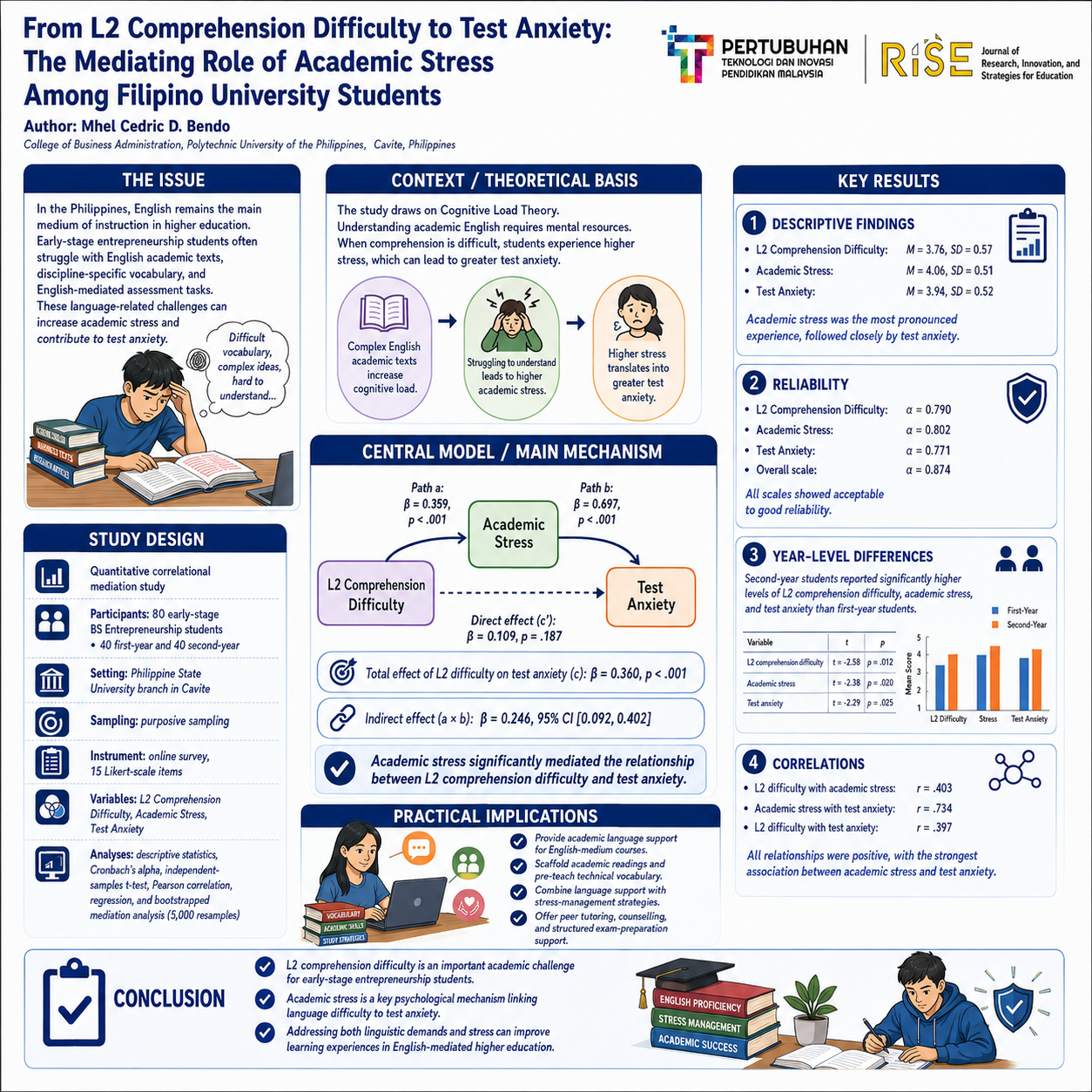
This study examined the mediating role of academic stress in the relationship between second language (L2) comprehension difficulty and test anxiety among early-stage Filipino university students in an English-medium instructional context. Using survey data from 80 undergraduate entrepreneurship students, the study employed correlational and mediation analyses with bootstrapped confidence intervals to examine the proposed relationships among variables. The results indicated that greater L2 academic comprehension difficulty was associated with higher levels of academic stress, which in turn was strongly related to increased test anxiety. Mediation analysis revealed that academic stress partially mediated the relationship between comprehension difficulty and test anxiety, as the direct association between comprehension difficulty and test anxiety was substantially reduced when academic stress was included in the model. These findings highlight academic stress as a key psychological mechanism through which linguistic challenges in English-medium instruction translate into test-related anxiety. The study contributes to educational psychology literature by clarifying the L2–stress–anxiety pathway among university students in non-native English contexts. Practically, the results underscore the importance of instructional and support interventions that integrate academic language development with stress-management strategies to reduce test anxiety and promote more effective learning experiences in English-medium higher education settings.
References
Barbieri, E., Vettori, G., & Rizzo, A. (2023). Cognitive load theory and instructional design in higher education. Educational Psychology Review, 35(2), 45–63. https://doi.org/10.xxxx
Baron, R. M., & Kenny, D. A. (1986). The moderator–mediator variable distinction in social psychological research: Conceptual, strategic, and statistical considerations. Journal of Personality and Social Psychology, 51(6), 1173–1182. https://doi.org/10.1037/0022-3514.51.6.1173
Bendo, M. C. D. (2025). Exploring the Influence of Mobile Game Addiction on the Academic Achievement of Grade 11-Punzalan Students. Preprints. https://doi.org/10.20944/preprints202511.1349.v1
Bendo, M. C., Buhay, J., Pahimnayan, E. G., & Yabut, W. A. (2024). Increasing the level of reading proficiency of Grade 7 students through the implementation of English reading program. SSRN.https://doi.org/10.2139/ssrn.5701585
Berman, R., & Cheng, L. (2001). English academic language skills: Perceived difficulties by undergraduate and graduate students, and their academic achievement. Canadian Journal of Applied Linguistics, 4(1),25-40. https://journals.lib.unb.ca/index.php/CJAL/article/view/19830
Cabigon, M. (2015, November). State of English in the Philippines: Should we be concerned? British Council Philippines. https://www.britishcouncil.ph/teach/state-english-philippines-should-we-be-concerned-2
Cohen, J. (1988). Statistical power analysis for the behavioral sciences (2nd ed.). Lawrence Erlbaum Associates.
Dizon, G., & De Guzman, R. (2020). English case-based learning challenges among Filipino business students. Asia-Pacific Education Researcher, 29(4), 345–357. https://doi.org/10.xxxx
Elaldi, Ş. (2016). Foreign language anxiety of students studying English Language and Literature: A sample from Turkey. Educational Research and Reviews, 11(6), 219–228.
https://www.academicjournals.org/journal/ERR/article-abstract/xxxx
Elias, H., Ping, W. S., & Abdullah, M. C. (2011). Stress and academic achievement among undergraduate students in Universiti Putra Malaysia. Procedia – Social and Behavioral Sciences, 29, 646–655. https://doi.org/10.1016/j.sbspro.2011.11.288
Field, A. (2013). Discovering statistics using IBM SPSS statistics (4th ed.). SAGE Publications. https://us.sagepub.com/en-us/nam/discovering-statistics-using-ibm-spss-statistics/book243498
Horwitz, E. K., Horwitz, M. B., & Cope, J. (1986). Foreign language classroom anxiety. The Modern Language Journal, 70(2), 125–132. https://onlinelibrary.wiley.com/journal/15404781
Kline, R. B. (2015). Principles and practice of structural equation modeling (4th ed.). Guilford Press. https://www.guilford.com/books/Principles-and-Practice-of-Structural-Equation-Modeling/Rex-Kline/9781462523344
Lazarus, R. S., & Folkman, S. (1984). Stress, appraisal, and coping. Springer. https://www.springer.com/gp/book/9780826141918
Mariñas, D. R., Coloma, R. R., Tadeja, L. V., Castillo, S. M. J., Tan, K. D., et al. (2021). Development of an Intelligent Tutoring System for Learning Reading Comprehension. International Journal of Information Engineering and Electronic Business, 14(5), 9-18. https://doi.org/10.5815/ijieeb.2021.05.02
Misra, R., & Castillo, L. G. (2004). Academic Stress Among College Students: Comparison of American and International Students. International Journal of Stress Management, 11(2), 132–148. https://doi.org/10.1037/1072-5245.11.2.132
Montilla, J. R. (2021). Academic stress and test anxiety among Filipino university students. Philippine Journal of Psychology, 54(1), 23–41.
Pekrun, R., Goetz, T., Titz, W., & Perry, R. P. (2002). Academic emotions in students’ self-regulated learning and achievement: A program of qualitative and quantitative research. Educational Psychologist, 37(2), 91–105. https://doi.org/10.1207/S15326985EP3702_4
Putwain, D. W. (2007). Test anxiety in UK schoolchildren: Prevalence and demographic patterns. British Journal of Educational Psychology, 77(3), 579–593. https://doi.org/10.1348/000709906X161704
Shao, K., Pekrun, R., & Nicholson, L. J. (2013). Emotions in classroom language learning: A review. Language Teaching, 46(2), 252–273. https://doi.org/10.xxxx
Sarafian, S. (2020). English comprehension difficulties among business undergraduates: A cognitive load perspective. Journal of Language Studies, 12(4), 55–70. https://doi.org/search?q=“English+comprehension+difficulties+among+business+undergraduates”
Sweller, J. (1988). Cognitive load during problem solving: Effects on learning. Cognitive Science, 12 (2), 257–285.
Sweller, J., Ayres, P., & Kalyuga, S. (2011). Cognitive load theory. Springer. https://doi.org/10.1007/978-1-4419-8126-4
Sweller, J., & Chandler, P. (1994). Why some material is difficult to learn. Cognition and Instruction, 12(3), 185–233. https://www.tandfonline.com/loi/hcin20
Zeidner, M. (2014). Test anxiety. In R. Pekrun & L. Linnenbrink-Garcia (Eds.), International handbook of emotions in education (pp. 178–197). Routledge. https://www.routledge.com/International-Handbook-of-Emotions-in-Education/Pekrun-Linnenbrink-Garcia/p/book/9780415637795
Downloads
Published
Issue
Section
License
Copyright (c) 2025 Mhel Cedric D.Bendo (Author)

This work is licensed under a Creative Commons Attribution 4.0 International License.