Effects of Presentation Slides on Students Attention and Visual Fatigue in Teaching Scenarios
DOI:
https://doi.org/10.70148/rise.v3i3.6Keywords:
Presentation slides, Teaching scenarios, Visual characteristics, Attention, Visual fatigueAbstract
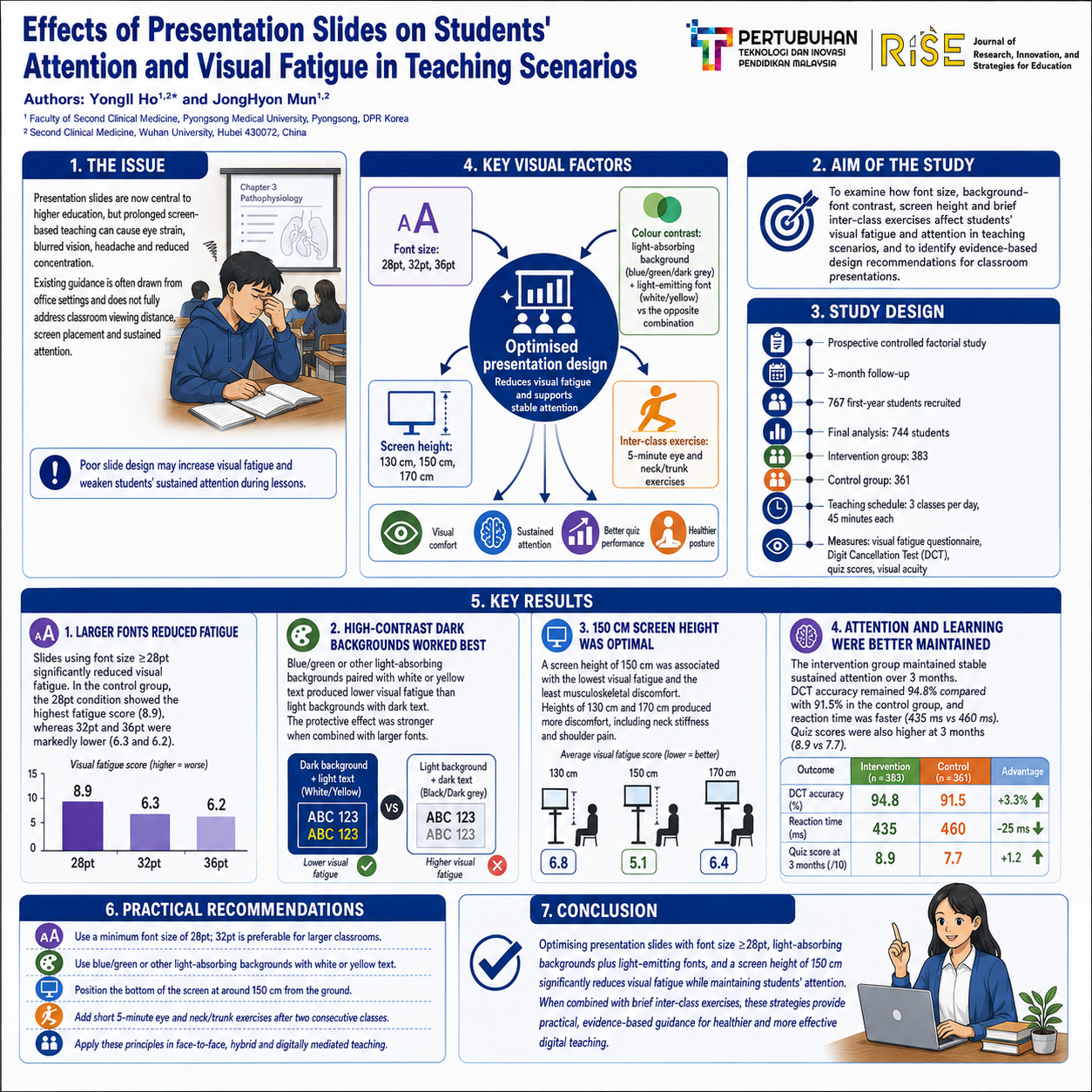
This study aimed to investigate the effects of visual and information characteristics of presentation slides, including font size, background–font contrast, and screen height, on students’ attention and visual fatigue in teaching scenarios, as well as to provide evidence-based recommendations for optimizing presentation design in educational settings. With the increasing reliance on electronic presentation slides in contemporary teaching, prolonged visual exposure has raised concerns regarding visual discomfort and reduced learning attention among students. Using a controlled teaching context, this study examined how variations in slide design influence visual fatigue symptoms and sustained attention during instructional sessions. The findings indicate that optimizing presentation slides with a font size of at least 28 points, light-absorbing backgrounds such as blue or green combined with light-emitting fonts such as white or yellow, and a screen height of 150 cm effectively reduces visual fatigue while maintaining stable levels of student attention in teaching scenarios. In addition, the integration of brief inter-class eye and musculoskeletal exercises further enhances the effectiveness of optimized slide design by alleviating cumulative visual and postural strain. Overall, the results demonstrate that appropriate visual design characteristics, when combined with simple physical interventions, play a significant role in promoting students’ visual comfort and attentional stability. These findings provide practical and evidence-based guidelines for educators and institutions to improve visual health, learning sustainability, and overall teaching efficiency in digitally mediated educational environments.
References
Adams, C. (2006). PowerPoint, habits of mind, and classroom culture. Journal of Curriculum Studies, 38(3), 389–411.
Chang, Y. C., et al. (2023). The effects of display height on cervical spine posture and muscle activity during computer work. Applied Ergonomics, 107, 103923.
Chen, Y., & Li, X. (2023). The effect of font size on visual fatigue and reading performance in long-distance viewing. Journal of Applied Ergonomics, 102, 103567.
Corbeil, G. (2007). Can PowerPoint presentations effectively replace textbooks and blackboards for teaching grammar? Do students find them an effective learning tool? CALICO Journal, 24(3), 631–656.
Dewaele, J., et al. (2021). Lessons unlearned: A conceptual review and meta-analysis of the relationship between the Attention Control Scale and Objective Attention Control. Cognitive Research: Principles and Implications, 6(1), 1–15.
Faber, B., et al. (2012). Mental fatigue effects on selective attention in visual processing. Frontiers in Human Neuroscience, 6, 223.
Foos, P. W., & Goolkasian, P. (2005). Presentation format effects in working memory: The role of attention. Memory & Cognition, 33(3), 499–513.
Fransson, E., et al. (2022). Neck and shoulder symptoms in relation to physical and psychosocial work factors: A 3-year prospective cohort study. Applied Ergonomics, 104, 103858.
Hatta, T., Yoshizaki, K., Ito, Y., Mase, M., & Kabasawa, H. (2012). Reliability and validity of the digit cancellation test, a brief screen of attention. Psychologia, 55(4), 246–256.
Hayes, J. R., Sheedy, J. E., Stelmack, J. A., & Heaney, C. A. (2007). Computer use, symptoms, and quality of life. Optometry and Vision Science, 84(8), 738-744.
Höffler, T., & Leutner, D. (2007). Instructional animation versus static pictures: A meta-analysis. Learning and Instruction, 17(4), 422–433.
Hoffman, D. A., Lee, S. Y., & Kim, J. H. (2023). Visual discomfort and acuity changes in university students after consecutive screen-based lectures. Journal of Educational Technology & Society, 26(2), 143–158.
Hornbæk, K., & Oulasvirta, A. (2017). What Is Interaction? Proceedings of the 2017 CHI Conference on Human Factors in Computing Systems, 5040-5052.
Lamb, T. D., & Pugh, E. N. (2004). Phototransduction in the rods and cones of the human eye. Nature Reviews Neuroscience, 5(12), 889-903.
Legge, G. E., & Bigelow, C. A. (2011). Does print size matter for reading? A review of findings from vision science and typography. Journal of Vision, 11(5), 8.
Li, X. J., Ling, J. X., & Shen, Y. (2022). Visual fatigue relief zone in an extra-long tunnel using virtual reality with wearable EEG-based devices. Journal of Central South University, 28(12), 3871–3881.
Nakazawa, T., et al. (2023). Effects of background color on visual fatigue during prolonged display work. Displays, 76, 102345.
Rempel, D. M., & Gerson, B. J. (2023). Meta-analysis of font size effects on visual fatigue in digital reading. Human Factors, 65(3), 421-435.
Sakurai, T., et al. (2019). A new efficient and comprehensive asthenopia questionnaire. Journal of Ophthalmology, 20, 1–10.
Shieh, K. K., & Lin, C. C. (2000). Effects of screen type, ambient illumination, and color combination on VDT visual performance and subjective preference. International Journal of Industrial Ergonomics, 26(5), 527-536.
Stockman, A., & Sharpe, L. T. (2000). Spectral sensitivity of the human cone photoreceptors. Journal of the Optical Society of America A, 17(10), 1613-1631.
Sweller, J. (1988). Cognitive load during problem solving: Effects on learning. Cognitive Science, 12(2), 257-285.
Takahashi, Y., et al. (2023). Dynamic Blood Flow Changes in Extraocular Muscles During Voluntary Eye Rotation. Ophthalmic Research, 69(2), 123-131.
Tsubota, K., et al. (2020). Blue Light from Digital Devices and Its Effects on the Eye. Ophthalmologica, 243(4), 197–208.
Uwimana, A., Ma, C., & Ma, X. (2023). Concurrent Rising of Dry Eye and Eye Strain Symptoms Among University Students During the COVID-19 Pandemic Era: A Cross-Sectional Study. Risk Management and Healthcare Policy, 16, 3331–3340.
Wang, L., & Li, J. (2024). Office Environment vs. Classroom Setting: A Comparative Analysis of Visual Fatigue Mechanisms. Journal of Optometry and Ophthalmology, 16(2), 189–197.
Zhang, Y., et al. (2024). Video Display Terminal Use and Ocular Symptoms Among Medical Students. Journal of Optometry and Ophthalmology, 15(3), 221–228.
Downloads
Published
Issue
Section
License
Copyright (c) 2025 YongIl Ho, JongHyong Mun (Author)

This work is licensed under a Creative Commons Attribution 4.0 International License.