Kahoot and the Classroom: Exploring Faculty Beliefs, Practices, and Active Learning
DOI:
https://doi.org/10.70148/rise.v3i4.6Keywords:
active learning, teaching practices, faculty development, instructional technology, STEM educationAbstract
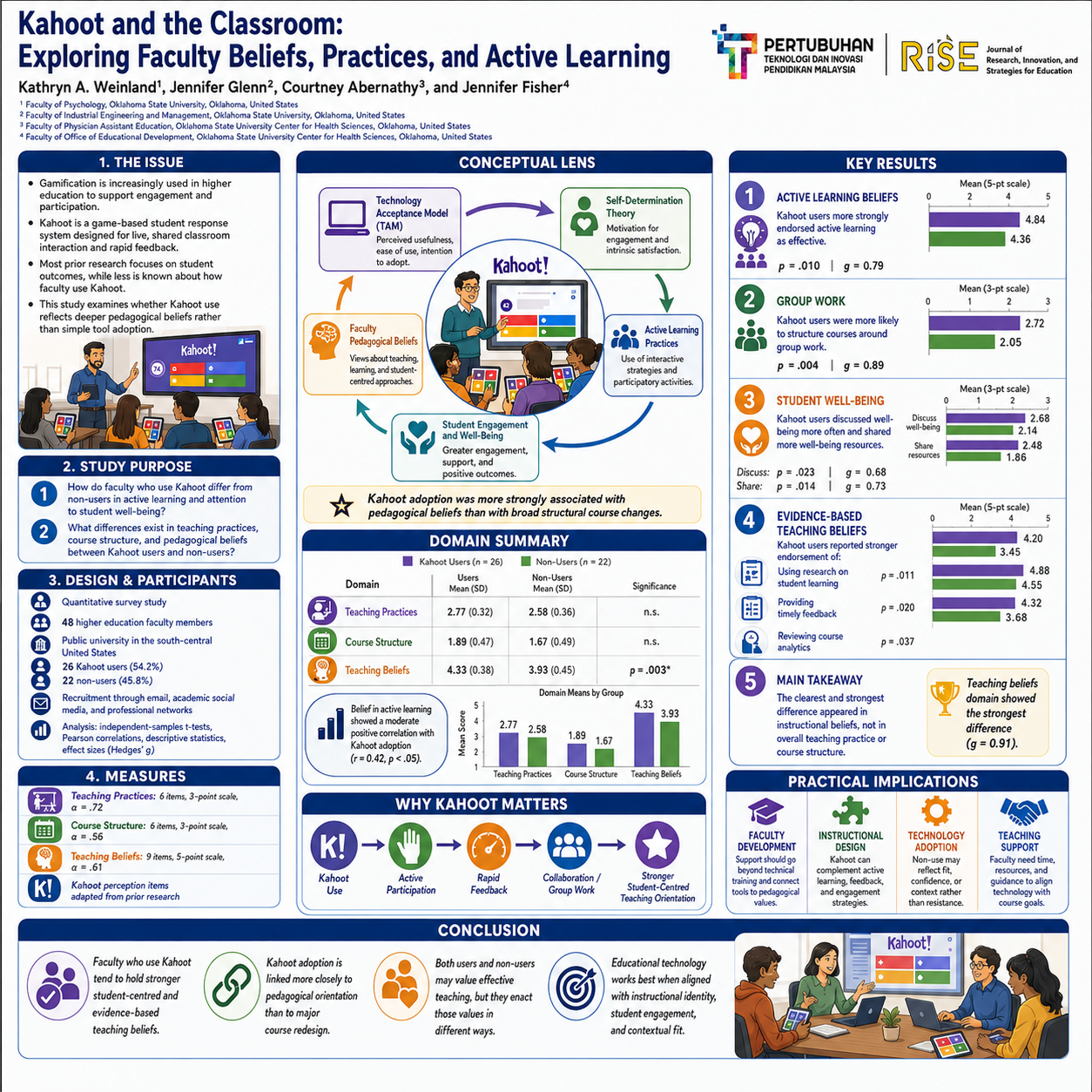
This study analyzed survey data from 48 higher education faculty members at a public university in the south-central United States to examine the relationship between Kahoot usage, active learning beliefs, and teaching practices. Grounded in Technology Acceptance Model and the scholarship of teaching and learning, the study used a modified version of the 2023 Teaching Practices Survey and items adapted from prior Kahoot research to explore differences in pedagogical beliefs, course structure, and student engagement strategies between Kahoot users and non-users. Independent samples t-tests and Pearson correlations assessed group differences and associations across 3 domains: teaching practices, course structure, and instructional beliefs. Kahoot users were significantly more likely to endorse active learning as effective (g .79), structure courses around group work (g .89), and discuss well-being topics in class (g= .68). Composite analyses revealed a significant difference in instructional beliefs between users and non-users (d = .71), but not in overall teaching practices or course structure. A moderate positive correlation was found between belief in active learning and Kahoot adoption (r = .42, p < .05). These findings suggest that technology adoption is more closely aligned with underlying pedagogical beliefs than with broad structural changes in course design, contributing to research on instructional technology and evidence-based teaching.
References
About Kahoot!: Company history & key facts. Kahoot! (2025, May 5).
https://kahoot.com/company/#:~:text=Our%20users,sessions%20across%20diverse%20e ducational%20settings.
Boman, J., Lindsay, B., Bernier, E., & Boyce, M. A. (2025). Fostering student wellbeing in the postsecondary
teaching and learning environment. Journal of Further and Higher Education, 49(2), 230–242.
https://doi.org/10.1080/0309877X.2024.2447852
Codish, D., & Ravid, G. (2014). Academic course gamification: The art of perceived playfulness. Interdisciplinary Journal of E-Learning and Learning Objects, 10, 131-151.
Davis F. (1989). Perceived usefulness, perceived ease of use, and user acceptance of information technology. MIS
Quarterly 1989;13:319-340. https://doi.org/10.2307/249008
Deterding, S., Dixon, D., Khaled, R., & Nacke, L. (2011). From game design elements to gamefulness: Defining
gamification. Paper presented at the 15th International Academic MindTrek Conference: Envisioning
Future Media Environments, Tampere, Finland.
https://doi.org/10.1145/2181037.2181040
Fuchs. (2022). Bringing Kahoot Into the Classroom: The Perceived Usefulness and Perceived Engagement of
Gamified Learning in Higher Education. International Journal of Information and Education Technology,
Vol. 12, No. 7.
https://doi.org/10.18178/ijiet.2022.12.7.1662
Holles, C. (2023). Faculty-Student Interaction and Well-Being: The Call for Care in Higher Education. International
Journal of TESOL Studies, 5(3), 7-20.
https://doi.org/10.58304/ijts.20230302
Hsu, J. & Goldsmith, G. (2021). Instructor Strategies to Alleviate Stress and Anxiety among College and University
STEM Students. CBE—Life Sciences Education, 20(1).
https://doi.org/10.1187/cbe.20-08-0189
Kim, B., Park, H., & Baek, Y. (2009). Not just fun, but serious strategies: Using meta-cognitive strategies in game-
based learning. Computers & Education, 52(4), 800-810.
https://doi.org/10.1016/j.compedu.2008.12.004
Kharbach, M. (2023, May 18). Best gamification tools for teachers. Educators Technology.
https://www.educatorstechnology.com/2022/10/best-gamification-tools-for-teachers.html
Licorish, S.A., Owen, H.E., Daniel, B. et al. Students’ perception of Kahoot!’s influence on teaching and learning.
Research and Practice in Technology Enhanced Learning 13, 9 (2018).
https://doi.org/10.1186/s41039-018-0078-8
Lakens, D. (2013). Calculating and reporting effect sizes to facilitate cumulative science: A practical primer for t
tests and ANOVAs. Frontiers in Psychology, 4, Article 863.
https://doi.org/10.3389/fpsyg.2013.00863
Mat Husin, M.Z., & Azmuddin, R.A. (2022). Learner Engagement in Using Kahoot! within a University English
Proficiency Course. Educational Process: International Journal, 11(2): 167-180.
https://doi.org/10.22521/edupij.2022.112.9
N. S. Jayawardena, M. Ross, S. Quach, A. Behl, and M. Gupta, Effective online engagement strategies through
gamification: A systematic literature review and a future research agenda, Journal of Global Information
Management, vol. 30, no. 5, pp. 1-25, 2021.
https://doi.org/10.4018/JGIM.290370
Pertegal-Felices, M. L., Jimeno-Morenilla, A., Sánchez-Romero, J. L., & Mora-Mora, H. (2020). Comparison of the effects of the Kahoot tool on teacher training and Computer Engineering Students for Sustainable
Education. Sustainability, 12(11), 4778.
https://doi.org/10.3390/su12114778
Ryan, R. M., & Deci, E. L. (2000). Intrinsic and extrinsic motivations: Classic definitions and new directions.
Contemporary Educational Psychology, 25(1), 54–67.
https://doi.org/10.1006/ceps.1999.1020
Wang, A.I. (2015). The wear out effect of a game-based student response system. Computers & Education, 82, p
– 227.
https://doi.org/10.1016/j.compedu.2014.11.004
Wang, A. I., & Tahir, R. (2020, January 31). The effect of using Kahoot for learning – A literature review. Computers
& Education. Volume 149, May 2020,
https://doi.org/10.1016/j.compedu.2020.103818
Zheng, F. (2022). Fostering Students’ Well-Being: The Mediating Role of Teacher Interpersonal Behavior and Student-Teacher Relationships. Frontiers in Psychology, 12, 1-8.
Downloads
Published
Issue
Section
License
Copyright (c) 2025 Kathryn Weinland, Jennifer Glenn, Courtney Abernathy, Jennifer Fisher (Author)

This work is licensed under a Creative Commons Attribution 4.0 International License.