Enhancing Grade 7 Reading Proficiency through an English Reading Program Intervention in High School
DOI:
https://doi.org/10.70148/rise.v3i3.7Keywords:
Reading Proficiency, Reading Intervention, English Reading Program, Grade 7 Learners, Philippine Education, Reading ComprehensionAbstract
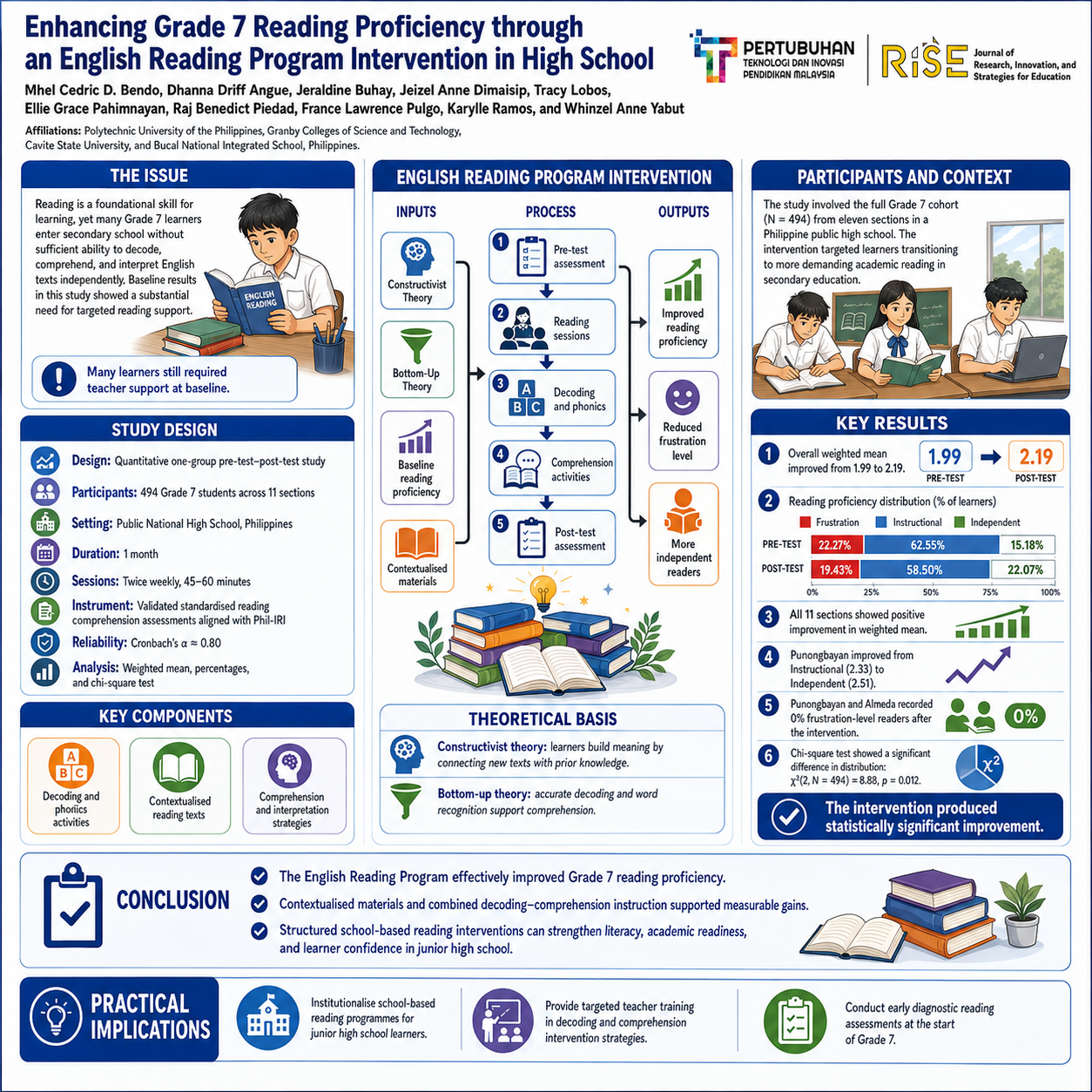
This study aimed to determine the level of reading proficiency of Grade 7 students through the implementation of an English Reading Program at Public National High School, Philippines. A quantitative one-group pretest–posttest design was employed, involving 494 Grade 7 students across eleven sections. Data were gathered using validated standardized reading comprehension assessments administered before and after the intervention. Findings revealed that the English Reading Program was effective in improving students’ reading proficiency. Post-test results showed a notable increase in reading comprehension levels, with no students classified as non-readers after the intervention. The use of contextualized learning materials contributed to measurable improvements in students’ ability to decode, comprehend, and interpret texts. Overall, the study provides evidence-based support for the effectiveness of structured reading intervention programs in enhancing reading proficiency among junior high school learners. The findings offer practical implications for school administrators and teachers and highlight the importance of targeted reading programs in improving academic performance and promoting the overall well-being of Grade 7 students.
References
Abid, N., Aslam, S., Alghamdi, A. A., & Kumar, T. (2023). Relationships among students’ reading habits, study skills, and academic achievement in English at the secondary level. Frontiers in Psychology, 14, Article 1020269. https://doi.org/10.3389/fpsyg.2023.1020269
Al-Jarf, R. (2021). Enhancing reading and speaking skills in EFL through multicultural children’s short stories. SSRN Electronic Journal. https://doi.org/10.2139/ssrn.3848464
Alnahdi, G. H., & Aftab, R. (2020). The effectiveness of reading interventions for students with learning disabilities: A meta-analysis. International Journal of Disability, Development and Education, 67(3), 273–291. https://doi.org/10.1080/1034912X.2019.1585521
Bransford, J. D., Brown, A. L., & Cocking, R. R. (Eds.). (2000). How people learn: Brain, mind, experience, and school. National Academies Press. https://doi.org/10.17226/9853
Bernardez, M. L. (2014). Reading theories and classroom practices. Rex Book Store.
Bhan, K., & Gupta, R. (2014). Reading comprehension skills of children: A study of poor readers. Journal of Education and Practice, 5(16), 143–148. https://eric.ed.gov/?id=EJ1079958
Burns, M. K. (2021). Response to intervention research: Confounds and considerations. School Psychology Review, 50(2–3), 238–245. https://doi.org/10.1080/2372966X.2020.1868623
Carlson, C. D., & Francis, D. J. (2014). Examining the effects of early reading intervention on students at risk for reading disabilities. Journal of Learning Disabilities, 47(3), 226–237. https://doi.org/10.1177/0022219412457375
Connor, C. M., Phillips, B. M., Kaschak, M. P., Apel, K., Kim, Y.-S. G., Al Otaiba, S., & Lonigan, C. J. (2019). Individualizing student instruction precisely: Effects of child × instruction interactions. Journal of Educational Psychology, 111(6), 1141–1159. https://doi.org/10.1037/edu0000319
Duke, N. K., Ward, A. E., & Pearson, P. D. (2021). The science of reading comprehension instruction. The Reading Teacher, 74(6), 663–672. https://doi.org/10.1002/trtr.1993
Ehri, L. C., Nunes, S. R., Stahl, S. A., & Willows, D. M. (2001). Systematic phonics instruction helps students learn to read. Review of Educational Research, 71(3), 393–447. https://doi.org/10.3102/00346543071003393
Erguvan, D. (2016). Instructors’ perceptions toward the use of an integrated reading–writing approach. Journal of Education and Training Studies, 4(6), 93–100. https://doi.org/10.11114/jets.v4i6.1458
Espin, C. A., Cevasco, J., van den Broek, P., Baker, S., Gersten, R., & Dimino, J. (2015). Developing comprehension through text structure instruction. Reading Research Quarterly, 50(1), 47–70. https://doi.org/10.1002/rrq.88
Flores, R. T. (2015). Reading proficiency and academic performance of secondary students (Unpublished master’s thesis). Philippines.
Gough, P. B., & Tunmer, W. E. (1986). Decoding, reading, and reading disability. Remedial and Special Education, 7(1), 6–10. https://doi.org/10.1177/074193258600700104
Guthrie, J. T., Wigfield, A., & Perencevich, K. C. (2004). Motivation and reading comprehension. Lawrence Erlbaum. https://doi.org/10.4324/9781410610019
Hoover, W. A., & Gough, P. B. (1990). The simple view of reading. Reading and Writing, 2, 127–160. https://doi.org/10.1007/BF00401799
Hernandez, D. J. (2011). Double jeopardy: How third-grade reading skills and poverty influence high school graduation. Annie E. Casey Foundation. https://eric.ed.gov/?id=ED518818
Issa, A. O., Aliyu, M. B., Akangbe, R. B., & Adedeji, A. F. (2012). Reading interests and habits of the federal polytechnic students. International Journal of Learning & Development, 2(1), 470–486. https://doi.org/10.5296/ijld.v2i1.1470
Kim, Y.-S. G., Hemphill, L., Troyer, M., & McCutchen, D. (2020). Integrating decoding and comprehension instruction for struggling adolescent readers. Journal of Educational Psychology, 112(6), 1191–1210. https://doi.org/10.1037/edu0000427
Kintsch, W. (2004). The construction–integration model of text comprehension and its implications for instruction. Psychonomic Bulletin & Review, 11(2), 211–218. https://doi.org/10.3758/BF03196268
Maiao, A., Lopez, M., & Rivera, C. (2014). Early intensive reading interventions for struggling readers. Journal of Research in Reading, 37(4), 362–381. https://doi.org/10.1111/1467-9817.12021
McKenna, M. C., & Stahl, K. A. D. (2021). Assessment for reading instruction (3rd ed.). Guilford Press.
Meniado, J. C. (2016). Metacognitive reading strategies and reading comprehension. International Journal of Applied Linguistics & English Literature, 5(3), 147–156. https://doi.org/10.7575/aiac.ijalel.v.5n.3p.147
Mirza, N., Mahmood, A., & Hussain, M. (2021). Reading comprehension strategies and academic achievement. International Journal of Instruction, 14(2), 301–316. https://doi.org/10.29333/iji.2021.14218a
National Reading Panel. (2000). Teaching children to read: An evidence-based assessment of the scientific research literature on reading and its implications for reading instruction. National Institute of Child Health and Human Development. https://www.nichd.nih.gov/publications/pubs/nrp/smallbook
Perfetti, C. A., & Stafura, J. (2014). Word knowledge in a theory of reading comprehension. Scientific Studies of Reading, 18(1), 22–37. https://doi.org/10.1080/10888438.2013.827687
Rasinski, T. (2012). Why reading fluency should be hot! The Reading Teacher, 65(8), 516–522. https://doi.org/10.1002/TRTR.01077
Rapp, D. N., van den Broek, P., McMaster, K. L., Kendeou, P., & Espin, C. A. (2017). Higher-order comprehension processes in reading. Scientific Studies of Reading, 21(2), 123–139. https://doi.org/10.1080/10888438.2016.1256366
Rosli, N. A., Razak, N. A., & Zulkifli, N. (2018). Reading strategies and comprehension. International Journal of Academic Research in Progressive Education and Development, 7(3), 101–112. https://doi.org/10.6007/IJARPED/v7-i3/4358
Slavin, R. E. (2020). How evidence-based reform will transform research and practice in education. Educational Psychologist, 55(1), 21–30. https://doi.org/10.1080/00461520.2019.1682060
Snow, C. (2002). Reading for understanding: Toward an R&D program in reading comprehension. Rand Corporation. https://www.rand.org/pubs/monograph_reports/MR1465.html
Snow, C. E., Burns, M. S., & Griffin, P. (1998). Preventing reading difficulties in young children. National Academies Press. https://doi.org/10.17226/6023
Torgesen, J. K. (2004). Preventing early reading failure and its devastating downward spiral. American Educator, 28(3), 6–19. https://files.eric.ed.gov/fulltext/EJ852634.pdf
Vaughn, S., Roberts, G., Wanzek, J., & Swanson, E. (2022). Reading interventions for secondary students with reading difficulties. Learning Disabilities Research & Practice, 37(2), 72–84. https://doi.org/10.1111/ldrp.12263
Wanzek, J., Vaughn, S., Scammacca, N., Metz, K., Murray, C., Roberts, G., & Danielson, L. (2013). Extensive reading interventions for struggling readers in Grades 4–12: A meta-analysis. Review of Educational Research, 83(2), 163–195. https://doi.org/10.3102/0034654313477212
Wanzek, J., Vaughn, S., Roberts, G., & Fletcher, J. M. (2019). Intensive reading interventions for older struggling readers: A meta-analysis. Journal of Learning Disabilities, 52(2), 103–119. https://doi.org/10.1177/0022219418775116
Downloads
Published
Issue
Section
License
Copyright (c) 2025 Mhel Cedric D. Bendo, Dhanna Driff Angue, Jeraldine Buhay, Jeizel Anne Dimaisip, Tracy Lobos, Ellie Grace Pahimnayan, Raj Benedict Piedad, France Lawrence Pulgo, Karylle Ramos, Whinzel Anne Yabut (Author)

This work is licensed under a Creative Commons Attribution 4.0 International License.