Attention Fragmentation in Digital Learning Environments: Micro-Procrastination, Cognitive Load, and Deep Work Across Educational Levels
DOI:
https://doi.org/10.70148/rise.v3i4.1Keywords:
Digital Micro-Procrastination, Cognitive Load, Deep Work, Attention Fragmentation, Educational PsychologyAbstract
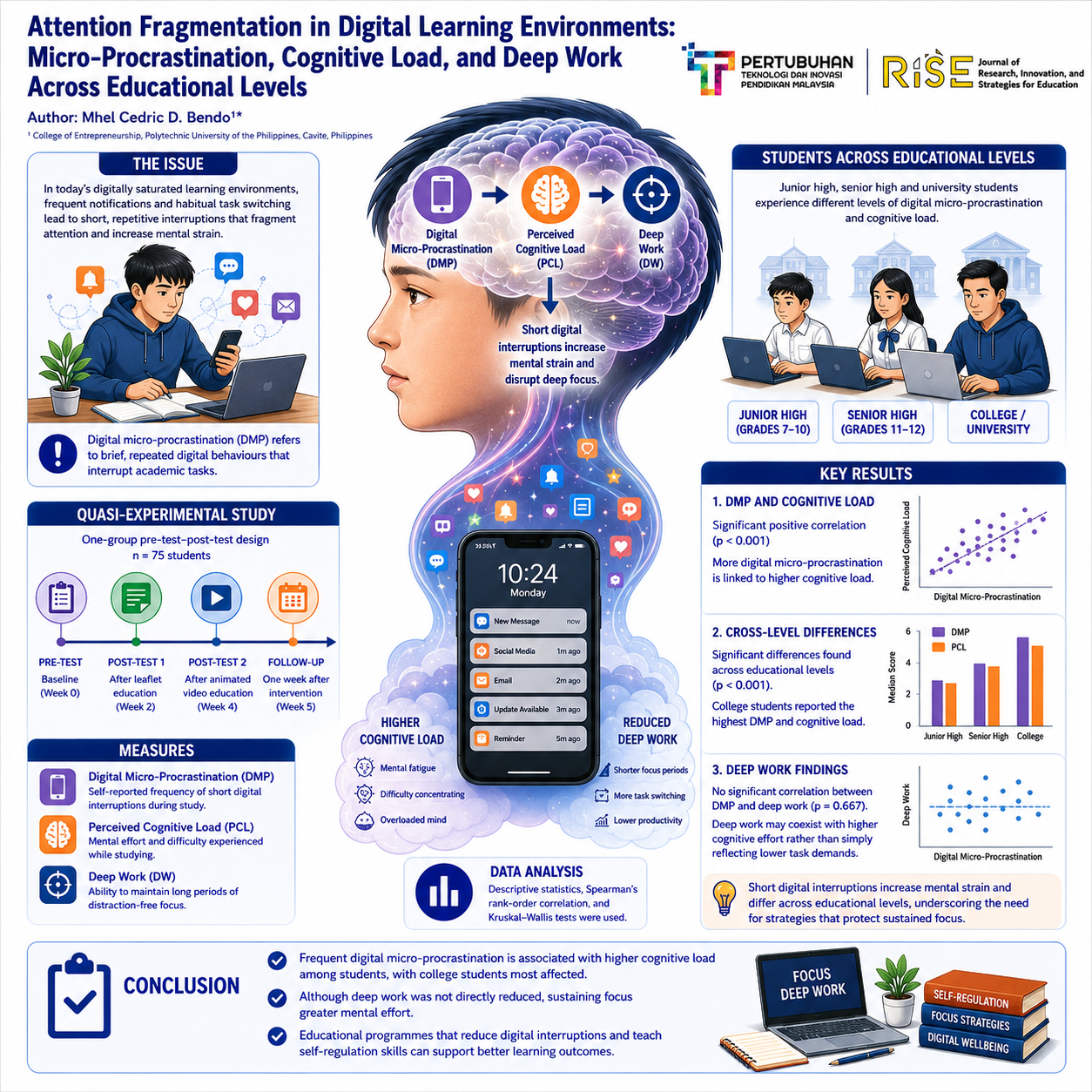
Maintaining sustained attention has become increasingly challenging in digitally saturated learning environments, where frequent notifications and habitual task switching are normalized. Although digital distraction has been widely examined, limited research has focused on digital micro-procrastination—brief, repetitive digital interruptions—and its cognitive consequences across educational levels. This study examined the relationships among Digital Micro-Procrastination (DMP), Perceived Cognitive Load (PCL), and Deep Work (DW) among junior high school, senior high school, and college students. Using a quantitative descriptive-comparative design, survey data were collected from 45 students equally distributed across three academic levels. All measures demonstrated acceptable internal consistency following reliability refinement. Data were analyzed using descriptive statistics, Spearman’s rank-order correlation, and Kruskal–Wallis tests. Results revealed a significant positive association between digital micro-procrastination and perceived cognitive load, indicating that frequent short digital interruptions are linked to heightened mental strain and attention fragmentation. Significant cross-level differences were observed, with college students reporting the highest levels of digital micro-procrastination and cognitive load. Findings related to deep work suggest a more nuanced relationship, wherein sustained focus may coexist with elevated cognitive effort rather than reduced task demands. Overall, the study underscores the cognitive implications of everyday digital practices and highlights the need for instructional and self-regulatory strategies that mitigate attention fragmentation in contemporary educational contexts.
References
Adhikari, S., & Sinha, S. (2025). Positive impacts of social media on students' academic and social life. Bharati International Journal of Multidisciplinary Research & Development (BIJMRD), 3(1). https://www.bijmrd.com/
Bond, T. G., & Fox, C. M. (2015). Applying the Rasch model: Fundamental measurement in the human sciences (3rd ed.). Routledge.
Cierniak, G., Scheiter, K., & Gerjets, P. (2009). Explaining the split-attention effect: Is the reduction of extraneous cognitive load accompanied by an increase in germane cognitive load? Computers in Human Behavior, 25(2), 315–324. https://doi.org/10.1016/j.chb.2008.12.003
DeVellis, R. F. (2017). Scale development: Theory and applications (4th ed.). Sage Publications. https://us.sagepub.com/en-us/nam/scale-development/book246570
GlobalWebIndex (GWI). (2020). Digital behaviors in the Asia-Pacific region. https://www.gwi.com/reports
Greenhow, C., & Lewin, C. (2016). Social media and education: Reconceptualizing the boundaries of formal and informal learning. Learning, Media and Technology, 41(1), 6–30. https://doi.org/10.1080/17439884.2015.1064954
Hazra, S., & Kant, R. (2024). Navigating academic procrastination in the digital age among digital natives. The Social Science Review, 2(5), 190–195. https://doi.org/10.70096/tssr.240205030
Junco, R. (2012). The relationship between frequency of Facebook use, shyness, and college students’ academic performance. Journal of Educational Computing Research, 46(2), 119–138. https://doi.org/10.2190/EC.46.2.b
Junco, R., Heiberger, G., & Loken, E. (2011). The effect of Twitter on college student engagement and grades. Journal of Computer Assisted Learning, 27(2), 119–132. https://doi.org/10.1111/j.1365-2729.2010.00387.x
Kemp, S. (2021). Digital in the Philippines: All the statistics you need in 2021 [Report]. Datareportal. https://datareportal.com/reports/digital-2021-philippines
Kemp, S. (2023, January). Digital 2023: Global overview report [Report]. Datareportal. https://datareportal.com/reports/digital-2023-global-overview-report
Klepsch, M., Schmitz, F., & Seufert, T. (2017). Development and validation of two instruments measuring intrinsic, extraneous, and germane cognitive load. Frontline Learning Research, 5(3), 1–18. https://doi.org/10.14786/flr.v5i3.279
Klingsieck, K. B. (2013). Procrastination: When good things don't come to those who wait. European Psychologist, 18(1), 24–34. https://doi.org/10.1027/1016-9040/a000138
Monsell, S. (2003). Task switching. Trends in Cognitive Sciences, 7(3), 134–140. https://doi.org/10.1016/S1364-6613(03)00028-7
National Center for Education Statistics. (2025). Effects of cell phone use in K–12 schools. U.S. Department of Education. https://nces.ed.gov/whatsnew/press_releases/2_19_2025.asp
Newport, C. (2016). Deep work: Rules for focused success in a distracted world. Grand Central Publishing. https://www.hachettebookgroup.com/titles/cal-newport/deep-work/9781455586691/
Shiers, D. (2020). Smartphone use, sleep deprivation, and academic performance among students. Journal of Behavioral Addictions, 9(2), 345–353. https://doi.org/10.1556/2006.2020.00029
Statista. (2023). Smartphone users worldwide. https://www.statista.com/topics/840/smartphones/
Steel, P. (2007). The nature of procrastination: A meta-analytic and theoretical review of quintessential self-regulatory failure. Psychological Bulletin, 133(1), 65–94. https://doi.org/10.1037/0033-2909.133.1.65
Tavakol, M., & Dennick, R. (2011). Making sense of Cronbach’s alpha. International Journal of Medical Education, 2, 53–55. https://doi.org/10.5116/ijme.4dfb.8dfd
Tess, P. A. (2013). The role of social media in higher education classes (real and virtual)—A literature review. Computers in Human Behavior, 29(5), A60–A68. https://doi.org/10.1016/j.chb.2012.12.032
van Merriënboer, J. J. G., & Sweller, J. (2005). Cognitive load theory and complex learning: Recent developments and future direction. Educational Psychology Review, 17(2), 147–177. https://doi.org/10.1007/s10648-005-3951-0
Wingfield, N., & Sharma, A. (2007, June 29). iPhone “surfing” on AT&T network isn’t fast, Jobs concedes. The Wall Street Journal. https://www.wsj.com/articles/SB118307103947663695
Zumbo, B. D. (2007). Validity: Foundational issues and statistical methodology. In C. R. Rao & S. Sinharay (Eds.), Handbook of statistics (Vol. 26, pp. 45–79). Elsevier. https://www.sciencedirect.com/handbook/handbook-of-statistics/vol/26
Downloads
Published
Issue
Section
License
Copyright (c) 2025 Mhel Cedric D. Bendo (Author)

This work is licensed under a Creative Commons Attribution 4.0 International License.