‘KEEP IT HOT’ Module: Integrating STEM with Mathematics as the Core Focus through Problem-Based Learning and the Engineering Design Process
DOI:
https://doi.org/10.70148/rise.v3i4.3Keywords:
STEM integration, Problem based learning, Engineering Design Process, inquiry based learning, Integrated STEM , Mathematics education, Mathematics Classroom, Project Based learning, STEM educationAbstract
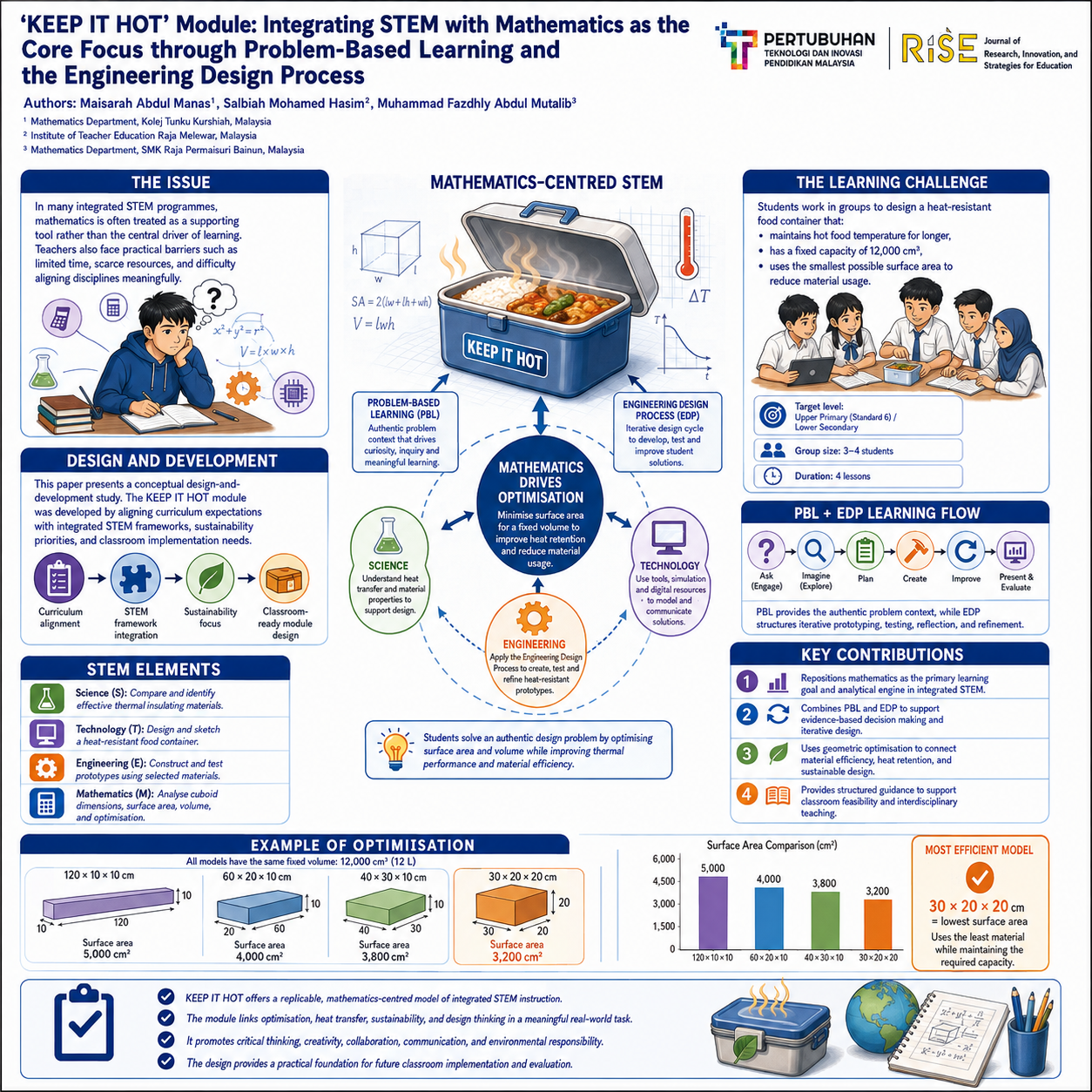
Secondary school STEM programmes often underemphasise mathematics, positioning it as a supporting tool rather than a central component of problem solving. This paper introduces KEEP IT HOT, an integrated STEM module designed to reposition mathematics as the foundation of STEM learning. The module combines Problem-Based Learning (PBL) with the Engineering Design Process (EDP) to immerse students in an authentic design challenge: creating a heat-retaining food container. The task requires applying geometric concepts of surface-area and volume optimisation while considering constraints such as efficiency, material sustainability, and thermal performance. Conceptually developed by aligning curriculum standards with established STEM education frameworks and sustainability priorities, the module integrates science, technology, and engineering around a mathematics-driven optimisation task. It provides structured guidance for teachers and hands-on inquiry for students, addressing common barriers to STEM implementation (e.g., resource constraints and fragmented subject delivery) while fostering critical 21st-century competencies including critical thinking, creativity, collaboration, and communication. This work contributes to the STEM education literature by offering a replicable, mathematics-centred model of integrated STEM instruction and sets the stage for future classroom implementation and evaluation. Integrating PBL with EDP purposefully situates scientific and mathematical knowledge within technological design, enabling learners to envision solutions, marshal evidence, and solve authentic problems (Wahono, Lin, & Chang, 2020).References
Aba-Oli, Z., Koyas, K., & Husen, A. (2024). Higher-order thinking skills-oriented problem-based learning interventions in mathematics: A systematic literature review. School Science and Mathematics, 124(12), 1–14. https://doi.org/10.1111/ssm.12676
Abdurrahman, A., Maulina, H., Nurulsari, N., Sukamto, I., Umam, A. N., & Mulyana, K. M. (2023). Impacts of integrating engineering design process into STEM makerspace on renewable energy unit to foster students’ systems thinking skills. Heliyon, 9(4), e15100. https://doi.org/10.1016/j.heliyon.2023.e15100
Acikay, N., Bircan, M. A., & Karakas, H. (2023). The effect of STEM activities on primary school students’ attitudes towards STEM. International Journal of Research in Teacher Education, 14(2), 19–35. https://doi.org/10.29329/ijrte.2023.566.2
Anderson, D., Milner-Bolotin, M., Santos, R., & Petrina, S. (Eds.). (2021). Proceedings of the 6th International STEM in Education Conference (STEM 2021). University of British Columbia.
Anderson, J., & Makar, K. (2024). The contribution of mathematics to an integrated STEM curriculum in schools. In J. Anderson & K. Makar (Eds.), The contribution of mathematics to school STEM education (pp. xx–xx). Springer. https://doi.org/10.1007/978-981-97-2728-5_1
Anderson, J., & Tully, D. (2020). Designing and evaluating an integrated STEM professional development programme for secondary and primary school teachers in Australia. In J. Anderson & Y. Li (Eds.), Integrated approaches to STEM education: An international perspective (pp. 403–426). Springer. https://doi.org/10.1007/978-3-030-52229-2_22
Anderson, J., Wilson, K., Tully, D., & Way, J. (2019). “Can we build the wind-powered car again?” Students’ and teachers’ responses to a new integrated STEM curriculum. Journal of Research in STEM Education, 5(1), 20–39.
Appelgate, M. H., & Jurgenson, K. (2022). How engagement with mathematics in an integrated STEM lesson evolved over four years. Investigations in Mathematics Learning, 14(1), 63–86. https://doi.org/10.1080/19477503.2021.2023965
Arthur, Y. D., Owusu, E. K., Asiedu-Addo, S., & Arhin, A. K. (2018). Connecting mathematics to real-life problems: A teaching quality that improves students’ mathematics interest. IOSR Journal of Research & Method in Education, 8(4), 65–71. https://doi.org/10.9790/7388-0804026571
Baker, C. K., & Galanti, T. M. (2017). Integrating STEM in elementary classrooms using model-eliciting activities: Responsive professional development for mathematics coaches and teachers. International Journal of STEM Education, 4, 10. https://doi.org/10.1186/s40594-017-0066-3
Barrows, H. S. (1986). A taxonomy of problem-based learning methods. Medical Education, 20(6), 481–486. https://doi.org/10.1111/j.1365-2923.1986.tb01386.x
Baydere, F. K., & Bodur, A. M. (2022). 9th-grade students’ learning of designing an incubator through instruction based on engineering design tasks. Journal of Science Learning, 5(3), 500–508. https://doi.org/10.17509/jsl.v5i3.47226
Bybee, R. W. (2013). The case for STEM education: Challenges and opportunities. National Science Teachers Association.
Costa, M. C., & Domingos, A. (2019). Promoting mathematics teaching in the framework of STEM integration. In U. T. Jankvist, M. van den
Heuvel-Panhuizen, & M. Veldhuis (Eds.), Proceedings of CERME11 (pp. 4798–4805). Utrecht University & ERME.
Costantino, T. (2018). STEAM by another name: Transdisciplinary practice in art and design education. Arts Education Policy Review, 119(2), 100–106.
Crotty, E. A., Guzey, S. S., Roehrig, G. H., Glancy, A. W., Ring-Whalen, E. A., & Moore, T. J. (2017). Approaches to integrating engineering in STEM units and student achievement gains. Journal of Pre-College Engineering Education Research, 7(2), 1–14.
Cunningham, C. (2009). Engineering is Elementary: An engineering and technology curriculum for children. Museum of Science, Boston.
Cunningham, C., Lachapelle, C., & Lindgren-Streicher, A. (2018). Elementary teachers’ changing ideas about engineering and engineering design. In Proceedings of ASEE Annual Conference.
Dewey, J. (1938). Experience and education. Macmillan.
Engle, R. A., & Conant, F. R. (2002). Guiding principles for fostering productive disciplinary engagement: Explaining an emergent argument in a community of learners classroom. Cognition and Instruction, 20(4), 399–483. https://doi.org/10.1207/S1532690XCI2004_1
English, L. D. (2016). Advancing integrated STEM learning through engineering design: Sixth-grade students’ design and construction of earthquake-resistant buildings. The Journal of Educational Research, 110(3), 255–271. https://doi.org/10.1080/00220671.2016.1264053
Fidai, A., Barroso, L. R., Capraro, M. M., & Capraro, R. M. (2020). Effects of engineering design process on science and mathematics. Frontiers in Education Conference (FIE 2020), 4–7. https://doi.org/10.1109/FIE44824.2020.9274167
Goos, M., Carreira, S., & Namukasa, I. K. (2023). Mathematics and interdisciplinary STEM education: Recent developments and future directions. ZDM Mathematics Education, 55, 1199–1217. https://doi.org/10.1007/s11858-023-01533-z
Hartley, K., & Rehmat, A. P. (2020). Building engineering awareness: Problem-based learning approach for STEM integration. The Interdisciplinary Journal of Problem-based Learning, 14(1), 1–15. http://dx.doi.org/10.14434/ijpbl.v14i1.28636
Jamaluddin, F., Abdul Razak, A. Z., & Abdul Rahim, S. S. (2025). Navigating the challenges and future pathways of STEM education in Asia-Pacific region: A comprehensive scoping review. STEM Education, 5(1), 53–88. https://doi.org/10.3934/steme.2025004
Jeon, S., & Star, J. R. (2024). Connecting mathematics and science in an elementary STEM curriculum. In Y. Li, Z. Zeng, & N. Song (Eds.), Disciplinary and interdisciplinary education in STEM (pp. xx–xx). Springer. https://doi.org/10.1007/978-3-031-52924-5_11
Khalik, M., Abdul Talib, C., Aliyu, H., Ali, M., & Samsudin, M. A. (2019). Dominant instructional practices and their challenges of implementation in integrated STEM education: A systematic review with the way forward. Learning Science and Mathematics, 14, 92–106.
Kristensen, M. A., Larsen, D. M., Seidelin, L., & Svabo, C. (2024). The role of mathematics in STEM activities: Syntheses and a framework from a literature review. International Journal of Education in Mathematics, Science, and Technology, 12(2), 418–431. https://doi.org/10.46328/ijemst.3357
Laine, C. E., & Mahmud, M. S. (2022). The influence of problem-based learning (PBL) on mathematics learning: Systematic literature review. International Journal of Academic Research in Progressive Education and Development, 11(3), 1120–1137.
Lesseig, K., Nelson, T. H., Slavit, D., & Seidel, R. (2016). Supporting middle school teachers’ implementation of STEM design challenges. School Science and Mathematics, 116(4), 177–188. https://doi.org/10.1111/ssm.12172
Li, Y., Wang, K., Xiao, Y., et al. (2020). Research and trends in STEM education: A systematic review of journal publications. International Journal of STEM Education, 7, 11. https://doi.org/10.1186/s40594-020-00207-6
Maiorca, C., & Stohlmann, M. (2016). Inspiring students in integrated STEM education through modelling activities. In Annual Perspectives in Mathematics Education 2016: Mathematical Modelling and Modelling Mathematics (pp. 1–15). NCTM.
Moore, T. J., Glancy, A. W., Tank, K. M., Kersten, J. A., Smith, K. A., & Stohlmann, M. S. (2014). A framework for quality K–12 engineering education: Research and development. Journal of Pre-College Engineering Education Research, 4(1), 1–13.
Nadelson, L. S., & Seifert, A. L. (2017). Integrated STEM defined: Context, challenges, and the future. The Journal of Educational Research, 110(3), 221–223.
OECD. (2018). The future of education and skills: Education 2030. OECD. https://www.oecd.org/education/2030/E2030%20Position%20Paper%20(05.04.2018).pdf
Piaget, J. (1970). Science of education and the psychology of the child. Orion Press.
Pugalenthi, P. (2019). Integration of engineering in a middle-grade mathematics classroom: A conceptual framework for STEM integration (Doctoral dissertation). University of North Carolina at Charlotte.
Samson, G. (2014). From writing to doing: The challenges of implementing integration in mathematics, science, and technology teaching. Canadian Journal of Science, Mathematics and Technology Education, 14(4), 346–358. https://doi.org/10.1080/14926156.2014.964883
Siller, H.-S., & Just, J. (2022). The role of mathematics in STEM secondary classrooms: A systematic literature review. Education Sciences, 12(9), 629. https://doi.org/10.3390/educsci12090629
Stohlmann, M. (2020). STEM integration for high school mathematics teachers. Journal of Research in STEM Education, 6(1), 40–52. https://doi.org/10.51355/jstem.2020.71
TeachEngineering. (2021). Engineering design process. https://www.teachengineering.org
Touitou, I., Schneider, B., & Krajcik, J. (2020). Incorporating mathematical thinking and engineering design into high school STEM physics: A case study. In J. Anderson & Y. Li (Eds.), Integrated approaches to STEM education (pp. xx–xx). Springer. https://doi.org/10.1007/978-3-030-52229-2_17
Wahono, B., Lin, P. L., & Chang, C.-Y. (2020). Evidence of STEM enactment effectiveness in Asian student learning outcomes. International Journal of STEM Education, 7, 36. https://doi.org/10.1186/s40594-020-00236-1
Wang, H. H., & Knobloch, N. A. (2018). Levels of STEM integration through interdisciplinary teaching. Science Education International, 29(1), 8–20. https://doi.org/10.33828/sei.v29.i1.2
Downloads
Published
Issue
Section
License
Copyright (c) 2025 Maisarah Abdul Manas, Salbiah Mohamed Hashim, Muhammad Fazdhly Abdul Mutalib (Author)

This work is licensed under a Creative Commons Attribution 4.0 International License.