Teachers’ Tablets Use in Facilitating Students’ Learning in Public Secondary Schools in Karatu District, Tanzania: A Concurrent Mixed-Methods Study
DOI:
https://doi.org/10.70148/rise.v3i3.10Keywords:
Tablets, digital technology, teachers, TPACK, ICT in education, public secondary schoolsAbstract
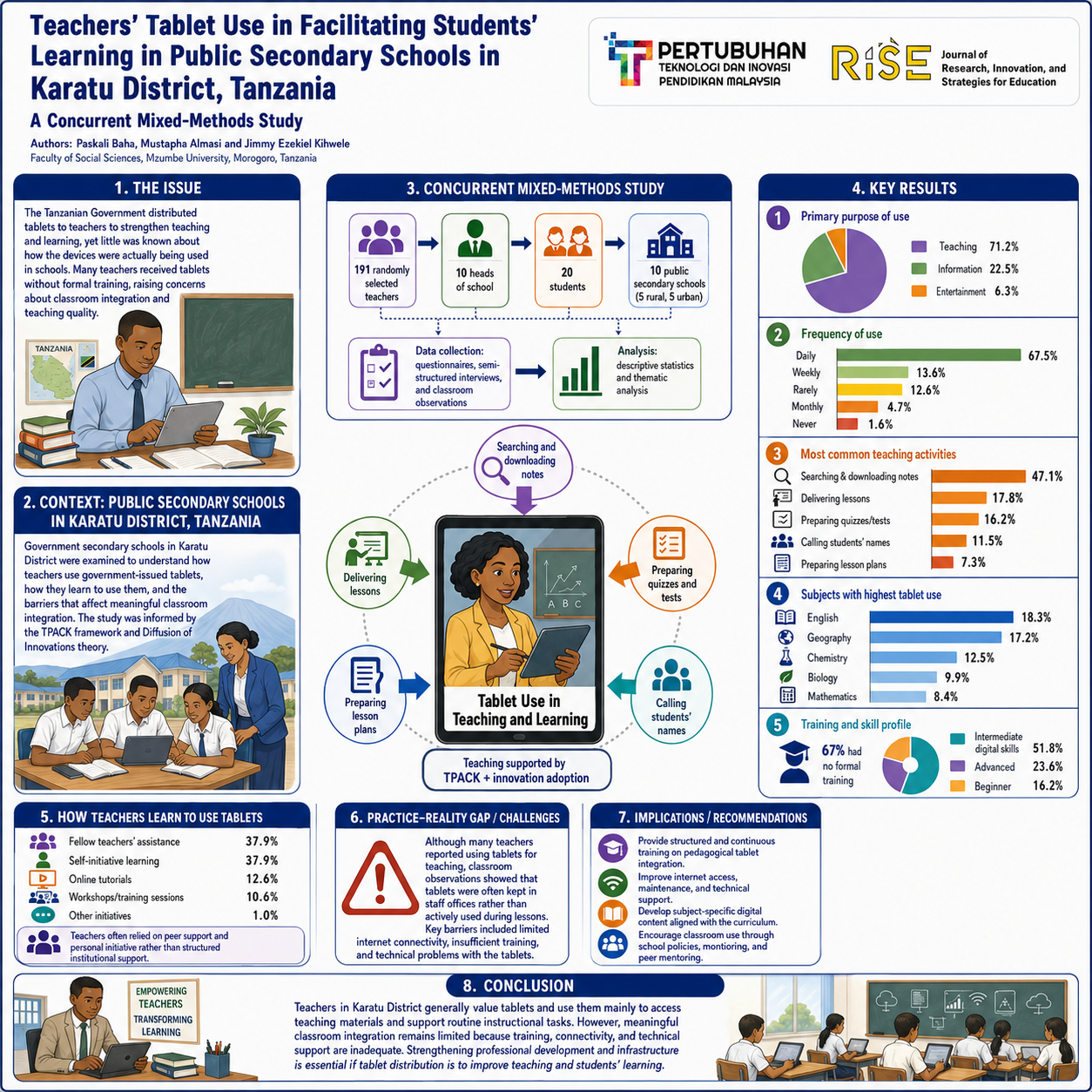
This study explored teachers’ tablet use in facilitating students’ learning in public secondary schools after the government had distributed them to all teachers. The focus was on understanding how teachers learn to use tablets in teaching, how they use them, and the challenges they encounter. The study employed a concurrent mixed design with a sample of 211 selected respondents from government secondary schools. Data collection employed questionnaires, interviews, and observation methods, and the analysis involved descriptive statistics and thematic analysis. The findings revealed that teachers use tablets primarily for teaching and information searching, and rarely for entertainment. Specific teaching activities for teachers using tablets include searching and downloading teaching materials and delivering lessons, despite 67% of teachers have not received formal training on using tablets. Teachers learn to use tablets through self-initiative and assistance from fellow teachers, while facing limited internet connectivity, insufficient training, and technical issues with the tablets. The findings imply that continued ICT use without adequate TPACK skills among teachers risks the quality of teaching and digital integration in the era of technological advancement. The findings call for interventions to help teachers embrace the power of technology in teaching.
References
Akpan, E. T. (2019). Challenges and prospects of ICT integration in secondary schools in Nigeria. International Journal of Education and Development, 12(1), 35–44.
Albirini, A. (2020). The impact of tablet computers on student engagement and learning outcomes in higher education: A meta-analysis. Journal of Educational Computing Research, 57(4), 539-562. https://www.researchgate.net/publication/262494764_Student_Use_of_the_Tablet_PC_Impact_on_Student_Learning_Behaviors
Ayo, M. (2023, May 3). Walimu watoa kauli hotua ya Rais Samia Mei Mosi. Millardayo Blog. https://millardayo.com/walimu-watoa-kauli-hotuba-ya-rais-samia-mei-mosi/
Bjørgen, A. M., Fritze, Y., & Haugsbakk, G. (2021). Dealing with increased complexity. Teachers’ reflections on the use of tablets in school. Pedagogies: An International Journal, 16(4), 347–362. https://doi.org/10.1080/1554480x.2021.1897010
Cheng, Y., & Zhang, F. (2020). Collaborative learning with tablets: A research synthesis. International Journal of Education and Development, 10(2), 34–42. https://doi.org/10.3389/ftox.2022.893924
Daily News. (2022, November 6). Census tablets distributed to schools, colleges. Daily News. https://dailynews.co.tz/census-tablets-distributed-to-schools-colleges/
Dovigo, F. (2021). The role of teachers’ attitude towards the use of the tablet in the first-grade elementary classroom. International Journal of Education and Development Using Information and Communication Technology, 17(3), 234–248.
Fernandez, S. C. (2022). Lecturers’ perspectives on the advantages and disadvantages of tablet use for learning and teaching in a South African rustic university. Advances in Educational Technology and Psychology, 6(12). https://doi.org/10.23977/aetp.2022.061201
Goh, K. C., & Ang, R. C. (2023). Online forum participation for knowledge construction: Exploring the mediating role of self-regulated learning in a tablet-based environment. Computers and Education, 192. https://doi.org/10.3389/fpsyg.2022.943072
Haji, M. A., Qian, X., Ramadhan, M. K., & Mike, S. A. (2024). Integration of use of tablets into teaching and learning in secondary school of Michewen District in Zanzibar. Asian Journal of Education and Social Studies, 50(5), 477–488. https://doi.org/10.9734/ajess/2024/v50i51377
Hamidi, H., & Smith, L. P. (2021). The impact of formative assessment and feedback delivery using mobile technology on student achievement: A meta-analysis. Journal of Computer Assisted Learning, 37(5), 669–700. https://doi.org/10.3389/fpsyg.2022.990196
Heinrich, C. J., Darling‐Aduana, J., & Martin, C. (2019). The potential and prerequisites of effective tablet integration in rural Kenya. British Journal of Educational Technology, 51(2), 498–514. https://doi.org/10.1111/bjet.12870
Javid, Z. S., Nazeer, Z., Sewani, R., & Laghari, A. (2023). Effect of using mobile devices as an instructional tool on teachers’ creativity: An interpretive phenomenological study of Pakistani teachers’ experiences. Asian Association of Open Universities Journal, 18(3), 292–305. https://doi.org/10.1108/AAOUJ-01-2023-0011
Mishra, P., & Koehler, M. J. (2006). Technological pedagogical content knowledge: A framework for teacher knowledge. Teachers College Record, 108(6), 1017–1054. https://doi.org/10.1111/j.1467-9620.2006.00684.x
Mwakapemba, J. L., Phabiano, E., & Retnawati, H. (2024). Teachers’ perceptions towards the utilization of tablets for educational purposes in Tanzania. Jurnal Penelitian Pendidikan IPA, 10(3), 1331–1339. https://doi.org/10.29303/jppipa.v10i3.7085
Rajab, S. H. (2020). Assessment of teachers’ digital literacy towards ICT integration in secondary schools: The case of Dodoma city [Masters Dissertation, University of Dodoma]. http://hdl.handle.net/20.500.12661/2708
Raphael, J. (2022, November 4). Walimu Wagaiwa Vishikwambi 293,400, Huku Waziri Mkuu Majaliwa Akitoa Onyo Kwa Matumizi Sahihi Ya Vishikwambi Hivyo. Michuziblog. https://www.michuzi.co.tz/2022/11/walimu-wagaiwa-vishikwambi-293400-huku.html?m=1
Rogers, E. M. (2003). Diffusion of innovations (5th Ed.). Free Press.
Saha, T. (2023). The role of ICT in education: Challenges and issues. Journal of Emerging Technologies and Innovative Research, 10(2), 98–99. www.jetir.org
Salmerón, L., Delgado, P., Vargas, C., & Gil, L. (2021). Tablets for all? Testing the screen inferiority effect with upper primary school students. Learning and Individual Differences, 86, 101975. https://doi.org/10.1016/j.lindif.2021.101975
Sharma, Dr. L. R., Bidari, S., Bidari, D., Neupane, S., & Sapkota, R. (2023). Exploring the mixed methods research design: Types, purposes, strengths, challenges, and criticisms. Global Academic Journal of Linguistics and Literature, 5(1), 3–12. https://doi.org/10.36348/gajll.2023.v05i01.002
Trucano, M. (2013). Big educational laptop and tablet projects: Global Lead for Innovation in Education, Sr. Education & Technology Policy Specialist: [EduTech]. EduTech. cationhttps://blogs.worldbank.org/edutech/b ig-educational-laptop-and-tablet-projects-ten-
Velchik, A. (2020). Digital tablets in the classroom: A perspective from students. Journal of Education and Practice, 11(15), 11–16. https://doi.org/10.7176/jep/11-15-02
Willermark, S. (2018). Technological pedagogical and content knowledge: A review of empirical studies published from 2011 to 2016. Journal of Educational Computing Research, 56(3), 315–343. https://doi.org/10.1177/0735633117713114
World Bank. (2023). Continuous teacher training goes nationwide in Tanzania. World Bank. https://www.worldbank.org/en/news/feature/2023/01/24/continuous-teacher-training-goes-nationwidtanzania
Downloads
Published
Issue
Section
License
Copyright (c) 2025 Paskali Baha, Mustapha Almasi, Jimmy Ezekiel Kihwele (Author)

This work is licensed under a Creative Commons Attribution 4.0 International License.