From Pedagogy to Heutagogy: Leveraging Double-Loop Learning to Foster Metacognition in Secondary Social Science Education in Bangladesh
DOI:
https://doi.org/10.70148/rise.v3i4.2Keywords:
Double loop, Heutagogy, Metacognitive, Social Science, Self-AssessmentAbstract
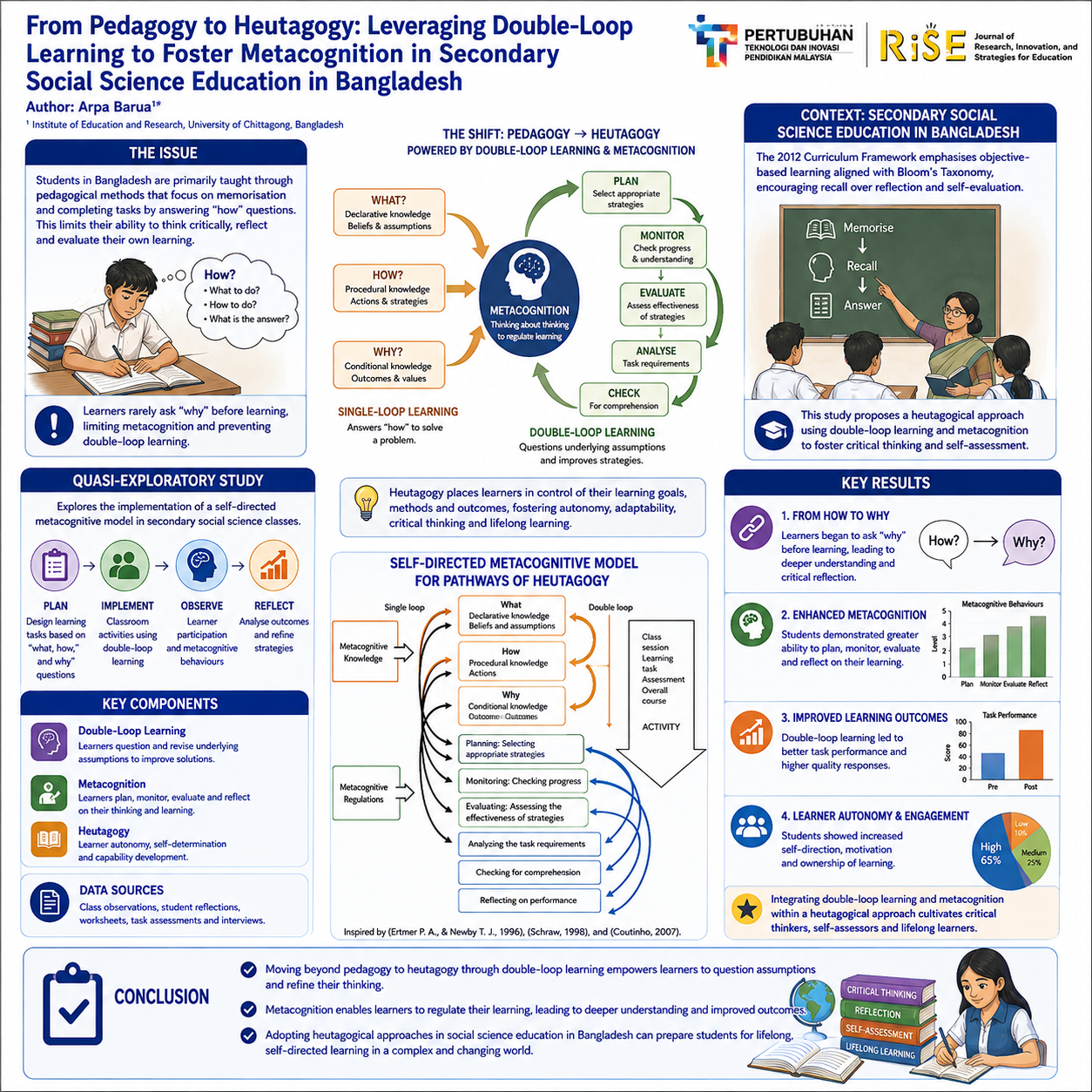
Double loop learning and heutagogy have an impact on students' critical thinking and self-assessment. There are three methods of learning: heutagogy, andragogy, and pedagogy. Heutagogy goes in the opposite direction and finds answers to questions like why to solve this problem, whereas students currently only find answers to questions like how to solve this problem due to the completion of learning through pedagogical methods. So, learning starts by asking students why they will solve a topic before studying it, and if the teacher teaches a topic in the classroom, the student can begin learning through their own thinking and evaluation. At this stage, the student's metacognition is triggered, allowing him to critically assess the subject and learning strategy, guaranteeing double loop learning. The 2012 Curriculum Framework, an objective-based curriculum, is used to guide students' learning in Bangladesh's present educational system. By motivating students to memorize particular concepts using Bloom's Taxonomy, their learning was completed. Students are consequently unable to improve their own abilities in self-evaluation. Students are not able to become proficient in this subject even when pedagogical approaches are used to teach them how to overcome problems during the learning process. In the context of social science education, this study investigates how to broaden the heuristic learning path by implementing double loop learning and metacognition in the classroom.
References
Argyris, C. a. (2000). Theory in Practice: Increasing Professional.
Barone, T. (2001). Aesthetics, politics and educational inquiry: Essays and examples.
Blakey & Spence. (1990). Developing metacognition. Eric Reproduction Services.
Blakey, Spence . (1990). Developing metacognition. Eric Reproduction.
Blaschke, L. M. (2016). Strategies for Implementing Self-Determined Learning (Heutagogy) within. Germany: University of Oldenburg.
Boekaerts & Simons . (1995). Leren en instructie: Psychologie van de leerling en het leerproses. . Assen: Van Gorcum.
Bogdan, R. J. (2000). Minding minds: evolving a reflexive mind by interpreting others. MIT Press , Cambridge, MA.
Brenda A. Allen. (1993). Construct Validation of Metacognition. The journal of pshchology.
Cheong Jan Chan, Siao Ern Wong, Shien Wei Lee, Joshua Rickard, Phyllis . (· December 2022). Short-term Student Exchange using Double Loop Learning Framework of Heutagogy. International Journal of Academic Research in Business and Social Science.
Clark, K. M. (2021). Double-Loop Learning and Productive Reasoning: Chris Argyris’s. Midwest social sciences journal.
Costa. (1984). Mediating the metacognitive. Educational Leadership, 11, 57-62.
Costa. (1984). Mediating the metacognitive. Educational Leadership, 57-62.
Costa, A. L. (1984). Mediating the metacognitive. Educational Leadership, 57-62.
Coulter, C., Michael, C., & Poynor, L. (2007). Storytelling as pedagogy: An unexpected outcome of narrative inquiry. Curriculum Inquiry, 103-122.
Coutinho, C. P. (2007). Metacognitive knowledge and metacognitive regulation in self-regulatory learning style. Instructional Science, 1-20.
Declan Kennedy and Áine Hyland. (2009). Learning Outcomes and COMPETENCIES. Research gate.
Doğanay, A. (2012). A Curriculum Framework for Active Democratic Citizenship Education. Turkey: Brill.
Dooley, J. (1999). Problem Solving As a Double Loop Learning System. Research gate.
Elbaz, F. (1983). Teacher Thinking . London: Routledge.
Ertmer P. A., & Newby T. J. (1996). The expert learner: strategic, self-regulated, and reflective. Instructional Science, 1-20.
Flavell, J. (1979). Metacognition and cognitive monitoring: A new area of cognitive–developmental inquiry. American Psychologist,, 906–911.
Flavell, J. H. (1999). Cognitive development: children's knowledge about the mind. Annual Review of Psychology , 21-45.
Freeman, I. (2011). Double-Loop Learning and the Global. Canadian Journal of Higher Education, 102-127.
Frida Vania Alfizahr, Alfyananda Kurnia Putra, Syazwani Binti Sazali. (2023). ENHANCING ENVIRONMENTAL DECISION-MAKING: THE ROLE OF. Jurnal Pendidikan Ilmu Sosial.
Fullan, M. ( 2011). The Six Secrets of Change: What Successful School Leaders Know. United States: Jossey-Bass; 1st edition (November 22, 2011).
Glaser, R. (1984). Education and thinking : The role of knowledge . American Psychologist.
Glogger-Frey Inga , Schwonke, Rolf , Holzäpfel Lars,Nückles Matthias, Alexander Renkl. (2012). Learning Strategies Assessed by Journal Writing: Prediction of Learning Outcomes by Quantity, Quality, and Combinations of Learning Strategies. Journal of Educational Psychology, 452-468.
Hans Kuyper ,Margaretha Werf, Miranda Lubbers. (2000). Motivation, MetaCognition and Self-Regulation as Predictors of Long Term Educational Attainment. Educational Research and Evaluation, 181-205.
Hase , Kenyon. (2013). Self-Determined Learning : Heutagogy in Action. New york: Bloomsbury.
Houchens, Gary; Hurt, Janet; Stobaugh, Rebecca; Keedy, John L. (2012). Double-loop Learning: A Coaching Protocol for Enhancing Principal Instructional Leadership. Educational Administration,.
Huda, M. (2014). Model-Model Pengajaran dan Pembelajaran. . Yogyakarta: Pustaka Pelajar.
Ina Freeman, Peter Knight. (2011). Double-Loop Learning and the Global. Canadian Journal of Higher Education, 102-127.
John perry and David Lundie, Gill Golder. (2018). Metacognition in schools: what does the literature suggest about the effectiveness of teaching metacognition in schools? Educational Review.
Jonassen, David H. ; Peck, Kyle L.; Wilson Brent G.;. (1998). Learning with Technology: A Constructivist Perspective. New Jersey: Merrill Pub Co.
Killen, R. (2000). Teaching strategies for outcomes-based education. Landsdowne: Juta.
Lucky, H. (2015). Penerapan Double Loop Problem Solving untuk Meningkatkan Kemampuan Literasi Matematis. STKIP PGRI Sumbar(Level 3 pada Siswa Kelas VII SMPN 27 Bandung.).
M. Ridwan., A. M. Suhar., B. Ulum., and F. Muhammad,. (2021). “Pentingnya Penerapan Literature Review Pada Penelitian. Jurnal Masohi, 42-51.
Mazur, Amber; Brown, Barbara; Jacobsen, Dr;. (2015). Learning Designs using Flipped Classroom Instruction. Canadian Journal of Learning and Technolog.
McAuliffe, M. H. (2009). Does pedagogy still rule? . Australasian Journal of Engineering education , 13-18.
Metcalfe, J. (2000 ). Metamemory: theory and data. The Oxford handbook of memory, 197-211.
Moos, D.C. &Ringdal, A. (2012). Self-regulated learning in the classroom: a literature review on the teacher’s role. Education Research International, 1-15.
Muijs & Reynolds. (2000). School effectiveness and teacher effectiveness in mathematics: some preliminary findings from the evaluation of the Mathematics Enhancement programme . School effectiveness and school improvement, 273-303.
Ngalimun. (2012). Strategi Pembelajaran dilengkapi dengan 65 model pembelajaran. Banjarmasin: Aswaja Persindo.
National Curriculum and Textbook Board (NCTB). (2022). National Curriculum Framework 2022.
Ogle. (1986). KWL: A teaching model that develops active reading of expository text. The reading teacher, 564-570.
Ornstein and Hunkins. ( 1998 ). Curriculum: Foundations, Principles, and Issues. MA: Allyn & Bacon. : Needham Heights.
Panaoura, Philippou, & Christou,. (2003). Young pupils’ metacognitive ability in mathematics Education. Third Conference of the European Society for Research in .
Perkins, D. (1992). Smart Schools: Better Thinking and Learning for Every Child. New York:: Free Press.
Reynolds, D.; Muijs, D.;. (2005). Effective Teaching—Introduction and Conclusion. London: Sage PublicationS.
R. Q. (2011). The Question Formulation Technique (QFT). Boston: Harvard Education Press .
Schraw, G. (1998). Promoting general metacognitive awareness. Instructional Science, 113–125.
Shohel, M. M. (2022). Education in emergencies: challenges of providing education for Rohingya children living in refugee camps. EDUCATION INQUIRY.
Shoimin. (2014). Model Pembelajaran Inovatif Dalam Kurikulum . Yogyakarta: ar ruzz media.
Spoelstra, Howard; Rosmalen, Peter; Sloep, Peter;. (2014). Toward Project-based Learning and Team Formation in Open Learning Environments. JOURNAL OF UNIVERSAL COMPUTER SCIENCE.
Stewart Hase and Chris Kenyon;. (n.d.). Theory in Practice: Increasing Professional.
Trisnowati, E & Firdaus, F. . (2017). Kegiatan Laboratorium Fisika dengan Pendekatan. Jurnal Pena Sains, 4(2), 138-145.
Tyler, R. W. (2013). Basic Principles of Curriculum and Instruction. Chicag: University of Chicago Press.
UNESCO. (2015). Global Citizenship Education: Topics and learning objectives. UNESCO: Paris, France.
Zamroni & Mahfudz. (2009). Panduan Teknis Pembelajaran yang Mengembangkan Critical.
Downloads
Published
Issue
Section
License
Copyright (c) 2025 Arpa Barua (Author)

This work is licensed under a Creative Commons Attribution 4.0 International License.