Exploring Intervention Strategies for Effective Integration of Indigenous Games in Teaching Market Structures in Economics Class in Thabo-Mofutsanyane Education District, Free State, South Africa
DOI:
https://doi.org/10.70148/rise.v3i3.14Keywords:
Indigenous games, market structures, economics education, indigenous knowledge systemsAbstract
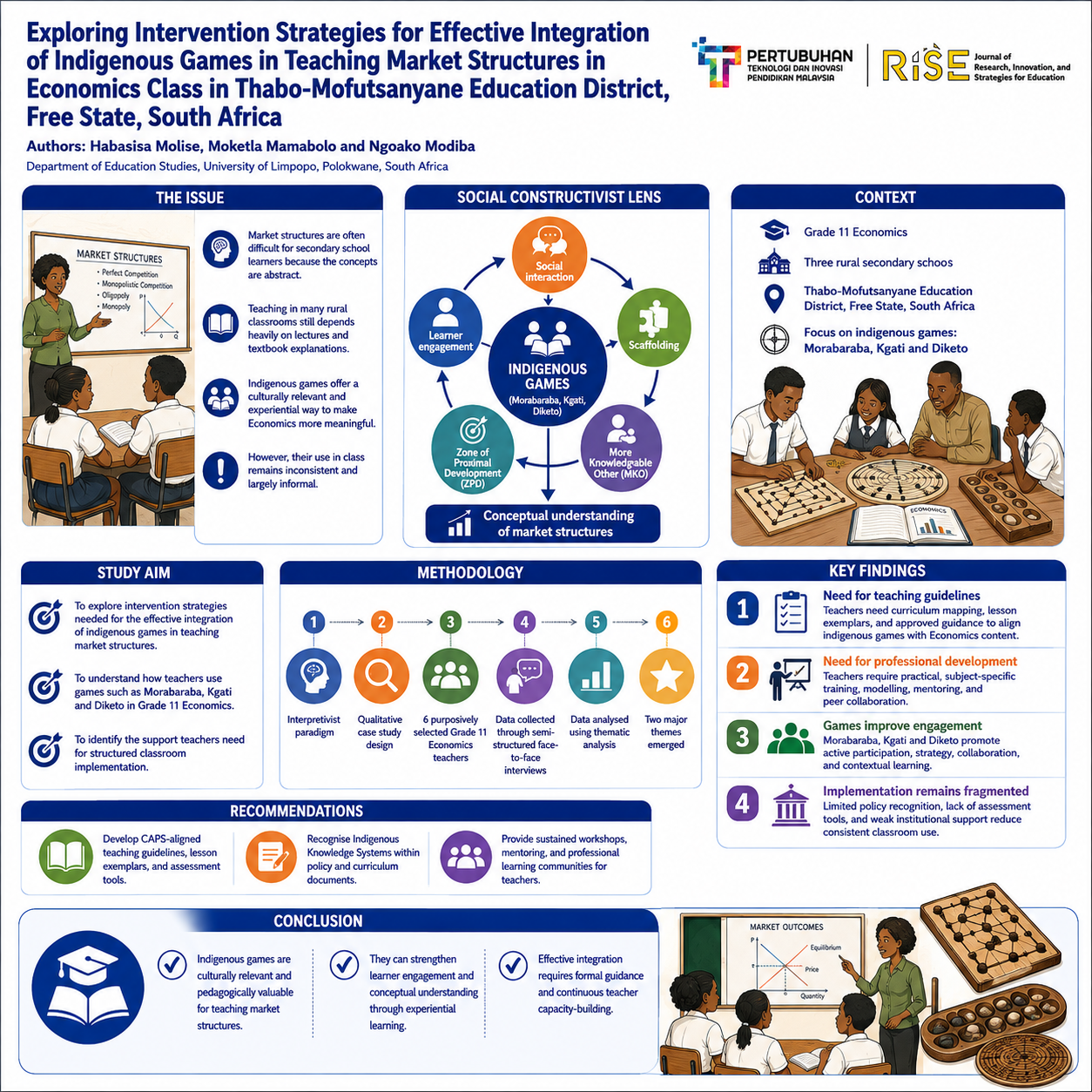
The teaching of market structures is often hindered by learners’ difficulty in understanding abstract concepts, and while indigenous games offer a culturally relevant, experiential approach, their classroom use remains inconsistent. This study addresses this gap by exploring context-specific intervention strategies for effectively integrating indigenous games in rural Economics classrooms. Guided by the interpretivist paradigm and a qualitative case study design, data were generated through semi-structured interviews with six purposively selected Economics teachers from three rural schools in the Thabo-Mofutsanyane Education District. Thematic analysis was employed to analyse participants’ narratives. The findings revealed that although teachers value indigenous games such as Morabaraba, Kgati, and Diketo for promoting learner engagement and contextual understanding, their implementation is constrained by systemic challenges. Two key intervention needs emerged: the development of structured teaching guidelines and the provision of targeted professional development. Teachers highlighted the absence of curriculum-aligned frameworks, lesson exemplars, and assessment tools, resulting in fragmented pedagogical practices. Additionally, limited training restricted their ability to translate gameplay into structured economic instruction. The study concludes that institutionalising indigenous game-based pedagogy requires curriculum integration, policy recognition, and sustained teacher capacity-building initiatives. This study contributes to existing literature by moving beyond descriptive accounts of indigenous games to provide empirically grounded, context-specific intervention strategies for their structured integration in rural Economics classrooms.
References
Ahmad, M., & Wilkins, S. (2024). Purposive sampling in qualitative research: A framework for the entire journey. Quality & Quantity. https://doi.org/10.1007/s11135-024-02022-5
Ahmed, S. K. (2024). The pillars of trustworthiness in qualitative research. Journal of Medicine, Surgery and Public Health, 2, 100051. https://doi.org/10.1016/j.glmedi.2024.100051
Ali, C. A., & Tangkur, M. (2023). The mathematics teacher is at the crossroads between indigenous cultural and exotic games in teaching mathematics. Research Square, 1(3), 1–19.
Bhuda, M. T. (2021). The Ndebele indigenous games pertinent to primary school mathematics learning: Why indigenous games are a vital tool for mathematics teaching and learning [Master’s thesis, University of Mpumalanga]. https://openscholar.ump.ac.za/handle/20.500.12714/529
Braun, V., & Clarke, V. (2006). Using thematic analysis in psychology. Qualitative Research in Psychology, 3(2), 77–101. https://doi.org/10.1191/1478088706qp063oa
Braun, V., & Clarke, V. (2023). Toward good practice in thematic analysis: Avoiding common problems and be(com)ing a knowing researcher. International Journal of Transgender Health, 24(1), 1–6. https://doi.org/10.1080/26895269.2022.2129597
Braun, V., & Clarke, V. (2024). Reporting guidelines for qualitative research: a values-based approach. Qualitative Research in Psychology, 22(2), 399–438. https://doi.org/10.1080/14780887.2024.2382244
Braun, V., & Clarke, V. (2024b). Thematic analysis. In N. K. Denzin, Y. S. Lincoln, M. D. Giardina, & G. S. Cannella (Eds.), The Sage handbook of qualitative research (6th ed., pp. 385–402). Sage.
Daud, S. (2023). Research design. In Carbon Nanotubes: Fabrication Using the Arc Discharge Process (pp. 37–49). Springer.
Department of Basic Education. (2011). Economics: Curriculum and Assessment Policy Statement Grades 10–12. Government Printers. www.education.gov.za
Ekeh, M. C. (2024). The pedagogic role of indigenous play for early-grade learners. Journal of Culture and Values in Education, 7(4), 73–88. https://doi.org/10.46303/jcve.2024.41
Galawe, B. F. (2023). The use of indigenous games in the teaching of geometric patterns in mathematics in the intermediate phase [Master’s dissertation, University of the Free State].
Hadebe-Ndlovu, B. N. (2022). Teachers’ experiences of indigenous games in the early grades. South African Journal of Childhood Education, 12(1), 1–7.
Hennink, M., & Kaiser, B. N. (2022). Sample sizes for saturation in qualitative research: a systematic review of empirical tests. Social Science & Medicine, 292, 114523. https://doi.org/10.1016/j.socscimed.2021.114523
Kieninger, K., & Kopish, M. A. (2023). Developing an Understanding of Secondary Social Studies Teacher Candidates’ Economic Pedagogical Content Knowledge. Journal of Social Studies Education Research, 14(3), 1–25. https://jsser.org/index.php/jsser/article/view/5100/623
Kiger, M. E., & Varpio, L. (2020). Thematic analysis of qualitative data: AMEE Guide No. 131. Medical Teacher, 42(8), 846–854.
Korstjens, I., & Moser, A. (2022). Series: practical guidance to qualitative research. Part 6: longitudinal qualitative and mixed-methods approaches for longitudinal and complex health themes in primary care research. European Journal of General Practice, 28(1), 118–124.
Lohr, S. L. (2021). Sampling: Design and analysis. CRC Press.
Lui, A. (2012). Teaching in the Zone: An introduction to working within the Zone of Proximal Development (ZPD) to drive effective early childhood instruction (White paper).
Madondo, F., & Tsikira, J. (2022). Traditional children’s games: Their relevance on skills development among rural Zimbabwean children aged 3–8 years. Journal of Research in Childhood Education, 36(3), 1–15. https://doi.org/10.1080/02568543.2021.1982084
Maimela, G., Madima, T., & Makhanikhe, J. (2024). Overcoming digital barriers to African indigenous games in local communities. Bussecon Review of Social Sciences, 6(1), 29–39. https://doi.org/10.36096/brss.v6i1.552
Matafwali, B., & Mpofu, M. (2023). Exploring the feasibility of outdoor indigenous games and songs to enhance play-based pedagogy in early childhood education. Journal of Childhood, Education and Society, 4(3), 391–405. https://doi.org/10.37291/2717638X.202343270
Matsekoleng, T. K., Mapotse, T. A., & Gumbo, M. T. (2022). The role of indigenous games in education: A technology and environmental education perspective. Diaspora, Indigenous, and Minority Education, 18(1), 68–82. https://doi.org/10.1080/15595692.2022.2160436
Merriam, S. B. (2009). Qualitative research: A guide to design and implementation. Jossey-Bass.
Merriam, S. B., & Grenier, R. S. (2019). Qualitative research in practice: Examples for discussion and analysis (2nd ed.). Jossey-Bass.
Merriam, S. B., & Tisdell, E. J. (2016). Qualitative research: A guide to design and implementation (4th ed.). Jossey-Bass.
Mohammed, B. (2021). How to write qualitative research. International Journal of Quantitative and Qualitative Research Methods, 9(3), 1–6.
Mohammed, S. H., & Kinyo, L. (2020). The role of constructivism in the enhancement of social studies education. Journal of Critical Reviews, 7(7), 249–256.
Moloi, T. J. (2020). Decolonising the teaching of mathematics in rural learning ecologies by using indigenous games. Alternation, 27(2), 125–150. https://doi.org/10.29086/2519-5476/2020/v27n2a6
Mosimege, M. (2020). The use of indigenous games in the teaching and learning of mathematics. Revemop, 2, e202009. https://doi.org/10.33532/revemop.e202009
Muzari, T., Shava, G. N., & Shonhiwa, S. (2022). Qualitative research paradigm, a key research design for educational researchers, processes and procedures: A theoretical overview. Indiana Journal of Humanities and Social Sciences, 3(1), 14–20.
Mwinsa, G., & Dagada, M. (2024). Efficacy of indigenous games on literacy and numeracy development in pre-schoolers in Zambia. South African Journal of Childhood Education, 14(1). https://doi.org/10.4102/sajce.v14i1.1555
Ngwenya, J. C., & Hlophe, N. Q. (2021). Strategies used to teach Grade 11 Financial Accounting in one district in South Africa. International Journal of Sciences and Research, 77(7/1), 15–32.
Ngwenya, J. C., & Shange, N. L. (2019). Learners’ views on challenges encountered during practical work in Consumer Studies: A case of one school in KwaZulu-Natal. African Journal of Hospitality, Tourism and Leisure, 8(1), 1–13.
Nxumalo, S. A., & Mncube, D. W. (2019). Using indigenous games and knowledge to decolonise the school curriculum: Ubuntu perspectives. Perspectives in Education, 36(2), 103–118.
Nyimbili, F., & Nyimbili, L. (2024). Types of Purposive Sampling Techniques with Their Examples and Application in Qualitative Research Studies. British Journal of Multidisciplinary and Advanced Studies, 5, 90–99. https://doi.org/10.37745/bjmas.2022.0419
Obilor, E. I. (2023). Convenience and purposive sampling techniques: Are they the same. International Journal of Innovative Social & Science Education Research, 11(1), 1–7.
Ogbonnaya, I. C. (2024). Teachers’ topic-specific pedagogical content knowledge: A driver in understanding graphs in dynamics of market. European Journal of Educational Research, 13(3), 1247–1262. https://doi.org/10.12973/eu-jer.13.3.1247
Omotayo, S. A., & Adeleke, J. O. (2017). The 5E instructional model: a constructivist approach for enhancing students' learning outcomes in mathematics. Journal of the International Society for Teacher Education, 21(2), 15–26.
Prasetyono, H., Abdillah, A., Djuhartono, T., Ramdayana, I. P., & Desnaranti, L. (2021). Improvement of Teacher's Professional Competency in Strengthening Learning Methods to Maximize Curriculum Implementation. International Journal of Evaluation and Research in Education, 10(2), 720–727. https://doi.org/10.11591/ijere.v10i2.21010
Rahman, R. B. A. (2023). Comparison of telephone and in-person interviews for data collection in qualitative human research. Interdisciplinary Undergraduate Research Journal, 10–13.
Renwick, K., & Bauer Edstrom, M. (2022). Finding home economics when it has never been lost: A journey of discovery for pre‐service teachers. International Journal of Home Economics, 15(1), 171–182. https://search.informit.org/doi/10.3316/informit.591143978573971
Sharma, S. K., Mudgal, S. K., Gaur, R., Chaturvedi, J., Rulaniya, S., & Sharma, P. (2024). Navigating sample size estimation for qualitative research. Journal of Medical Evidence, 5, 133–9. https://doi.org/10.4103/JME.JME_59_24
Shava, G., & Nkengbeza, D. (2019). Qualitative Research Paradigm: A Design for Distance Education Researchers. Namibia CPD Journal for Educators, 237–258.
Stake, R. (2005). Qualitative case studies. In N. K. Denzin & Y. S. Lincoln (Eds.), The Sage handbook of qualitative research (3rd ed., pp. 443–466). Sage.
Tachie, S. A., & Galawe, B. F. (2021). The value of incorporating indigenous games in the teaching of number sentences and geometric patterns. International Journal for Cross-Disciplinary Subjects in Education, 12(1), 4350–4361.
Van Hover, S., & Hicks, D. (2017). Social constructivism and student learning in social studies. In M. M. Manfra & C. M. Bolick (Eds.), The Wiley Handbook of Social Studies Research (pp. 270–318). https://doi.org/10.1002/9781118768747.ch12
Vygotsky, L., & Cole, M. (2018). Lev Vygotsky: Learning and social constructivism. In Learning Theories for Early Years Practice (pp. 58–66). Sage.
Whitehead, D., & Whitehead, L. (2020). Data collection and sampling in qualitative research. Nursing and Midwifery Research Methods and Appraisal for Evidence-Based Practice (6th ed., pp. 118–135). Elsevier.
Yin, R. K. (2017). Case Study Research and Applications: Design and methods (6th ed.). Sage.
Yin, R. K. (2018). Case Study Research Design and Methods (5th ed.). Sage. https://doi.org/10.3138/CJPE.BR-240
Zajda, J., & Zajda, S. J. (2021). Constructivist learning theory and creating effective learning environments. Globalisation and education reforms: Creating effective learning environments (pp. 35–50). https://doi.org/10.1007/978-3-030-71575-5_3
Downloads
Published
Issue
Section
License
Copyright (c) 2025 Habasisa Molise, Moketla Mamabolo, Ngoako Modiba (Author)

This work is licensed under a Creative Commons Attribution 4.0 International License.