A Systematic Review of Music Education, Acoustics, and STEAM Integration in South African Primary and Lower Secondary Schools
DOI:
https://doi.org/10.70148/rise.v3i4.7Keywords:
Music education, STEAM integration, ICT in classrooms, Acoustic, South African basic schoolsAbstract
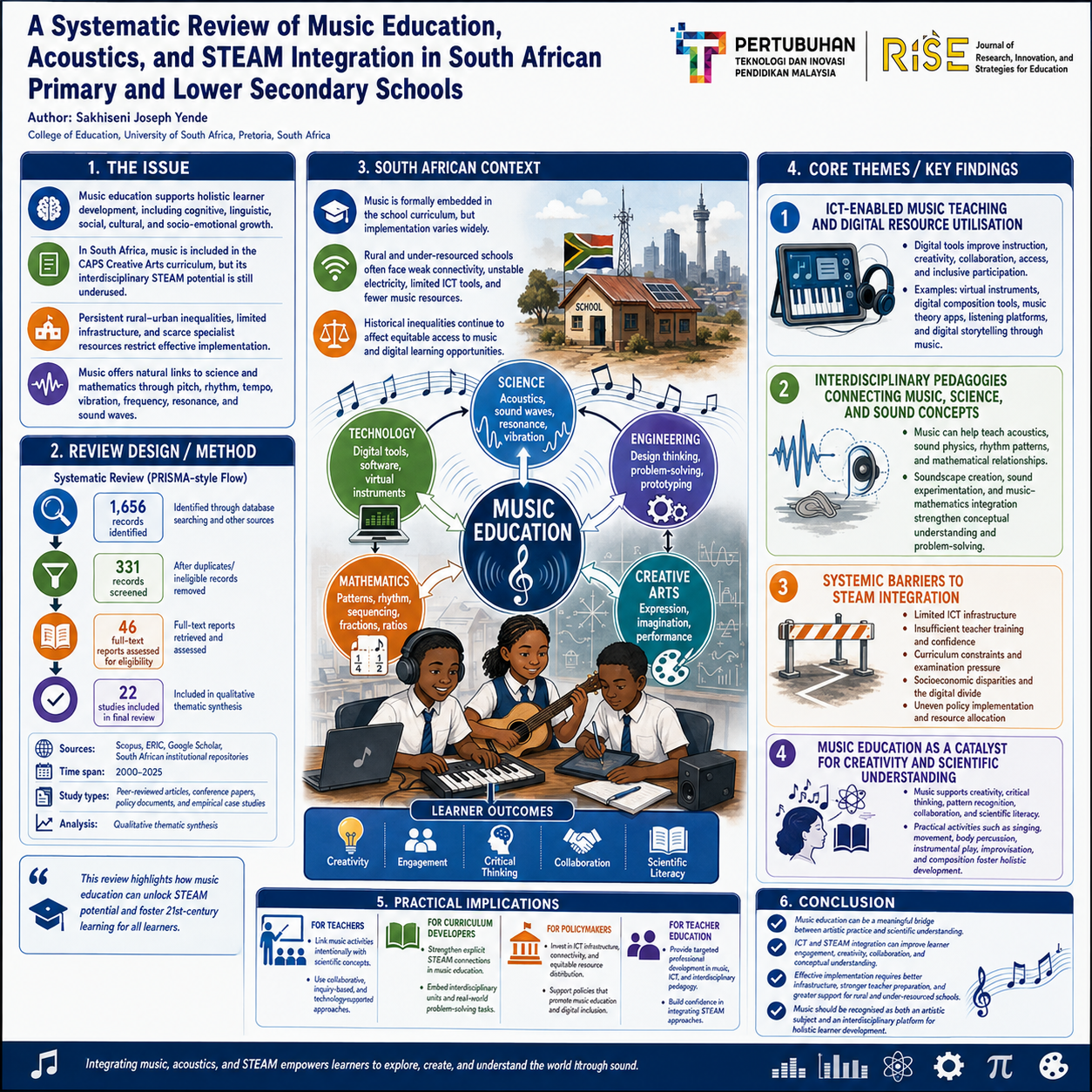
This systematic review investigates the integration of music education with science, technology, engineering, arts, and mathematics (STEAM) in South African basic schools. The study explores how music instruction can enhance scientific and technological literacy, particularly through acoustics concepts and ICT-enabled digital tools. Peer-reviewed journal articles, policy documents, and case studies published between 2000 and 2025 were systematically analysed following established review guidelines, with 19 studies meeting the inclusion criteria. The findings reveal that although music is formally embedded within the national curriculum, its interdisciplinary potential for STEAM integration remains underutilised. Key challenges include limited teacher professional development, inadequate ICT infrastructure, curriculum constraints, and insufficient emphasis on scientific principles such as sound waves, frequency, resonance, and vibration. However, innovative practices including digital composition software, virtual acoustics simulations, music-mathematics integration activities, and collaborative cross-disciplinary projects demonstrate positive effects on learner engagement, conceptual understanding, creativity, and problem-solving skills. The review further indicates that structured integration of digital music skills can support inclusive participation and foster critical thinking across artistic and scientific domains. The study concludes that embedding scientific and technological concepts within music education can contribute significantly to holistic learner development and interdisciplinary competence. These findings have implications for curriculum design, teacher training programmes, resource allocation, and education policy, supporting the advancement of contextually responsive STEAM education in South African primary and lower secondary schools.
References
An, S., Capraro, M. M., & Tillman, D. A. (2013). Elementary teachers integrate music activities into regular mathematics lessons: Effects on students’ mathematical abilities. Journal for Learning through the Arts, 9(1). http://escholarship.org/uc/item/0js732gf
Department of Education. (2011). National Curriculum and Assessment Policy Statement (CAPS) for Creative Arts Senior Phase. Pretoria: Government Printer. https://www.education.gov.za/Curriculum/CurriculumAssessmentPolicyStatements(CAPS)/CAPSSenior.aspx
Di Paolo, A., & Todino, M. D. (2025). Inclusive music education in the digital age: The role of technology and edugames in supporting students with special educational needs. Encyclopedia, 5(3), 102. https://doi.org/10.3390/encyclopedia5030102
Fuentes, B. J. C., Flórez, N. H., & Klimenko, O. (2025). Music education from the perspective of the cognitive and communicative dimensions as components of the integral formation of secondary school students: A documentary analysis. Ciencia y Reflexión, 4(1), 2130–2166. https://doi.org/10.70747/cr.v4i1.184
Galea, T. Y., & Ramos, J. V. (2024). Creative musical activities in early childhood education: An analysis of teaching practices. International Journal of Music Education. https://doi.org/10.1177/02557614241295
Hendriks, M., & Cruywagen, S. (2024). Mathematics in South Africa’s intermediate phase: Music integration for enhanced learning. South African Journal of Childhood Education, 14(1), a1535. https://doi.org/10.4102/sajce.v14i1.1535
Lam, C. K. (2023). Technology-enhanced creativity in K-12 music education: A scoping review. International Journal of Music Education, 42(4). https://doi.org/10.1177/02557614231194073
Mpungose, C.B. (2020). Emergent transition from face-to-face to online learning in a South African University in the context of the Coronavirus pandemic. Humanities and Social Sciences Communications, 7(1), pp.1-9. https://doi.org/10.1057/s41599-020-00603-x
Muhuro, P. and Kangethe, S.M. (2021). Prospects and pitfalls associated with implementing blended learning in rural-based higher education institutions in Southern Africa. Perspectives in Education, 39(1), pp.427-441. https://doi.org/10.38140/pie.v39i1.4615
Nchabeleng, P. M. (2025). From traditional face-to-face contact to face-the-screen method of teaching and learning: The challenges faced by South African rural school learners and tertiary students during COVID-19 lockdown and beyond. Journal of Education and Learning Technology (JELT), 6(6), 406–423. https://doi.org/10.38159/jelt.2025667
Nkosi, A. D. (2025). Children’s theatre play production as an integrated arts pedagogy in the foundation phase: A case study. South African Journal of Childhood Education, 15(1), a1614. https://doi.org/10.4102/sajce.v15i1.1614
Parkita, E. (2021). Digital tools of universal music education. Central European Journal of Educational Research, 3(1), 60–66. https://doi.org/10.37441/cejer/2021/3/1/9352
Portero, G. H., & Bravo, P. C. (2022). The use of ICT in secondary music education and its relationship with teachers' beliefs. Digital Education Review, 42, 1–15. https://doi.org/10.1344/der.2022.42.1-15
Qian, S., & Hami, A. H. B. A. (2025). Research on pathways for integrating music and STEAM education: A case study of the Affiliated Primary School of Anhui Normal University. International Journal of Research and Innovation in Social Science (IJRISS), 9(11). https://doi.org/10.47772/IJRISS.2025.91100617
Seleke, B., Teis, N. J. P., Els, C. J., & Legodu, G. (2025). Indigenous knowledge integration in South Africa's technology education curriculum: Current status, challenges, and future directions. Journal of Education and Learning Technology (JELT), 6(1), 120–138. https://doi.org/10.38159/jelt.2025619
Semenikhina, O., Yurchenko, A., Ostroga, M., & Shamonya, V. (2024). STEM education and music: A comparative analysis of practices. Education. Innovation. Practice, 12(9), 78–82. https://doi.org/10.31110/2616-650X-vol12i9-012
Van Vreden, M. (2018). Music-inspired free play to foster scientific exploration in early childhood. South African Journal of Childhood Education, 8(2), a560. https://doi.org/10.4102/sajce.v8i2.560
Xiao, Y., & Watson, M. (2017). Guidance on conducting a systematic literature review. Journal of Planning Education and Research, 39(1), 93–112. https://doi.org/10.1177/0739456X17723971
Yende, S.J. (2021). A Transition towards the Fourth Industrial Revolution (4IR) in the South African Education Sector: A Perspective from Rural-based Higher Education. African Journal of Development Studies (formerly AFFRIKA Journal of Politics, Economics and Society), 11(2), pp.55-75. https://doi.org/10.31920/2634- 3649/2021/v11n2a3
Yende, S. J. (2023). Effectiveness of music education in developing and fostering reading and writing for learners. Reading & Writing, 14(1), a425. https://doi.org/10.4102/rw.v14i1.425
Yende, S. J. (2024). Feasibility of introducing digital music skills into South African primary school curriculum. South African Journal of Childhood Education, 14(1), a1479. https://doi.org/10.4102/sajce.v14i1.1479
Zibani, P., Rajkoomar, M., & Naicker, N. (2021). A systematic review of faculty research repositories at higher education institutions. Digital Library Perspectives, ahead-of-print. https://doi.org/10.1108/DLP-04-2021-0035
Downloads
Published
Issue
Section
License
Copyright (c) 2025 Sakhiseni Joseph Yende (Author)

This work is licensed under a Creative Commons Attribution 4.0 International License.