From Classroom to Microlearning: Comparing Learner Perceptions of Traditional and Innovative Approaches in Lifelong and Adult Education in Tanzania
DOI:
https://doi.org/10.70148/rise.v3i4.8Keywords:
Blended learning, microlearning, traditional learning, Tanzania, adult learningAbstract
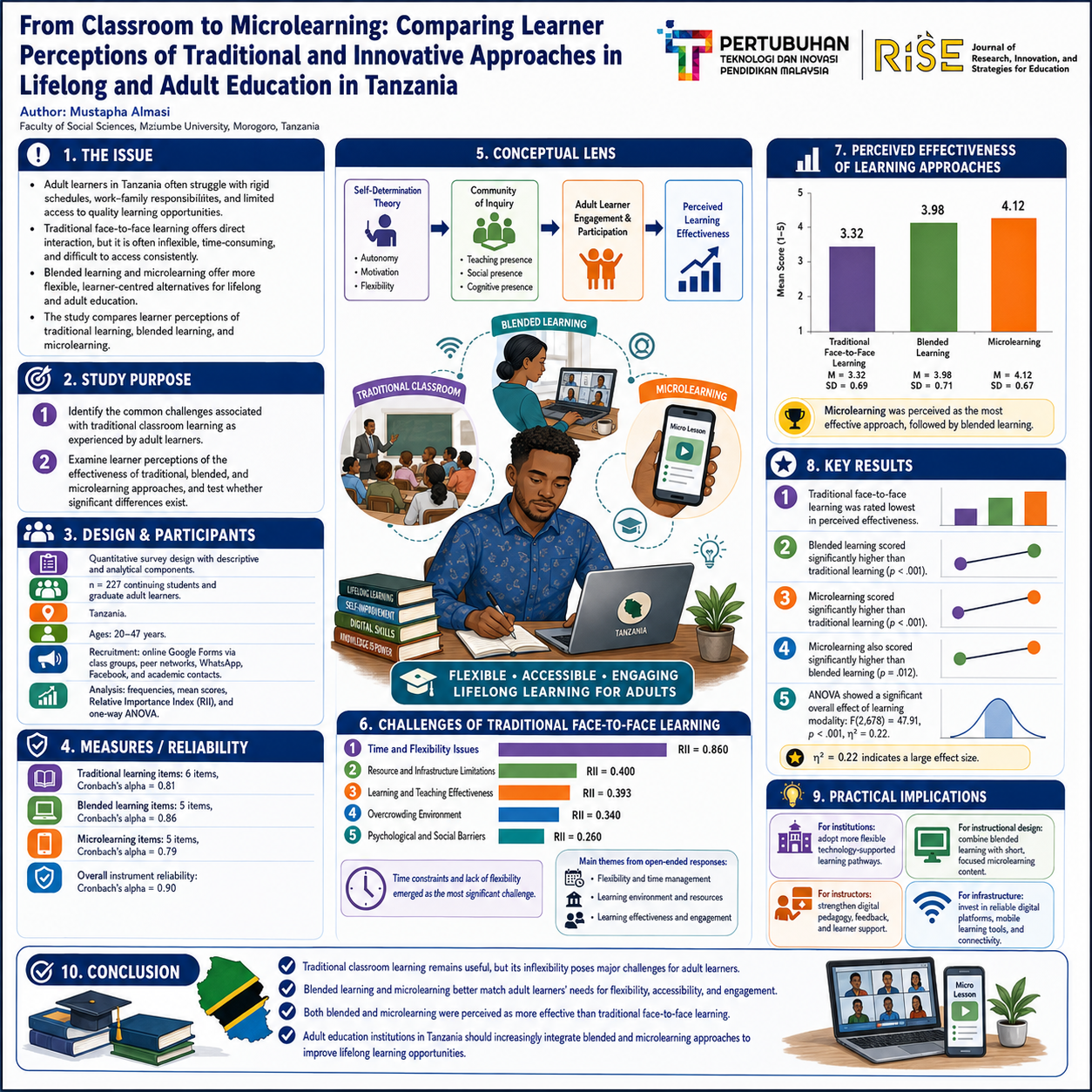
Access to quality adult education remains a significant challenge in many developing countries due to low technology adoption, inadequate teaching materials, and adult family responsibilities. Traditional educational models often fail to address the diverse needs of learners, highlighting the need to adopt innovative approaches. This study examined challenges of traditional classroom learning, compared learners’ perceptions of its effectiveness to blended and microlearning, and assessed differences in perceived effectiveness among the approaches. Using quantitative survey design combining both descriptive and analytic components, a total of 227 graduate and ongoing adult learners were studied. Data were analyzed using means, frequencies, thematic analysis, the Relative Importance Index (RII), and one-way ANOVA. Time constraints and lack of flexibility (RII= 0.86) was the most significant challenge of traditional face-to-face learning. Mean scores indicated that blended learning and microlearning were perceived as more effective than traditional learning. Furthermore, ANOVA results demonstrated that blended learning and microlearning were associated with significantly higher effectiveness scores compared to traditional face-to-face learning. Based on the findings, this study offers practical insights in improving accessibility, engagement, and learning effectiveness among adult learners.
References
Alias, N. F., & Razak, R. A. (2025). Revolutionizing learning in the digital age: A systematic literature review of microlearning strategies. Interactive Learning Environments, 33(1), 1-21.
Almasi, M., & Zhu, C. (2020). Investigating Students' Perceptions of Cognitive Presence in Relation to Learner Performance in Blended Learning Courses: A Mixed-Methods Approach. Electronic Journal of Learning, 18(4), 324-336. https://doi.org/10.34190/EJEL.20.18.4.005
Almasi, M. (2019). Investigating influential variables related to blended learning courses in the context of selected Tanzanian universities. PhD Dissertation. Vrije Universiteit Brussel, Brussels.
Almasi, M., Mgata, F. Y., Machumu, H., & Masashua, A. (2025). Students’ experiences and motivational factors on using e-learning systems in higher education institutions in Tanzania. Educational Technology Quarterly, 2025(1), 86-100. http://dx.doi.org/10.55056/etq.866
Almasi, M., Zhu, C., Machumu, H., Rwechungura, E. M., & Fred, M. (2024). The influence of student interaction on sense of community and academic performance in blended learning courses in selected Tanzania universities. The International Journal of Learning Spaces Studies, 3(3), 31-42.
Almasi, M., Machumu, H., & Kalimasi, P. Exploring Students' Perceptions of Moodle as a Tool for Enhancing Transformative Learning in a Rural University in Tanzania. https://doi.org/10.36261/ijdeel.v11i1
Almasi, M., Rumulika, S. M., Hakimu, J., & Mbukwa, J. N. (2024). Teachers'beliefs and constraints in adopting learner-centered pedagogy; an analysis of teacher-centered methods in tanzanian teacher training colleges. Pedagogik: Jurnal Pendidikan, 11(2), 249-263.
Almasi, M., Zhu, C., & Machumu, H. (2018). Teaching, social, and cognitive presences and their relations to students’ characteristics and academic performance in blended learning courses in a Tanzanian University. Afrika Focus, 31(1), 73-89.
Anderson, T., Rourke, L., Vaughan, R. D., & Archer, W. (2001). Assessing teaching presence in a computer conferencing context. JALN 5(2).
Bryman, A. (2003). Research methods and organization studies. Routledge.
Cohen, J. (1988). Statistical power analysis for the behavioral sciences (2nd ed.). Lawrence Erlbaum Associates
Cosmas, J. K. (2018). Perceived challenges and recommendations for overcoming challenges by diploma in adult education student, teachers through open and distance learning in Tanzania: A case of institute of adult education, Dodoma centre, Tanzania. International Journal of Innovative Research and Development, 7(10), 1-8.
Creswell, J. W., & Creswell, J. D. (2018). Research design: Qualitative, quantitative, and mixed methods approach (5th ed.). SAGE Publications.
Drakidou, C. (2018). Micro-learning as an Alternative in Lifelong eLearning. The Aristotle University of Thessaloniki.
Elhamuye, M. (2024). Evaluating the Effectiveness of Blended Learning Approaches in ESL/EFL Education. Innovation in Language Learning and Teaching.
ElSayad, G. (2024). Higher education students’ learning perception in the blended learning community of inquiry. Journal of Computers in Education, 11(4), 1061-1088. https://doi.org/10.1007/s40692-023-00290-y
Ghasia, M. A., & Rutatola, E. P. (2021). Contextualizing micro-learning deployment: An evaluation report of platforms for the higher education institutions in Tanzania. International Journal of Education and Development using Information and Communication Technology, 17(1), 65-81.
Emmanuel, O. (2018). Realization of time as a resource in the practice of Adult Education: The case of COBET programme in Dar es Salaam Region. Journal of Adult Education in Tanzania, 21(1).
Fitria, T. N. (2022). Microlearning in teaching and learning process: A review. CENDEKIA: Jurnal Ilmu Sosial, Bahasa Dan Pendidikan, 2(4), 114-135. https://doi.org/10.55606/cendikia.v2i4.473
Garrison, D. R., & Arbaugh, J. B. (2007). Researching the community of inquiry framework: Review, issues, and future directions. The Internet and Higher Education, 10(3), 157-172.
Garrison, D. R., & Vaughan, N. D. (2008). Blended learning in higher education: Framework, principles, and guidelines. Jossey-Bass.
Ghasia, M. A., & Rutatola, E. P. (2021). Contextualizing micro-learning deployment: An evaluation report of platforms for the higher education institutions in Tanzania. International Journal of Education and Development using Information and Communication Technology, 17(1), 65-81.
Gürbüz, S. (2017). Survey as a quantitative research method. Research methods and techniques in public relations and advertising, 2017, 141-62.
Graham, C. R. (2006). Blended learning systems: Definition, current trends, and future directions. In C. J. Bonk & C. R. Graham (Eds.), Handbook of blended learning (pp. 3–21). Pfeiffer.
Hoic-Bozic, N., Mornar, V., & Boticki, I. (2008). A blended learning approach to course design and implementation. IEEE transactions on education, 52(1), 19-30. https://doi.org/10.1109/TE.2007.914945
Hrastinski, S. (2019). What do we mean by blended learning? TechTrends, 63, 564–569. https://doi.org/10.1007/s11528-019-00375-5
Jeffrey, L. M., Milne, J., Suddaby. G., & Higgins, A. (2014). Blended learning: How teachers balance the blend of online and classroom components. Journal of Information Technology Education: Research, 13, 121-140. http://www.jite.org/documents/Vol13/JITEv13ResearchP121-140Jeffrey0460.pdf
Johnson, J. W., & LeBreton, J. M. (2004). History and use of relative importance indices in organizational research. Organizational research methods, 7(3), 238-257.DOI: 10.1177/1094428104266510
Kaur, M. (2013). Blended learning-its challenges and future. Procedia-social and behavioral sciences, 93, 612-617. https://doi.org/10.1016/j.sbspro.2013.09.248
Kaplan, A. (2016). Lifelong learning: conclusions from a literature review. International Online Journal of Primary Education, 5(2), 43-50.
Kapinga, B., & Mtani, M. (2014). Challenges faced by adult learners enrolled in blended distance learning programmes: A case study of the institute of adult education. Huria: journal of the open university of Tanzania, 18(1), 100-106. https://doi.org/10.61538/huria.v18i0.13
Kometa, S. T., Olomolaiye, P. O., & Harris, F. C. (1994). Attributes of UK construction clients influencing project consultants’ performance. Construction Management and Economics, 12(5), 433–443. https://doi.org/10.1080/0144619940000005
Kyei-Blankson, L., Ntuli, E., & Donnelly, H. (2019). Establishing the importance of interaction and presence to student learning in online environments. Journal of Interactive Learning Research, 30(4), 539-560.
Lusa, H., Adnan, A., & Yurniawati, Y. (2022). Effect of blended learning on students’ learning outcomes: A meta-analysis. Jurnal Pendidikan Progresif, 12(2), 309-325.
Mahai, L. S. (2021). Adult Education Centre Learning in Tanzania: Motives, Challenges and Interventions. SCHOOL OF EDUCATION, 36.
Mariki, B. E. (2025). Contextual Challenges and Adaptive Strategies of ODL Learners at the Institute of Adult Education, Tanzania. Journal of Adult Education in Tanzania, 27(1).
Martin, F., Wu, T., Wan, L., & Xie, K. (2022). A meta-analysis on the community of inquiry presences and learning outcomes in online and blended learning environments. Online Learning, 26(1), 325-359. https://doi.org/10.24059/olj.v26i1.2604
McLaughlin, J. E., Roth, M. T., Glatt, D. M., Gharkholonarehe, N., Davidson, C. A., Griffin, L. M., ... & Mumper, R. J. (2014). The flipped classroom: a course redesign to foster learning and engagement in a health professions school. Academic medicine, 89(2), 236-243.
Means, B., Toyama, Y., Murphy, R., & Baki, M. (2013). The effectiveness of online and blended learning: A meta-analysis of the empirical literature. Teachers college record, 115(3), 1-47. https://doi.org/10.1177/016146811311500
Msuya, A. A. (2016). Facilitators and learners’ perceptions on the implementation of competence-based curricula in adult education programmes in Tanzania (Doctoral dissertation, The Open University of Tanzania).
Mwakyambiki, S. E., Lunyelele, S. P., Ndumbaro, R., & Ndunguru, W. (2024). Assessing Adults’ Willingness to Engage in Adult Education: A Case Study of Kigamboni and Temeke Municipalities. Tanzania. Journal of Adult Education in Tanzania, 26(1), 65-85.
Mwila, C. A. (2025). An Investigation into the Challenges Faced by ODL Students in Iringa, Tanzania. Journal of Adult Education in Tanzania, 27(2).
Mostrady, A., Sanchez-Lopez, E., & Gonzalez-Sanchez, A. F. (2025). Microlearning and its effectiveness in modern education: A mini review. Acta Pedagogia Asiana, 4(1), 33-42.
Năznean, A. (2022). Effective teacher-learner communication and interaction–a brief literature. Journal pedagogy, 1, 151-161.
Nikkhoo, I., Ahmadi, Z., Akbari, M., Imannezhad, S., Anvari Ardekani, S., & Lashgari, H. (2023). Microlearning for today’s students: A rapid review of essentials and considerations. Medical Education Bulletin, 4(1), 673-685. https://doi.org/10.22034/meb.2022.355659.1066
Picciano, A. G. (2009). Blending with purpose: The multimodal model. Journal of asynchronous learning networks, 13(1), 7-18.
Pitaloka, N. (2025). The Impact of Video-Based Microlearning on Student Learning Outcomes and Motivation. Journal of Education Innovation and Curriculum Development, 3(2), 72–79. Retrieved from https://journals.iarn.or.id/index.php/educur/article/view/534
Nikou, S. (2019, March). A micro-learning-based model to enhance student teachers’ motivation and engagement in blended learning. In Society for Information Technology & Teacher Education International Conference (pp. 509-514). Association for the Advancement of Computing in Education (AACE).
Nikou, S. (2019, March). A micro-learning-based model to enhance student teachers’ motivation and engagement in blended learning. In Society for Information Technology & Teacher Education International Conference (pp. 509-514). Association for the Advancement of Computing in Education (AACE).
Rasheed, R. A., Kamsin, A., & Abdullah, N. A. (2020). Challenges in the online component of blended learning: A systematic review. Computers & education, 144, 103701.
Ryan, R. M., & Deci, E. L. (2024). Self-determination theory. In Encyclopedia of quality of life and well-being research (pp. 6229-6235). Cham: Springer International Publishing.
Sakhare, M. V., & Chougule, M. B. (2019). Construction equipment monitoring: By using relative important indices (Rii) analysis. Int. Res. J. Eng. Technol. (IRJET), 6, 261-263.
Semingson, P., Crosslin, M., & Dellinger, J. (2015, March). Microlearning as a tool to engage students in online and blended learning. In Society for Information Technology & Teacher Education International Conference (pp. 474-479). Association for the Advancement of Computing in Education (AACE).
Senadheera, V. V., Muthukumarana, C. K., Ediriweera, D. S., & Rupasinghe, T. P. (2023). Impact of microlearning on academic performance of students in higher education: A systematic review and meta-analysis.
Senandheera, V. V., Muthukumarana, C. K., Ediriweera, D. S., & Rupasinghe, T. P. (2024). Impact of microlearning on academic performance of students in higher education: A systematic review and meta-analysis. Journal of Multidisciplinary & Translational Research, 9(1).
Sozmen, E. Y. (2022). Perspective on pros and cons of microlearning in health education. Essays in Biochemistry, 66(1), 39-44.
Taylor, A. D., & Hung, W. (2022). The effects of microlearning: A scoping review. Educational technology research and development, 70(2), 363-395.
Tong, D. H., Uyen, B. P., & Ngan, L. K. (2022). The effectiveness of blended learning on students' academic achievement, self-study skills and learning attitudes: A quasi-experiment study in teaching the conventions for coordinates in the plane. Heliyon, 8(12). https://doi.org/10.1016/j.heliyon.2022.e12657
Topping, K. J. (2023). Advantages and disadvantages of online and face-to-face peer learning in higher education: A review. Education Sciences, 13(4), 326.
Vaughan, N. D. (2010). A blended community of inquiry approach: Linking student engagement and course redesign. The Internet and Higher Education, 13(1-2), 60-65.
Vallée, A., Blacher, J., Cariou, A., & Sorbets, E. (2020). Blended learning compared to traditional learning in medical education: systematic review and meta-analysis. Journal of medical Internet research, 22(8), e16504. https://doi.org/10.2196/16504
Vo, H. M., Zhu, C., & Diep, N. A. (2017). The effect of blended learning on student performance at course-level in higher education: A meta-analysis. Studies in Educational Evaluation, 53, 17-28.
Yin, B., & Yuan, C. H. (2024). Blended learning performance influence mechanism based on community of inquiry. Asia Pacific Journal of Education, 44(4), 977-992.
Yu, Q., Yu, K., Li, B., & Wang, Q. (2025). Effectiveness of blended learning on students’ learning performance: a meta-analysis. Journal of research on Technology in educaTion, 57(3), 499-520. https://doi.org/10.1080/15391523.2023.2264984
Zarshenas, L., Mehrabi, M., Karamdar, L., Keshavarzi, M. H., & Keshtkaran, Z. (2022). The effect of micro-learning on learning and self-efficacy of nursing students: an interventional study. BMC Medical Education, 22(1), 664. https://doi.org/10.1186/s12909-022-03726-8
Zhang, H. Huang, R., & Ma, D (2008). Towards a design theory of blended learning curriculum. Hybrid Learning and Education. LectureNotes in Computer Science, 5169, 66, 78
Downloads
Published
Issue
Section
License
Copyright (c) 2025 Mustapha Almasi (Author)

This work is licensed under a Creative Commons Attribution 4.0 International License.