Digital Divide and Educational Inequality in Asia: A Cross-Country Secondary Data Analysis of Connectivity, Access, and Student Achievement
DOI:
https://doi.org/10.70148/rise.v3i4.9Keywords:
Digital Divide, Educational Inequality, Student Achievement, Digital Connectivity, Rural PopulationAbstract
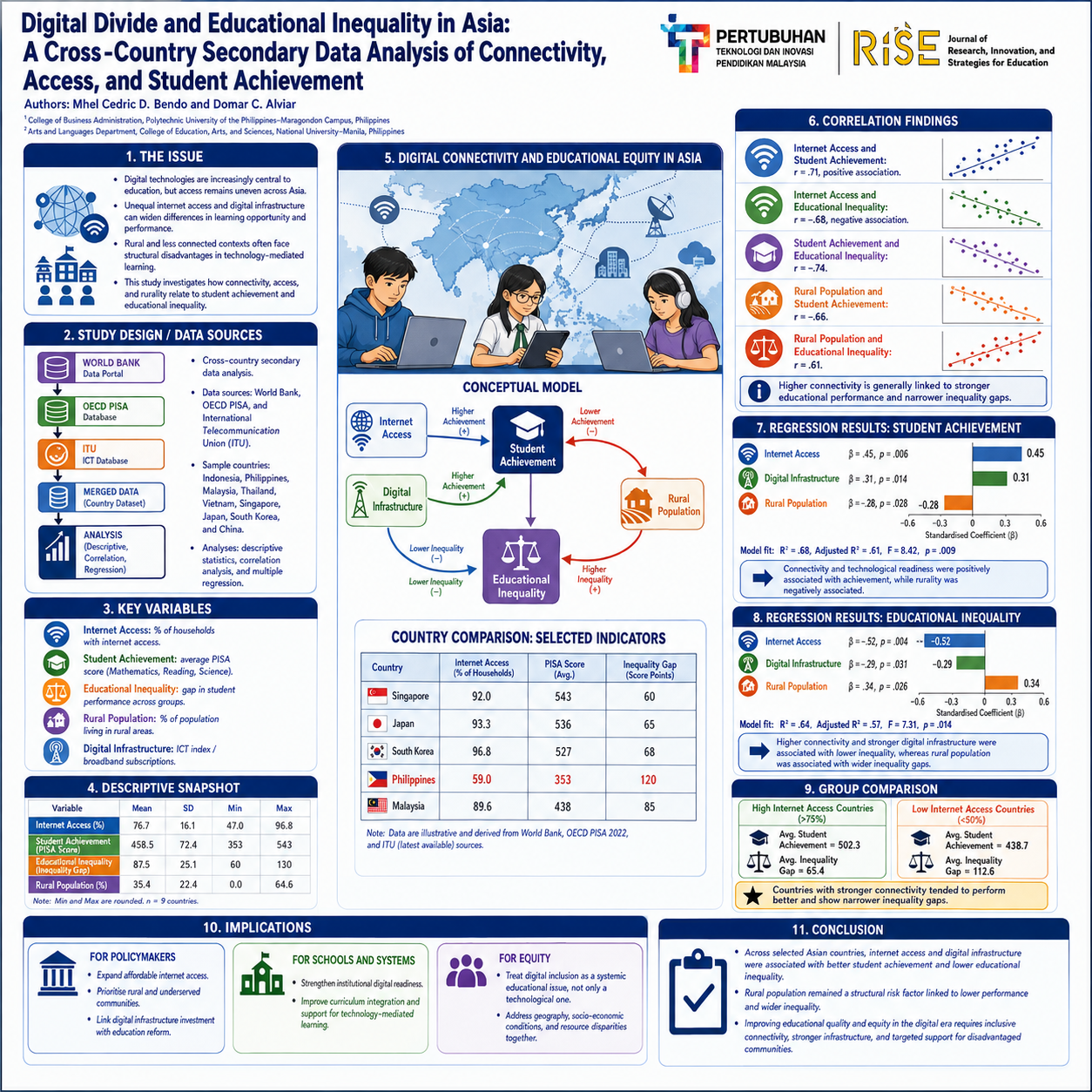
The increasing reliance on digital technologies in education has intensified concerns regarding unequal access to digital resources across countries, particularly in developing regions. While digital connectivity has the potential to enhance learning opportunities, disparities in internet access and technological infrastructure may contribute to unequal educational outcomes. This study examines the relationship between the digital divide and educational inequality in Asia through a cross-country secondary data analysis of connectivity, access, and student achievement. Using publicly available datasets from the World Bank, the Organisation for Economic Co-operation and Development (OECD), and the International Telecommunication Union (ITU), the study analyzes key indicators of internet access, digital infrastructure, student achievement, and educational inequality across selected Asian countries. Descriptive statistics, correlation analysis, and multiple regression models were employed to examine structural associations among variables. The results indicate that internet access is positively associated with student achievement and negatively associated with educational inequality. Digital infrastructure also demonstrates positive associations with educational performance and lower levels of inequality. In contrast, rural population is negatively associated with student achievement and positively associated with educational inequality. Overall, the findings highlight the importance of digital connectivity and technological capacity in shaping both the quality and equity dimensions of education systems across diverse national contexts.
References
Alviar, D. C. (2023, August 2). Sapat ba ang teknolohiya upang epektibong magturo? Mga aral mula sa PIDS. Philippine Institute for Development Studies. https://www.pids.gov.ph/details/news/in-the-news/sapat-ba-ang-teknolohiya-upang-epektibong-magturo-mga-aral-mula-sa-pids
Amin, C., Sigit, A. A., Saputra, A., Samson, M. G. M., & Sattar, F. (2026). Beyond access: Understanding digital platform adoption in Indonesia's informal economy. Digital Geography and Society, 10, 100162. https://doi.org/10.1016/j.diggeo.2026.100162
Bakhtiar, H. A., Abu, R., & Shaifuddin, N. (2024). Sustainable collaboration between public libraries and school resource centers: Advancing digital information literacy in the digital age. Journal of Information and Knowledge Management, 14(2), 50–60. https://doi.org/10.24191/jikm.v14i2.4467
Barrot, J. S., Llenares, I. I., & Del Rosario, L. S. (2021). Students' online learning challenges during the COVID-19 pandemic and how they cope with them. Education and Information Technologies, 26, 7321–7338. https://doi.org/10.1007/s10639-021-10589-x
Becker, G. S. (1993). Human capital: A theoretical and empirical analysis (3rd ed.). University of Chicago Press. https://press.uchicago.edu/ucp/books/book/chicago/H/bo3684037.html
Bendo, M. C. D. (2026). Attention fragmentation in digital learning environments: Micro-procrastination, cognitive load, and deep work across educational levels. Journal of Research, Innovation, and Strategies for Education (RISE), 3(6), 1–16. https://doi.org/10.70148/rise.v3i4.1
Bulman, G., & Fairlie, R. W. (2016). Technology and education: Computers, software, and the Internet. Handbook of the Economics of Education, 5, 239–280. https://doi.org/10.1016/B978-0-444-63459-7.00005-1
Billion, M., Crespo, J., & Lera-Lopez, F. (2021). Do educational inequalities affect Internet use? An analysis for developed and developing countries. Telematics and Informatics, 58, 101521. https://doi.org/10.1016/j.tele.2020.101521
Chen, C., & Phanumartwiwath, A. (2025). Bridging the gray digital divide: A cross-cultural qualitative study on digital inclusion and healthy aging in Germany, Japan, and Thailand. Telematics and Informatics Reports, 18, 100218. https://doi.org/10.1016/j.teler.2025.100218
Creswell, J. W. (2014). Research design: Qualitative, quantitative, and mixed methods approaches. Sage Publications. https://us.sagepub.com/en-us/nam/research-design/book235675
Dormann, C. F., Elith, J., Bacher, S., Buchmann, C., Carl, G., Carré, G., García Marquéz, J. R., Gruber, B., Lafourcade, B., Leitão, P. J., Münkemüller, T., McClean, C., Osborne, P. E., Reineking, B., Schröder, B., Skidmore, A. K., Zurell, D., & Lautenbach, S. (2013). Collinearity: A review of methods to deal with it and a simulation study evaluating their performance. Ecography, 36(1), 27–46. https://doi.org/10.1111/j.1600-0587.2012.07348.x
Field, A. (2013). Discovering statistics using IBM SPSS statistics (4th ed.). Sage Publications. https://uk.sagepub.com/en-gb/eur/discovering-statistics-using-ibm-spss-statistics/book235999
Guo, C., & Wan, B. (2022). The digital divide in online learning in China during the COVID-19 pandemic. Technology in Society, 71, 102122. https://doi.org/10.1016/j.techsoc.2022.102122
Hanushek, E. A. (1979). Conceptual and empirical issues in the estimation of educational production functions. Journal of Human Resources, 14(3), 351–388. https://doi.org/10.2307/145575
Hilbert, M. (2016). The bad news is that the digital access divide is here to stay: Domestically installed bandwidths among 172 countries for 1986–2014. Telecommunications Policy, 40(6), 567–581. https://doi.org/10.1016/j.telpol.2016.01.006
Heaton, J. (2008). Secondary analysis of qualitative data: An overview. Historical Social Research, 33(3), 33–45. https://www.jstor.org/stable/20762299
International Telecommunication Union. (2023a). ICT Development Index 2023. https://www.itu.int
International Telecommunication Union. (2023b). Measuring digital development: Facts and figures 2023. https://www.itu.int/en/ITU-D/Statistics/Pages/facts/default.aspx
Jafar, K., Ananthpur, K., & Venkatachalam, L. (2023). Digital divide and access to online education: New evidence from Tamil Nadu, India. Journal of Social and Economic Development, 25, 313–333. https://doi.org/10.1007/s40847-023-00236-1
Johnston, M. P. (2017). Secondary data analysis: A method of which the time has come. Qualitative and Quantitative Methods in Libraries, 3(3), 619–626. http://qqml-journal.net/index.php/qqml/article/view/169
Kawaii, D. (2023, March 7). Overcoming Japan’s uphill battle toward digital transformation. National Bureau of Asian Research. https://www.nbr.org/publication/overcoming-japans-uphill-battle-toward-digital-transformation/
Kim, J. H. (2019). Multicollinearity and misleading statistical results. Korean Journal of Anesthesiology, 72(6), 558–569. https://doi.org/10.4097/kja.19087
Lee, H., & Lee, R. (2024). Transformation of Korean higher education in the digital era: Achievements and challenges. Journal of Comparative & International Higher Education, 16(2), 47–55. https://files.eric.ed.gov/fulltext/EJ1427546.pdf
Li, M. (2025). Exploring the digital divide in primary education: A comparative study of urban and rural mathematics teachers’ TPACK and attitudes towards technology integration in post-pandemic China. Education and Information Technologies, 30, 1913–1945. https://doi.org/10.1007/s10639-024-12890-x
Lim, K., Kim, Y., Kim, M., Jang, Y., & Joo, M. (2019). The digital divide? Analyzing regional differences of tablet PC use in Korean middle schools for sustainable development. Sustainability, 11(18), 5054. https://doi.org/10.3390/su11185054
Lim, S. S., & Suhaila, Z. S. (2022). Bridging Singapore’s digital divides: Making our Smart Nation smarter. In I. A. Mokhtar & Y. Ibrahim (Eds.), Social context, policies and changes in Singapore: Beyond the first 50 years. World Scientific. https://doi.org/10.13140/RG.2.2.33371.13609
Mirazchiyski, P. V. (2025). Contemporary gaps in research on digital divide in education: A literature review. Universal Access in the Information Society, 24, 991–1008. https://doi.org/10.1007/s10209-024-01166-3
Nguyen, T. Q., Ngoc, P. T. A., Phuong, H. A., Duy, D. P. T., Hiep, P. C., McClelland, R., & Noroozi, O. (2024). Digital competence of Vietnamese citizens: An application of DigComp framework and the role of individual factors. Education and Information Technologies, 29, 19267–19298. https://doi.org/10.1007/s10639-024-12585-3
Organisation for Economic Co-operation and Development. (2023). OECD Programme for International Student Assessment (PISA) database. https://www.oecd.org/pisa/data/
Puspitasari, L., & Ishii, K. (2016). Digital divides and mobile Internet in Indonesia: Impact of smartphones. Telematics and Informatics, 33(2), 472–483. https://doi.org/10.1016/j.tele.2015.11.001
Robinson, L., Cotten, S. R., Ono, H., Quan-Haase, A., Mesch, G., Chen, W., Schulz, J., Hale, T. M., & Stern, M. J. (2015). Digital inequalities and why they matter. Information, Communication & Society, 18(5), 569–582. https://doi.org/10.1080/1369118X.2015.1012532
Selwyn, N. (2016). Education and technology: Key issues and debates (2nd ed.). Bloomsbury Academic.
Osborne, J. W., & Waters, E. (2002). Four assumptions of multiple regression that researchers should always test. Practical Assessment, Research, and Evaluation, 8(1), 1–9. https://doi.org/10.7275/r222-hv23
Tamim, R. M., Bernard, R. M., Borokhovski, E., Abrami, P. C., & Schmid, R. F. (2015). What forty years of research says about the impact of technology on learning: A second-order meta-analysis and validation study. Review of Educational Research, 85(1), 4–28. https://doi.org/10.3102/0034654314540006
UNESCO. (2023). Global education monitoring report 2023: Technology in education—A tool on whose terms? UNESCO Publishing. https://www.unesco.org/gem-report
Van Dijk, J. A. G. M. (2020). The digital divide. Polity Press. https://www.politybooks.com/bookdetail?book_slug=the-digital-divide--9781509534450
Warschauer, M. (2004). Technology and social inclusion: Rethinking the digital divide. MIT Press.
World Bank. (2024). World development indicators. https://data.worldbank.org
Downloads
Published
Issue
Section
License
Copyright (c) 2025 Mhel Cedric D. Bendo, Dr. Domar C. Alviar (Author)

This work is licensed under a Creative Commons Attribution 4.0 International License.