Learning Management Systems and Self-Regulated Learning Among Postgraduate Teacher-Students in Open and Distance Learning in the Sri Lankan Context
DOI:
https://doi.org/10.70148/rise.v3i4.10Keywords:
Self-Regulated Learning, Learning Management Systems, Open and Distance Learning, Postgraduate Teacher-Students, Sri LankaAbstract
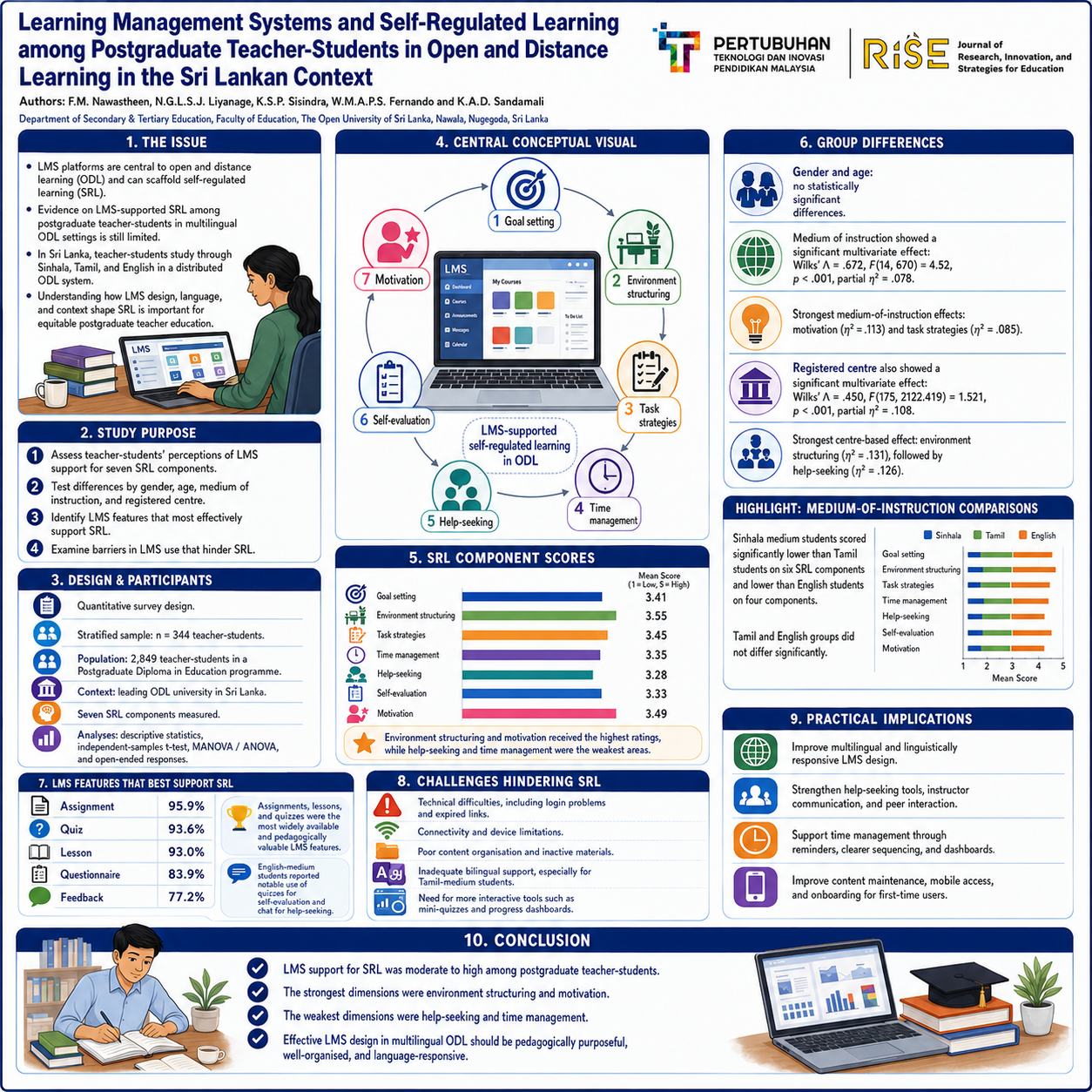
Learning Management Systems (LMS) have become vital tools in open and distance learning (ODL), playing a central role in supporting teaching and learning. However, their contribution to promoting self-regulated learning (SRL) among postgraduate teacher-students remains insufficiently examined in multilingual contexts. This study investigated LMS-supported SRL among postgraduate teacher-students enrolled in a Postgraduate Diploma in Education programme at a leading ODL university in Sri Lanka. Using a quantitative survey design, data were collected from 344 teacher-students selected through stratified sampling from a population of 2,849 teacher-students enrolled across the regional and study centres of the University. A structured questionnaire measuring seven SRL components; goal setting, environment structuring, task strategies, time management, help-seeking, self-evaluation, and motivation, was administered. Findings revealed moderate to high levels of LMS-supported SRL. Environment structuring and motivation received the highest ratings, while help-seeking and time management emerged as weaker areas. Multivariate analysis demonstrated that medium of instruction and registered centre significantly influenced multiple SRL components. Medium of instruction most strongly affected motivation and task strategies, whereas registered centre had the greatest influence on environment structuring and help-seeking. Gender and age showed no statistically significant differences. Assignments, lessons, and quizzes were the most widely available and pedagogically impactful LMS features. Students highlighted challenges including expired content links, inadequate bilingual support, poor content organisation, and connectivity limitations as barriers to SRL engagement. These findings underscore the need for linguistically responsive and pedagogically purposeful LMS design. The study offers actionable recommendations to enhance LMS effectiveness in supporting diverse postgraduate teacher-students across multilingual settings.
References
Alotaibi, N. S. (2024). The impact of AI and LMS integration on the future of higher education: Opportunities, challenges, and strategies for transformation. Sustainability, 16(23), 10357. https://doi.org/10.3390/su162310357
Araka, E., Maina, E., Gitonga, R., Oboko, R., & Kihoro, J. (2021). University students' perception on the usefulness of learning management system features in promoting self-regulated learning in online learning. International Journal of Education and Development using Information and Communication Technology, 17(1), 45–64. https://eric.ed.gov/?id=EJ1285531
Bordoloi, R. (2018). Transforming and empowering higher education through open and distance learning in India. Asian Association of Open Universities Journal, 13(1), 24–36. https://doi.org/10.1108/AAOUJ-11-2017-0037
Bradley, V. M. (2020). Learning management system (LMS) use with online instruction. International Journal of Technology in Education, 4(1), 68. https://doi.org/10.46328/ijte.36
Bruestle, P., Haubner, D., Schinzel, B., Holthaus, M., Remmele, B., Schirmer, D., & Reips, U. D. (2009). Doing e-learning/doing gender? Examining the relationship between students' gender concepts and e-learning technology. Paper presented at the Fifth European Symposium on Gender & ICT Digital Cultures: Participation-Empowerment-Diversity, University of Bremen. http://www.informatik.uni-bremen.de/soteg/gict2009/proceedings/GICT2009_Adamus.pdf
Çakiroğlu, Ü., Kokoç, M., & Atabay, M. (2024). Online learners' self-regulated learning skills regarding LMS interactions: A profiling study. Journal of Computing in Higher Education, 36(1), 220–241. https://doi.org/10.1007/s12528-024-09397-2
Cuadrado-García, M., Ruiz-Molina, M., & Montoro-Pons, J. D. (2010). Are there gender differences in e-learning use and assessment? Evidence from an online interuniversity project in Europe. Procedia — Social and Behavioral Sciences, 2(2), 367–371. https://doi.org/10.1016/j.sbspro.2010.03.027
De Oliveira, P. C., De a Cunha, C. J. C., & Nakayama, M. K. (2016). Learning management systems (LMS) and e-learning management: An integrative review and research agenda. Journal of Information Systems and Technology Management, 13(2), 157–180. https://doi.org/10.4301/s1807-17752016000200001
Du Plessis, E. C. (2023). The preparedness of student teachers in open and distance learning environments for the classroom. Education Sciences, 13(9), 934. https://doi.org/10.3390/educsci13090934
Edisherashvili, N., Saks, K., Pedaste, M., & Leijen, Ä. (2022). Supporting self-regulated learning in distance learning contexts at higher education level: Systematic literature review. Frontiers in Psychology, 12. https://doi.org/10.3389/fpsyg.2021.792422
Gambo, Y., & Shakir, M. Z. (2021). Review on self-regulated learning in smart learning environment. Smart Learning Environments, 8(1). https://doi.org/10.1186/s40561-021-00157-8
Ghosh, S., Nath, J., Agarwal, S., & Nath, A. (2012). Open and distance learning (ODL) education system: Past, present and future — A systematic study of an alternative education system. Journal of Global Research in Computer Sciences, 3, 53–57.
Hill, P. (2025, April 14). State of Higher Ed LMS Market for US and Canada: Year-End 2023 Edition. On EdTech Newsletter. https://onedtech.philhillaa.com/p/state-of-lms-market-us-canada-year-end-2023
Kucuk, S., & Karabey, S. C. (2022). The university students' self-regulated effort, flexibility and satisfaction in distance education. International Journal of Educational Technology in Higher Education, 19(35). https://doi.org/10.1186/s41239-022-00342-w
Liu, X., He, W., Zhao, L., & Hong, J. (2021). Gender differences in self-regulated online learning during the COVID-19 lockdown. Frontiers in Psychology, 12. https://doi.org/10.3389/fpsyg.2021.752131
Nawastheen, F. M., Liyanage, N. G. L. S. J., Fernando, W. M. A. P. S., & Sandamali, K. A. D. (2024). Impact of learning management systems on postgraduate diploma in education students’ self-regulated learning practices. International Research Conference Open University of Sri Lanka (IRC OUSL 2024).
Nunnally, J. C. (1978). Psychometric theory (2nd ed.). McGraw-Hill.
Odekeye, O. T., Fakokunde, U. B., Metu, A. V., & Adewusi, M. A. (2023). Perception of learning management system (LMS) on the academic performance of undergraduate students during the COVID-19 pandemic. International Journal of Education and Development Using Information and Communication Technology, 19(02), 7–19.
Simon, P. D., Jiang, J., Fryer, L. K., King, R. B., & Frondozo, C. E. (2024). An assessment of learning management system use in higher education: Perspectives from a comprehensive sample of teachers and students. Technology Knowledge and Learning. https://doi.org/10.1007/s10758-024-09734-5
Statista. (2025). Online Education - Worldwide: Statista Market Insights. Statista Inc.
Steindal, S. A., Ohnstad, M. O., Landfald, Ø. F., Solberg, M. T., Sørensen, A. L., Kaldheim, H., Mathisen, C., & Christensen, V. L. (2021). Postgraduate students' experience of using a learning management system to support their learning: A qualitative descriptive study. SAGE Open Nursing, 7. https://doi.org/10.1177/23779608211054817
UNESCO. (2002). Open and distance learning — Trends, policy and strategy considerations. United Nations Educational, Scientific, and Cultural Organization. https://unesdoc.unesco.org/ark:/48223/pf0000128463
Xu, L., Duan, P., Padua, S. A., & Li, C. (2022). The impact of self-regulated learning strategies on academic performance for online learning during COVID-19. Frontiers in Psychology, 13, 1047680. https://doi.org/10.3389/fpsyg.2022.1047680
Zimmerman, B. (2002). Becoming a self-regulated learner: An overview. Theory Into Practice, 41(2), 64–70. https://doi.org/10.1207/s15430421tip4102_2
Zimmerman, B. J., & Schunk, D. H. (2011). Self-regulated learning and performance: An introduction and an overview. In B. J. Zimmerman & D. H. Schunk (Eds.), Handbook of self-regulation of learning and performance (pp. 15–26). Routledge.
Downloads
Published
Issue
Section
License
Copyright (c) 2025 Nawastheen Fareed Mohamed, N.G.L.S.J. Liyanage , K.S.P. Sisindra, W.M.A.P.S. Fernando, K.A.D. Sandamali (Author)

This work is licensed under a Creative Commons Attribution 4.0 International License.