Improving High School Students’ Alignment of Qualitative Research Questions, Designs, and Data Sources Through a Feedback-Rich Web-Based Intervention
DOI:
https://doi.org/10.70148/rise.v3i4.12Keywords:
Formative feedback, Methodological alignment, Web-based intervention, Principal Leadership; Teacher Perceptions; Educational Leadership; Secondary Education; Leadership Capacity; Instructional Leadership, Qualitative research instruction, Secondary educationAbstract
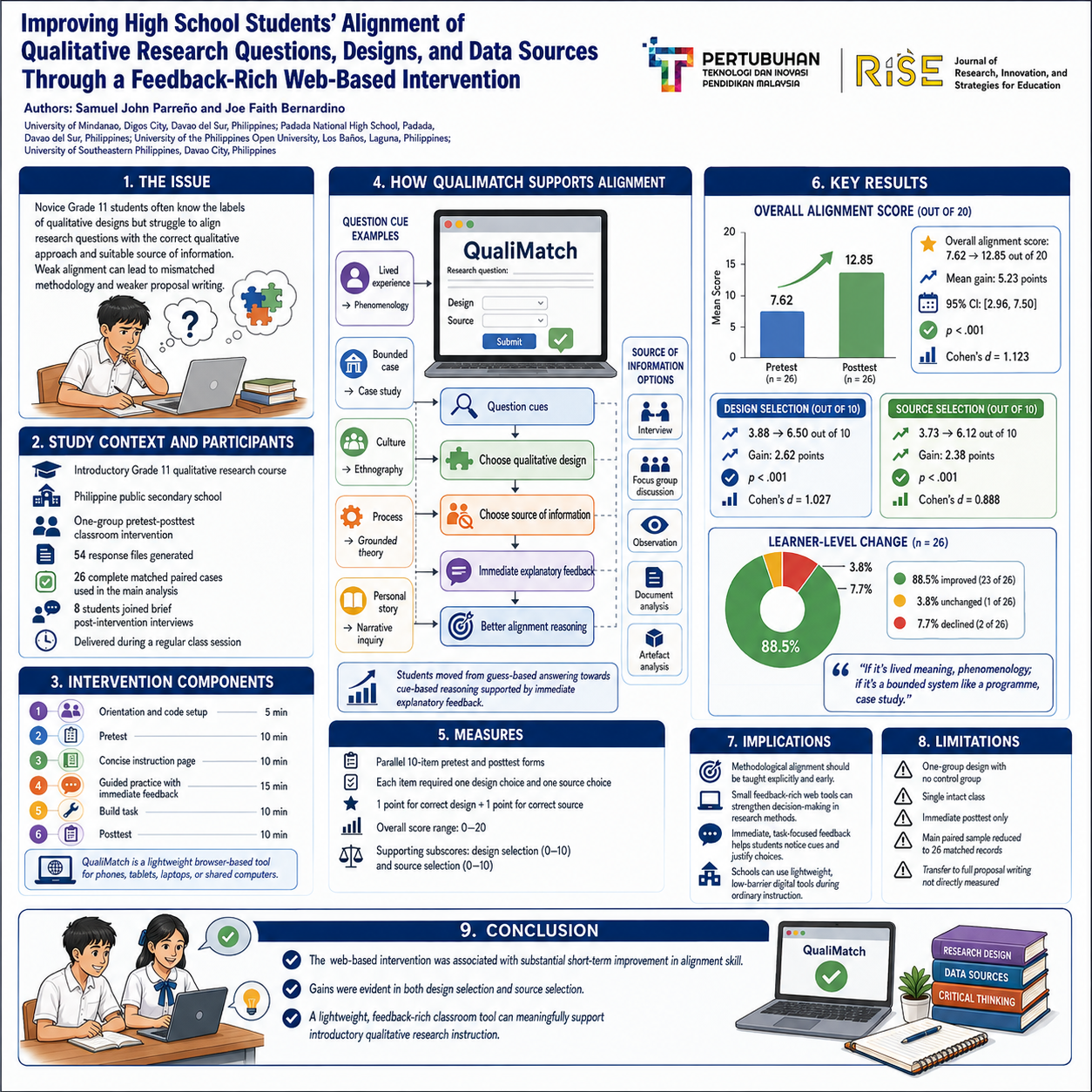
Students who are new to qualitative research often learn the labels of common designs without yet being able to align a research question with an appropriate qualitative approach and a suitable source of information. This classroom intervention study examined whether a feedback-rich web-based tool could improve that alignment skill in an introductory Grade 11 qualitative research course. The intervention was implemented with one intact class in a Philippine public secondary school using a one-group pretest-posttest design. Across both administrations, 54 response files were generated. Because the tool used student-created participant codes rather than named accounts, only records with complete and matchable pretest-posttest codes were retained for the primary analysis, resulting in 26 complete paired cases. The primary outcome was overall alignment score on parallel 10-item forms, each requiring students to select both a qualitative design and a source of information. Mean overall score increased from 7.62 to 12.85 out of 20, for a mean gain of 5.23 points (95% CI [2.96, 7.50], p < .001, d = 1.123). Twenty-three of 26 students improved, one remained unchanged, and two declined. Supporting analyses showed gains in both design selection (3.88 to 6.50 out of 10) and source selection (3.73 to 6.12 out of 10). Brief post-intervention interviews with eight students suggested that improvement was associated with a shift from guess-based responding to cue-based reasoning supported by immediate explanatory feedback. The findings suggest that a lightweight, feedback-rich digital practice environment may support short-term gains in methodological alignment in introductory qualitative research instruction. However, the results should be interpreted cautiously because the study used a single-group, single-class design, an immediate posttest, and a reduced matched analytic sample.
References
Banihashem, S. K., Noroozi, O., van Ginkel, S., Macfadyen, L. P., & Biemans, H. J. A. (2022). A systematic review of the role of learning analytics in enhancing feedback practices in higher education. Educational Research Review, 37, Article 100489. https://doi.org/10.1016/j.edurev.2022.100489
Black, P., & Wiliam, D. (1998). Assessment and classroom learning. Assessment in Education: Principles, Policy & Practice, 5(1), 7–74. https://doi.org/10.1080/0969595980050102
Carless, D., & Boud, D. (2018). The development of student feedback literacy: Enabling uptake of feedback. Assessment & Evaluation in Higher Education, 43(8), 1315–1325. https://doi.org/10.1080/02602938.2018.1463354
CAST. (2024). Universal design for learning guidelines version 3.0 [Graphic organizer]. https://udlguidelines.cast.org
Chi, M. T. H., & Wylie, R. (2014). The ICAP framework: Linking cognitive engagement to active learning outcomes. Educational Psychologist, 49(4), 219–243. https://doi.org/10.1080/00461520.2014.965823
Creswell, J. W., & Creswell, J. D. (2023). Research design: Qualitative, quantitative, and mixed methods approaches (6th ed.). SAGE.
Creswell, J. W., & Poth, C. N. (2018). Qualitative inquiry and research design: Choosing among five approaches (4th ed.). SAGE.
Department of Education. (2018). K to 12 Senior High School Applied Track Subject – Practical Research 1 Curriculum Guide. DepEd Learning Resource Portal.
Earley, M. A. (2014). A synthesis of the literature on research methods education. Teaching in Higher Education, 19(3), 242–253. https://doi.org/10.1080/13562517.2013.860105
Hattie, J., & Timperley, H. (2007). The power of feedback. Review of Educational Research, 77(1), 81–112. https://doi.org/10.3102/003465430298487
Lederer, A. M. (2025). Learning by doing: Description and assessment of an experiential undergraduate public health research methods course curriculum. Pedagogy in Health Promotion, 11(3), 193–200. https://doi.org/10.1177/23733799241305387
Nicol, D. J., & Macfarlane-Dick, D. (2006). Formative assessment and self-regulated learning: A model and seven principles of good feedback practice. Studies in Higher Education, 31(2), 199–218. https://doi.org/10.1080/03075070600572090
Rio, I. D. L., De la Pena, R. F., Gumban, G. G., Catolin, A. B., & Otayde, E. C. (2021). Lived experiences of senior high school teachers teaching qualitative research without training. Turkish Online Journal of Qualitative Inquiry, 12(10), 3877–3888.
Samante, J. D. (2023). Difficulties encountered by the senior high school students of Labo Science and Technology High School in writing research. E-Saliksik: DepEd Research Portal.
Shute, V. J. (2008). Focus on formative feedback. Review of Educational Research, 78(1), 153–189. https://doi.org/10.3102/0034654307313795
Tomaszewski, L. E., Zarestky, J., & Gonzalez, E. (2020). Planning qualitative research: Design and decision making for new researchers. International Journal of Qualitative Methods, 19, 1–7. https://doi.org/10.1177/1609406920967174
Downloads
Published
Issue
Section
License
Copyright (c) 2025 Samuel John Parreño, Joe Faith Bernardino (Author)

This work is licensed under a Creative Commons Attribution 4.0 International License.