Reading Internship Evaluations Across Liberal Arts Programs: A Comparative Qualitative Case Study
DOI:
https://doi.org/10.70148/rise.v3i4.13Keywords:
internship evaluation, work-integrated learning, signature pedagogies, comparative case study, PhilippinesAbstract
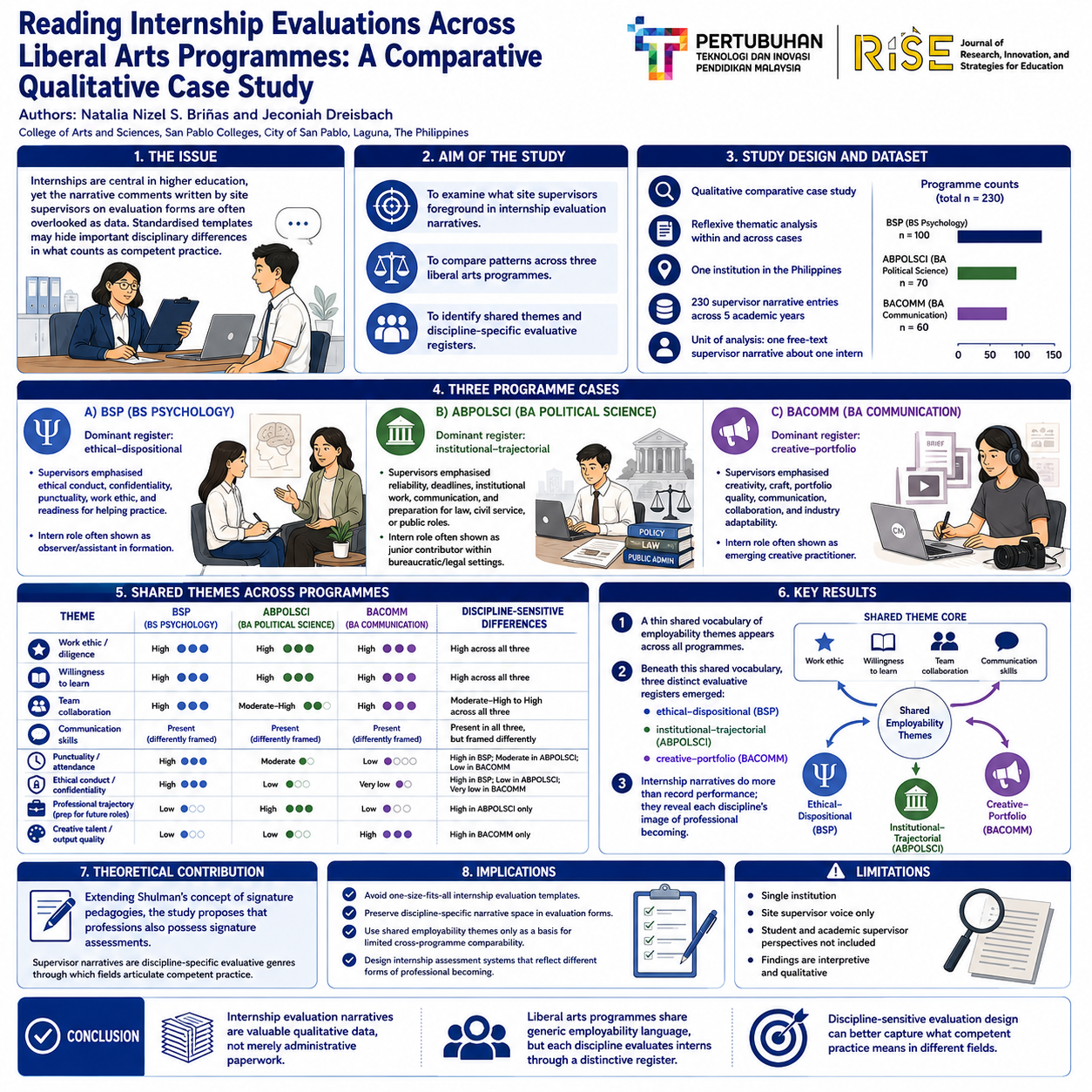
Internships have become a central feature of undergraduate education, yet the evaluative documents produced at their close remain under-examined as data in their own right. This qualitative comparative case study analyses the site supervisor narratives written on internship evaluation forms across three liberal arts degree programs at a single Philippine higher education institution: the Bachelor of Science in Psychology (BSP), the Bachelor of Arts in Political Science (ABPOLSCI), and the Bachelor of Arts in Communication (BACOMM). The unit of analysis is the individual supervisor narrative entry, a single free-text evaluative comment written by one site supervisor about one intern. A total of 230 narrative entries (BSP, n = 100; ABPOLSCI, n = 70; BACOMM, n = 60), extracted from completed internship evaluation forms across five academic years, were analysed using reflexive thematic analysis within and across cases to examine what supervisors foreground when they write about emerging practitioners. Findings reveal a thin shared vocabulary of generic employability themes, such as work ethic, willingness to learn, team collaboration, and communication, beneath which three distinct evaluative registers operate: an ethical–dispositional register in BSP, an institutional–trajectorial register in ABPOLSCI, and a creative–portfolio register in BACOMM. Extending Shulman’s concept of signature pedagogies, the study proposes that professions possess signature assessments: discipline-specific evaluative genres through which fields articulate competent practice. The findings caution against standardized evaluation templates and support discipline-sensitive designs that preserve narrative specificity while identifying legitimate bases for cross-program comparability.
References
Abbott, A. (1988). The system of professions: An essay on the division of expert labor. University of Chicago Press.
Anderson, L. M., & Stillman, J. A. (2013). Student teaching's contribution to preservice teacher development: A review of research focused on the preparation of teachers for urban and high-needs contexts. Review of Educational Research, 83(1), 3–69. https://psycnet.apa.org/doi/10.3102/0034654312468619
Banks, M. (2007). The politics of cultural work. Palgrave Macmillan.
Billett, S. (2011). Curriculum and pedagogic bases for effectively integrating practice-based experiences. Australian Learning and Teaching Council.
Billett, S. (2014). Integrating learning experiences across tertiary education and practice settings: A socio-personal account. Educational Research Review, 12, 1–13. https://doi.org/10.1016/j.edurev.2014.01.002
Bowen, G. A. (2009). Document analysis as a qualitative research method. Qualitative Research Journal, 9(2), 27–40. https://doi.org/10.3316/QRJ0902027
Braun, V., & Clarke, V. (2019). Reflecting on reflexive thematic analysis. Qualitative Research in Sport, Exercise and Health, 11(4), 589–597. https://doi.org/10.1080/2159676X.2019.1628806
Braun, V., & Clarke, V. (2021). Thematic analysis: A practical guide. Sage.
British Educational Research Association. (2018). Ethical guidelines for educational research (4th ed.). BERA.
Commission on Higher Education. (2017). CHED Memorandum Order No. 104, s. 2017: Revised guidelines for student internship program in the Philippines (SIPP) for all programs. CHED.
Flyvbjerg, B. (2006). Five misunderstandings about case-study research. Qualitative Inquiry, 12(2), 219–245. https://doi.org/10.1177/1077800405284363
Helminen, K., Coco, K., Johnson, M., Turunen, H., & Tossavainen, K. (2016). Summative assessment of clinical practice of student nurses: A review of the literature. International Journal of Nursing Studies, 53, 308–319. https://doi.org/10.1016/j.ijnurstu.2015.09.014
Jackson, D. (2015). Employability skill development in work-integrated learning: Barriers and best practice. Studies in Higher Education, 40(2), 350–367. https://doi.org/10.1007/s10734-016-0080-2
Jackson, D. (2017). Developing pre-professional identity in undergraduates through work-integrated learning. Higher Education, 74(5), 833–853. https://doi.org/10.1007/s10734-017-0216-z
Jackson, D., & Collings, D. (2018). The influence of work-integrated learning and paid work during studies on graduate employment and underemployment. Higher Education, 76(3), 403–425. https://doi.org/10.1007/s10734-017-0216
Lincoln, Y. S., & Guba, E. G. (1985). Naturalistic inquiry. Sage.
McRobbie, A. (2016). Be creative: Making a living in the new culture industries. Polity Press.
Merriam, S. B., & Tisdell, E. J. (2016). Qualitative research: A guide to design and implementation (4th ed.). Jossey-Bass.
Miles, M. B., Huberman, A. M., & Saldaña, J. (2020). Qualitative data analysis: A methods sourcebook (4th ed.). Sage.
Patrick, C.-J., Peach, D., Pocknee, C., Webb, F., Fletcher, M., & Pretto, G. (2009). The WIL (work-integrated learning) report: A national scoping study. Queensland University of Technology.
Republic Act No. 10029. (2010). An act to regulate the practice of psychology, creating for this purpose a Professional Regulatory Board of Psychology, appropriating funds therefor, and for other purposes [Philippine Psychology Act of 2009]. Republic of the Philippines.
Rowe, A. D., & Zegwaard, K. E. (2017). Developing graduate employability skills and attributes: Curriculum enhancement through work-integrated learning. Asia-Pacific Journal of Cooperative Education, 18(2), 87–99.
Shulman, L. S. (2005). Signature pedagogies in the professions. Daedalus, 134(3), 52–59. https://doi.org/10.1162/0011526054622015
Silva, P., Lopes, B., Costa, M., Melo, A. I., Dias, G. P., Brito, E., & Seabra, D. (2018). The million-dollar question: Can internships boost employment? Studies in Higher Education, 43(1), 2–21. https://doi.org/10.1080/03075079.2016.1144181
Stake, R. E. (1995). The art of case study research. Sage.
Stake, R. E. (2006). Multiple case study analysis. Guilford Press.
Stirling, A., Kerr, G., Banwell, J., MacPherson, E., & Heron, A. (2016). A practical guide for work-integrated learning. Higher Education Quality Council of Ontario.
Sullivan, W. M., Colby, A., Wegner, J. W., Bond, L., & Shulman, L. S. (2007). Educating lawyers: Preparation for the profession of law. Jossey-Bass.
Wilton, N. (2012). The impact of work placements on skills development and career outcomes for business and management graduates. Studies in Higher Education, 37(5), 603–620. https://doi.org/10.1080/03075079.2010.532548
Yin, R. K. (2018). Case study research and applications: Design and methods (6th ed.). Sage.
Downloads
Published
Issue
Section
License
Copyright (c) 2025 Natalia Nizel S. Briñas, Jeconiah Dreisbach (Author)

This work is licensed under a Creative Commons Attribution 4.0 International License.