Nurturing Innovation, Transforming Education: A Longitudinal Study
DOI:
https://doi.org/10.70148/rise.1Keywords:
educational innovation, professional development, design thinking, pedagogyAbstract
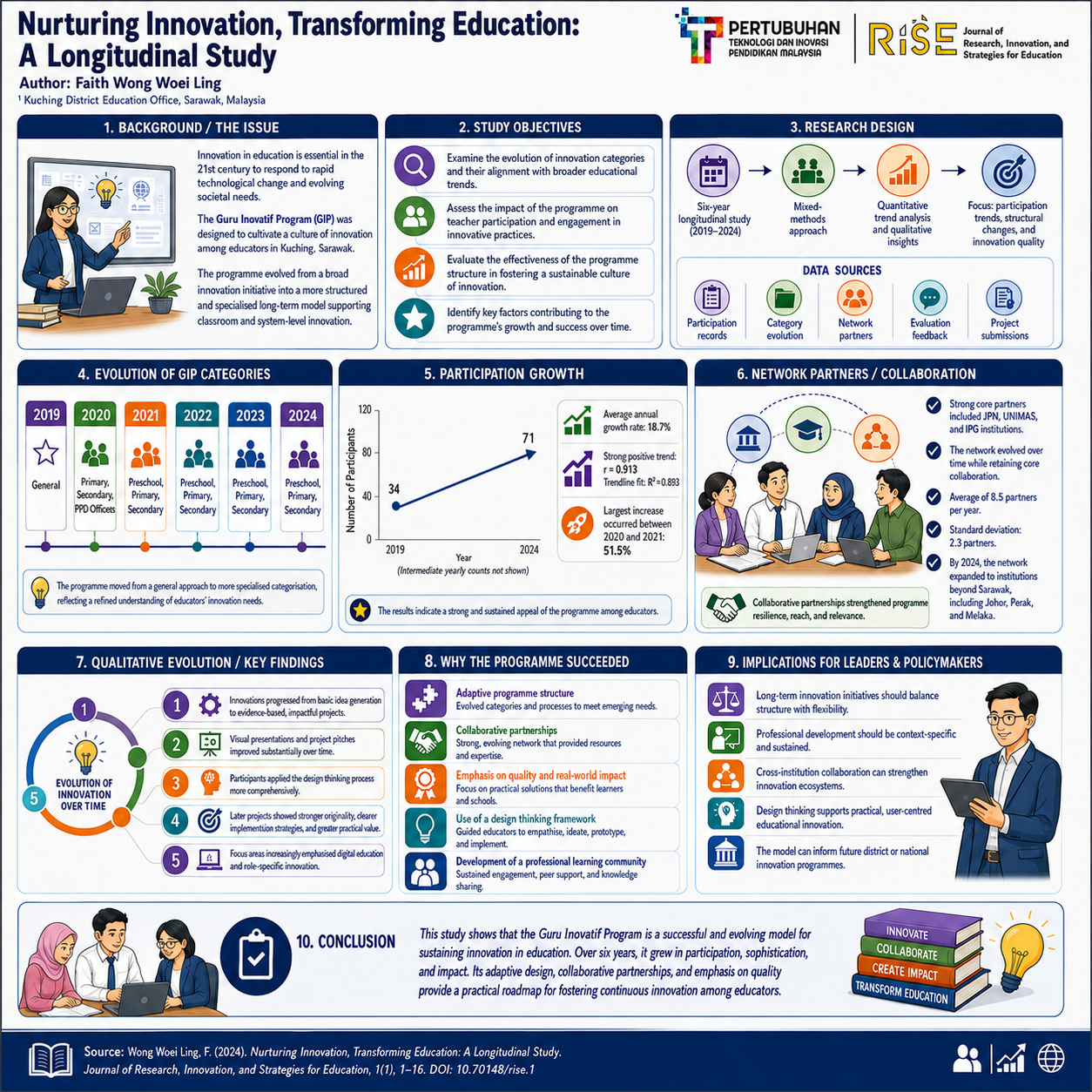
In an era of rapid technological advancement and evolving societal needs, fostering innovation in education has become paramount. This study examines the six-year trajectory of the Guru Inovatif Program (GIP), a unique initiative designed to cultivate a culture of innovation among educators in Malaysia. Through a mixed-methods longitudinal approach, we analyzed the program's evolution from 2019 to 2024, focusing on participation trends, structural changes, and qualitative shifts in innovation quality. The results reveal a significant growth in participation, with numbers more than doubling from 34 to 71 over the study period. Statistical analysis showed a strong positive trend (R² = 0.893), indicating consistent program appeal. The GIP's structure evolved from a generalized approach to specialized categories, reflecting a nuanced understanding of diverse educational innovation needs. Qualitative analysis revealed a marked improvement in the sophistication of innovations, transitioning from basic idea generation to evidence-based, impactful projects. The implementation of a design thinking framework proved crucial in enhancing the quality and applicability of innovations. The program's success was underpinned by its adaptive structure, collaborative partnerships, and emphasis on real-world impact. This study provides valuable insights into sustaining long-term educational innovation initiatives, offering a model that balances structure with flexibility, and theory with practical application. The findings have significant implications for educational policymakers and administrators seeking to foster a culture of continuous innovation in education.
References
Basten, D., & Haamann, T. (2018). Approaches for organizational learning: A literature review. SAGE Open, 8(3), 2158244018794224
Braun, V., & Clarke, V. (2006). Using thematic analysis in psychology. Qualitative Research in Psychology, 3(2), 77-101.
Brisco, R., Whitfield, R. I., & Grierson, H. (2020). Modelling the use of digital sketching tools by experienced designers for idea generation. International Journal of Technology and Design Education, 30, 835-862.
Brown, T. (2008). Design thinking. Harvard Business Review, 86(6), 84-92.
Creswell, J. W., & Creswell, J. D. (2018). Research design: Qualitative, quantitative, and mixed methods approaches (5th ed.). Sage Publications.
Darling-Hammond, L. (2010). The flat world and education: How America’s commitment to equity will determine our future. New York, NY: Teachers College Press.
Darling-Hammond, L., Hyler, M. E., & Gardner, M. (2017). Effective teacher professional development. Learning Policy Institute.
Davenport, G. (2022). Adaptive leadership for school equity. Educational Leadership, 79(6) .
Desimone, L. M., & Garet, M. S. (2015). Best practices in teachers' professional development in the United States. Psychology, Society, & Education, 7(3), 252-263.
Dodgson, M., Gann, D. M., & Phillips, N. (2013). The Oxford handbook of innovation management. Oxford University Press.
Fullan, M. (2007). The new meaning of educational change (4th ed.). Teachers College Press.
Fullan, M. (2011). Change leader: Learning to do what matters most. San Francisco, CA: Jossey-Bass.
Garrison, B. (2021). Concerns-based adoption model (CBAM). Accelerating Systemic Change in STEM Higher Education.
Hall, G. E., & Hord, S. M. (1987). Change in schools: Facilitating the process. State University of New York Press.
Hargreaves, A., & Fullan, M. (2012). Professional capital: Transforming teaching in every school. New York, NY: Teachers College Press.
Hargreaves, A., & Shirley, D. (2012). The global fourth way: The quest for educational excellence. Corwin Press.
Hattie, J. (2009). Visible learning: A synthesis of over 800 meta-analyses relating to achievement. New York, NY: Routledge.
Kearney, J., & Zuber-Skerritt, O. (2012). From learning organization to learning community: Sustainability through lifelong learning. The Learning Organization, 19(5), 400-413.
Leavitt, C. C. (2011). A comparative analysis of three unique theories of organizational learning. ProQuest Dissertations Publishing.
Lektorich, B. (2023). 10 Strategies to Create a Culture of Innovation in Your Classroom. Education World. Retrieved from: https://www.educationworld.com/teachers/10-strategies-create-culture-innovation-your-classroom
Mintrop, R., & Zumpe, E. (2019). Solving real-life problems of practice and education leaders' school improvement mind-set. American Journal of Education, 125(3), 295-344.
Neck, H. M., & Greene, P. G. (2011). Entrepreneurship education: Known worlds and new frontiers. Journal of Small Business Management, 49(1), 55-70.
Patton, M. Q. (2008). Utilization-focused evaluation (4th ed.). Sage Publications.
Roberts, M. (2016). Theories of change: Concerns-based adoption model. USAID.
Rogers, E. M. (2003). Diffusion of innovations (5th ed.). Free Press.
Rogers, E. M., Singhal, A., & Quinlan, M. M. (2014). Diffusion of innovations. In An integrated approach to communication theory and research (pp. 432-448). Routledge.
Rossi, P. H., Lipsey, M. W., & Henry, G. T. (2019). Evaluation: A systematic approach (8th ed.). Sage Publications.
Sahin, I. (2006). Detailed review of Rogers’ diffusion of innovations theory and educational technology-related studies based on Rogers’ theory. The Turkish Online Journal of Educational Technology, 5(2), 14-23.
Savick, S. (2022). Six steps for adaptive leadership. Educational Leadership, 79(6).
Serdyukov, P. (2017). Innovation in education: what works, what doesn’t, and what to do about it? Journal of Research in Innovative Teaching & Learning, 10(1), 4-33.
Setser, B., & Morris, H. (2015). Building a culture of innovation in higher education: Design & practice for leaders. Next Generation Learning Challenges.
Singer, J. D., & Willett, J. B. (2003). Applied longitudinal data analysis: Modeling change and event occurrence. Oxford University Press.
Stanford d.school. (2010). An introduction to design thinking process guide. Hasso Plattner Institute of Design at Stanford.
Wagner, T. (2008). The global achievement gap: Why even our best schools don’t teach the new survival skills our children need–and what we can do about it. New York, NY: Basic Books.
Webster, R. (2023). How to Create an Effective Learning Culture for Continuous Improvement. Thinkific. Retrieved from: https://www.thinkific.com/blog/effective-learning-culture/
Wilson, D., & Conyers, M. (2015). Transform teaching with the diffusion of innovation. Edutopia.
Downloads
Published
Issue
Section
License
Copyright (c) 2024 Faith Wong Woei Ling (Author)

This work is licensed under a Creative Commons Attribution 4.0 International License.