The Power of Environment: Examining Emotional and Social Factors Affecting ESL Learners’ Speaking Performance in Secondary School
DOI:
https://doi.org/10.70148/rise.v2i2.25Keywords:
ESL learners, speaking performance, emotional environment, social environment, classroom strategiesAbstract
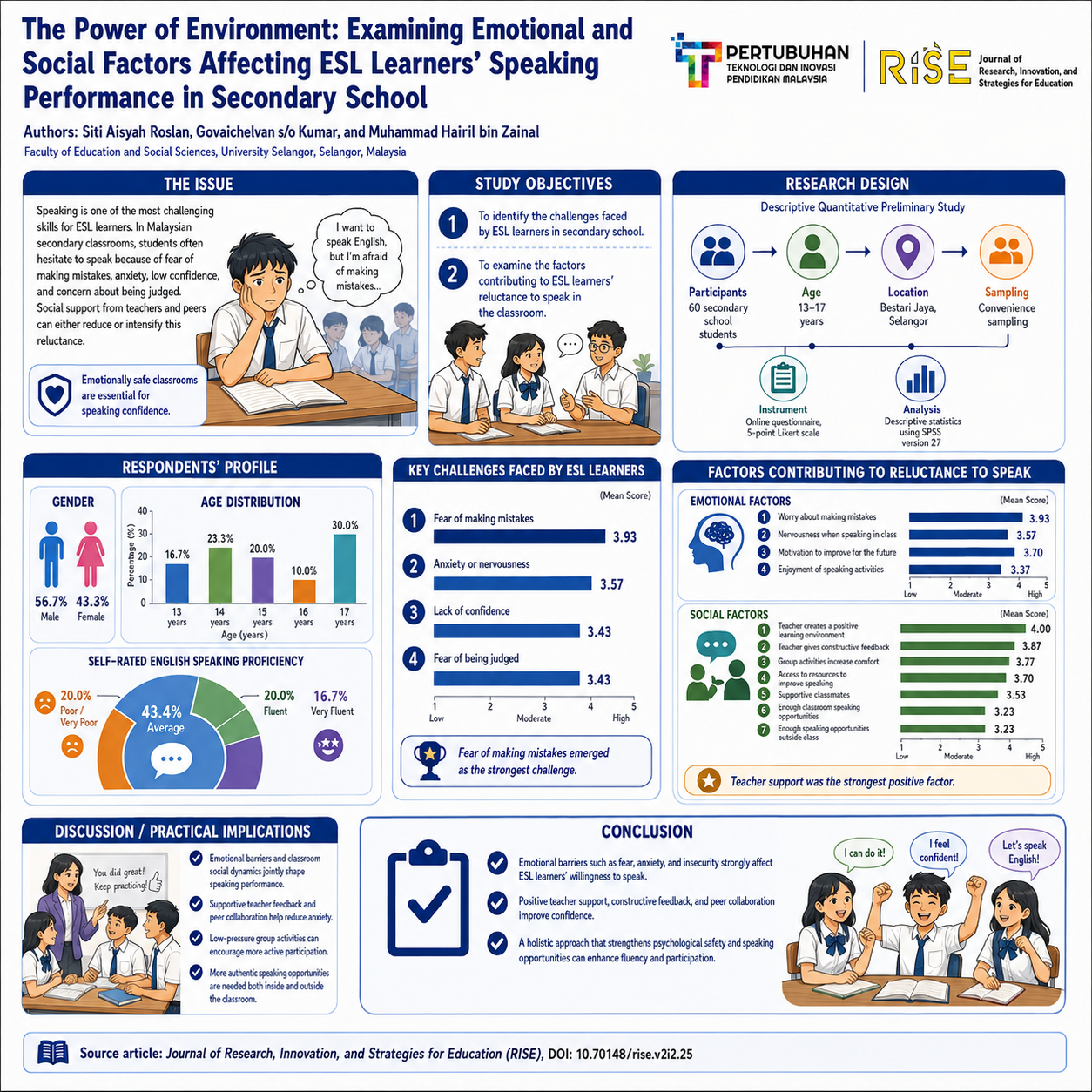
This study investigates the influence of emotional and social environments on the speaking performance of secondary ESL learners in Selangor, Malaysia. Adopting a descriptive quantitative design, data were collected from 60 students aged 13-17 via an online questionnaire comprising 5-points Likert-scale questions. The instrument explored students’ confidence levels, anxiety, classroom experiences and cultural influences. Findings indicate that anxiety and fear of making mistakes significantly hinder students’ participation in speaking activities. Conversely, supportive classroom environment, characterized by constructive teacher feedback and peer collaboration, enhance students’ speaking confidence. Group-based tasks is highlighted as a key strategy to foster comfort and engagement in oral English use. However, limited exposure to English outside of the classroom remain as a barrier to practice and proficiency. These insights highlight the importance of classroom interventions, including emotionally supportive teaching practices and increased access to authentic speaking opportunities. This study offers practical implications for ESL educators and curriculum planners aiming to improve speaking outcomes through innovative, learner-centered strategies. Future research could explore targeted interventions to assess their effectiveness in boosting speaking confidence and reducing reluctance among ESL learners.
References
Bakar, N. A., Latiff, H., & Hamat, A. (2013). Enhancing ESL Learners Speaking Skills through Asynchronous
Online Discussion Forum. Asian Social Science, 9(9). https://doi.org/10.5539/ass.v9n9p224
Behera,S. (2024) Innovative Pedagogical Practices In Teacher Education. International Journal of Financial
Management and Research, 6(2), 1-10. https://doi.org/10.36948/ijfmr.2024.v06i02.15488
Eddraoui, B., & Wirza, Y. (2020). Speaking Anxiety of EFL High School Students: Indonesian and Moroccan
Cases. Advances in Social Science, Education and Humanities Research. https://doi.org/10.2991/assehr.k.200513.079
Ganasan, M. J., Abdul Aziz, M. N., & Jamal, M. (2022). Incorporating social and emotional learning strategies among
ESL speakers of higher education in Malaysia. Journal of Positive School Psychology, 6(7),
–3891. https://journalppw.com/index.php/jpsp/article/view/12003/7804
Ghazali, N., Mohd Said, N. E., & Hua, T. K. (2020). Understanding second language anxiety: Feedback from ESL
learners in TVET. Universal Journal of Educational Research, 8(5), 2057–2063. https://doi.org/10.13189/ujer.2020.080543
Ibrahim, Q. (2024). Exploring students’ level of oral apprehension in ESL context. The Asian Journal of English
Language and Pedagogy (AJELP), 12 (1) https://doi.org/10.37134/ajelp.vol12.1.6.2024
Irene, J., Sathasivam, K., Ng, M. M., Jeyaraja, S. S. B., & Maniam, M. (2023). The Effects of
Mother Tongue Interference among ESL Learners’ Speaking Skills. International Journal ofAcademic Research in Business & Social Sciences, 13(7). https://doi.org/10.6007/ijarbss/v13- i7/17453
Kashinathan, S., & Aziz, A. A. (2021). ESL Learners’ Challenges in Speaking English in Malaysian Classroom.
International Journal of Academic Research in Progressive Education and Development, 10(2),
–991. http://doi.org/10.6007/IJARPED/v10-i2/10355
Marzuki, M., Indrawati, I., & H, I. Y. (2023). Teachers’ Challenges in Promoting Learner Autonomy. Pioneer:
Journal of Language and Literature, 15(1), 119–137. https://doi.org/10.36841/pioneer.v15i1.2853
Mustapha, N. A. N., & Mohamad Uri, N. F. (2024). Investigating the level and factors of speaking anxiety among high performing school students. The Malaysian Journal of ELT Research, 20(1), 1-15. https://doi.org/10.52696/FMYO5189
Nadesan, N. K., & Shah, P. Md. (2020). Non-Linguistic Challenges Faced by Malaysian Students in
Enhancing Speaking Skills. Creative Education , 11, 1988-2001.
https://doi.org/10.4236/ce.2020.1110145
Nik Fauzi, S. F. B., Ambi, S. H., Madaud, A. F. A., & Unin, N. (2022). Students’ Perceptions of Online Learning
Experiences for ESL Speaking Activities. Journal of Cognitive Sciences and Human Development, 8(1), 186–201. https://doi.org/10.33736/jcshd.4520.2022
Özcanlı, N., & Kozikoğlu, İ. (2024). The Relationship Between Secondary School Students’ English
Speaking Anxiety, English Speaking Self‑Efficacy and Personality Traits. Educational Academic Research, 55, 36–45. https://doi.org/10.33418/education.1437725
Paneerselvam, A.,& Mohamad, M. (2019). Learners’ Challenges and English Educators’ Approaches in
Teaching Speaking Skills in an ESL Classroom: A Literature Review. Creative Education, 10,
-3305. https://doi.org/10.4236/ce.2019.1013253
Razawi, N.A. & Mohamad, F. (2024). Investigating ESL Students’ Use of Socio-Affective Strategies
to Enhance Speaking Motivation and Speech Fluency at A Public University in Malaysia. Asian People
Journal, 7(1), 1-17. https://doi.org/10.37231/apj.2024.7.2.586
Tunku Mohtar, T.M., a/p Swaran Singh, C.K., Abdullah, N.Y., & Mat, M. (2015). Developing the Speaking Skills among ESL Elementary Learners. AJELP: Asian Journal of English Language and Pedagogy, 3,
-180. https://ejournal.upsi.edu.my/index.php/AJELP/article/view/1226
Yahaya, R. S., Madzlan, N. A., & Muhammad, M. (2021). ESL Learners’ Obstacles in Learning Speaking Skills. The
English Teacher, 50(3), 173–181. https://doi.org/10.52696/wyzy7207
Downloads
Published
Versions
- 10-08-2026 (2)
- 10-08-2026 (1)
Issue
Section
License
Copyright (c) 2025 Siti Aisyah Roslan (Author)

This work is licensed under a Creative Commons Attribution 4.0 International License.