Integrating Problem-Based Learning And Design Thinking: Innovative Approaches To Enhancing Student Engagement
DOI:
https://doi.org/10.70148/rise.4Keywords:
Problem-based learning, design thinking, learning strategies, teaching and learning, constructivismAbstract
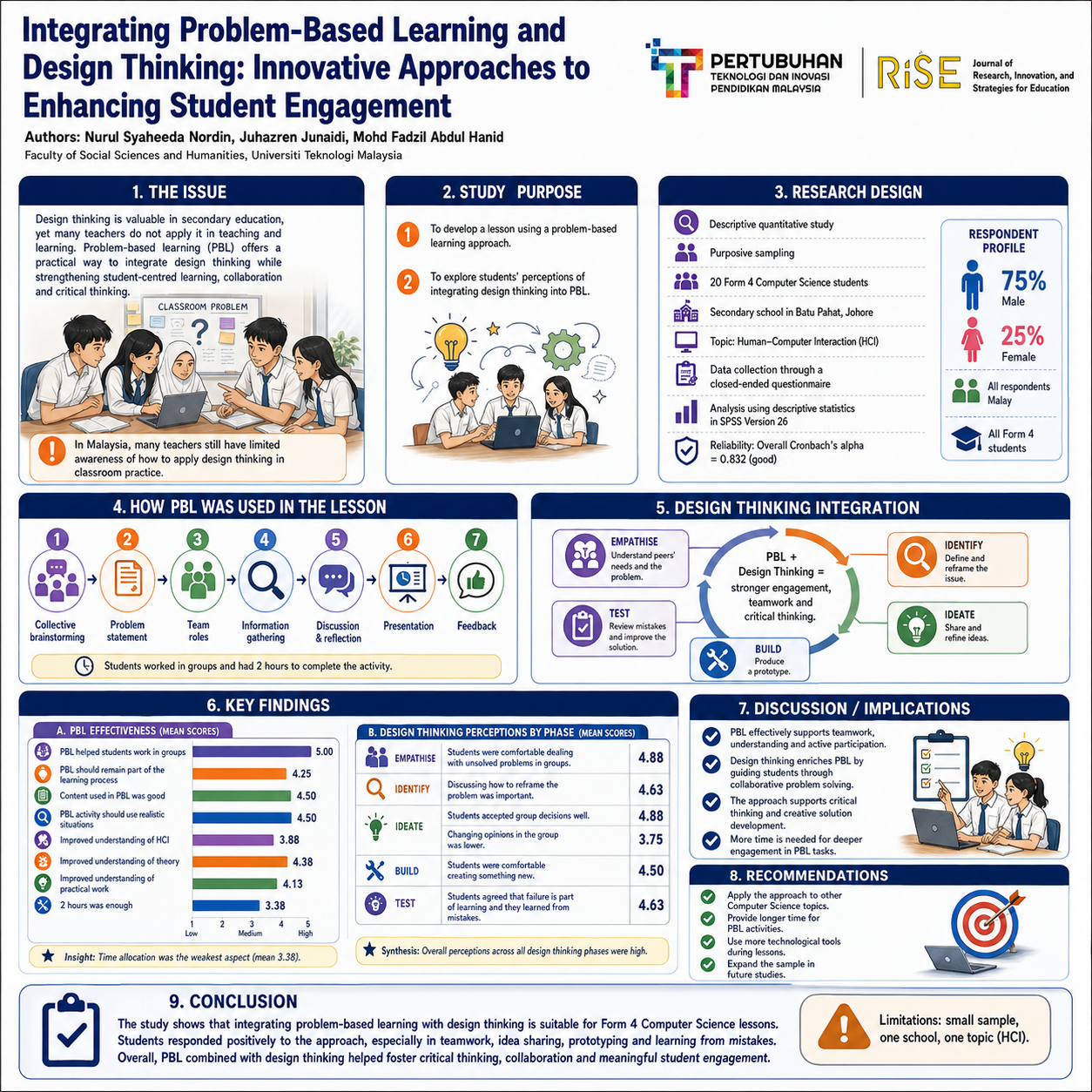
Design thinking is a suitable strategy for educators to implement in secondary education. However, 45% of teachers never applied in teaching and learning (T&L). One effective approach to integrating design thinking skills in learning is through problem-based learning (PBL). PBL allows secondary students to develop self-directed learning, teamwork, communication and critical thinking skills. This study aims to explore how design thinking skills can be use in PBL. In this study, Form 4 secondary students from Batu Pahat, Johore were chosen using purposive sampling using a quantitative approach with an adaption a set of questionnaires. Through the descriptive statistics analysis the results indicate majority of the samples strongly agreed PBL have helped them to work in group (5.00), PBL should be kept as part of T&L process (4.25). For design thinking samples felt in; Empathize, comfortable to deal the unsolved problems with their group (4.88), Identify, important to discuss in a group how to reframe the initial problem in order to achieve a good result (4.63), Ideate, comfortable to accept the group’s decision (4.88), Build, comfortable to create something new (4.50), Test, failure is part of learning process and learnt from the mistakes made (4.63). Overall, PBL in lessons proved to be effective, fostering students' critical thinking and teamwork skills as students adapted cognitive and social constructivism and design thinking enhancing critical thinking and teamwork of students.
References
Aboagye, E., Jensen, I., Bergström, G., Hagberg, J., Axén, I., & Lohela-Karlsson, M. (2016). Validity and test-retest reliability of an at-work production loss instrument. Occupational Medicine, 66(5), 377–382. https://doi.org/10.1093/occmed/kqw021
Andrew D. Watson. (2015). Design Thinking for Life. Art Education, 68(3), 12–18. https://doi.org/http://dx.doi.org/10.1080/00043125.2015.11519317
Anggraeni, N. (2021). Improving The Quality Of Education Through The Application Of Students Centered Learning: A Theoretical Review. Eduvest-Journal of Universal Studies, 1(7), 603–607. https://doi.org/https://doi.org/10.59188/eduvest.v1i7.99
Ayodele, J. (2012). Validity and Reliability Issues in Educational Research. Journal of Educational and Social Research, 2(2). https://doi.org/10.5901/jesr.2012.v2n2.391
Christmann, A., & Van Aelst, S. (2006). Robust estimation of Cronbach’s alpha. Journal of Multivariate Analysis, 97(7), 1660–1674. https://doi.org/10.1016/j.jmva.2005.05.012
Cobern, W. W. (1993). Synthesis Of Research Constructivism. Journal of Educational and Psychological Consultation, 4(1), 105–112. https://doi.org/10.1207/s1532768xjepc0401_8
Décieux, J. P., Mergener, A., Neufang, K. M., & Sischka, P. (2015). Implementation of the forced answering option within online surveys: Do higher item response rates come at the expense of participation and answer quality? Psihologija, 48(4), 311–326. https://doi.org/10.2298/PSI1504311D
Deitte, L. A., & Omary, R. A. (2019). The Power of Design Thinking in Medical Education. In Academic Radiology (Vol. 26, Issue 10, pp. 1417–1420). Elsevier USA. https://doi.org/10.1016/j.acra.2019.02.012
Dosi, C., Rosati, F., & Vignoli, M. (2018). Measuring design thinking mindset. Proceedings of International Design Conference, DESIGN, 5, 1991–2002. https://doi.org/10.21278/idc.2018.0493
Doukanari, E., Ktoridou, D., Efthymiou, L., & Epaminonda, E. (2020). The quest for sustainable teaching praxis: Opportunities and challenges of multidisciplinary and multicultural teamwork. MDPI. https://doi.org/10.20944/preprints202010.0148.v1
Erat, S., & Kavadias, S. (2008). Sequential testing of product designs: Implications for learning. Management Science, 54(5), 956–968. https://doi.org/10.1287/mnsc.1070.0784
Funa, A. A., & Prudente, M. S. (2021). Effectiveness of problem-based learning on secondary students’ achievement in science: A meta-analysis. International Journal of Instruction, 14(4), 69–84. https://doi.org/10.29333/iji.2021.1445a
Ghani, A. S. A., Rahim, A. F. A., Yusoff, M. S. B., & Hadie, S. N. H. (2021). Effective Learning Behavior in Problem-Based Learning: a Scoping Review. In Medical Science Educator (Vol. 31, Issue 3, pp. 1199–1211). Springer. https://doi.org/10.1007/s40670-021-01292-0
Ginaya, G., Kanca, I. N., & Sri Astuti, N. N. (2020). Designing problem-based learning (PBL) model for tourism vocational education in 4.o industry. International Journal of Linguistics, Literature and Culture, 6(1), 14–23. https://doi.org/10.21744/ijllc.v6n1.808
Gregor Gabrysiak, Holger Giese, & Andreas Seibel. (2011). Towards Next Generation Design Thinking: Scenario-Based Prototyping for Designing Complex Software Systems with Multiple Users. Understanding Innovation. https://doi.org/10.1007/978-3-642-13757-0
Harlow, S., Cummings, R., & Aberasturi, S. M. (2006). Karl popper and jean piaget: A rationale for constructivism. Educational Forum, 71(1), 41–48. https://doi.org/10.1080/00131720608984566
Hayes, E. R., & Games, I. A. (2008). Making computer games and design thinking: A review of current software and strategies. Games and Culture, 3(3–4), 309–332. https://doi.org/10.1177/1555412008317312
Hendry, G. D., Frommer, M., & Walker, R. A. (1999). Constructivism and problem-based Learning. International Journal of Phytoremediation, 23(3), 369–371. https://doi.org/10.1080/0309877990230306
Henriksen, D., Richardson, C., & Mehta, R. (2017). Design thinking: A creative approach to educational problems of practice. Thinking Skills and Creativity, 26, 140–153. https://doi.org/10.1016/j.tsc.2017.10.001
Horan. (1982). standard deviation or standard error of the mean. Anaesthesia and Intensive Care. https://doi.org/https://doi.org/10.1177/0310057X8201000430
Jabarullah, N. H., & Iqbal Hussain, H. (2019). The effectiveness of problem-based learning in technical and vocational education in Malaysia. Education and Training, 61(5), 552–567. https://doi.org/10.1108/ET-06-2018-0129
Jadallah, E. (2000). Constructivist Learning Experiences for Social Studies Education. The Social Studies, 91(5), 221–225. https://doi.org/10.1080/00377990009602469
Kimbell, L. (2011). Rethinking Design Thinking: Part I. Design and Culture, 3(3), 285–306. https://doi.org/10.2752/175470811x13071166525216
Kimberlin, C. L., & Winterstein, A. G. (2008). Validity and reliability of measurement instruments used in research. In American Journal of Health-System Pharmacy (Vol. 65, Issue 23, pp. 2276–2284). American Society of Health-Systems Pharmacy. https://doi.org/10.2146/ajhp070364
Li, T., & Zhan, Z. (2022). A Systematic Review on Design Thinking Integrated Learning in K-12 Education. In Applied Sciences (Switzerland) (Vol. 12, Issue 16). MDPI. https://doi.org/10.3390/app12168077
Md Hashim, A., Ruzaina Syed Aris, S., & Yuen Fook, C. (2019). Promoting Empathy Using Design Thinking In Project-Based Learning And As A Classroom Culture. Asian Journal of University Education. https://doi.org/http://dx.doi.org/10.24191/ajue.v15i3.7817
Mercy, A., Lapuz, E., & Fulgencio, M. N. (2020). Improving the Critical Thinking Skills of Secondary School Students using Problem-Based Learning. In International Journal of Academic Multidisciplinary Research (Vol. 4, Issue 1). www.ijeais.org/ijamr
Morrison, B. B., Margulieux, L. E., & Guzdial, M. (2015). Subgoals, context, and worked examples in learning computing problem solving. ICER 2015 - Proceedings of the 2015 ACM Conference on International Computing Education Research, 21–30. https://doi.org/10.1145/2787622.2787733
Mustaffa, N., Ismail, Z., Tasir, Z., & Said, M. N. H. M. (2016). The Impacts of Implementing Problem-Based Learning (PBL) in Mathematics: A Review of Literature. International Journal of Academic Research in Business and Social Sciences, 6(12). https://doi.org/10.6007/ijarbss/v6-i12/2513
Noh, S. C., & Karim, A. M. A. (2021). Design thinking mindset to enhance education 4.0 competitiveness in Malaysia. International Journal of Evaluation and Research in Education, 10(2), 494–501. https://doi.org/10.11591/ijere.v10i2.20988
Patrick Lowenthal. (2008). Constructivism. Encyclopedia of the Social and Cultural Foundations of Education, 177–179. https://doi.org/https://doi.org/10.1111/j.1521-9488.2004.419_1.x
Pratomo, L. C., Siswandari, & Wardani, D. K. (2021). The effectiveness of design thinking in improving student creativity skills and entrepreneurial alertness. International Journal of Instruction, 14(4), 695–712. https://doi.org/10.29333/iji.2021.14440a
Rahmad Timor, A., Dakhi, O., Verawadina, U., Magdalena Zagoto, M., & Kesehatan SITEBA, P. (2021). Effectiveness Of Problem-Based Model Learning On Learning Outcomes And Student Learning Motivation In Basic Electronic Subjects. International Journal of Multi Science, 1(10). Timor, A. R., AMBIYAR, A., DAKHI, O., VERAWADINA, U., & ZAGOTO, M. M. (2021). Effectiveness of problem-based model learning on learning outcomes and student learning motivation in basic electronic subjects. International journal of multi science, 1(10), 1-8.
Rahmayani. (2021). Literature Study The Effect Of Variations Of The Application Of The Problem Based Learning (PBL) Model On Students ’Learning Interest In Middle Schools. Science Education Journal, 2(2), 185–191. https://doi.org/http://dx.doi.org/10.54443/ijerlas.v3i5.1047
Razzouk, R., & Shute, V. (2012). What Is Design Thinking and Why Is It Important? Review of Educational Research, 82(3), 330–348. https://doi.org/10.3102/0034654312457429
Savery, J. R., & Duffy, T. (1995). Problem Based Learning: An instructional model and its constructivist framework. Educational Technology, 35(5), 31–38. Savery, J. R., & Duffy, T. M. (1995). Problem based learning: An instructional model and its constructivist framework. Educational technology, 35(5), 31-38.
Silva, A. B. Da, Bispo, A. C. K. de A., Rodriguez, D. G., & Vasquez, F. I. F. (2018). Problem-based learning: A proposal for structuring PBL and its implications for learning among students in an undergraduate management degree program. Revista de Gestao, 25(2), 160–177. https://doi.org/10.1108/REGE-03-2018-030
Smith, R. C., Iversen, O. S., & Hjorth, M. (2015). Design thinking for digital fabrication in education. International Journal of Child-Computer Interaction, 5, 20–28. https://doi.org/10.1016/j.ijcci.2015.10.002
Somawati, S., Andri, A., Sepni Yanti, & Munali, M. (2023). Pengelolaan Pembelajaran Berbasis Learning Management System (LMS) Menggunakan Aplikasi Canva. PaKMas: Jurnal Pengabdian Kepada Masyarakat, 3(1), 80–85. https://doi.org/10.54259/pakmas.v3i1.1670
Sulisworo, D., & Suryani, F. (2014). The Effect Of Cooperative Learning, Motivation And Information Technology Literacy To Achievement. International Journal of Learning and Development, 4(2), 58. https://doi.org/10.5296/ijld.v4i2.4908
Suprapto, E., Fahrizal, F., Priyono, P., & K., B. (2017). The Application of Problem-Based Learning Strategy to Increase High Order Thinking Skills of Senior Vocational School Students. International Education Studies, 10(6), 123. https://doi.org/10.5539/ies.v10n6p123
Svein Sjøberg. (2010). Constructivism and learning. International Encyclopaedia of Education 3rd Edition. https://doi.org/http://dx.doi.org/10.1016/B978-0-08-044894-7.00467-X
Tatar, E., & Oktay, M. (2011). The effectiveness of problem-based learning on teaching the first law of thermodynamics. Research in Science and Technological Education, 29(3), 315–332. https://doi.org/10.1080/02635143.2011.599318
Tsai, K.-C. (2018). Development of the Tsai Design Thinking Scale. Arts and Design Studies , 69. www.iiste.org
Tu, J. C., Liu, L. X., & Wu, K. Y. (2018). Study on the learning effectiveness of stanford design thinking in integrated design education. Sustainability (Switzerland), 10(8). https://doi.org/10.3390/su10082649
Utami, B., Probosari, R. M., Saputro, S., Ashadi, & Masykuri, M. (2019). Empowering critical thinking skills with problem solving in higher education. Journal of Physics: Conference Series, 1280(3). https://doi.org/10.1088/1742-6596/1280/3/032047
Utami, Y., Dewi, &, & Djamdjuri, S. (2021). Students’ Motivation In Writing Class Using Of Canva: Students’ Perception. Bogor English Student and Teacher (BEST). https://doi.org/http://dx.doi.org/10.32832/english.v15i2.5536
Valentim, N. M. C., Silva, W., & Conte, T. (2017). The Students’ Perspectives on Applying Design Thinking for the Design of Mobile Applications. IEEE. https://doi.org/http://dx.doi.org/10.1109/ICSE-SEET.2017.10
Visschers-Pleijers, A. J. S. F., Dolmans, D. H. J. M., De Leng, B. A., Wolfhagen, I. H. A. P., & Van Der Vleuten, C. P. M. (2006). Analysis of verbal interactions in tutorial groups: A process study. Medical Education, 40(2), 129–137. https://doi.org/10.1111/j.1365-2929.2005.02368.x
Wadkar, S. K., Singh, K., Chakravarty, R., & Argade, S. D. (2016). Assessing the Reliability of Attitude Scale by Cronbach’s Alpha. Journal of Global Communication, 9(2), 113. https://doi.org/10.5958/0976-2442.2016.00019.7
Wina Smeenk, Oscar Tomico, & Koen van Turnhout. (2016). A systematic analysis of mixed perspectives in empathic design: not one perspective encompasses all. International Journal of Design, 10(2), 31–48. www.tue.nl/taverne
Wloka, J., Hoest, E. W., & Ryder, B. G. (2010). Tool support for change-centric test development. IEEE Software, 27(3), 66–71. https://doi.org/10.1109/MS.2009.159
Yuan, H. Bin, Williams, B. A., Yin, L., Liu, M., Fang, J. B., & Pang, D. (2011). Nursing students’ views on the effectiveness of problem-based learning. Nurse Education Today, 31(6), 577–581. https://doi.org/10.1016/j.nedt.2010.10.009
Zhou, C., Purushothaman, A., & Rongbutsri, N. (2013). Facilitating sustainability of education by problem-based learning (PBL) and information and communication technology (ICT). International Journal of Emerging Technologies in Learning, 8(6), 50–54. https://doi.org/10.3991/ijet.v8i6.3146
Downloads
Published
Issue
Section
License
Copyright (c) 2024 Nurul Syaheeda Nordin, Juhazren Junaidi, Mohd Fadzil Abdul Hanid (Author)

This work is licensed under a Creative Commons Attribution 4.0 International License.