Malaysian Armed Forces Spiritual Strength Instrument
DOI:
https://doi.org/10.70148/v3i1.3Keywords:
Spiritual Strength, Military Psychology, Malaysian Armed Forces, Exploratory Factor Analysis, Instrument DevelopmentAbstract
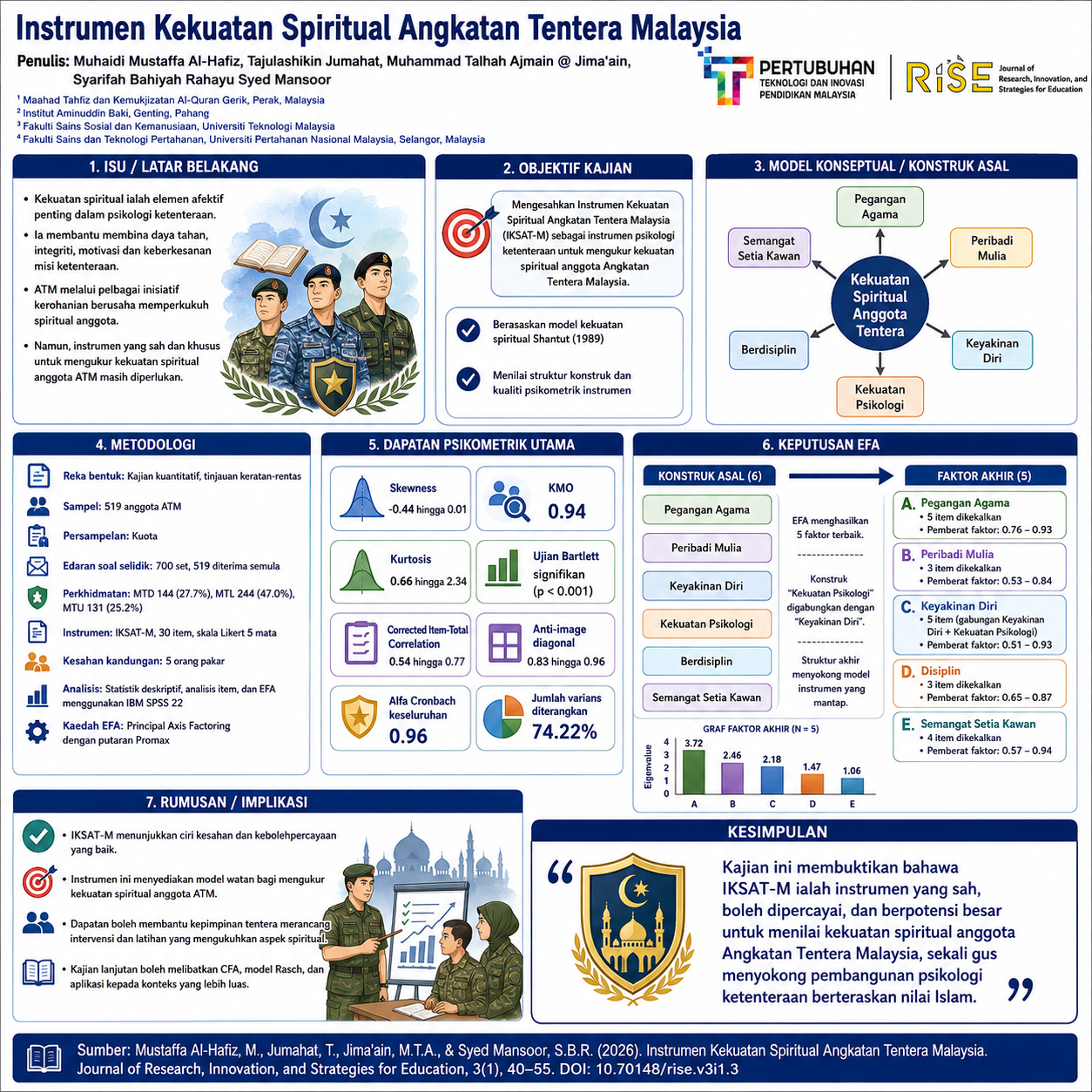
Spiritual strength plays a significant role within the armed forces as it enhances resilience and contributes to the effectiveness of military missions in maintaining national peace and security. Therefore, this study aims to validate a military psychological measurement instrument known as the Instrumen Kekuatan Spiritual Angkatan Tentera Malaysia (IKSAT-M), developed specifically to assess affective elements among members of the Malaysian Armed Forces (MAF). IKSAT-M was constructed based on the spiritual strength model proposed by Shantut (1989). This instrument measures six constructs of spiritual strength: Religious Adherence, Noble Character, Self-Confidence, Psychological Strength, Discipline, and Esprit de Corps, which were examined using factor analysis procedures. At the initial stage, the content of IKSAT-M was validated by five experts. Subsequently, an exploratory factor analysis (EFA) produced five factors and revealed that the constructs of Psychological Strength and Self-Confidence had merged. The development of IKSAT-M provides a new pathway for future research on the spiritual strength of MAF personnel.
References
Abidin, Z., Mohd Zainol, N., Salleh, D., & Razali, N. (2022). Teaching Al-Quran among the army personnel to increase the level of discipline. Islamic Research, 5(2), 141-147. https://doi.org/https://doi.org/10.47076/jkpis.v5i2.103
Abu-Ras, W., & Hosein, S. (2015). Understanding resiliency through vulnerability: Cultural meaning and religious practice among Muslim military personnel. Psychology of Religion and Spirituality, 7(3), 179–191. https://doi.org/10.1037/rel0000017
Affandi, L. A., Akbar, M., Dedi Purwana, D., & Hanafi, M. F. (2019). Evolution of Leadership in Esprit de Corps: Evidence from Military Organization. Advances in Social Science, Education and Humanities Research, 343,399-403. http://doi.org/10.2991/icas-19.2019.83
Affandi, L. A., Akbar, M., & Purwana, D. (2018). Esprit de Corps and Desertion Intention in Indonesian Navy. Journal of Business and Behavioural Entrepreneurship, 2(2), 51–61. https://doi.org/10.21009/JOBBE.002.2.01
Anisin, A. (2022). Military Defection During the Collapse of the Soviet Union. Central European Journal of International and Security Studies, 16, 26-53. https://doi.org/10.51870/UNYW3133.
Beavers, A. S., Lounsbury, J. W., Richards, J. K., Huck, S. W., Skolits, G. J., & Esquivel, S. L. (2013). Practical considerations for using exploratory factor analysis in educational research. Practical Assessment Research & Evaluation, 18, 1–13.
Boe, O., Bang, H., & Nilsen, F. (2015). Selecting the Most Relevant Character Strengths for Norwegian Army Officers: An educational tool. Procedia-Social and Behavioral Sciences, 197, 801-809. http://dx.doi.org/10.1016/j.sbspro.2015.07.188.
Boe, O. & Bang, H. (2016). The Big 12: The most important character strengths for military officers. Athens Journal of Social Sciences, 4(2), 161-174. http://dx.doi.org/10.30958/ajss.4-2-4
Bujai, M. R., & Hashim, A. (2015). Pelaksanaan aktiviti keagamaan dan hubungannya dengan penghayatan kerohanian Anggota Tentera Malaysia. Tinta Artikulasi Membina Ummah, 1(1), 176-186. https://www.researchgate.net/publication/280499752_Pelaksanaan_Aktiviti_Keagamaan_dan_Hubungannya_dengan_Penghayatan_Kerohanian_Anggota_Tentera_Malaysia
Cohen, R.J. & Swerdlik, R.J. (2010). Psychological testing and assessment: An introduction to tests and measurement (7th ed.). New York: McGraw-Hill.
Costello, A. B., & Osborne, J. W. (2005). Best practices in exploratory factor analysis: Four recommendations for getting the most from your analysis. Practical Assessment Research & Evaluation, 10, 1–9. https://doi.org/10.7275/jyj1-4868
Fauzi , A. F. I., Safiai , M. H., Jamsari, E. A., Ahmad, Y., Ashari, M. Z. A. H., & Muttaqin, A. (2025). Application of Islamic values in the military: A literature review. International Journal of Advance Research, 13(04), 58-65. http://dx.doi.org/10.21474/IJAR01/20700
Field, A. (2017). Discovering statistics using SPSS (5th ed.). Thousand Oaks: Sage.
Fisher, R. C., Gerstner, J. J., & Bandalos, D. L. (2013, May). A review and analysis of scale development procedures in psychology and education. Poster presented at the annual conference of the Association for Psychological Science, Washington D.C.
Floyd, F. J., & Widaman, K. F. (1995). Factor analysis in the development and refinement of clinical assessment instruments. Psychological Assessment, 7(3), 286–299. https://doi.org/10.1037/1040-3590.7.3.286
Goudarzian, A. H. (2023). Challenges and recommendations of exploratory and confirmatory factor analysis: A narrative review from a nursing perspective. Journal of Nursing Reports in Clinical Practice, 1(3), 133-137. https://doi.org/10.32598/JNRCP.23.44
Hair, J.F., Black, W.C., Babin, B. J., Anderson, R. E., & Tatham, R. L. (2019). Multivariate data analysis (8th ed.). New Jersey: Prentice Hall.
Hogan, T. P. (2007). Psychological testing: A practical introduction (2nd ed.). New Jersey: Wiley.
Hufford, D. J., Fritts, M. J., & Rhodes, J. E., (2010). Spiritual Fitness. Military Medicine, 175, 73-87. https://doi.org/10.7205/MILMED-D-10-00075
Jalal, B. (2015). Tahap Penghayatan Islam Dalam Pengurusan Diri Anggota Angkatan Tentera Malaysia. Jurnal Kepimpinan Pendidikan, 2(20), 34-41. https://ejournal.um.edu.my/index.php/JUPIDI/article/view/8322/5778
Jalal, B., Zainurin, A. R., Ismail, S. A., Madarsha, K. B., Joharry, O., Nordin, M. S.,Redwan, Y., & Sayuti, A. G. (2016). Kajian pelaksanaan program pendidikan spiritual terhadap anggota Angkatan Tentera Malaysia. In: International Seminar on al-Quran in Contemporary Society (SQ 2015) , 10th-11th Oct. 2015, Kuala Terengganu, Terengganu. http://irep.iium.edu.my/49066/
Jalal, B. (2017). Tahap Penghayatan Islam dalam pengurusan diri Anggota Angkatan Tentera Malaysia. Jurnal Kepimpinan Pendidikan, 2(2), 34-41. https://ejournal.um.edu.my/index.php/JUPIDI/article/view/8322/5778
Jalal, B., Nasir,B. M., Safiai, M. H., & Jamsari, E. A. (2022a). Shariah compliance efforts and approaches in Malaysian Armed Forces Organisation by Kor Agama Angkatan Tentera (KAGAT). International Journal of Advance Research, 11(01), 1449-1456. http://dx.doi.org/10.21474/IJAR01/16163
Jalal, B., Basiron, M.K., Ab Ghani, S. & Ismail, A.S. (2022b). Malaysian Military Leadership: History, Values and Principles. Zulfaqar Journal of Defence Management, Social Science & Humanities, 5(1), 14-23.
Khairani, A. Z., & Nordin, M. S. (2011). The development and construct validation of the mathematics proficiency test for 14-year-old students. Asia Pacific Journal of Educators and Education, 26 (1). 33-50.
Krauss, S., Azimi, H., & Idris, F. (2007). Adaption of a Muslim religiosity scale for use with four different faith communities in Malaysia. Review of Religious Research. 49. 147-164. https://www.jstor.org/stable/20447486
Lokyan, A., Baghdasaryan, S., & Hayk Hovhannisyan, H. (2025). Enhancing psychological training in military personnel: Modern approaches, systemic assessments and hands-on recommendations. Asian Journal of Psychiatry, 106. https://doi.org/10.1016/j.ajp.2025.104442.
Matsunaga, M. (2010). How to factor-analyze your data right: do’s, don’ts, and how-to’s. International Journal of Psychological Research, 3(1), 97–110. https://doi.org/10.21500/20112084.854
Meyers, L., Gamst, G., & Guarino, A. J. (2013). Applied multivariate research design and interpretation (2nd ed.). Newbury Park, CA: Sage.
Monerva, J., & Tribunalo, S. M. (2020). Students’ Level of Self-confidence and Performance Tasks. Asia Pacific Journal of Academic Research in Social Sciences, 5(1), 42-48. https://asiapjournals.org/students-level-of-self-confidence-and-performance-tasks/
Muhaidi Mustaffa. (2022). Pengaruh Penghayatan Program Pembudayaan Al-Quran Terhadap Anggota Angkatan Tentera Malaysia. [Unpublished doctoral thesis]. Universiti Teknologi Malaysia.
Netemeyer, R. G., Bearden, W. O., & Sharma, S. (2003). Scaling procedures: Issues and application. Thousand Oaks: Sage Publication.
Pallant, J. (2010). SPSS survival manual: A step by step guide to data analysis using SPSS (4th ed.). New York: McGraw Hill.
Pargament, K. I., & Sweeney, P. J. (2011). Building spiritual fitness in the Army: An innovative approach to a vital aspect of human development. American Psychologist, 66(1), 58–64. https://doi.org/10.1037/a0021657
Pattyn, N., Van Cutsem, J., Van Puyvelde, M., van den Berg, N., Lacroix, E., Dessy, E., Verheyden, C., Huybens, W., Lo Bue, S., Tibax, V., Vliegen, R., Ceccaldi, J., Savieri, P., Stas, L., & Mairesse, O. (2024). Smart is the new strong: An investigation of the contribution of physical, cognitive, anthropometric, and personality variables to success in a Tier 1 special forces qualification course. Sport, Exercise, and Performance Psychology, 13(2), 183–204. https://doi.org/10.1037/spy0000336
Raba, A. M. (2010). Major personalities in the Quran (2nd ed.). Kuala Lumpur: A. S. Noordeen.
Raubenheimer, J. (2004). An item selection procedure to maximise scale reliability and validity. SA Journal of Industrial Psychology, 30(4), 59–64. http://doi.org/10.4102/sajip.v30i4.168
Reise, S. P., Waller, N. G., & Comrey, A. L. (2000). Factor analysis and scale revision. Psychological Assessment, 12, 287–297. http://doi:10.1037//1040-3590.12.3.287
Rohall, D. E., Prokopenko, O., Ender, M. G., & Matthews, M. D. (2014). The role of collective and personal self-esteem in a military context. Current Research in Social Psychology, 22(2), 10-21. http://www.uiowa.edu/-grpproc/crisp/crisp.html
Sekaran, U. (2003). Research methods for business: A skill building approach. John Wiley & Son: Singapore.
Serban, M. (2024). The role of military morale as an essential dimension of combat power. Security and Defence Quarterly, 47(3). https://doi.org/10.35467/sdq/174832.
Shantut, K. A. (1989). Al-Muslimun Wa al-Tarbiyyah al-Askariyyah. Al-Qahirah: Dar al-Wafa.
Tabachnick, B. G., & Fidell, L. S. (2007). Using Multivariate Statistics (5th ed.). Boston: Allyn and Bacon.
Downloads
Published
Issue
Section
License
Copyright (c) 2025 Muhaidi Mustaffa Al-Hafiz, Tajulashikin Jumahat, Muhammad Talhah Ajmain@Jima'ain and Syarifah Bahiyah Rahayu Syed Mansoor

This work is licensed under a Creative Commons Attribution 4.0 International License.