The Effects of Augmented Reality Technology on Students’ Academic Achievement: A Systematic Literature Review
DOI:
https://doi.org/10.70148/rise.2Keywords:
Augmented Reality; Education; Academic Impact; Student SkillsAbstract
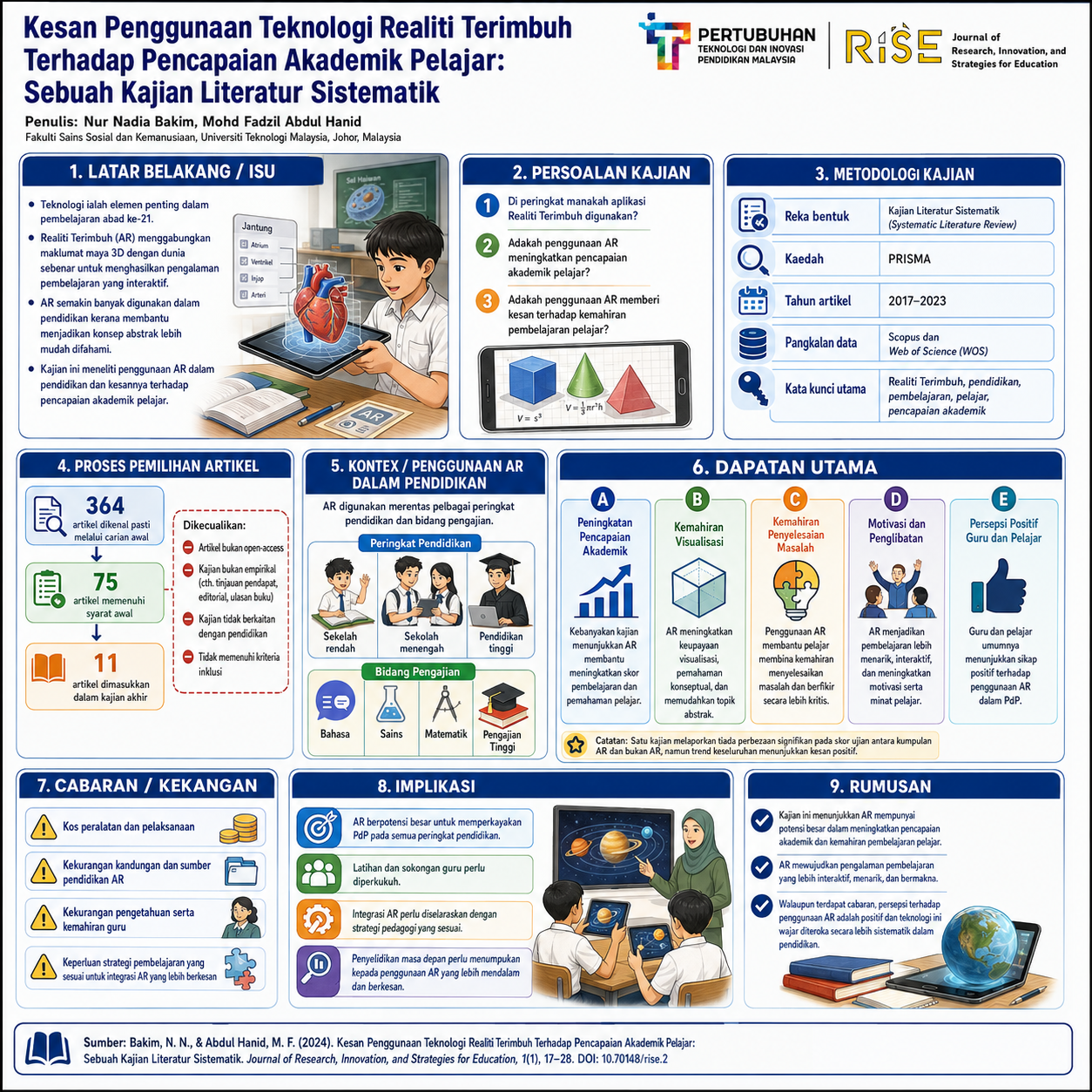
The use of technological elements in education has become one of the elements of learning in the 21st century (21st Century Learning) Incorporated Augmented Reality is one of the branches of technology that is increasingly being applied in education. Augmented Reality is a technology that applies virtual information to the physical world in a three-dimensional form, which produces an interactive and comprehensive experience for the user. The highlighting objective of this systematic study is to identify the use of Augmented Reality applications in education and its impact on student academic achievement. The methodology of this study is based on online research highlighting from databases such as Scopus and Web of Science (WOS). The keywords used in the search are Augmented Reality in education, impact, learning, and academic achievement. This systematic study highlighted the use of augmented reality in a range of primary education level up to tertiary education level in learning fields, such as language studies, science, mathematics, and higher education. The study also found that the application of augmented reality can help improve student visualization skills, student problem-solving skills and help improve students' academic achievement. This aided researchers and educators to use the augmented reality application in education, while also providing future study related to the implementation of augmented reality and appropriate learning strategies for effective use of augmented reality technologies. The study also found that both teachers and also students have positive perception towards the use of augmented reality applications in learning process.
References
Ali, D. F., Omar, M., Abdullah, A. H., Ibrahim, N. H., Mokhtar, M., Zaid, N. M., & Johari, N. (2021). 5 years into augmented reality technology in education: Research trends, bibliometric study and its application to enhance visualization skills. WSEAS Transactions on Systems and Control, 16, 253–260. https://doi.org/10.37394/23203.2021.16.21
AlNajdi, S. M. (2022). The effectiveness of using augmented reality (AR) to enhance student performance: using quick response (QR) codes in student textbooks in the Saudi education system. Educational Technology Research and Development, 70(3), 1105–1124. https://doi.org/10.1007/s11423-022-10100-4
António, F., & Lobato, M. G. (2023). Effects of using augmented reality on students’ learning. Trends in Computer Science and Information Technology. https://api.semanticscholar.org/CorpusID:257094681
Aprinaldi, A., Rahmawati, Y., & Komaro, M. (2019). Implementation of Augmented Reality (AR) android based in learning. Journal of Physics: Conference Series, 1402. https://api.semanticscholar.org/CorpusID:214390828
Aso, B., Navarro-Neri, I., García-Ceballos, S., & Rivero, P. (2021). Quality requirements for implementing augmented reality in heritage spaces: Teachers’ perspective. Education Sciences, 11(8). https://doi.org/10.3390/educsci11080405
Balog, A., & Pribeanu, C. (2010). The Role of Perceived Enjoyment in the Students’ Acceptance of an Augmented Reality Teaching Platform: a Structural Equation Modelling Approach. Studies in Informatics and Control, 19. https://api.semanticscholar.org/CorpusID:55330853
Batdi, V. (2022). The Effects of Augmented Reality Applications on Secondary Students’ Academic Achievement in Science Course. Article in Journal of Education in Science Environment and Health. https://doi.org/10.21891/jeseh.1193695
Becker, S. A. , C. M. , D. A. , F. A. , G. H. C. & A. V. (2017). Horizon Report > 2017 Higher Education Edition.
Chang, H.-Y., Binali, T., Liang, J.-C., Chiou, G.-L., Cheng, K.-H., Lee, S. W.-Y., & Tsai, C.-C. (2022). Ten years of augmented reality in education: A meta-analysis of (quasi-) experimental studies to investigate the impact. Computers and Education, 191. https://doi.org/10.1016/j.compedu.2022.104641
Chen, C., Zhang, L., Luczak, T., Smith, E., & Burch, R. (2019). Using Microsoft HoloLens to improve memory recall in anatomy and physiology: A pilot study to examine the efficacy of using augmented reality in education. Journal of Educational Technology Development and Exchange, 12(1), 17–31. https://doi.org/10.18785/jetde.1201.02
Delello, J. A., McWhorter, R. R., & Camp, K. M. (2015). Integrating augmented reality in higher education: A multidisciplinary study of student perceptions. Journal of Educational Multimedia and Hypermedia, 24, 209–233. https://api.semanticscholar.org/CorpusID:33280681
Ertmer, P. A., & Ottenbreit-Leftwich, A. T. (2010). Teacher technology change: How knowledge, confidence, beliefs, and culture intersect. Journal of Research on Technology in Education, 42(3), 255–284. https://doi.org/10.1080/15391523.2010.10782551
Furht. (2006). Augmented Reality. In B. Furht (Ed.), Encyclopedia of Multimedia (pp. 29–31). Springer US. https://doi.org/10.1007/0-387-30038-4_10
Gün, E. T., & Atasoy, B. (2017). The effects of augmented reality on elementary school students’ spatial ability and academic achievement. Egitim ve Bilim, 42(191), 31–51. https://doi.org/10.15390/EB.2017.7140
Hsiao, K.-F. (2010). The effects of augmented reality on learning. Studies in Health Technology and Informatics, 154, 160–164. https://api.semanticscholar.org/CorpusID:11296611
Hsieh, M.-C. (2016). Teachers’ and Students’ Perceptions toward Augmented Reality Materials. 2016 5th IIAI International Congress on Advanced Applied Informatics (IIAI-AAI), 1180–1181. https://api.semanticscholar.org/CorpusID:263092987
Hyder, H., Baloch, G., Saad, K., Shaikh, N., Buriro, A. B., & Bhatti, J. (2021). Particle Physics Simulator for Scientific Education using Augmented Reality. International Journal of Advanced Computer Science and Applications, 12(2), 671–681. https://doi.org/10.14569/IJACSA.2021.0120284
Kye, B., & Kim, Y. (2008). Investigation of the Relationships between Media Characteristics, Presence, Flow, and Learning Effects in Augmented Reality Based Learning. https://api.semanticscholar.org/CorpusID:221004169
Majid, N. A. A., Mohammed, H., & Sulaiman, R. (2015). Students’ Perception of Mobile Augmented Reality Applications in Learning Computer Organization. Procedia - Social and Behavioral Sciences, 176, 111–116. https://api.semanticscholar.org/CorpusID:62718675
Marín-Marín, J.-A., López-Belmonte, J., Pozo-Sánchez, S., & Moreno-Guerrero, A.-J. (2023). Attitudes Towards the Development of Good Practices with Augmented Reality in Secondary Education Teachers in Spain. Technology, Knowledge and Learning, 28(4), 1443–1459. https://doi.org/10.1007/s10758-023-09671-9
Martín-Gutiérrez, J., Contero, M., & Raya, M. L. A. (2010). Evaluating the Usability of an Augmented Reality Based Educational Application. International Conference on Intelligent Tutoring Systems. https://api.semanticscholar.org/CorpusID:3100988
Mat-jizat, J. E., Osman, J., Abidin, Z., binti Yahaya, R., & Samsudin, N. (2015). THE USE OF AUGMENTED REALITY (AR) AMONG TERTIARY LEVEL STUDENTS: PERCEPTION AND EXPERIENCE. https://api.semanticscholar.org/CorpusID:55249658
Mayilyan, H. (2019a). Augmented reality in education, AR globe project assessment in actual teaching-learning environment. International Journal of Learning, Teaching and Educational Research, 18(3), 1–14. https://doi.org/10.26803/ijlter.18.3.1
Mayilyan, H. (2019b). Implementation of Augmented Reality Globe in Teaching-Learning Environment. 2019 IEEE Conference on Multimedia Information Processing and Retrieval (MIPR), 389–390. https://api.semanticscholar.org/CorpusID:133603039
Moher David AND Liberati, A. A. N. D. T. J. A. N. D. A. D. G. A. N. D. T. P. G. (2009). Preferred Reporting Items for Systematic Reviews and Meta-Analyses: The PRISMA Statement. PLOS Medicine, 6(7), 1–6. https://doi.org/10.1371/journal.pmed.1000097
Nadzri, A. Y. N. M., Ayub, A. F. M., & Zulkifli, N. N. (2023). The Effect of Using Augmented Reality Module in Learning Geometry on Mathematics Performance among Primary Students. International Journal of Information and Education Technology, 13(9), 1478–1486. https://doi.org/10.18178/ijiet.2023.13.9.1952
Nurbekova, Z., & Baigusheva, B. (2020). On the issue of compliance with didactic principles in learning using augmented reality. International Journal of Emerging Technologies in Learning, 15(15), 121–132. https://doi.org/10.3991/ijet.v15i15.14399
Perifanou, M., Economides, A. A., & Nikou, S. A. (2023). Teachers’ Views on Integrating Augmented Reality in Education: Needs, Opportunities, Challenges and Recommendations. Future Internet, 15(1). https://doi.org/10.3390/fi15010020
Petrovych, O., Zavalniuk, I., Bohatko, V., Poliarush, N., & Petrovych, S. (2023). Motivational Readiness of Future Teachers-Philologists to Use the Gamification with Elements of Augmented Reality in Education. International Journal of Emerging Technologies in Learning, 18(3), 4–21. https://doi.org/10.3991/ijet.v18i03.36017
Phon, D. N. E., Ali, M. B., & Halim, N. D. A. (2015). Learning with augmented reality: Effects toward student with different spatial abilities. Advanced Science Letters, 21, 2200–2204. https://api.semanticscholar.org/CorpusID:54858335
Pranoto, H., & Panggabean, F. M. (2019). Increase The Interest In Learning By Implementing Augmented Reality: Case studies studying rail transportation. International Conference on Computer Science and Computational Intelligence. https://api.semanticscholar.org/CorpusID:208090217
Saritha, R. C., Mankad, U., Venkataswamy, G., & Bapu, S. B. (2018). An Augmented Reality ecosystem for learning environment. 2018 IEEE International Conference on Advanced Networks and Telecommunications Systems (ANTS), 1–6. https://api.semanticscholar.org/CorpusID:148573531
Sirakaya, M., & Cakmak, E. K. (2018). The effect of augmented reality use on achievement, misconception and course engagement. Contemporary Educational Technology, 9(3), 297–314. https://doi.org/10.30935/cet.444119
Syawaludin, A., Gunarhadi, G., & Rintayati, P. (2019). Enhancing Elementary School Students’ Abstract Reasoning in Science Learning through Augmented Reality-Based Interactive Multimedia. Jurnal Pendidikan IPA Indonesia. https://api.semanticscholar.org/CorpusID:199159085
Tarng, W., Lin, Y. S., Lin, C. P., & Ou, K. L. (2016). Development of a Lunar-Phase Observation System Based on Augmented Reality and Mobile Learning Technologies. Mobile Information Systems, 2016. https://doi.org/10.1155/2016/8352791
Wojciechowski, R., & Cellary, W. (2013). Evaluation of learners’ attitude toward learning in ARIES augmented reality environments. Comput. Educ., 68, 570–585. https://api.semanticscholar.org/CorpusID:40482534
Xue, Y., & Wang, J. (2021). English Listening Teaching Device and Method Based on Virtual Reality Technology under Wireless Sensor Network Environment. Journal of Sensors, 2021. https://doi.org/10.1155/2021/8261861
Yen, J.-C., Tsai, C.-H., & Wu, M. (2013). Augmented Reality in the Higher Education: Students’ Science Concept Learning and Academic Achievement in Astronomy. Procedia - Social and Behavioral Sciences, 103, 165–173. https://doi.org/10.1016/j.sbspro.2013.10.322
Yu -Lien Chang, H.-T. H. C.-Y. P. Y.-T. S. and K.-E. C. (2015). Apply an Augmented Reality in a Mobile Guidance to Increase Sense of Place for Heritage Places. Educational Technology & Society, 18(2), 166–178.
Downloads
Published
Issue
Section
License
Copyright (c) 2024 Nur Nadia Bakim, Mohd Fadzil Abdul Hanid (Author)

This work is licensed under a Creative Commons Attribution 4.0 International License.