The Relation between Physics Expectation and Physics Achievement among Form Four Students in Besut District
DOI:
https://doi.org/10.70148/rise.v2i6.3Keywords:
Physics expectation, Physics achievement, Correlational studyAbstract
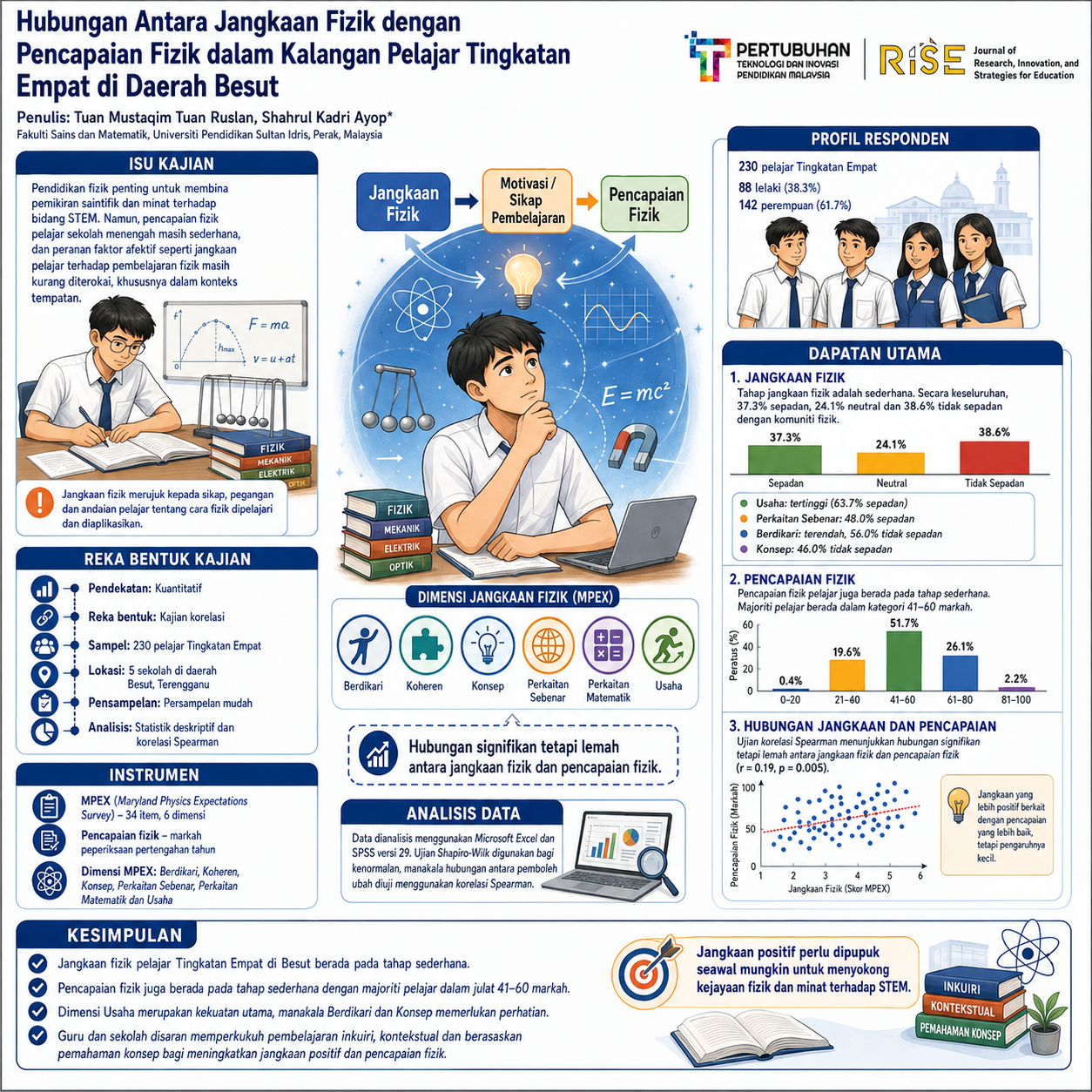
Physics education plays a vital role in fostering scientific thinking and promoting interest in STEM fields; however, the influence of affective factors such as students’ expectations remains underexplored, particularly within local contexts. This study aims to identify students’ expectations toward learning physics, their level of Physics achievement, and the relationship between the two in the Besut district of Terengganu. The research design employed was a correlational study with a quantitative approach, involving a total of 230 Form Four students from five schools. The main instrument used was the Maryland Physics Expectations Survey (MPEX), while physics achievement was measured using mid-year examination scores in Form Four Physics subject. Data were analyzed using descriptive statistics (mean, percentage) and inferential statistics (Spearman’s correlation test). The findings indicated that students’ physics expectations and their physics achievement were at a moderate level. The correlation test showed a significant but weak relationship (r(28)=.19,p=.005) between physics expectations and physics achievement. This study recommends further longitudinal research to explore how students’ expectations evolve throughout the process of learning Physics.
References
Assem, H. D., Nartey, L., Appiah, E., & Aidoo, J. K. (2023). A Review of Students’ Academic Performance in Physics: Attitude, Instructional Methods, Misconceptions and Teachers Qualification. European Journal of Education and Pedagogy, 4(1), 84–92. https://doi.org/10.24018/EJEDU.2023.4.1.551
Bond, T. G., & Fox, C. M. (2007). Applying the rasch model: Fundamental measurement in the human sciences: Second edition. Applying the Rasch Model: Fundamental Measurement in the Human Sciences: Second Edition, 1–340. https://doi.org/10.4324/9781410614575
Creswell, J. W. ., & Guetterman, T. C. . (2024). Educational Research: Planning, Conducting, and Evaluating Quantitative and Qualitative Research, 7th Edition. Pearson, 677.
Eccles, J. S., & Wigfield, A. (2020). From expectancy-value theory to situated expectancy-value theory: A developmental, social cognitive, and sociocultural perspective on motivation. Contemporary Educational Psychology, 61, 101859. https://doi.org/10.1016/J.CEDPSYCH.2020.101859
Flanagan, J. R., Beck, C. T., & Polit, D. F. (2024). Polit & Beck’s Nursing Research: Generating and Assessing Evidence for Nursing Practice. 2024, International Edition., 810.
Hayat, A. A., Shateri, K., Amini, M., & Shokrpour, N. (2020). Relationships between academic self-efficacy, learning-related emotions, and metacognitive learning strategies with academic performance in medical students: A structural equation model. BMC Medical Education, 20(1). https://doi.org/10.1186/s12909-020-01995-9
Knaub, A. V, Aiken, J. M., & Ding, L. (2010). Two-phase study examining perspectives and use of quantitative methods in physics education research. https://doi.org/10.1103/PhysRevPhysEducRes.15.020102
Körhasan, N. D., & Çıtak, C. (2024). Examination of undergraduate students’ physics expectations. European Journal of Physics, 45(4), 045701. https://doi.org/10.1088/1361-6404/AD37E5
Krejcie, R. V., & Morgan, D. W. (1970). Determining Sample Size for Research Activities. Educational and Psychological Measurement, 30(3), 607–610. https://doi.org/10.1177/001316447003000308
Kritsadatan, N., & Wattanakasiwich, P. (2014). First Year Students’ and Physics Teachers’ Expectations in Learning Physics: Case Study in Thailand. International Journal of Innovation in Science and Mathematics Education, 22(1), 32–42.
Lembaga Peperiksaan Kementerian Pendidikan. (n.d.). Laporan Analisis Keputusan SPM 2024.
Mistades, V. M. (2011). Freshman Physics Majors’ Cognitive Expectations and Academic Performance in their Introductory Physics Course. The Manila Journal of Science, 7(1), 1–6.
Piaget, J. (1977). The Role of Action in the Development of Thinking. In W. F. Overton & J. M. Gallagher (Eds.), Knowledge and Development: Volume 1 Advances in Research and Theory (pp. 17–42). Springer US. https://doi.org/10.1007/978-1-4684-2547-5_2
Redish, E. F., Saul, J. M., & Steinberg, R. N. (1998). Student expectations in introductory physics. American Journal of Physics, 66(3), 212–224. https://doi.org/10.1119/1.18847
Taber, K. S. (2025). Developing Intellectual Sophistication and Scientific Thinking—The Schemes of William G. Perry and Deanna Kuhn. In Science Education in Theory and Practice (pp. 215–231). Springer, Cham. https://doi.org/10.1007/978-3-031-81351-1_13
Vygotsky, L. S. (1978). Development of Higher Psychological Processes (M. Cole, V. Jolm-Steiner, S. Scribner, & E. Souberman, Eds.). Harvard University Press. https://doi.org/10.2307/j.ctvjf9vz4
Wahono, B., Lin, P. L., & Chang, C. Y. (2020). Evidence of STEM enactment effectiveness in Asian student learning outcomes. In International Journal of STEM Education (Vol. 7, Issue 1). Springer. https://doi.org/10.1186/s40594-020-00236-1
Zemplén, G. Á. (2023). Epistemic Beliefs and Physics Teacher Education. The International Handbook of Physics Education Research: Special Topics, 11-1-11–30. https://doi.org/10.1063/9780735425514_011
Downloads
Published
Issue
Section
License
Copyright (c) 2025 Shahrul Kadri Ayop, Tuan Mustaqim Tuan Ruslan (Author)

This work is licensed under a Creative Commons Attribution 4.0 International License.