Integration Of Open Educational Resources in Course Materials: A Content Analysis of the Teacher Education Programme in Open and Distance Education
DOI:
https://doi.org/10.70148/rise.v2i5.5Keywords:
Open Educational Resources (OER), OER Utilization, Open-Distance Education, Postgraduate Diploma in Education , Teacher EducationAbstract
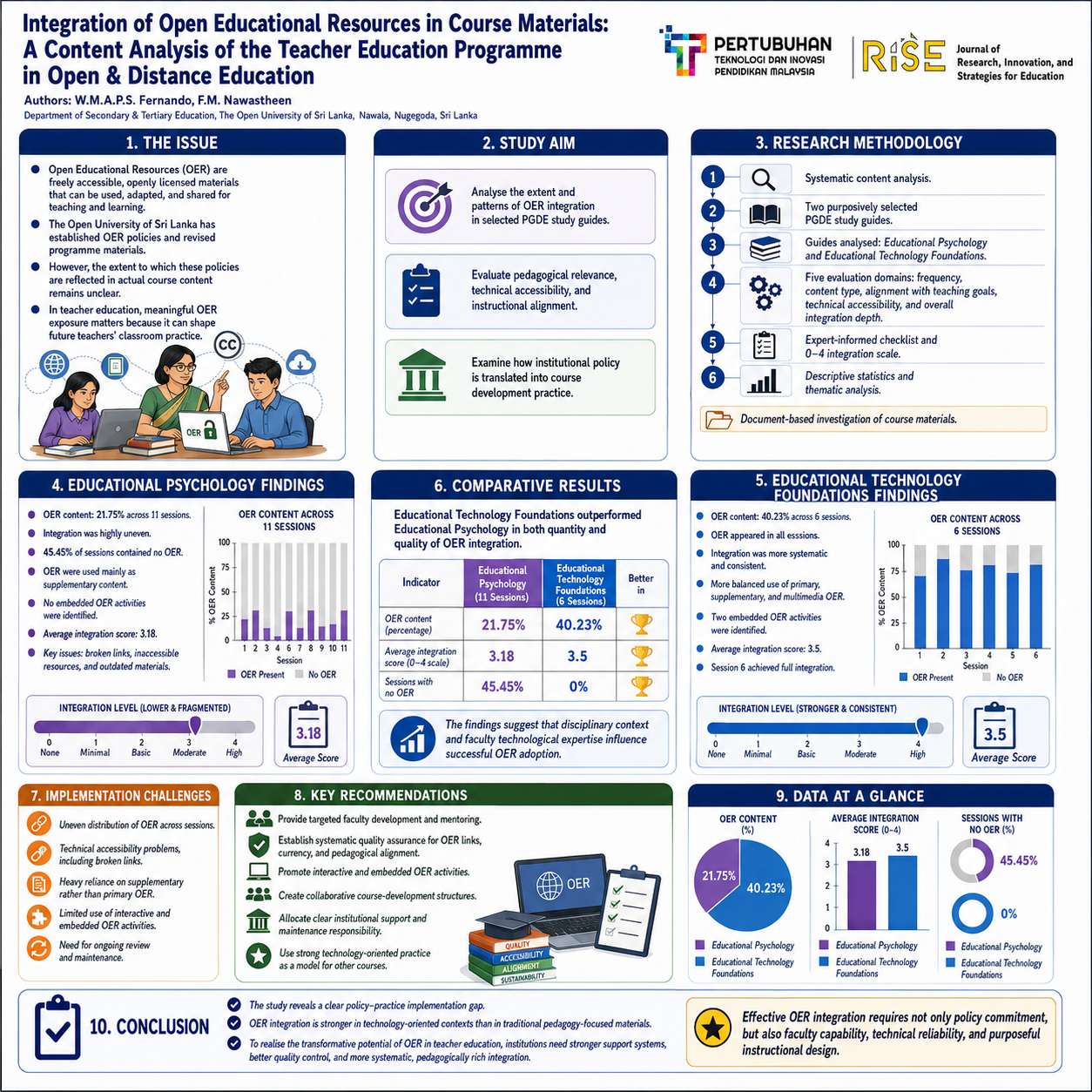
Open Educational Resources (OER) comprise freely accessible, openly licensed educational materials that educators and learners can adapt and share for teaching and learning. The Open University of Sri Lanka (OUSL) has recently increased OER integration into various programme learning materials. This study examined the integration of Open Educational Resources (OER) in teacher education course materials at the Open University of Sri Lanka. Using systematic content analysis, researchers evaluated OER frequency, type, and pedagogical quality in two Postgraduate Diploma in Education study guides: Educational Psychology and Educational Technology Foundations. The analysis revealed significant disciplinary variations in the adoption of OER. The Educational Technology Foundations guide incorporated 40.23% OER content with an average integration score of 3.5, while Educational Psychology included only 21.75% OER content, scoring 3.18. Both guides relied heavily on supplementary rather than primary OER content, with technical issues, including broken links and outdated materials, undermining the effectiveness of implementation. The absence of interactive OER activities represents missed opportunities for modeling innovative teaching practices. Findings reveal a policy-practice implementation gap where faculty technological expertise and disciplinary context significantly influence OER adoption patterns. The study recommends targeted faculty development, systematic quality assurance, and enhanced integration of interactive OER to realize the transformative potential of open educational resources in teacher preparation programs.
References
Abramovich, S., & McBride, M. (2018). Open education resources and perceptions of financial value. Internet
and Higher Education. https://doi.org/10.1016/j.iheduc.2018.06.002
Ali, W. (2020). Online and Remote Learning in Higher Education Institutes: A Necessity in light of COVID-19 Pandemic. Higher Education Studies, 10(3), 16. https://doi.org/ 10.5539/hes .v 10n3p16
Alkhasawneh, S. (2020). Perception of academic staff toward barriers, incentives, and benefits
of the open educational resources (OER) network (SHMS) at Saudi Universities. Italian Journal of Sociology of Education, 12(1), 211–225. https://doi.org/10.14658/pupj-ijse-2020-1-12
Alyami, H. Y. (2020). Integration of Open Educational Resources in Higher and General
Education Institutions: from the Perspectives of Specialized and Concerned Bodies in E-Learning. World Journal of Education, 10(1), 30–41. https://doi.org/10.5430/wje.v10n1p30
Bol, L., Esqueda, M. C., Ryan, D., & Kimmel, S. C. (2021). A Comparison of Academic
Outcomes in Courses Taught With Open Educational Resources and Publisher
Content. Educational Researcher, 51(1), 17-26. https://doi.org/10.3102/0013189X211052563
Bordoloi, R. (2018). Transforming and empowering higher education through Open and
Distance Learning in India. Asian Association of Open Universities Journal, 13(1), 24–
https://doi.org/10.1108/aaouj-11-2017-0037
Bozkurt, A., Gjelsvik, T., Adam, T., Asino, T. I., Atenas, J., Bali, M., Blomgren, C., Bond, M., Bonk, C. J., Brown, M., Burgos, D., Conrad, D., Costello, E., Cronin, C., Czerniewicz, L., Deepwell, M., Deimann, M., DeWaard, H. J., Dousay, T. A., . . . Zawacki-Richter, O. (2023). Openness in education as a praxis: From individual testimonials to collective voices. Open Praxis, 15(2), 76–112. https://doi.org/10.55982/openpraxis.15.2.574
Caswell, T., Henson, S., Jensen, M., & Wiley, D. (2008). Open educational resources: Enabling universal education.
International Review of Research in Open and Distance Learning, 9(1), 1–11. https://doi.org/10.19173/irrodl.v9i1.469
Choi, Y. M., & Carpenter, C. (2017). Evaluating the impact of open educational resources: A case study. portal:
Libraries and the Academy, 17(4), 685-693.. https://doi.org/10.1353/pla.2017.0041
Cronin, C., Havemann, L., Karunanayaka, S., & McAvinia, C. (2023). Open educational practices. In EdTechnica: The open encyclopedia of educational technology. https://doi.or g/10.59668/371.12239
Commonwealth of Learning. (2021). Open Educational Resources Policy. COL. https://www.col.org/about/values/cols-policy-open-educational-resources/
Davis, F. D. (1989). Perceived usefulness, perceived ease of use, and user acceptance of information technology. MIS Quarterly, 13(3), 319–340. https://doi.org/10.2307/249008
Fine, M., & Read, H. (2020). Factors Impacting Student Perception of Open Educational
Resources. E-Journal of Business Education and Scholarship Teaching, 14(1), 151-173.
Grewe, K. E., & Davis, W. P. (2017). The Impact of Enrollment in an OER Course on Student Learning
Outcomes. International Review of Research in Open and Distributed Learning, 18(4).
Gunasekera, D. (2007). Evolution of distance education in Sri Lanka. Open University of Sri
Lanka. http://repository.ou.ac.lk/handle/94ousl/861
Horn, E. A., Anderson, R., & Pierick, K. (2018). Information Discovery and Delivery Open Educational Resources
(OERs) in Self-Directed Competency-Based Education. 46 (4), 197–203. https://doi.org/10.1108/IDD-02-2018-0005
Jaggars, S. S., Folk, A. L., & Mullins, D. (2019). Understanding students' satisfaction with OERs as course
materials. Bridging Educational Divides MOOCs and OERs, 149–159. https://doi.org/10.1108/PMM-12-2017-0059
Joo, Y. J., So, H. J., & Kim, N. H. (2018). Examination of relationships among students’ self-determination,
technology acceptance, satisfaction, and continuance intention to use OER. Educational Technology
Research and Development, 66(1), 73–92. https://doi.org/10.1007/s11423-017-9540-2
Karunanayaka, S. P. (2024). Teacher education via open and distance learning at the Open University of Sri Lanka: a transformational journey. https://doi.org /10.56059/ 11599/5666
Karunanayaka, S. P., & Naidu, S. (2014). Integration of open educational resources in teacher education: The case of the Open University of Sri Lanka. Journal of Learning for Development, 1(2), 1–12. https://jl4d.org/index.php/ejl4d/article/view/28
Karunanayaka, S. P., & Naidu, S. (2017). A design-based approach to support and nurture open educational practices. AAOU Journal, 12(1), 1–20. https:// doi.org/ 10.1108/AAOUJ-01-2017-0010
Karunanayaka, S. P., & Naidu, S. (2017). Impact of integrating OER in teacher education at the Open University of Sri
Lanka. In C. Hodgkinson-Williams & P. B. Arinto (Eds.), Adoption and impact of OER in the Global South (pp. 459–498). Zenodo. https://doi.org/10.5281/zenodo.6003
Kumar, A. & Singh, M. (2019) - "Exploring the Use and Practice of Open Educational Resources (OERs) in Social Science Discipline with Special Reference to University of Delhi, Delhi" - Published in Library Philosophy and Practice (e-journal), University of Nebraska-Lincoln.
Naidu, S., & Karunanayaka, S. P., (2024). Development and validation of the Open Educational Practices Impact Evaluation (OEP-IE) Index. Open Learning: The Journal of Open, Distance and e-Learning, 1-16 https://www.tandfonline. com/doi/full/10. 1080 /026 80513.2024.2340482
Kleymeer, P., Kleinman, M., & Hanss, T. (2010). Reaching the Heart of the University: Libraries and the Future of
OER. Library Philosophy and Practice (e-Journal), 2097, 1–15.
KUMAR, A., Diganta Baishya, & Deka, M. (2021). Open Educational Resources (OER) Issues and Problems Experienced by Social Scientists of Select Higher Educational Institutions in India. DigitalCommons@University of Nebraska - Lincoln. https://digital commons.unl.edu/l ibphilprac/5625
Mishra, S. (2017). Open educational resources: removing barriers from within. In Distance Education. https://doi.org/10.1080/01587919.2017.1369350
Pande, J. (2018). Open educational practices at Uttarakhand Open University: From policies to implementation. International Journal of Information Technology. https://doi.org/ 10.1007/s41870-018-0208-y
Patidar, N. & Singh, A.K. (2018). Utilization of Open Courseware amongst Students of Higher Learning Institutions in India. International Journal of Interdisciplinary Research and Innovations, 6 (4).
Sandanayake, T. C. (2019). Promoting open educational resources-based blended learning. International Journal of Educational Technology in Higher Education, 16(1). https://doi.org/10.1186/s41239-019-0133-6
Sandanayake, T. C., Karunanayaka, S. P., & Madurapperuma, A. P. (2021). A framework to design open educational resources-integrated online courses for undergraduate learning: A design-based research approach. Education and Information Technologies, 26(3), 3135–3154. https://doi.org/10.1007/s10639-020-10393-z
Saykılı, A. (2018). Distance education: Definitions, generations, key concepts and future directions. International Journal of Contemporary Educational Research, 5(1), 2–17. https://ijcer.net/index.php/pub/article/view/37
Sheeja, N. (2018). Open Educational Resources in India: A Study of NPTEL and its Usage. Library Herald, 56(1), 122. https://doi.org/10.5958/0976-2469.2018.00012.x
Thakran, A., & Sharma, R. C. (2016). Meeting the Challenges of Higher Education in India
Through Open Educational Resources: Policies, Practices, and Implications. Education Policy Analysis Archives, 24(37), 1–12. https://doi.org/10.14507/epaa.24.1816
Tlili, A., Jemni, M., Khribi, M. K., Huang, R., Chang, T. W., & Liu, D. (2020). Current state of
open educational resources in the Arab region: an investigation in 22 countries. Smart
Learning Environments, 7(1). https://doi.org/10.1186/s40561-020-00120-z
UNESCO. (2002). Forum on the Impact of Open Courseware for Higher Education in Developing Countries: Final Report (CI-2002/CONF.803/CLD.1). UNESCO
UNESCO. (2012). 2012 Paris OER Declaration. UNESCO. https://unesdoc.unesco.org/ark:/48223/pf0000246687
UNESCO & Commonwealth of Learning. (2011). Guidelines for open educational resources (OER) in higher education.
UNESCO & COL. https://unesdoc.unesco.org/ark:/48223/pf0000213605 UNESCO. (2019). UNESCO Recommendation on Open Educational Resources (OER). UNESCO. https://unesdoc.unesco.org/ark:/48223/pf0000373755
Venkatesh, V., & Davis, F. D. (2000). A theoretical extension of the Technology Acceptance Model: Four
longitudinal field studies. Management Science, 46(2), 186–204.
https://doi.org/10.1287/mnsc.46.2.186.11926
Venkaiah, V. (2008). Open educational resources in India—a study of attitudes and perceptions of distance teachers. Retrieved from https://wikieducator.org/images/d/d7/PID_386.pdf
Zhang, X., Tlili, A., Nascimbeni, F., Burgos, D., Huang, R., & Chang, T. (2020). Accessibility within open educational
resources and practices for disabled learners: a systematic literature review. Smart Learning
Environments, 7(1), 1–19.
Zhang, M., & Li, Y. (2017). Teaching Experience on Faculty Members’ Perceptions about the Attributes of Open Educational Resources (OER). International Journal of Emerging Technologies in Learning (iJET), 12(04), 191. https://doi.org/10.3991/ijet.v12i04.6638
Downloads
Published
Issue
Section
License
Copyright (c) 2025 F.M.Nawastheen, W.M.A.P.S.Fernando (Author)

This work is licensed under a Creative Commons Attribution 4.0 International License.