Perspectives on Principal Leadership Capacities: Evidence from Secondary Schools in Sri Lanka
DOI:
https://doi.org/10.70148/rise.v3i1.1Keywords:
Principal Leadership; Teacher Perceptions; Educational Leadership; Secondary Education; Leadership Capacity; Instructional LeadershipAbstract
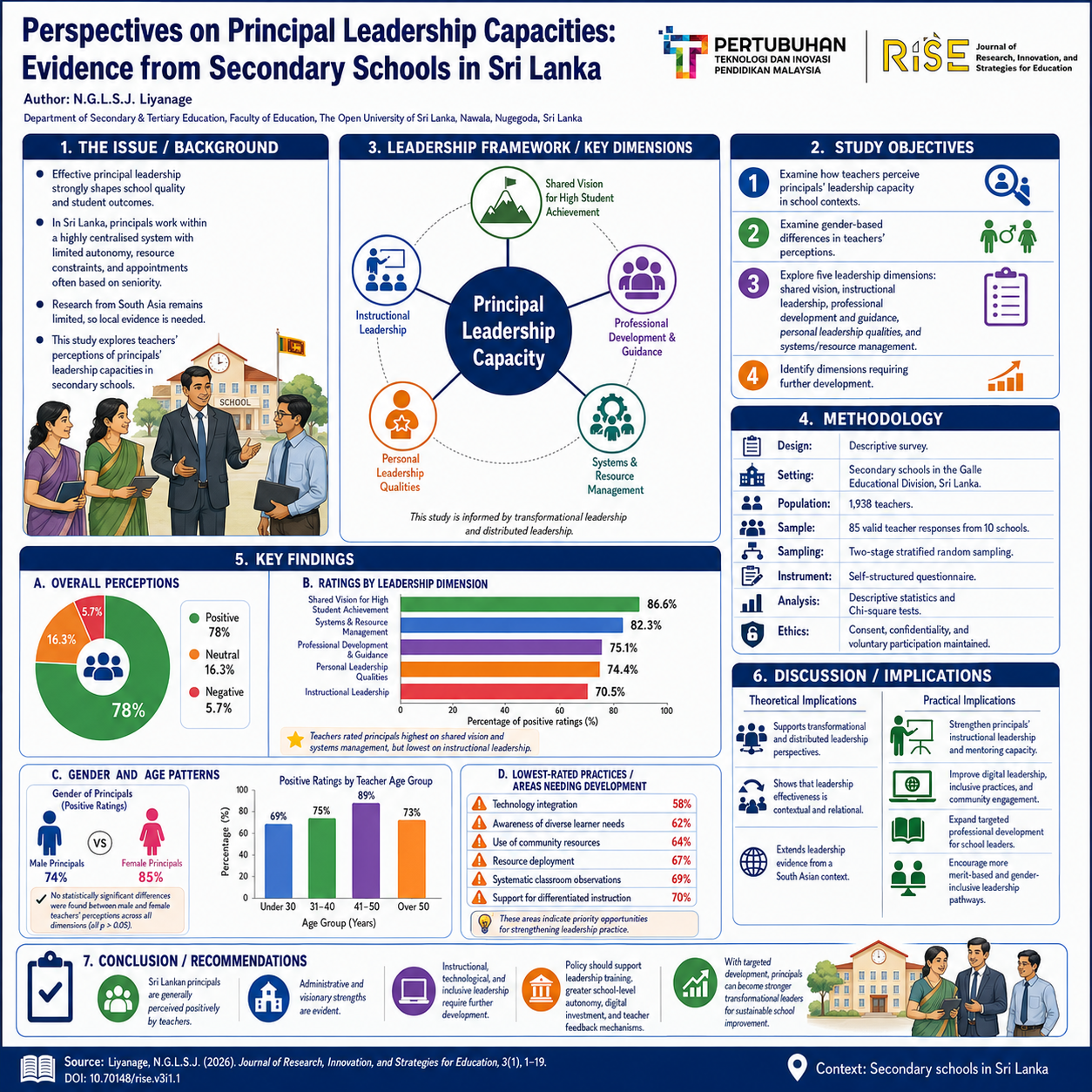
This study investigated teachers’ perceptions of principals’ leadership capacities in secondary schools within the Galle Educational Division, Sri Lanka. Grounded in transformational and distributed leadership theories, the research explored how teachers evaluated their principals’ competencies across five dimensions: shared vision for high student achievement, instructional leadership, staff professional development and guidance, personal leadership qualities, and systems and resource management. A descriptive survey design was employed, involving 85 teachers randomly selected from ten schools representing diverse contexts. Data were collected using a self-structured questionnaire and analyzed primarily through descriptive statistics and Chi-square tests to identify variations in perceptions across demographic factors such as gender and age. Findings revealed that teachers generally perceived principals positively in personal leadership qualities and shared vision, while comparatively lower ratings were observed in areas related to staff professional development and instructional leadership. Gender-based analysis indicated minor perceptual differences, with female teachers showing slightly higher levels of satisfaction with leadership practices. The study highlights the contextual and relational nature of effective school leadership within Sri Lanka’s centralized education system. It concludes that developing principals’ instructional and mentoring capacities through targeted professional development programs is critical for enhancing school effectiveness. The findings contribute empirical insights to the limited body of research on educational leadership in South Asian contexts and inform leadership training and policy reforms in Sri Lanka.
References
Altalib, H. (2013). Training guide for Islamic workers. International Institute of Islamic Thought (IIIT).
Arikewuyo, M. O., & Onanuga, P. A. (2005). Management of primary and secondary education in Nigeria. In N. A.
Nwagwu, E. T. Ehiametalor, M. A. Ogunu, & M. Nwadiani (Eds.), Current issues in educational management in Nigeria (pp. 3–16). Nigerian Association for Educational Administration and Planning (NAEAP).
Aturupane, H., & Little, A. W. (2020). General education in Sri Lanka. In P. Sarangapani & R. Pappu (Eds.), Handbook of education systems in South Asia (pp. 1–39). Springer. https://doi.org/10.1007/978-981-13-3309-5_18-1
Bandura, A. (1986). Social foundations of thought and action: A social cognitive theory. Prentice-Hall.
Banerjee, A. (2016). Educational leadership in India. In H. Arlestig, C. Day, & O. Johansson (Eds.), A decade of research on school principals (pp. 391–410). Springer. https://doi.org/10.1007/978-3-319-23027-6_16
Barnett, K. (2005). Organisational values and culture change [Unpublished doctoral dissertation]. Griffith University.
Bass, B. M. (1985). Leadership and performance beyond expectations. Free Press.
Bhindi, N. (2003, August 4–7). Ethical leadership as a practice: The creation of communities of hope through the construction of shared moral discourse [Conference presentation]. New Zealand Educational Administration Society (NZEAS) Conference, Auckland, New Zealand.
Blasé, J., & Blasé, J. (2009). Bringing out the best in teachers: What effective principals do (3rd ed.). Corwin Press.
Bogler, R. (2001). The influence of leadership style on teacher job satisfaction. Educational Administration Quarterly, 37(5), 662–683. https://doi.org/10.1177/00131610121969460
Bryk, A. S., & Schneider, B. L. (2002). Trust in schools: A core resource for improvement. Russell Sage Foundation.
Burns, J. M. (1978). Leadership. Harper & Row.
Bush, T., & Glover, D. (2016). School leadership and management in South Africa: Findings from a systematic literature review. International Journal of Educational Management, 30(2), 211–231. https://doi.org/10.1108/IJEM-07-2014-0101
Chan, T. C., Chin, J. M., & Hsu, L. L. (2008). Perceptions of technology leadership among elementary school principals in Taiwan. International Journal of Educational Reform, 17(3), 229–245.
Christie, K. (2009). Building leadership capacity for school improvement. Corwin Press.
Cohen, J. (1988). Statistical power analysis for the behavioral sciences (2nd ed.). Lawrence Erlbaum Associates.
Cohen, L., Manion, L., & Morrison, K. (2011). Research methods in education (7th ed.). Routledge.
Collard, J. (2001). Leadership and gender: An Australian perspective. Educational Management & Administration, 29(3), 343–355. https://doi.org/10.1177/02611X01029003006
Creswell, J. W. (2008). Educational research: Planning, conducting, and evaluating quantitative and qualitative research (3rd ed.). Pearson Education.
Daily FT. (2024, April 12). Direct challenge to Sri Lanka's educational leaders. Daily FT. https://www.ft.lk/columns/Direct-challenge-to-Sri-Lanka-s-educational-leaders/4-781646
Day, C., Gu, Q., & Sammons, P. (2016). The impact of leadership on student outcomes: How successful school leaders use transformational and instructional strategies to make a difference. Educational Administration Quarterly, 52(2), 221–258. https://doi.org/10.1177/0013161X15616863
Dissanayake, S. (1988). Educational administration in Sri Lanka. Department of Educational Administration, University of Colombo.
Eagly, A. H., Johannesen-Schmidt, M. C., & Van Engen, M. L. (2010). Transformational, transactional, and laissez-faire leadership styles: A meta-analysis comparing women and men. Psychological Bulletin, 129(4), 569–591. https://doi.org/10.1037/0033-2909.129.4.569
Eagly, A. H., & Karau, S. J. (2002). Role congruity theory of prejudice toward female leaders. Psychological Review, 109(3), 573–598. https://doi.org/10.1037/0033-295X.109.3.573
Eastman, J. (2013). Leadership capacity and individual and school achievement [Unpublished doctoral dissertation]. University of Minnesota.
Fischer, A. H. (2018). Gender and emotion: Social psychological perspectives. Cambridge University Press.
Fook, C. Y. (2009). The relationship between instructional leadership practices of principals and teachers' commitment in vocational and technical schools [Unpublished doctoral dissertation]. Universiti Sains Malaysia.
Friend, M., & Cook, L. (2009). Interactions: Collaboration skills for school professionals (6th ed.). Pearson.
Gall, M. D., Gall, J. P., & Borg, W. R. (2007). Educational research: An introduction (8th ed.). Pearson Education.
Glesne, C. (2006). Becoming qualitative researchers: An introduction (3rd ed.). Pearson Education.
Hallinger, P. (2011). Leadership for learning: Lessons from 40 years of empirical research. Journal of Educational Administration, 49(2), 125–142. https://doi.org/10.1108/09578231111116699
Hallinger, P. (2018). Bringing context out of the shadows of leadership. Educational Management Administration & Leadership, 46(1), 5–24. https://doi.org/10.1177/1741143216670652
Hallinger, P., & Chen, J. (2015). Review of research on educational leadership and management in Asia: A comparative analysis of research topics and methods, 1995–2012. Educational Management Administration & Leadership, 43(1), 5–27. https://doi.org/10.1177/1741143213513185
Hargreaves, A. (2000). Mixed emotions: Teachers' perceptions of their interactions with students. Teaching and Teacher Education, 16(8), 811–826. https://doi.org/10.1016/S0742-051X(00)00028-7
Harris, A. (2013). Distributed leadership: Friend or foe? Educational Management Administration & Leadership, 41(5), 545–554. https://doi.org/10.1177/1741143213497635
Hettige, S. T. (1996). Higher education in Sri Lanka: Issues and challenges. University of Colombo.
Hite, L. M., Williams, E. J., Hilton, A. A., & Baugh, S. C. (2006). Multiple metaphors for the glass ceiling: A comparison of women and men in the executive suite. Journal of Career Development, 32(4), 334–349. https://doi.org/10.1177/0894845305283567
Hoerr, T. R. (2005). The art of school leadership. Association for Supervision and Curriculum Development (ASCD).
Hofstede, G. (2001). Culture's consequences: Comparing values, behaviors, institutions and organizations across nations (2nd ed.). SAGE Publications.
Hulpia, H., Devos, G., & Rosseel, Y. (2009). The relationship between the perception of distributed leadership in secondary schools and teachers' and teacher leaders' job satisfaction and organizational commitment. School Effectiveness and School Improvement, 20(3), 291–317. https://doi.org/10.1080/09243450902909840
IIEP-UNESCO. (2025, July 21). 120 education officials in Sri Lanka improve skills for planning education. International Institute for Educational Planning. https://www.iiep.unesco.org/en/articles/120-education-officials-sri-lanka-improve-skills-planning-education
Jayasuriya, L., & Semasinghe, D. M. (2015). Leadership challenges faced by school principals in Sri Lanka. International Journal of Educational Development, 45, 152–158. https://doi.org/10.1016/j.ijedudev.2015.09.010
Johns, D. (2011). School leadership effectiveness in Sri Lanka. Department of Education, University of Kelaniya.
Johnson, S. M. (1998). Who moved my cheese? An amazing way to deal with change in your work and in your life. G. P. Putnam's Sons.
Judge, T. A., Piccolo, R. F., & Ilies, R. (2004). The forgotten ones? The validity of consideration and initiating structure in leadership research. Journal of Applied Psychology, 89(1), 36–51. https://doi.org/10.1037/0021-9010.89.1.36
Keiser, N. J., & Shen, J. (2000). Principals' and teachers' perceptions of teacher empowerment. Educational Research Quarterly, 24(2), 37–46.
Khan, A., Saeed, I., & Fatima, K. (2009). Principals' leadership styles and teachers' job satisfaction: A study in selected schools of Rawalpindi city. Pakistan Journal of Commerce and Social Sciences, 2, 45–55.
Kılınç, A. Ç., Özdemir, N., & Recepoğlu, E. (2024). Investigating the relationship between leadership for learning and student achievement through the mediation of teacher performance: A meta-analytic structural equation modeling (MASEM) approach. Education Sciences, 14(12), 1320. https://doi.org/10.3390/educsci14121320
King, M. B. (2002). Professional development to promote schoolwide inquiry. Teaching and Teacher Education, 18(3), 243–257. https://doi.org/10.1016/S0742-051X(01)00067-8
Knowles, M. S. (1984). Andragogy in action: Applying modern principles of adult learning. Jossey-Bass.
Koford, C. (2008). Instructional leadership, student achievement, and the role of the elementary school principal [Unpublished doctoral dissertation]. University of Iowa.
Kuku, V., & Taylor, R. T. (2002). Factors related to instructional leadership: A study of Alabama high school principals. Planning and Changing, 33(3/4), 139–158.
Lafferty, N., O'Sullivan, K., Halvorsen, A., & White, T. (2024). An applied approach to transformational leadership for whole school communities: Perspectives of primary school and system leaders. Societies, 14(12), 275. https://doi.org/10.3390/soc14120275
Lambert, L. (1998). Building leadership capacity in schools. Association for Supervision and Curriculum Development (ASCD).
Lazaridou, A. (2006). Leadership theories and practice: Towards a new paradigm [Conference presentation]. Educational Administration Conference, Nicosia, Cyprus.
Leech, D., Smith, A., & Green, K. (2005). Principal leadership and teacher morale. American Association of School Administrators.
Leithwood, K. (2004). How leadership influences student learning. Center for Applied Research and Educational Improvement, University of Minnesota.
Leithwood, K., Harris, A., & Hopkins, D. (2008). Seven strong claims about successful school leadership. School Leadership and Management, 28(1), 27–42. https://doi.org/10.1080/13632430701800060
Leithwood, K., & Jantzi, D. (2006). Transformational school leadership for large-scale reform: Effects on students, teachers, and their classroom practices. School Effectiveness and School Improvement, 17(2), 201–227. https://doi.org/10.1080/09243450600565829
Luo, M., & Najjar, L. (2007). The Chinese principal leadership capacities as perceived by master teachers. Education, 128(1), 85–96.
Ma, X., Shen, J., Reeves, P. L., Wu, H., Roberts, L., Zheng, Y., & Chen, Q. (2024). Effects of the "High Impact Leadership for School Renewal" project on principal leadership, school leadership, and student achievement. Education Sciences, 14(6), 600. https://doi.org/10.3390/educsci14060600
Mailu, S. N. (2024). Distributed leadership in educational contexts: A catalyst for school improvement. Discover Education, 3(1), 33. https://doi.org/10.1007/s44217-024-00149-x
Mangin, M. M. (2007). Facilitating elementary principals' support for instructional teacher leadership. Educational Administration Quarterly, 43(3), 319–357. https://doi.org/10.1177/0013161X07299438
Marshall, C. (2006). Designing qualitative research (4th ed.). SAGE Publications.
Mayer, M. J., & Cornell, D. (2010). The prevalence and predictors of peer victimization in schools. Journal of School Violence, 9(1), 8–27. https://doi.org/10.1080/15388220903185084
Mazibuko, E. Z. (2003). The role of the school principal in the implementation of outcomes-based education in KwaZulu-Natal [Unpublished doctoral dissertation]. University of South Africa.
McEwan, E. K. (2003). 7 steps to effective instructional leadership (2nd ed.). Corwin Press.
Menon, M. E., & Saitis, C. (2006). Satisfaction of teachers in primary schools. International Journal of Educational Management, 20(2), 104–121. https://doi.org/10.1108/09513540610646119
Ministry of Education. (2016). School census report 2016. Ministry of Education, Sri Lanka.
Ministry of Education. (2020). School census report 2020. Ministry of Education, Sri Lanka.
Ministry of Education, Youth and Sport. (2004). National curriculum framework. Ministry of Education, Youth and Sport.
Mohan, K. P. (2014). School leadership in the 21st century. Atlantic Publishers & Distributors.
Moorosi, P. (2010). South African female principals' career paths: Understanding the gender gap in secondary school management. Educational Management Administration & Leadership, 38(5), 547–562. https://doi.org/10.1177/1741143210373741
Morefields, J. D. (2009). The relationship between teacher self-efficacy and the instructional leadership of principals [Unpublished doctoral dissertation]. University of Southern Mississippi.
Moreno, B. (2023). Teachers' perceptions toward their new principal. School Leadership & Management, 44(3), 207–227. https://doi.org/10.1080/13632434.2023.2277174
Mulford, B. (2003). School leaders: Changing roles and impact on teacher and school effectiveness. OECD Education Working Papers. https://doi.org/10.1787/232671484357
New Education Act for General Education in Sri Lanka. (2009). General education regulations. Parliament of Sri Lanka.
Ng, T. W. H., & Feldman, D. C. (2010). The relationships of age with job attitudes: A meta-analysis. Personnel Psychology, 63(3), 677–718. https://doi.org/10.1111/j.1744-6570.2010.01184.x
Nowlan, J. (2001). The principal as school leader: A review of the literature. Ontario Institute for Studies in Education.
Nunnally, J. C., & Bernstein, I. H. (1994). Psychometric theory (3rd ed.). McGraw-Hill.
Oluremi, O. F. (2008). Motivational factors and teachers' job performance in secondary schools in Southwestern Nigeria [Unpublished doctoral dissertation]. Obafemi Awolowo University.
Oplatka, I. (2004). The principalship in developing countries: Context, characteristics and reality. Comparative Education, 40(3), 427–448. https://doi.org/10.1080/0305006042000274872
O'Sullivan, K., & Lafferty, N. (2024). The impact of transformational school leadership on school staff and school culture in primary schools: A systematic review of international literature. Societies, 13(6), 133. https://doi.org/10.3390/soc13060133
Parkinson, J. (2008). Teacher perceptions of principal leadership style and student achievement [Unpublished doctoral dissertation]. Walden University.
Pashmforoosh, R., Irby, B. J., Lara-Alecio, R., & Tong, F. (2023). Building school leaders' instructional leadership capacity through virtual professional leadership learning communities. Frontiers in Education, 8, 1168734. https://doi.org/10.3389/feduc.2023.1168734
Peiris, G. I., & Smith, A. B. (2008). Gender differences in leadership approaches of principals in Sri Lankan schools. International Journal of Educational Management, 22(5), 446–463. https://doi.org/10.1108/09513540810883168
Petzko, V. N. (2008). The perceptions of new principals regarding the knowledge and skills important to their initial success. NASSP Bulletin, 92(3), 224–250. https://doi.org/10.1177/0192636508322824
Pietsch, M., Aydin, B., & Gümüş, S. (2023). Putting the instructional leadership–student achievement relation in context: A meta-analytical big data study across cultures and time. Educational Evaluation and Policy Analysis, 45(4), 659–682. https://doi.org/10.3102/01623737231197434
Pounder, D. G. (1999). Teacher teams: Exploring job characteristics and work-related outcomes of work group enhancement. Educational Administration Quarterly, 35(3), 317–348. https://doi.org/10.1177/0013161X99353002
Price, H. E., & Olsen, R. V. (2023). Teachers' and principals' perceptions of school climate: The role of principals' leadership style in organizational quality. Educational Assessment, Evaluation and Accountability, 35(3), 389–416. https://doi.org/10.1007/s11092-023-09413-6
Robinson, V. M. J., Lloyd, C. A., & Rowe, K. J. (2008). The impact of leadership on student outcomes: An analysis of the differential effects of leadership types. Educational Administration Quarterly, 44(5), 635–674. https://doi.org/10.1177/0013161X08321509
Scallon, A. M., Bristol, T. J., & Esboldt, J. (2023). Teachers' perceptions of principal leadership practices that influence teacher turnover. Journal of School Leadership, 33(2), 153–176. https://doi.org/10.1177/19427751211034214
Shen, J., & Wu, H. (2024). The relationship between principal leadership and student achievement: A multivariate meta-analysis with an emphasis on conceptual models and methodological approaches. Educational Administration Quarterly. Advance online publication. https://doi.org/10.1177/0013161X241286527
Shoraku, A. (2006). Gender and leadership in basic education in Cambodia. In L. Davies (Ed.), Education and conflict: Complexity and chaos (pp. 129–142). Routledge.
Smith, W. F., & Andrews, R. L. (1988). Instructional leadership: How principals make a difference. Association for Supervision and Curriculum Development.
Spillane, J. P. (2006). Distributed leadership. Jossey-Bass.
Stogdill, R. M. (1950). Leadership, membership and organization. Psychological Bulletin, 47(1), 1–14. https://doi.org/10.1037/h0053857
Tan, C. Y., Dimmock, C., & Walker, A. (2024). How school leadership practices relate to student outcomes: Insights from a three-level meta-analysis. Educational Management Administration & Leadership, 52(2), 314–338. https://doi.org/10.1177/17411432211061445
Tannenbaum, A. S. (1961). Control and effectiveness in a voluntary organization. American Journal of Sociology, 67(1), 33–46. https://doi.org/10.1086/223009
Taylor, S. J. (1998). Introduction to qualitative research methods: A guidebook and resource (3rd ed.). John Wiley & Sons.
Tosh, K., & Doss, C. J. (2020). Perceptions of school leadership: Implications for principal effectiveness. RAND Corporation, RR-2575/5-1-BMGF. https://www.rand.org/pubs/research_reports/RR2575z5-1.html
Tran, H., Dou, J., Ylimaki, R., & Brunderman, L. A. (2022). How do distributed and transformational leadership teams improve working conditions and student learning in underperforming high-needs schools? European Journal of Educational Management, 5(1), 1–14. https://doi.org/10.12973/eujem.5.1.1
Tschannen-Moran, M. (2014). Trust matters: Leadership for successful schools (2nd ed.). Jossey-Bass.
Tschannen-Moran, M., & Hoy, W. K. (1998). Trust in schools: A conceptual and empirical analysis. Journal of Educational Administration, 36(4), 334–352. https://doi.org/10.1108/09578239810211518
Uhl-Bien, M. (2006). Relational leadership theory: Exploring the social processes of leadership and organizing. The Leadership Quarterly, 17(6), 654–676. https://doi.org/10.1016/j.leaqua.2006.10.007
Van Houtte, M. (2006). Tracking and teacher satisfaction: Role of study culture and trust. Journal of Educational Research, 99(4), 247–254. https://doi.org/10.3200/JOER.99.4.247-254
Van Velsor, P., & Orozco, G. L. (2006). Involving low-income parents in the schools: Community-centric strategies for school counselors. Professional School Counseling, 11(1), 17–24. https://doi.org/10.5330/PSC.n.2010-11.17
Vroom, V. H. (1964). Work and motivation. Wiley.
Walker, A., & Dimmock, C. (2002). Moving school leadership beyond its narrow boundaries: Developing a cross-cultural approach. In K. Leithwood & P. Hallinger (Eds.), Second international handbook of educational leadership and administration (pp. 167–204). Kluwer Academic Publishers. https://doi.org/10.1007/978-94-010-0375-9_7
Walker, A., & Dimmock, C. (2006). Preparing leaders, preparing learners: The Hong Kong experience. School Leadership and Management, 26(2), 125–147. https://doi.org/10.1080/13632430600587745
Wise, L. R., & Tschirhart, M. (2000). Examining empirical evidence on diversity effects: How useful is diversity research for public sector managers? Public Administration Review, 60(5), 386–394. https://doi.org/10.1111/0033-3352.00102
Women Leading Ed. (2024). Illuminating bias in education leadership: 2024 Insight Survey findings. https://www.womenleadinged.org/illuminating-bias-in-education-leadership
Yin, R. K. (1994). Case study research: Design and methods (2nd ed.). SAGE Publications.
Youngs, P., & King, M. B. (2002). Principal leadership for professional development to build school capacity. Educational Administration Quarterly, 38(5), 643–670. https://doi.org/10.1177/0013161X02239642
Zimmerman, J. A., & Deckert-Pelton, M. (2003). Evaluating the evaluators: Teachers' perceptions of the principal's role in professional evaluation. NASSP Bulletin, 87(636), 28–37. https://doi.org/10.1177/019263650308763603
Downloads
Published
Issue
Section
License
Copyright (c) 2025 Sithara Jayamali Liyanage Nanayakkara Godewasam Liyanage (Author)

This work is licensed under a Creative Commons Attribution 4.0 International License.