Who Are We as Teachers? A Sequential Study of Structuring Teacher Professional Identity among Malaysian Educators
DOI:
https://doi.org/10.70148/rise.v3i1.5Keywords:
Teacher Professional Identity; Fuzzy Delphi Method; Pedagogical Beliefs; Emotional Commitment; Student EmpowermentAbstract
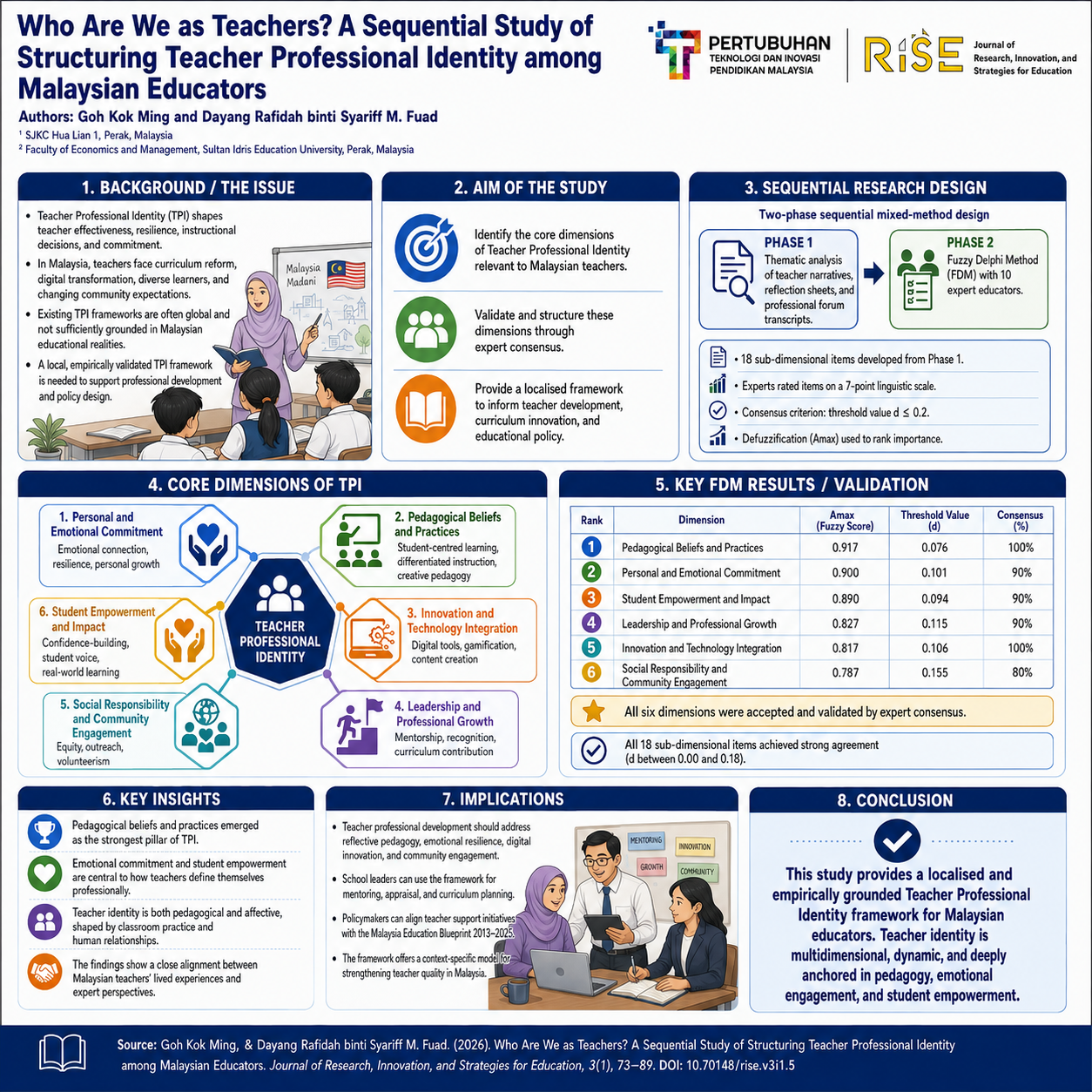
This study explores and empirically validates the key dimensions shaping Teacher Professional Identity (TPI) among Malaysian teachers through a two‑phase sequential, mixed‑method design. In the first phase, thematic analysis of teacher narratives and reflective accounts identified six interrelated dimensions, namely (i) Personal and Emotional Commitment, (ii) Pedagogical Beliefs and Practices, (iii) Innovation and Technology Integration, (iv) Leadership and Professional Growth, (v) Social Responsibility and Community Engagement, and (vi) Student Empowerment and Impact. In the second phase, the Fuzzy Delphi Method (FDM) was employed with ten expert educators to verify the relevance and consensus of these dimensions. All six dimensions achieved strong expert agreement (d ≤ 0.2), with Pedagogical Beliefs and Practices, Personal and Emotional Commitment, and Student Empowerment and Impact emerging as the most central elements of Teacher Professional Identity. The results reveal that Malaysian teachers’ professional identity is deeply anchored in pedagogical values, emotional engagement, and the transformative empowerment of learners. The validated Teacher Professional Identity framework provides a localized and empirically grounded model that integrates both cognitive‑pedagogical and affective dimensions of teaching. The study contributes to the theoretical enrichment of teacher identity research and offers practical guidance for policy design, teacher professional development, and curriculum innovation aligned with Malaysia’s educational goals.
References
Abendaño, M. D. O. (2024). Patterns of relationships between college teachers’ leadership competence and work engagement in selected private higher education institutions in davao region: the mediating impact of school as professional learning community. European Journal of Theoretical and Applied Sciences, 2(1), 660-672. https://doi.org/10.59324/ejtas.2024.2(1).57
Alnahdi, G. H., & Alwadei, A. (2023). Validation of the arabic version of the transition planning inventory (tpi-ar). International Journal of Environmental Research and Public Health, 20(2), 1135. https://doi.org/10.3390/ijerph20021135
Amoli, F. A., & Youran, M. (2014). Delving the relationship between teacher empowerment and job satisfaction among iranian efl teachers in tehran aviation university. Theory and Practice in Language Studies, 4(4). https://doi.org/10.4304/tpls.4.4.771-777
Beauchamp, C., & Thomas, L. (2009). Understanding teacher identity: An overview of issues in the literature and implications for teacher education. Cambridge Journal of Education, 39(2), 175–189. https://doi.org/10.1080/03057640902902252
Beijaard, D., Meijer, P. C., & Verloop, N. (2004). Reconsidering research on teachers’ professional identity. Teaching and Teacher Education, 20(2), 107–128. https://doi.org/10.1016/j.tate.2003.07.001
Cece, V., Martinent, G., Guillet‐Descas, E., & Lentillon‐Kaestner, V. (2022). The predictive role of perceived support from principals and professional identity on teachers’ motivation and well-being: a longitudinal study. International Journal of Environmental Research and Public Health, 19(11), 6674. https://doi.org/10.3390/ijerph19116674
Choy, S. C., Yim, J. S., & Sedhu, D. S. (2019). Pre-service teachers' reflection on reflective practices: a malaysian perspective. Universal Journal of Educational Research, 7(12A), 18-26. https://doi.org/10.13189/ujer.2019.071903
Deci, E. L., & Ryan, R. M. (2000). The “what” and “why” of goal pursuits: Human needs and the self‑determination of behavior. Psychological Inquiry, 11(4), 227‑268. https://doi.org/10.1207/S15327965PLI1104_01
Dweck, C. S. (2006). Mindset: The New Psychology of Success. Random House.
En, W. C. (2023). Research on the relationship between principal’s transformational leadership, teachers’ empowerment, and teachers’ well-being. Iris Journal of Educational Research, 1(1). https://doi.org/10.33552/ijer.2023.01.000503
Gengatharan, K., Beram, S., Noor, N., & Yuet, F. K. C. (2023). The fuzzy delphi techniques in the design and development of health education assessment module constructs for the implementation of classroom based assessment. International Journal of Academic Research in Business and Social Sciences, 13(3). https://doi.org/10.6007/ijarbss/v13-i3/16769
Gracia, E. P., Rodriǵuez, R. S., Pedrajas, A. P., & Carpio, A. J. (2021). Teachers’ professional identity: validation of an assessment instrument for preservice teachers. Heliyon, 7(9), e08049. https://doi.org/10.1016/j.heliyon.2021.e08049
Hargreaves, A. (2001). Emotional geographies of teaching. Teachers College Record, 103(6), 1056–1080. https://doi.org/10.1111/0161-4681.00142
Karaolis, A., & Philippou, G. (2019). Teachers’ professional identity. ICME-13 Monographs, 397-417. https://doi.org/10.1007/978-3-030-13761-8_18
Kayi‐Aydar, H., & Green‐Eneix, C. (2019). Shared identities through translanguaging practices in the multilingual mariachi classroom. TESOL Journal, 10(4). https://doi.org/10.1002/tesj.502
Lee, D. H. L., & Ip, N. K. K. (2021). The influence of professional learning communities on informal teacher leadership in a chinese hierarchical school context. Educational Management Administration & Leadership, 51(2), 324-344. https://doi.org/10.1177/1741143220985159
Li, X., Xiao, W., Sun, C., Li, W., & Sun, B. (2022). Does burnout decrease with teacher professional identity among teachers in china?. Journal of Career Development, 50(5), 983-996. https://doi.org/10.1177/08948453221138937
Mahoney, J. L., Weissberg, R. P., Greenberg, M. T., Dusenbury, L., Jagers, R. J., Niemi, K., & Yoder, N. (2021). Systemic social and emotional learning: promoting educational success for all preschool to high school students. American Psychologist, 76(7), 1128-1142. https://doi.org/10.1037/amp0000701
Malaysian Ministry of Education. (2013). Malaysia Education Blueprint 2013-2025. Putrajaya.
Mooman, A. F., & Sadruddin, M. M. (2023). Unveiling teacher's professional identity- a case study of teachers in karachi, pakistan. Journal of Education & Social Sciences, 11(1), 77-89. https://doi.org/10.20547/jess1112311105
Namaziandost, E., Heydarnejad, T., Rezai, A., & Javanmard, K. (2024). A voyage of discovering the impacts of teacher immunity and emotion regulation on professional identity, autonomy, and work motivation in iranian efl landscape. BMC Psychology, 12(1). https://doi.org/10.1186/s40359-024-01544-9
Ohle-Peters, A., McElvany, N., & Ullrich, M. (2023). Students’ text-picture-integration: the role of teacher competence and instructional quality. International Journal of Educational Psychology, 12(3), 251–268. https://doi.org/10.17583/ijep.11558
Othman, J., & Aljuhaish, S.F. (2021). Factors influencing non-native efl teachers' identity construction at a saudi school in kuala lumpur, malaysia. Arab World English Journal, 12(3), 524-535. https://dx.doi.org/10.24093/awej/vol12no3.35
Prasetyowati, S., Isnanto, I., & R, A. P. (2023). Improving oral hygiene maintenance through teacher empowerment to reduce the debris index of children with disabilities. International Journal of Advanced Health Science and Technology, 3(1). https://doi.org/10.35882/ijahst.v3i1.211
Rachmajanti, S., Sulistyo, G. H., Megawati, F., & Akbar, A. A. N. M. (2021). Professional identity construction of efl teachers as autonomous learners. JEES (Journal of English Educators Society), 6(2), 309-315. https://doi.org/10.21070/jees.v6i2.1646
Richards, J. C. (2021). Teacher, learner and student-teacher identity in tesol. RELC Journal, 54(1), 252-266. https://doi.org/10.1177/0033688221991308
Saddington, M. M., & Bacasmot, J. B. (2024). Model of role identity and behavioral creativity style as predictors of empowerment of assistant language teachers in japan. Journal of Natural Language and Linguistics, 2(1), 190-203. https://doi.org/10.54536/jnll.v2i1.3796
Sani, S. F. K., Motallebzadeh, K., Khodabakhshzadeh, H., & Zeraatpisheh, M. (2022). On the iranian english as foreign language novice and experienced teachers’ attributional styles and professional identity. Frontiers in Psychology, 12. https://doi.org/10.3389/fpsyg.2021.823815
Shalev, M., & Gidalevich, S. (2024). Social emotional learning in teacher education: biographical narrative as a method for professional development. Education Sciences, 14(8), 821. https://doi.org/10.3390/educsci14080821
Solihatun, S., Daming, H. M., & Hermansyah, S. (2025). Empowering educators: the mediating role of self-efficacy in reflective practice and teacher identity development. Eduscape : Journal of Education Insight, 3(4), 249-259. https://doi.org/10.61978/eduscape.v3i4.1110
Yan, Y. (2024). Investigating chinese university efl teachers' professional identity and socio-demographic factors. International Journal of Teacher Education and Professional Development, 6(1), 1-16. https://doi.org/10.4018/ijtepd.335906
Yang Xiao Ci, & Janaka Low. (2023). Effects of Cultural Dimensions on Teacher Identity: A Systematic Review. International Journal of Sciences: Basic and Applied Research (IJSBAR), 72(1), 43-52. https://gssrr.org/JournalOfBasicAndApplied/article/view/16335
Wong, C. Y. E., & Liu, W. C. (2022). Evaluating the teacher professional identity of student teachers: development and validation of the teacher professional identity scale. Journal of Education, 204(1), 131-144. https://doi.org/10.1177/00220574221101375
Voss, T., & Kunter, M. (2019). “reality shock” of beginning teachers? changes in teacher candidates’ emotional exhaustion and constructivist-oriented beliefs. Journal of Teacher Education, 71(3), 292-306. https://doi.org/10.1177/0022487119839700
Ulla, M. B., Perales, W. F., & Tarrayo, V. N. (2024). ‘becoming and being online efl teachers’: teachers' professional identity in online pedagogy. Heliyon, 10(17), e37131. https://doi.org/10.1016/j.heliyon.2024.e37131
Zulkifli, H., Rashid, S. M. M., Mohamed, S., Toran, H., Raus, N. M., Pisol, M. I. M., & Suratman, M. N. (2022). Designing the content of religious education learning in creating sustainability among children with learning disabilities: a fuzzy delphi analysis. Frontiers in Psychology, 13. https://doi.org/10.3389/fpsyg.2022.1036806
Downloads
Published
Issue
Section
License
Copyright (c) 2025 Kok Ming Goh, Dayang Rafidah Syariff M. Fuad (Author)

This work is licensed under a Creative Commons Attribution 4.0 International License.