The Mediating Role of Technological Acceptance in the Relationship between AI Education Platforms and Students’ Learning Outcomes
DOI:
https://doi.org/10.70148/rise.v3i1.4Keywords:
Technological Acceptance, AI Education Platforms, Learning Outcomes, Private Schools, KarachiAbstract
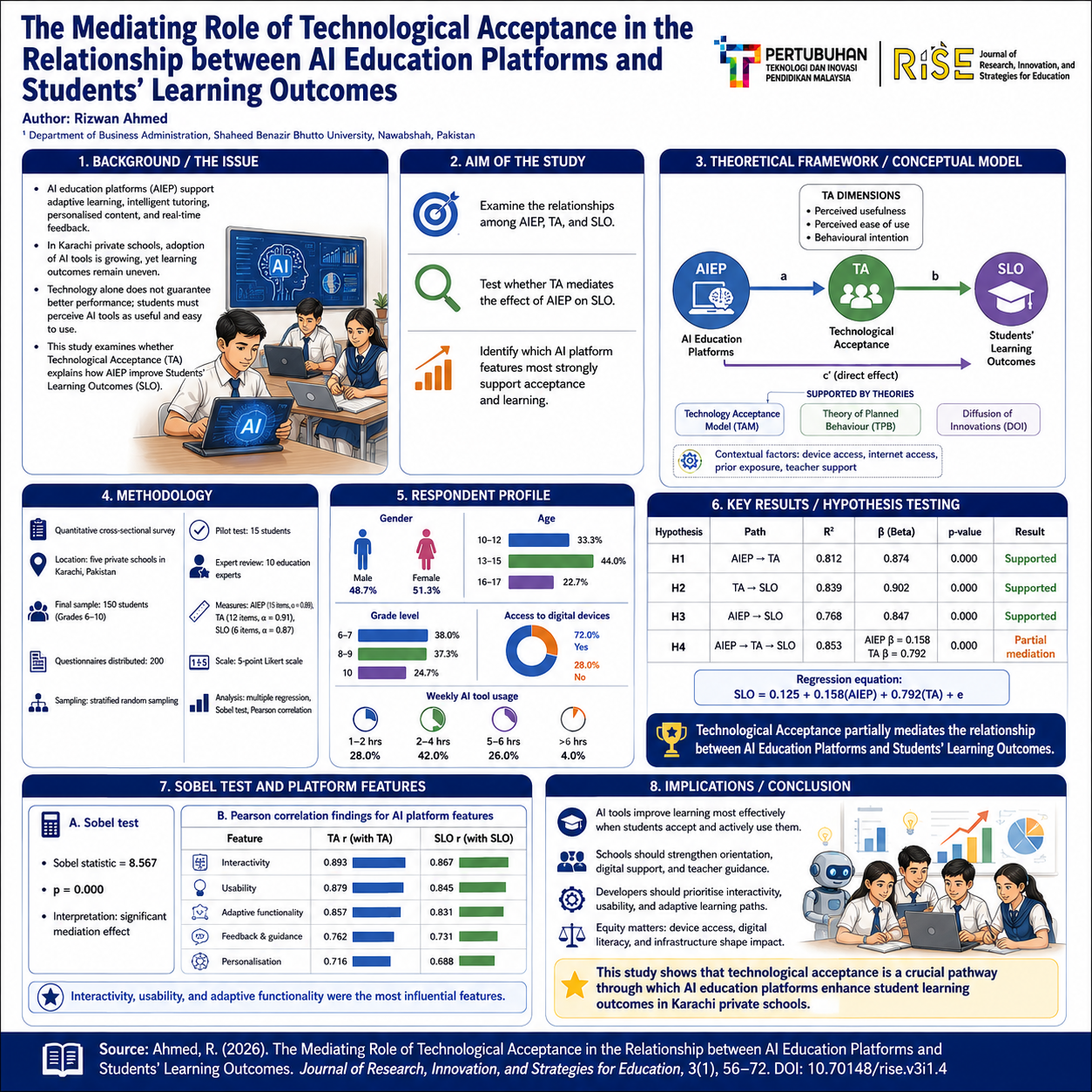
This paper is aimed to examine the interrelationship between AI education platforms (AIEP), technological acceptance (TA), and learning outcomes (SLO) of students in the context of Karachi-based private schools in Pakistan. The framework was constructed using the Theory of Planned Behaviour which was used to measure TA. Data was collected in the questionnaire survey format concerned the perceptions of students and teachers on the use of AIEP in their schools. Multiple regression analysis and Sobel test analysis of 150 respondents revealed that TA is the mediating variable between AIEP and SLO. That is, where AIEP positively affect TA, which in turn positively affect SLO, the effect of mediation can be observed. The additional analysis also found out that the two dimensions of TA, perceived usefulness and ease of use were the most significant when it comes to the determination of student engagement and academic success. The conclusion that provides the schooling sector with a refinement of the variables that can contribute to the greater adoption of AI tools by the students. This help schools enhance the quality of education, innovation, and the general learning performance
References
Altememy, H. A., Mohammed, B. A., Hsony, M. K., Hassan, A. Y., Mazhair, R., Dawood, I. I., ... & Sharif, H. R. (2023). The influence of the artificial intelligence capabilities of higher education institutions in Iraq on students' academic performance: The role of AI-based technology application as a mediator. Eurasian Journal of Educational Research, 104(104), 267-282.
Alfiras, M., Nagi, M., Bojiah, J., & Sherwani, M. (2021). Students’ perceptions of hybrid classes in the context of Gulf University: An analytical study. Journal of Hunan University Natural Sciences, 48(5).
Ajzen, I. (1991). The theory of planned behavior. Organizational behavior and human decision processes, 50(2), 179-211.
Aldraiweesh, A. A., & Alturki, U. (2025). The Influence of Social Support Theory on AI Acceptance: Examining Educational Support and Perceived Usefulness using SEM analysis. IEEE Access.
Alghizzawi, M., Hussain, Z., Abualfalayeh, G., Abu-AlSondos, I. A., Alqsass, M., & Chehaimi, E. M. (2025). The impact of AI-driven strategy on salespeople training and performance. International Review of Management and Marketing, 15(2), 1.
Aldabousi, A. M., Awad, A., Hassan, H. E. M., Abdullah, S. S., & Ghonim, A. (2025). Arbitration in Islamic banking: Exploring legal and practical implications for dispute resolution. Banks and Bank Systems, 20(2), 15.
Awad, A. (2025). The role of universities' social responsibility in enhancing business sustainability: Mediating role of entrepreneurial culture. Problems and Perspectives in Management, 23(1), 181.
Alkadash, T. M., Nagi, M., Ateeq, A. A., Alzoraiki, M., Alkadash, R. M., Nadam, C., ... & Dawwas, M. (2023). The effects of leadership style on employee sustainable behaviour: a theoretical perspective. In Artificial Intelligence and Transforming Digital Marketing (pp. 205-213). Cham: Springer Nature Switzerland.
Awad, A., Aziz, A. F., & Shma, T. R. (2025). Investment behavior in the Egyptian stock market: The impact of social media on investor decision-making. Investment Management & Financial Innovations, 22(1), 203.
Awad, A., Aldabousi, A. M., & Albatal, S. (2025). The influence of social media marketing on customer knowledge management: The role of confidentiality in UAE public banks. Banks and Bank Systems, 20(1), 1.
Almeer, S., Almaamari, Q., Ateeq, A., & Nagi, M. (2024). The impact of psychological empowerment on job creativity a study applied to employees of the ministry of works, municipalities affairs and Urban Planning in the Kingdom of Bahrain. In Business Sustainability with Artificial Intelligence (AI): Challenges and Opportunities: Volume 2 (pp. 517-529). Cham: Springer Nature Switzerland.
Aldabousi, A. M. (2024). The Joint Responsibility of the Air Carrier Established in accordance with International Conventions on the Status of Air Terrorism. Pakistan Journal of Criminology, 16(2), 135.
Awad, A., & Aldabousi, A. M. (2024). Analyzing the impact of viral marketing on brand equity dimensions in Egypt’s home appliances sector: A customer and legal perspective. Innovative Marketing, 20(4), 100.
Al-Fahim, N. H., Ateeq, A. A., Abro, Z., Milhem, M., Alzoraiki, M., Alkadash, T. M., & Nagi, M. (2024). Factors influencing the mobile banking usage: mediating role of perceived usefulness. In Digital technology and changing roles in managerial and financial accounting: theoretical knowledge and practical application (Vol. 36, pp. 115-128). Emerald Publishing Limited.
Awad, A. (2025). Augmented Reality as a Tool for Customer Engagement: Impact on Brand Perception in Retail. TEM Journal, 14(3), 2111-2123.
Aldabousi, A. M. (2022). Legal Problems of Electronic Pollution According to UAE and Egyptian Law. The Arab World Geographer, 25(2-3), 154-168.
Awad, A. (2024). Artificial intelligence and marketing innovation: The mediating role of organizational culture. Innovative Marketing, 20(3), 170.
Aldabousi, A. M. (2023). The Artificial Intelligence as an Inventor Legal Study. Russian Law Journal, 11(3S), 105-111.
Abdulrahim, H. M., Ateeq, A., Al-Khalifa, F. A., Al-Aghbas, N., Jo, S., Nagi, M., & Alastal, A. (2024). Qualitative investigation of green building rating system development in Bahrain’s affordable housing industry. In The AI Revolution: Driving Business Innovation and Research: Volume 1 (pp. 543-549). Cham: Springer Nature Switzerland.
Aldabousi, A. M. (2025). Managing commercial space activities: Legal and regulatory challenges in the UAE's space sector. Problems and Perspectives in Management, 23(2), 423.
Awad, A., & Ghonim, A. (2025). Data-Driven Marketing in Banks: The Role of Artificial Intelligence in Enhancing Marketing Efficiency and Business Performance. International Review of Management and Marketing, 15(5), 422.
Aldabousi, A. M. (2022). Legal problems of conclusion of intelligent software agent for smart commercial contracts in the era of Blockchain UAE as model. Universidad y Sociedad, 14(S3), 713-728.
Awad, A. (2025). The Role of Artificial Intelligence in Data-Driven Marketing: Enhancing Marketing Efficiency, Customer Engagement, and Business Performance in SMEs. Journal of Economics and Administrative Sciences, 31(149), 22-36.
Al-Sherman, N., & Aldabousi, A. M. (2024). The Complementary Penalties Enforced to Combat Corporate Crimes in UAE Law. Pakistan Journal of Criminology, 16(3).
Awad, A., Kordy, A., Hassan, A., & Aal, H. A. (2025). The role of blockchain technology in advancing supply chain innovation: A descriptive-analytical study.
Awad, A., Shemais, M., & Al-Embabi, M. (2024). Driving HR performance through digital transformation in educational directorates: A strategic imperative. Problems and Perspectives in Management, 22(4), 163.
Awad, A. (2025). The role of digital marketing tools in promoting tourism: An applied study on online marketing strategies. Innovative Marketing.
Aldabousi, A. M. (2023). The legal problems facing the conclusion of cloud computing contracts. University and Society , 15 (3), 602-611.
Awad, A., Al‐fil, N. Z., Dganni, K. M., Aldabousi, A. M., & Obeidat, M. A. (2024). Optimizing dormant account management in UAE banking: Legal gaps and proposed reforms. Banks and Bank Systems, 19 (4), 124.
Awad, A., Akola, O., Amer, M., & Mousa, E. K. A. (2025). Artificial intelligence in financial statement preparation: Enhancing accuracy, compliance, and corporate performance. Int. J. Innov. Res. Sci. Stud, 8, 361-374.
Chou, C. M., Shen, T. C., Shen, T. C., & Shen, C. H. (2022). Influencing factors on students’ learning effectiveness of AI-based technology application: Mediation variable of the human-computer interaction experience. Education and Information Technologies, 27(6), 8723-8750.
Davis, F. D. (1989). Perceived usefulness, perceived ease of use, and user acceptance of information technology. MIS quarterly, 319-340.
Fathallah, A. I., & Nagi, M. (2024). Retaining Talented Employees to Enhance Business and Management—A Case Study. In Business Sustainability with Artificial Intelligence (AI): Challenges and Opportunities: Volume 2 (pp. 601-608). Cham: Springer Nature Switzerland.
Gupta, A. D., & Nagi, M. (2022). Globalization and Trade in the Post-Covid World. In Transitioning From Globalized to Localized and Self-Reliant Economies (pp. 28-36). IGI Global Scientific Publishing.
Ghonim, A., & Awad, A. (2024). Leveraging E-Marketing for enhancing customer knowledge management: A systematic review of tourism strategies in the Saudi Arabian context. Journal of Ecohumanism, 3(8), 11693-11709.
Ghonim, A., Awad, A., Shemais, M., Shma, T., & Aziz, A. (2025). Exploring the impact of flexible work arrangements on employee engagement in telecommunications: case of Egypt. Problems and Perspectives in Management, 23(2), 198.
Ghonim, A., & Awad, A. (2025). Shaping customer insights through e-marketing: An applied study in the banking sector. Journal name not provided.
Hussain, Z., & Mari, A. K. (2023). Legal Protection of Customer Privacy on E-commerce: A comparative study of Iranian and American Law. International Journal of Marketing, Communication and New Media, (12).
Hussain, Z. (2023). The Use of Web 3.0 in University E-learning, Quality Assurance, and Knowledge Management. In Advances in Distance Learning in Times of Pandemic (pp. 155-176). Chapman and Hall/CRC.
Hussain, Z., Khan, A., Qureshi, M. A., Bansal, R., & Pruthi, N. (2025). The Impact of Online Reviews on Sustainable Product Adoption in the Food Industry: A Serial Mediation Effect of Consumer Trust and Perceived Value. Journal of Promotion Management, 31(6), 933-955.
Hussain, Z. (2023, April). Analyzing the emerging trends of digital literacy among Muslim students Zahid Hussain. In The 1st Annual Conference of Islamic Education (pp. 125-134). Atlantis Press.
Jeilani, A., & Abubakar, S. (2025, March). Perceived institutional support and its effects on student perceptions of AI learning in higher education: the role of mediating perceived learning outcomes and moderating technology self-efficacy. In Frontiers in Education (Vol. 10, p. 1548900). Frontiers Media SA.
Khan, A., Hamid, A. B. A., Saad, N. M., Hussain, Z., & Arif, A. R. (2023). Effectiveness of artificial intelligence in building customer loyalty: investigating the mediating role of chatbot in the tourism sector of Pakistan. International Journal of Academic Research in Business and Social Sciences, 13(9), 657-671.
Khan, A., Hamid, A. B. A., & Hussain, Z. (2024). Unveiling the Impact of AI in Customer Touchpoints: A Review and Research Agenda. Minds Unveiled, 70-83.
Khalifa, H., Al-Absy, M., Badran, S., Alkadash, T. M., Almaamari, Q. A., & Nagi, M. (2020). COVID-19 pandemic and diffusion of fake news through social media in the Arab world. Arab Media & Society, 30(Summer/Fall 2020).
Muskan Nagi, J. B. (2022). Effect of psychological support from employers to employees during COVID-19 pandemic in Bahrain. Journal of Hunan University Natural Sciences, 49(1).
Mahmoud, M., Shma, T., Aziz, A., & Awad, A. (2025). Integrating knowledge management with smart technologies in public pharmaceutical organizations. Knowledge and Performance Management, 9(1), 31.
Nagi, M., Nigam, S., Ateeq, A., Al-Maamari, Q., & Almeer, M. S. (2023). Analyzing relation among performance, career planning, and impact of retaining workers in industrial companies in the Kingdom of Bahrain. Bol. Lit. Oral Lit. J, 10(1), 3685-3700.
Nagi, M., Nigam, S., Pothu, H., & Sonika, S. (2025). Exploring Social Media Usage and Compulsive Scrolling Behaviour. In Integrating Artificial Intelligence, Security for Environmental and Business Sustainability: Volume 1 (pp. 539-550). Cham: Springer Nature Switzerland.
Nazil, A. R. (2025). AI-Powered Visualization is Transforming Modern Healthcare. International Journal of Research Publication and Reviews, 6(8), 1474-1478.
Nagi, M., Bojiah, J., & Al Firas, M. (2024). Students' Perceptions of Written Examinations and Typed Examinations-A Comparative Study in Gulf University. Journal of Engineering Education Transformations, 155-167.
Nazil, A. R. (2025). AI at War: The next revolution for military and defense.
Nagi, M., Nigam, S., Almaamari, Q., Khalifa, H., & Bojiah, J. (2021). Impact of social media on consumers brand preference for laptops. Turkish Journal of Computer and Mathematics Education, 12(11), 866-873.
Nagi, M., & Bojiah, J. (2020). Real classes vs Online classes: A comparative study on the chosen course of HRM students of Gulf University, Kingdom of Bahrain. International Journal of Emerging Technologies in Learning (iJET), 15(18), 31-39.
Nagi, M., & Nigam, S. (2023). Impact and Analyzing Employees Performance On Modern Working Approach and Work from home. Journal of Survey in Fisheries Sciences, 10(2S), 113-120.
Nagi, M., & Singh, S. (2025). The Future of Retail: A Technology Acceptance Model Analysis of Self-checkout. In Integrating Artificial Intelligence, Security for Environmental and Business Sustainability: Volume 1 (pp. 31-40). Cham: Springer Nature Switzerland.
Nagi, M. (2024). Strategic Human Resource Management Impacting on the Sustainable Competitive Advantage: Mediating Role of Employee Involvement and Human Capital Development. In Business Sustainability with Artificial Intelligence (AI): Challenges and Opportunities: Volume 2 (pp. 249-256). Cham: Springer Nature Switzerland.
Nagi, D. M., & Mohammed Ali, Y. (2020). The effect of talent management practices on employee performance. International Journal of Management, 11(9).
Obeidat, M. A., AlFil, N. Z., Aldabousi, A. M., & DGANNI, K. M. (2024). Criminal Protection for the Merchants from the Crimes of Electronic Publishing about Invasion of Privacy in UAE Legislation. Pakistan Journal of Criminology, 16(3).
Qadeer, A., & Awad, A. (2025). AI-Powered ChatGPT in Branding: Benefits, Challenges, and Future Directions. In Impacts of AI-Generated Content on Brand Reputation (pp. 1-26). IGI Global Scientific Publishing.
Qadeer, A., & Awad, A. (2025). Generative AI in Advertisements: A Conceptual Framework Based on the Technology Acceptance Model. In Impacts of AI-Generated Content on Brand Reputation (pp. 109-128). IGI Global Scientific Publishing.
Qadeer, A., Awad, A., & Ali, A. (2025). Understanding Generative AI Implementation in Digital Advertising Among Retail SMEs in Pakistan. In Impacts of AI-Generated Content on Brand Reputation (pp. 177-202). IGI Global Scientific Publishing.
Rogers, E. M. (2003). Diffusion of innovations/everett m. rogers. NY: Simon and Schuster, 576.
Saad, M., Awad, A., Aziz, A. F., & Shma, T. R. (2025). Influencer marketing’s impact on credibility and purchase intention: A study on University of Bisha students in Saudi Arabia. Innovative Marketing, 21(1), 326.
Saeed Almanbahi, F., Awad, A., Ghonim, A., Mohammed Alabsy, N., & Shemais, M. (2025). Ethical leadership and organizational excellence: the mediating role of citizenship behavior in healthcare. Humanities and Social Sciences Communications, 12(1), 1-14.
Sharma, M. K., & Nagi, M. (2018). Factors affecting prevalence of reverse mentoring in India. International Journal of Business Marketing and Management, 3(8), 2456-4559.
Tabachnick, B. G., & Fidell, L. S. (2007). Experimental designs using ANOVA (Vol. 724). Belmont, CA: Thomson/Brooks/Cole.
Wahid, A., & Awad, A. (2025). Role of AI Chatbots in Enhancing Customer Satisfaction and Customer Loyalty. In Impacts of AI-Generated Content on Brand Reputation (pp. 129-148). IGI Global Scientific Publishing.
Yahia Shams Eldin, A., Elnour, A., Omer Ahmed Hassan, R., & Awad, A. (2025). The role of technological and environmental factors in creating business value from social media dynamic capabilities for SMEs in Saudi Arabia. Humanities and Social Sciences Communications, 12(1), 1-11.
Yusuf, A., Ayus, A. K. M., Shiddieqy, D. F., & Awad, A. (2025). The Role of Sukuk Financing in Economic Growth and Poverty Reduction: Empirical Evidence from Selected ASEAN Countries. Public and Municipal Finance, 14, 42-50.
Downloads
Published
Issue
Section
License
Copyright (c) 2025 Rizwan Ahmed (Author)

This work is licensed under a Creative Commons Attribution 4.0 International License.